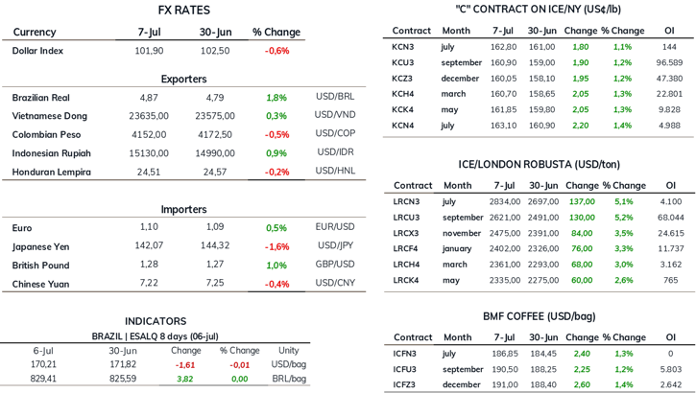
• Arabica coffee futures rose by 190 points (1.2%) on the week to 160.90 c/lb.
• Robusta coffee prices rose USD 130/t (5.2%) to USD 2621/t.
• Cepea indicator for Arabica coffee ended the week up 0.4% at BRL 829.19/bag.
• Cepea indicator for Robusta coffee was up 2%, ending Friday at BRL 657.77/bag.
• Funds liquidated 6,500 contracts in New York and 6,300 in London until the 4th.
• Robusta coffee supply constraint in Asia continues to support prices.
• Preliminary data from Secex pointed to a 23% drop in coffee exports in Brazil.
• Certified stocks of Robusta coffee fell by 19% in the week.
• Robusta coffee differentials jumped 28% in Vietnam and 20% in Indonesia in the last month.
• Dollar up 1.6% in the last week.
• US labor market in possible slowdown raises expectations for more accommodative Fed.
• IPCA and CPI releases expected to influence currency market in coming days.
After falling by 3.5% for Arabica and 6.9% for Robusta in the previous week, coffee futures partially recovered last week, with Arabica futures rising by 1.2% and Robusta by 5.2% in the period. The advances in coffee prices in the week stemmed from a correction process, but mainly due to the limited supply scenario for Robusta. In addition, last week volumes were reduced due to the 4th of July holiday in the US.
In New York, the most active contract ended the week up 190 points (1.2%) at 160.90 c/lb. In London, the September Robusta contract gained USD 130/t (5.2%) to USD 2621/t.
Following the trend abroad, in Brazil, both Arabica and Robusta coffee also recovered. The Cepea indicator for Arabica ended the week up 0.4%, quoted at BRL 829.19/bag. For Robusta, the indicator showed an appreciation of 2.1%, as it closed at BRL 657.77/bag.
Weekly Intraday (most active contract) – July 3 to 7
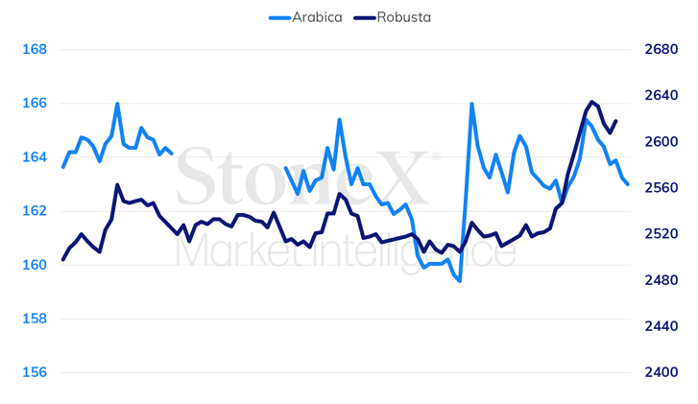
The week also saw the end of the funds' contract liquidation process. As shown in the CFTC reports, the fall in coffee futures occurred alongside the process of contract liquidation by speculative agents.
According to the CIT/CFTC report, funds in New York liquidated 14,600 contracts between June 20 and 27 and 6,500 contracts between June 27 and July 4. During this period, arabica coffee futures fell by 5.11% and 3.6% respectively.
In London, funds still maintain a large net long position of over 40,000 contracts, but between June 20 and 27 and June 27 and July 4, funds liquidated 1,100 and 6,300 contracts respectively. During the same period, Robusta coffee futures recorded losses of 2% and 6.9% respectively.
From a fundamentals point of view, the scenario remains unchanged for Arabica, which has the prospect of an increase in supply, while the sentiment is of limited supply for Robusta. As presented in other editions of this report, the Robusta coffee market continues to be supported by tight carryover stocks in Vietnam and the drop of over 2 million bags in Indonesia's production.
This week, in addition to weather issues, agents' attention will turn to coffee exports data in Brazil, which will be released by Cecafé. The preliminary export data, released by Secex, indicated that Brazil exported 2.3 million bags in June, which would represent a 23% drop compared to June 2022.
Last week, the dollar appreciated by 1.6% in the Brazilian foreign exchange market, closing Friday (7) quoted at BRL 4.865. The rise was mainly related to domestic factors, in which the repercussions on the government's difficulties in progressing with economic agendas in Congress predominated, raising investors' apprehension about the new government's ability to articulate the approval of reforms considered fundamental.
Overseas, the dollar fell against a basket of other advanced currencies, with the dollar index retreating 0.6% to end at 106 points. After operating with some stability in the week, the indicator showed a significant drop on Friday after the release of the Employment Situation Report in the United States in June by the Bureau of Labor Statistics (BLS). The report pointed to a net balance between hires and layoffs of 209,000 jobs, below the median of market expectations of 225,000, and down from the 306,000 jobs created in May.
As such, the figures indicate a possible slowdown for the US labor market, suggesting that it may be reflecting the effect of the US central bank's contractionary policy, which, if it persists, would allow bullish adjustments to be halted earlier than suggested by Federal Reserve members' projections.
Among other important indicators that may impact the market, the IBGE will release the National Broad Consumer Price Index (IPCA) for June, for which the median of market estimates points to a 0.1% retraction compared to May, with the 12-month accumulated reaching 3.15%. If confirmed, the result signals a continued improvement in the Brazilian economic framework and may continue to support the BRL.
In addition, the United States Consumer Price Index (CPI) will be released on Wednesday (12), with the expectation that the indicator will mark a monthly increase of 0.3%, and the 12-month accumulated will go from 4.0% in May to 3.1%. Abroad, readings of slowing inflation have been bearish for the US currency, as the dollar's fluctuations have been greatly influenced by expectations regarding the Fed's next steps in monetary policy.
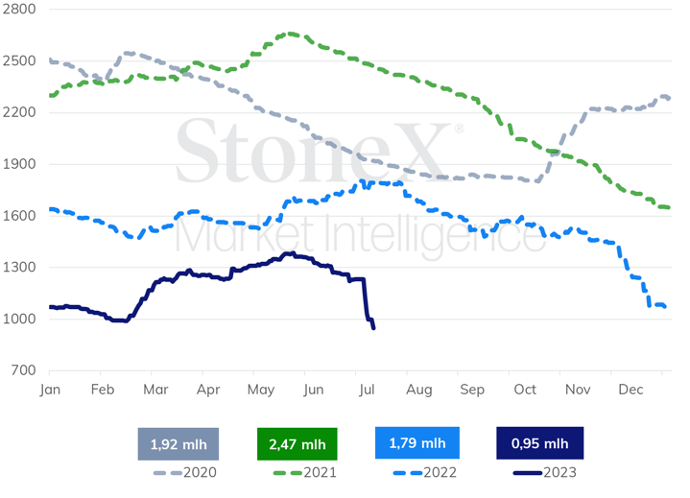
The sharp drop in certified stocks is related to the current level of coffee price differentials in the main origins. For certified stocks, the stronger the differential at origins, the less interest there is to certify new coffees and the more interest there is to withdraw product from certified stocks.
Price differential is an indicator that compares price levels in a given origin or region with the reference futures market. In the case of Robusta coffee, this is between prices in the main producing countries and the London Exchange. The higher the value of the differential, the stronger the local price is in relation to the exchange. If the value of the differential is positive, this indicates that the local price is higher than the price on the exchange, if it is negative, it indicates that it is lower than the price on the exchange.
Last week, differentials for Robusta grade 1 coffee in Vietnam were seen at around USD 550/t, which represented an increase of 28% in the last month and more than 200% since the beginning of the year. Robusta grade 2 coffee in Vietnam reached a differential of over USD 300/t, consolidating an advance of 14% in the month and 700% since the beginning of the year. In Indonesia, the Robusta coffee differential reached USD 300/t, posting an increase of 20% in the month and 67% since the beginning of the year.
In Vietnam, the increase in differentials occurred amid the limited supply of Robusta coffee and low carryover stocks. For Indonesia, the movement took place amid the scenario of a drop in the country's production, which is expected to fall by more than 2 million bags in the next cycle.
In Brazil, Robusta coffee differentials have been on a downward trend since the beginning of the year until mid-May but showed a slight advance in June. The fall in differentials in Brazil was mainly due to the strong price rise on the London exchange amid supply problems in Asia, as Robusta coffee futures gained more than 38% in the first half of the year. Last week, FOB Robusta coffee differentials were seen at a level close to neutral, which is not yet an attractive level for new certifications on the exchange.
If Robusta price differentials continue their downward trajectory in Brazil, this could favor the certification of new coffees on the exchange, a scenario that is not certain, since differentials in Brazil have strengthened a lot in recent years due to strong demand from the domestic industry. As long as this condition for differentials continues, it is possible that certified Robusta stocks will continue trending downwards.