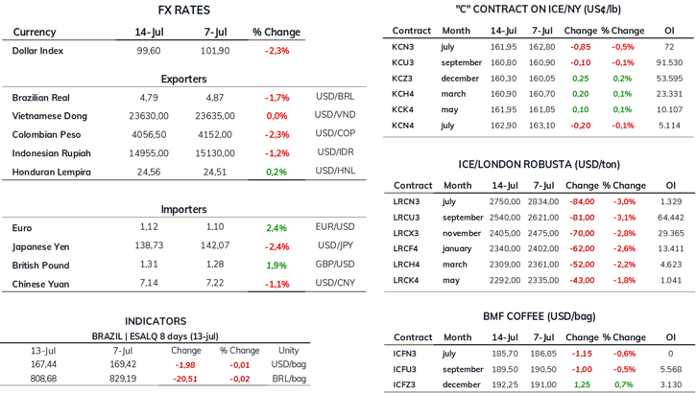
• Arabica coffee futures retreated 10 points (0.1%) on the week to 160.80 c/lb.
• Robusta coffee prices fell USD 81/t (3.1%) to USD 2540/t.
• Cepea indicator for Arabica coffee ended the week down 0.9% at BRL 821.75/bag.
• Cepea indicator for Robusta coffee fell 0.9%, ending Friday quoted at BRL 651.59/bag.
• IBGE reduces by 0.5% its estimates for Brazilian production in 2023
• Brazilian coffee shipments fell 19% in June
• Brazil ends crop cycle with worst export volume since 2017/18
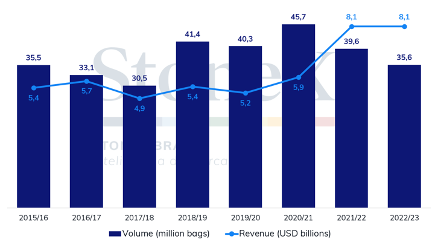
• Despite weak exports, foreign exchange revenue showed high level
• US coffee imports rebounded in May
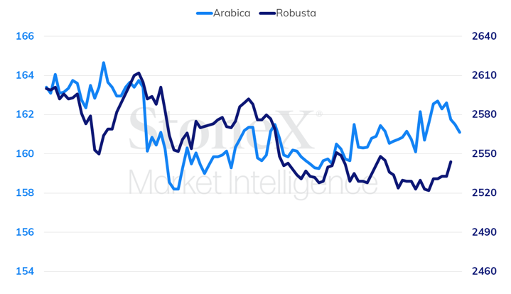
In a week of more sideways movements, with the market echoing weaker exports data in Brazil, the revision of IBGE estimates for the Brazilian crop and the dollar's decline in the domestic market, Arabica coffee futures closed near stability on the New York exchange. The Sept/23 contract fell 0.1% to 160.8 c/lb, while the next expiration, Dec/23, rose 0.2% to 160.3 c/lb.
In London, despite the fundamentally more positive market for Robusta coffee, prices followed the correction movement, returning throughout the week the gains achieved on the previous Friday (7). In this context, the Sep/23 contract for Robusta ended the period quoted at USD 2540/t, down 3.1%.
Weekly Intraday (most active contract) – July 10 to 14
In the domestic market, also influenced by the 1.4% devaluation of the exchange rate in the week, both recorded losses. The Cepea indicator for Arabica coffee ended at BRL 821.75/bag, while the indicator for Robusta ended at BRL 651.59/bag, both with losses of 0.9%.
In addition to Cecafé data pointing to another month of falling imports, with analysis that will be deepened in another section of this report, the coffee market followed the update of IBGE estimates for Brazilian production in 2023, which reduced its expectation for the country's crop by 0.5% to 55.1 million bags. The reduction was 0.1% in Arabica coffee, to 38.4 million bags, and 1.5% in Conilon, to 16.7 million bags. Still, the IBGE estimates a growth of 5.3% in the country's production.
Brazilian export data for June released by Cecafé last week closed the 2022/23 crop year cycle for the country. The June data came as anticipated by Secex data, and confirmed a significant retraction of shipments compared to the previous season. The 2.292 million bags of green coffee exported last month, despite representing an increase of 8.4% compared to May, were 19% lower than June 2022. The drop was mainly driven by the 2.062 million bags of Arabica coffee exported, 23.3% lower than the 2.7 million bags shipped in the same month last year, while the 230,000 bags of Conilon coffee shipped were 60.5% higher in the annual comparison.
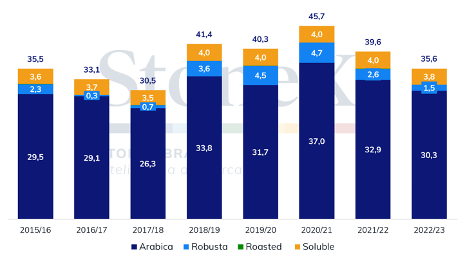
Therefore, the consolidated crop showed a total exported volume, considering green, roasted and soluble coffee, of 35.6 million bags in the 2022/23 crop year (Jul-Jun). This volume, in addition to being a 10% decrease compared to the previous year, represents the lowest volume since the 2017/18 season. For Arabica, 30.3 million bags were exported (-7.8%), while 1.47 million bags (-43.6%) were shipped for Robusta coffee, 45,800 bags (-4.5%) of roasted coffee and 3.8 million bags (-6.7%) of soluble coffee.
Trend of Brazilian exports by crop year (million bags)
Seasonality in US coffee imports (million bags)
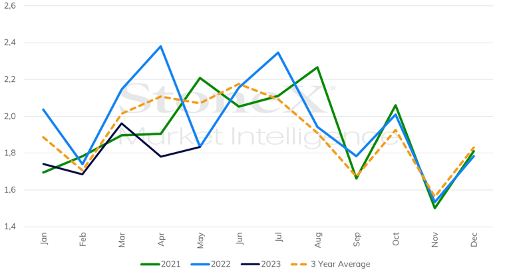
Although there is no progress in the annual comparison, the scenario is better than that seen in previous months. In the first four months of the year, considering the annual comparison, US coffee imports fell by 14.5%, 3.2%, 8.6% and 25.2%, respectively. As presented above, strong inflationary pressure and high differentials have helped to limit the volumes exported and consequently imported by consuming countries. However, with the relief in inflation and the progress of the crop in Brazil, it is expected that US imports may continue to recover.