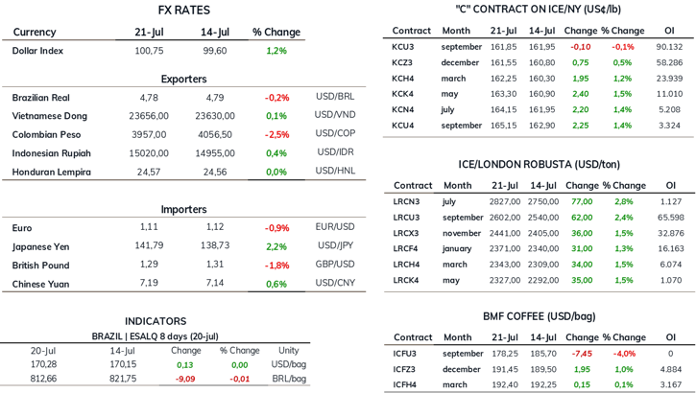
• September Arabica futures were down 0.1% to 160.80 c/lb.
• Robusta coffee prices rose 2.3% to USD 2602/t.
• Cepea indicator for Arabica coffee ended the week virtually unchanged.
• Cepea indicator for Robusta coffee fell 0.8% to close at BRL 646.13/bag on Friday.
• Traders' attention should turn to weather and bloom in Brazil
• NOAA forecast points to a strong El Niño in the second half of the year
• Brazilian real follows appreciation trend
• IPCA-15 may contribute to view of slowing inflation in Brazil
• Fed decision highlights the week's agenda
Against an unchanged fundamental backdrop dominated by technical and macroeconomic factors, coffee futures prices ended last week with mixed results, but with gains for most contracts.
In New York, the most active September contract ended last week slightly lower by 0.1%, closing the period at 161.85 c/lb. The next contract, December, ended the period up 0.5%, closing at 161.55 c/lb. In London, all contracts rose, with the most active September closing up 2.4% at USD 2,602/t.
Coffee futures prices rose amid a predominance of speculators and a currency scenario in some producing countries such as Brazil and Colombia. In Brazil, despite the rising dollar index, the dollar closed down 0.2% at BRL 4.78. In Colombia, the dollar ended the period down 2.5%, quoted at USDCOP 3.957.
Weekly Intraday (most active contract) – July 17 to 21
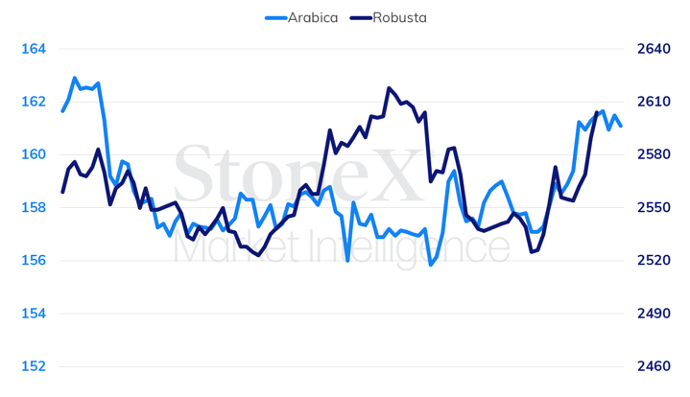
In the Brazilian domestic market, Arabica coffee prices closed the period almost unchanged, with the Cepea index ending Friday (21) at BRL 821.38/bag. For Robusta coffee, the Cepea indicator showed a slight decrease of 0.8%, closing the period quoted at BRL 646.13/bag.
In terms of fundamentals, the scenario continues without major news, with the prospect of greater supply for Arabica coffee, mainly in Brazilian production, while the Robusta market continues to be supported by limited supply in Asia, with low stocks in Vietnam and the 18% drop in Indonesian production.
In the coming weeks, attention will turn to climate issues, particularly the return of rain to Brazil in the second half of the year, given the opening of the Brazilian flowering season and the possible impact of El Niño. This phenomenon could cause problems for Brazilian Robusta coffee production, as well as in Asia, if it becomes more intense and persists for a longer period. In addition, the volume of Brazilian exports will be closely monitored. Early next month, export data for July will be released and the market is expecting exports to show signs of recovery.
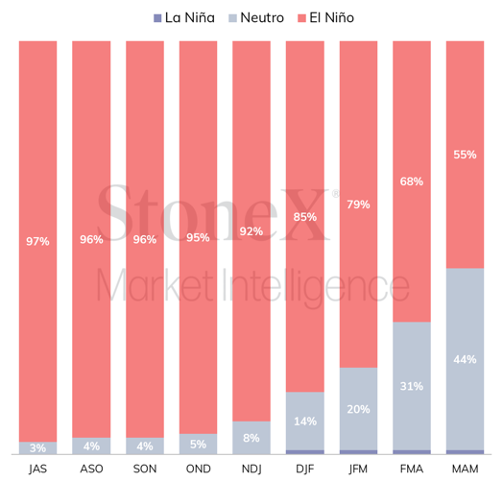
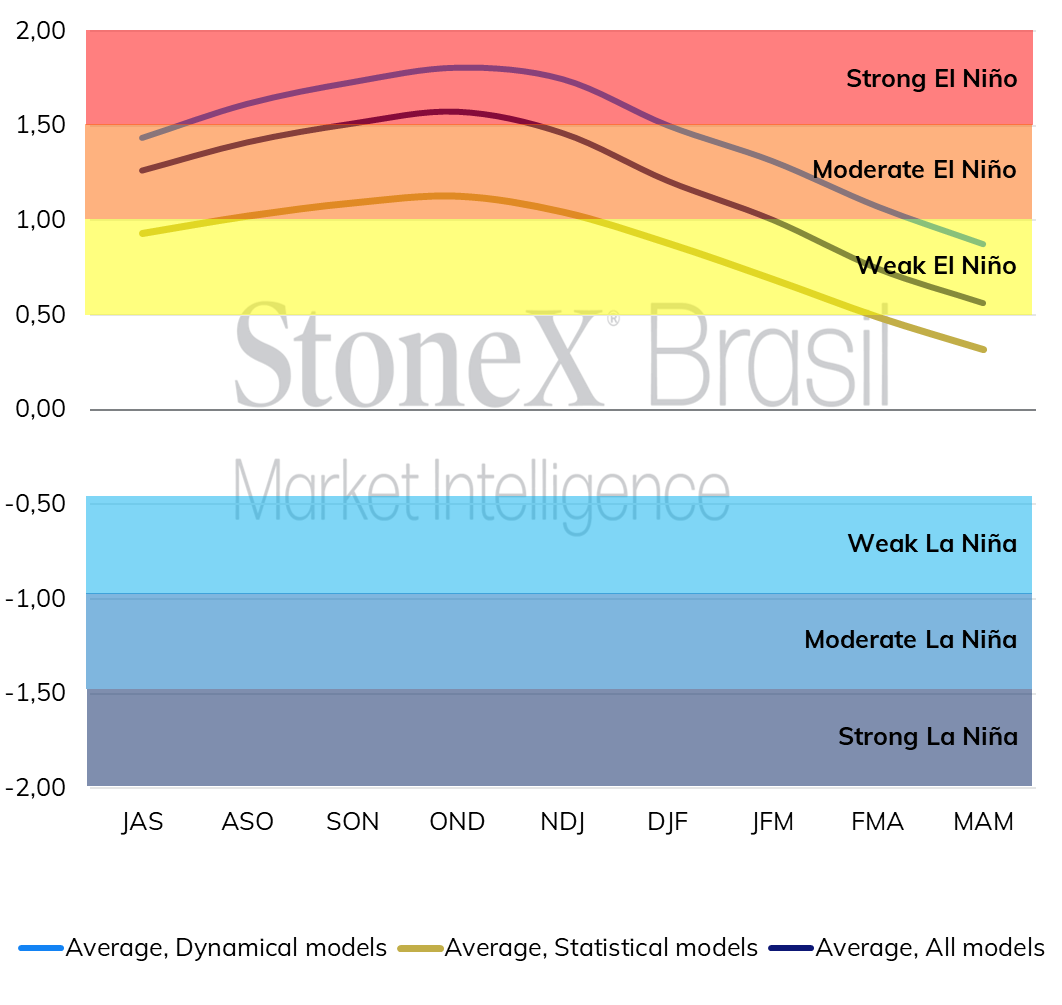
Last week, the U.S. National Oceanic and Atmospheric Administration (NOAA) released the latest update to its El Niño/La Niño prediction model, which increased the predicted intensity of El Niño in the second half of the year, with a strong El Niño expected in the months of October, November and December.
According to the model, there is a probability of more than 70% that El Niño will continue into the January, February and March quarters, and a probability of more than 50% that El Niño will continue into the March, April and May quarters.
El Niño probability and intensity forecast
In the foreign exchange market, the dollar ended last week with a slight decline of 0.3% against the Brazilian currency, which was quoted at BRL 4.780. Despite the Dollar Index's 1.2% gain for the week, the BRL continued to strengthen, supported by recent improvements in the country's GDP and inflation forecasts. The latest Focus Bulletin released by the Central Bank on the 17th showed that agents are betting that the country will end the year with an increase of 2.24%, while the IPCA is expected to end at 4.95%.
This week, the dollar begins sharply lower, renewing its lowest levels in just over a year. On Tuesday (25), the release of the IPCA-15, with expectations that the indicator will continue to show a slowdown in the country's cumulative inflation in the first half of July, may help the Brazilian currency close another week with gains.
Abroad, global markets will be focused on the FOMC's monetary policy decision on Wednesday 26. Almost all bets are that the monetary authority will approve a new increase of 0.25 p.p. in the US interest rate to a range between 5.25% and 5.50% per year. Recent weaker data for some activity and employment indicators, along with the latest softer inflation result, contribute to the expectation that this will be the last rate hike promoted by the Fed. Messages in both the statement and Jerome Powell's speech that reinforce this view and suggest the start of rate cuts between the end of this year and the beginning of 2024 tend to contribute to greater risk appetite among agents and have a negative impact on the US currency.