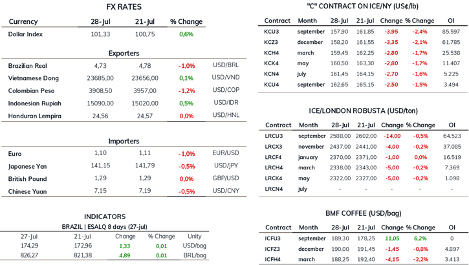
• Arabica coffee futures expiring in September retreated by 2.4% to 157.90 c/lb.
• Robusta coffee prices fell 0.5% to USD 2588/t.
• Cepea indicator for Arabica coffee ended the week down 1.2%.
• Cepea indicator for Robusta coffee fell 0.5%.
• Attention should turn to flowering and weather in Brazil.
• Preliminary data indicate a drop in Brazilian exports in July.
• Lower July exports maintain concerns over possible drop in consumption
• Eurozone consumer coffee inflation still a concern for demand
Last week, coffee futures prices showed a significant retreat amid a lack of fundamental news and a weak technical performance. Despite a 1% dollar drop on the week, which was expected to have a bullish impact in New York, prices retreated amid a predominance of short-term speculators, while trading activity in some sessions was rated as weak by traders.
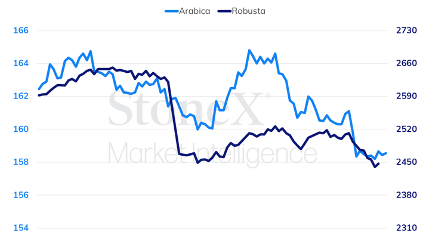
In New York, the most active contract, due in September, ended last week with a drop of 395 points (2.4%), closing the period quoted at 157.90 c/lb. In London, the most active September contract ended with slight losses of USD 14/t (0.5%), quoted at USD 2,588/t.
Weekly Intraday (most active contract) – July 24 to 28
Following the movements in international markets, coffee prices in the Brazilian domestic market ended the period in decline. The Cepea index for Arabica fell by 1.2% and closed Friday (28) quoted at BRL 811.74/bag. For Robusta coffee, the Cepea indicator fell by 0.5%, closing the period quoted at BRL 642.77/bag.
From the point of view of fundamentals, as mentioned in other editions, agents' attention will turn to the weather in Brazil and the start of flowering in the country. While most of the Robusta coffee plantations have already started flowering, this process has not yet happened in the Arabica coffee plantations. In addition to flowering, agents are also paying attention to certified coffee stocks on the New York and London stock exchanges, which are at historically low levels.
In the coming weeks, countries' export data, especially in Brazil, should be released. Cecafé data has indicated sharp declines in Brazilian exports in 2023, but agents expected a recovery in these exports from June onwards. However, this is not the scenario that preliminary data has indicated.
According to Secex data, Brazil exported 1.4 million bags of unroasted coffee until July 21, a volume 43% lower than that seen in the entire month of June 2022. Despite the comparison with a reduced period in 2023, the large difference indicates that exports may end the month of July in decline. Cecafé data also indicate a similar scenario, with raw coffee shipments totaling 2.06 million bags by July 28, which represents a 6.6% drop compared to total raw coffee exported in July 2022.
Cecafé previews, contrary to expectations of an increase in July shipments compared to the same month in 2022 (mainly due to a more abundant crop this year), may be at least partially justified by producers holding on to their coffee while waiting to find better prices in the market. However, consumption-related issues, with a possible reduction in global coffee consumption, where roasters' stocks have been lasting longer and reducing the need for companies to purchase, is still a hypothesis to be considered to justify the weaker shipments.
Strong inflation in the main consumers seems to have indeed affected consumption in some producing regions. According to official data, Brazil was not affected much, despite the surge in prices last year. The first country to feel the strong effect of the coffee spikes on the exchanges after the 2021 frost, by mid-2022 roasted and ground coffee inflation accumulated in 12 months in the country had reached above 65%, and even so, ABIC data indicated a retraction of only 0.9% in consumption last year, evidencing the resilience of Brazilian demand.
Inflation for roasted and ground coffee to consumers (accumulated over 12 months)
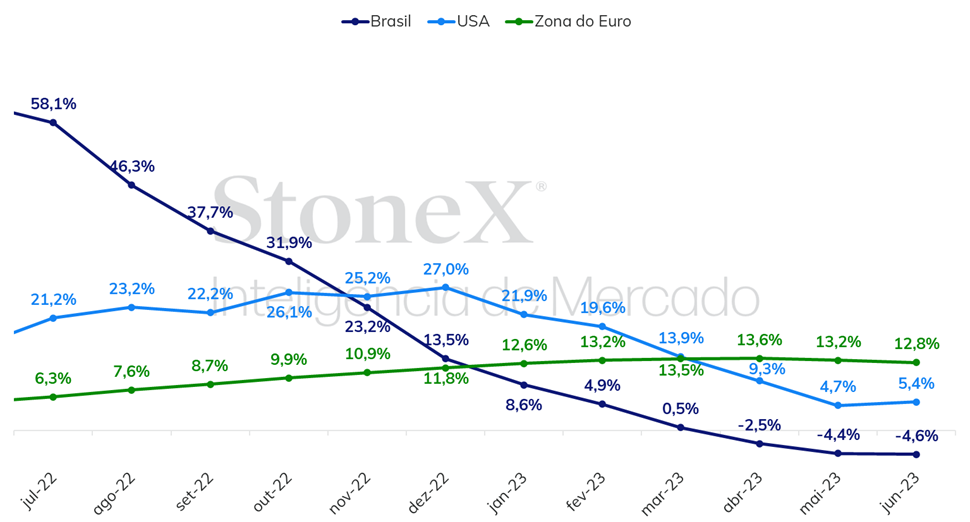
In the United States and Europe, reports of reduced purchases by roasters raise concerns about possible sharper demand cuts. The accumulated coffee inflation to the American consumer has been dropping. After reaching 27% in December last year, in recent months it reached 5.4%, which is a positive sign and may encourage greater consumption in the country during the second half.
Europe, on the other hand, is the most worrying. In cumulative terms, Eurozone inflation has shown a reduction in the last two published results, from 13.6% in April to 12.8% in June. However, changes are still slow, with inflation still at a historically high level in the region, which may remain a limiting factor for an eventual expansion of coffee consumption.