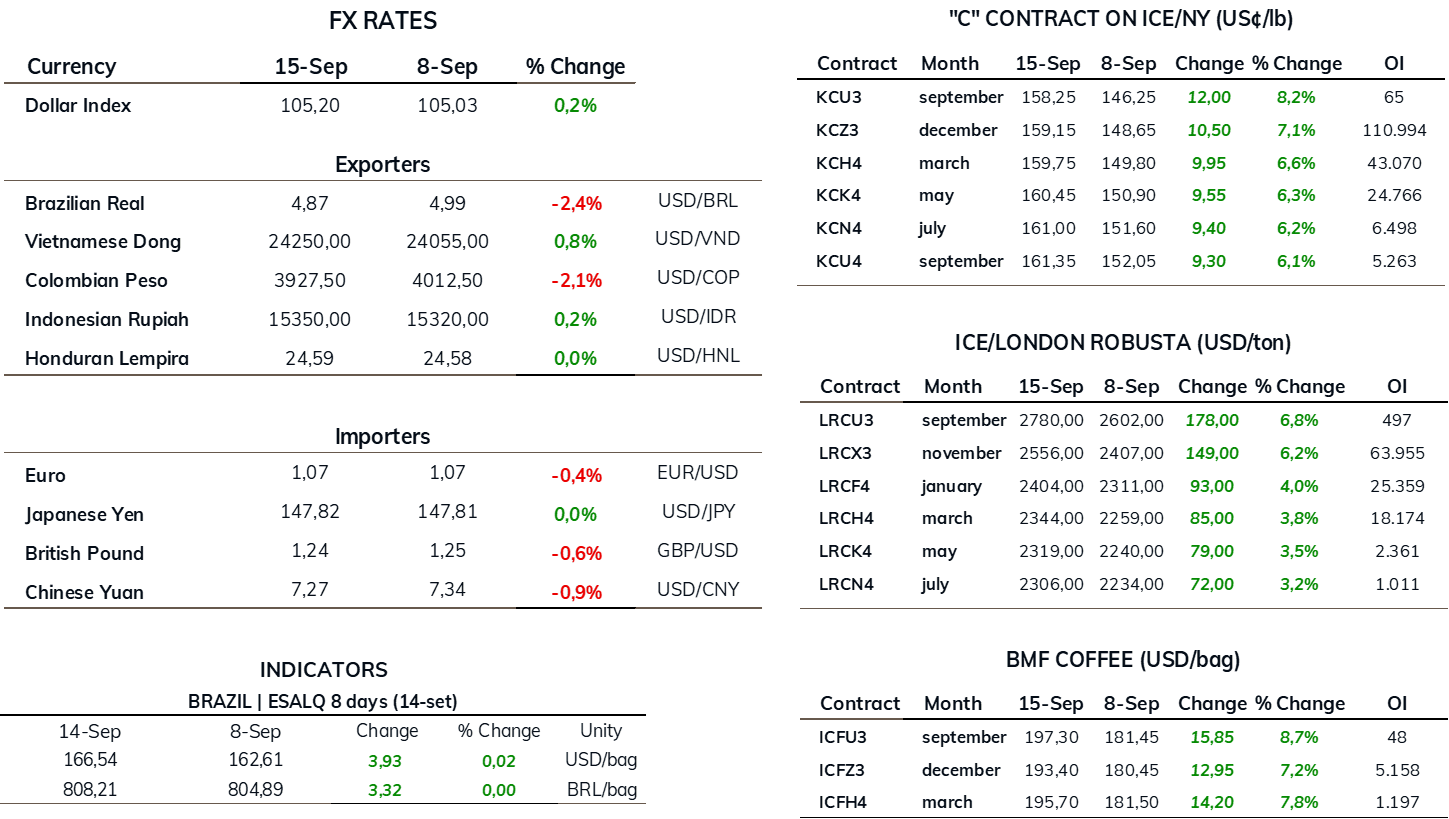
• Arabica coffee rises 1050 points (7.1%) to end the week at 159.15 c/lb
• Robusta coffee prices rise 6.2% to USD 2556/t
• Cepea indicator for Arabica coffee rises 2.5% to BRL 825.15/bag
• Cepea indicator for Robusta coffee falls 0.4% to BRL 647.05/bag
• Excessively high temperatures could harm coffee flowering
• Rain interruptions and excessive heat could be a concern for both the Arabica and Robusta crops
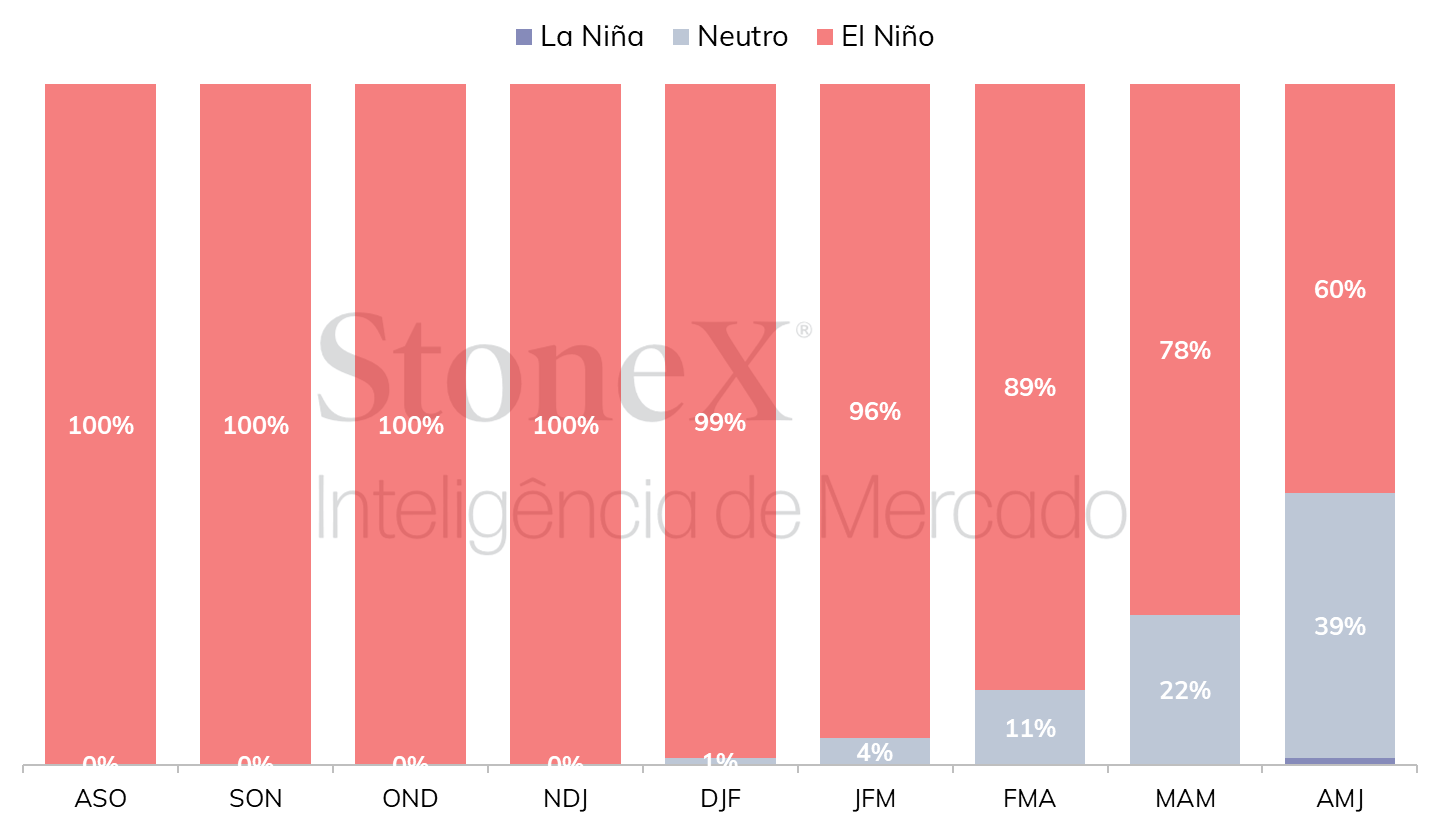
• New NOAA forecasts suggest a more prolonged El Niño
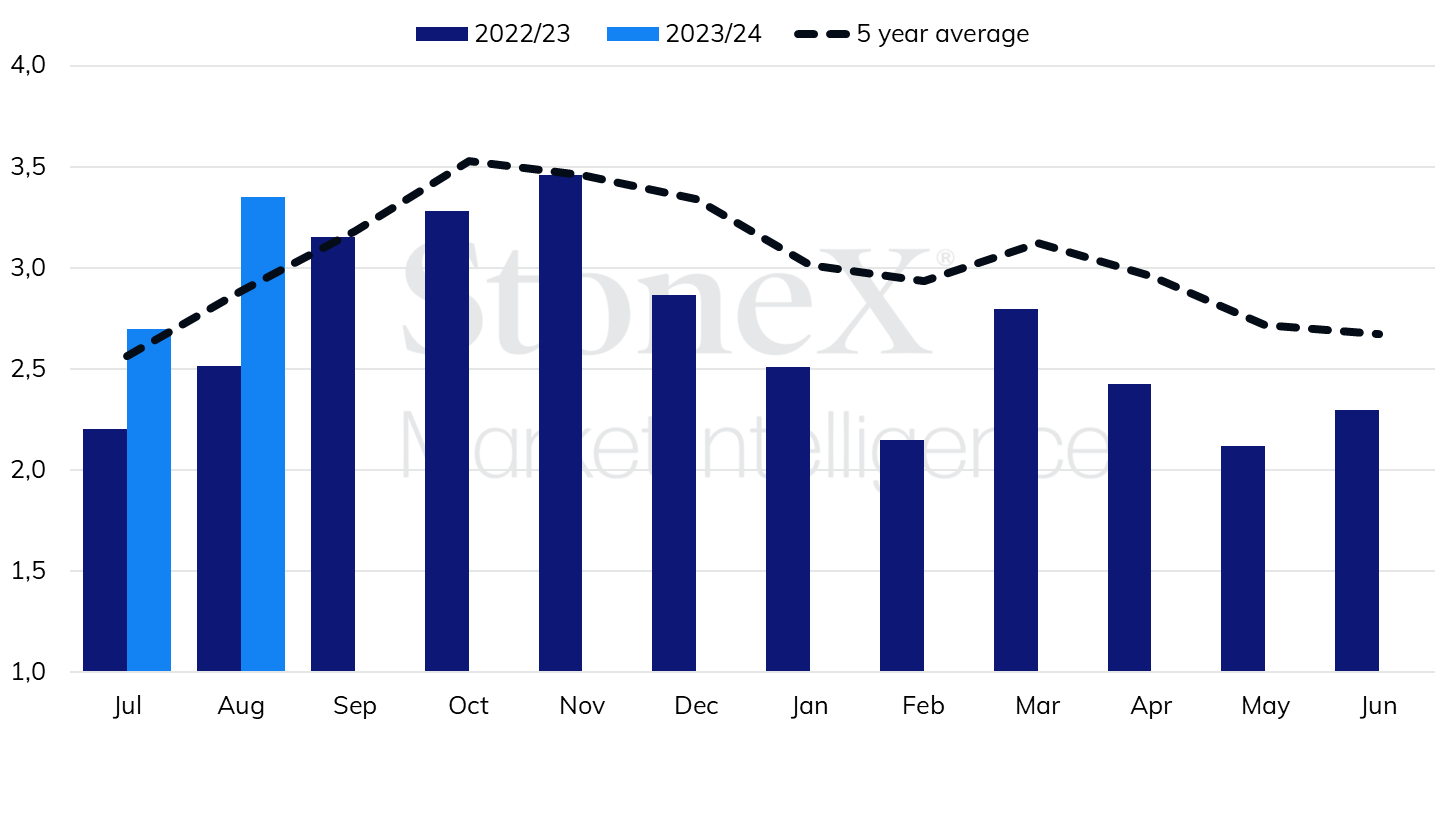
• Brazilian green coffee exports up 33% in August
• Robusta coffee registers highest export volume in a historical series month
Last week, Arabica and Robusta coffee futures prices posted a strong increase on the international markets, driven by the sharp drop in the dollar during the week and the dry weather in Brazil's coffee belt. Reflecting the positive data for the Brazilian economy, the dollar ended the week down 2.4%, acting positively for future prices. In addition, after the flowering start in parts of the Brazilian coffee fields, especially in irrigated areas, weather models have pointed to dry and hot weather for the coming weeks, which could be detrimental to production potential in 2024.
In New York, the most active contract, for December, ended the week with gains of 1,050 points (7.1%), closing Friday's trading session at 159.15 c/lb. At the London terminal, the most active contract for Robusta coffee, expiring in November, gained USD 149/t (6.2%), ending the week quoted at USD 2,556/t.
For Robusta coffee, in addition to the bullish points mentioned above, we have to remember that the restricted supply of this variety continues to act as a bullish factor for prices in London. Data from the Vietnamese customs agency showed that the country's exports fell by 22.3% in August, totaling 1.4 million bags. In addition, the possible impact of El Niño on Brazilian production is still a concern, should the phenomenon have a strong intensity during the critical periods of development in Brazil.
Weekly Intraday (most active contract) – September 11 to 15
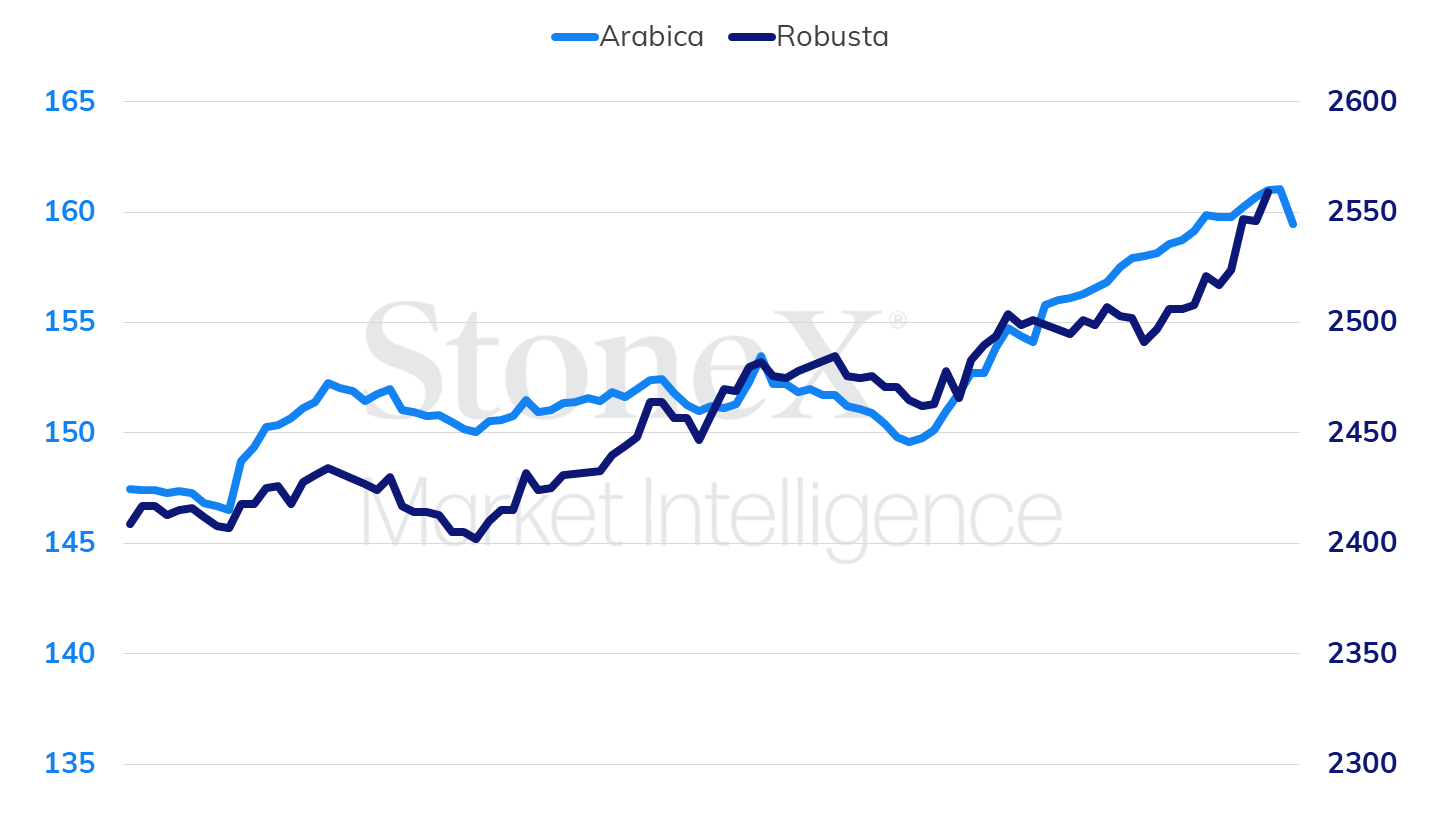
Despite the strong rise in coffee futures abroad, prices on the domestic market in Brazil had a mixed result. While Arabica coffee futures prices in New York rose by 7.1% in Brazil, the Cepea indicator for the variety pointed to a 2.5% rise in the period, reflecting the sharp dollar drop. On the other hand, despite the 6.2% increase in London, Robusta coffee prices fell by 0.4% in Brazil, according to the Cepea indicator, also reflecting the weaker dollar and the greater availability of the product after the harvest was completed. The Cepea indicator for Arabica coffee ended Friday (15) at BRL 825.15/bag and for Robusta coffee at BRL 647.05/bag.
In the coming weeks, as already mentioned in several previous editions of this report, the agents' focus will be on the weather in Brazil and the development of the flowering stage in the producing regions. With the end of the harvest, several agents in Arabica coffee producing regions have already reported the start of the first flowering in Brazil, with different rates of opening for some regions, with progress mainly in irrigated crops.
For these crops that have already started flowering, especially in non-irrigated areas, a regular rainfall regime is necessary for the proper setting of the flower and the initial development of the fruit. However, forecast models have pointed to dry weather for most regions in the coming weeks, which may raise doubts about the correct development of the flowering stage in the producing regions.
In addition, another weather factor could cause concern: excessive heat. A few weeks ago, we published an analysis of the possible impact of El Niño on Brazilian production. For Robusta coffee, as mentioned, the possibility of excessively hot weather during key periods could affect production, as happened between 2014 and 2016. Of course, it is important to note that the impact would be limited given the differences between then and now. For more details read IRI/CPC/NOAA: Models point to a strong El Niño in the coming months.
In that analysis, it was pointed out that considering historical data, the occurrence of El Niño was not directly linked to a drop in Arabica coffee production in Brazil. However, in light of the changes in the weather and the increased intensity of the phenomena, we cannot rule out the possibility of El Niño also having an impact on Arabica coffee production. As we have seen, part of the flowering has started in the coffee belt, but the forecasts point to dry weather in the coming weeks. In addition, as a reflection of El Niño, a new heatwave is expected with above-average temperatures in much of the country.
According to forecast models, the peak of the heatwave is expected to occur between September 22 and 27, with maximum temperatures reaching above 40°C in the Cerrado regions of Minas Gerais, a large part of Mogiana, in the state of São Paulo, and the south of Minas Gerais. According to the "Coffee agroclimatic zoning for the state of Minas Gerais", written by Sediyama et al, " temperatures equal to or higher than 34°C can favor floral abortion of coffee trees and the formation of "starlets", considerably reducing productivity."
The above-average temperatures in the producing regions are already a reflection of El Niño's impact on the Brazilian climate. According to the latest update from IRI/CPC/NOAA, released last week, there is a 60% probability that El Niño will last until April, May and June 2024. As such, the prospect of a prolonged phenomenon could be a decisive factor impacting the production potential of both Arabica and Robusta coffee in 2024.
La Niña/El Niño probabilistic forecasts
Last week, the market also reflected the data on Brazilian exports for August, published by Cecafé. The country shipped a total of 3.350 million bags of green coffee last month, up 24.2% on June and 33.3% on August last year, when 2.513 million bags were exported. In total, including roasted coffee and soluble coffee, 3.672 million bags were exported, an annual increase of 29%.
Brazil's monthly green coffee exports (million bags)
After falling short year-on-year in all the first six months of the year, the 2023/24 crop has recorded a better performance for Arabica coffee, which showed a higher volume than last year for the second consecutive month. In August, 2.651 million bags of Arabica coffee were shipped, an increase of 11.2% compared to August 2022 and 6.3% compared to the average for August over the last five years.
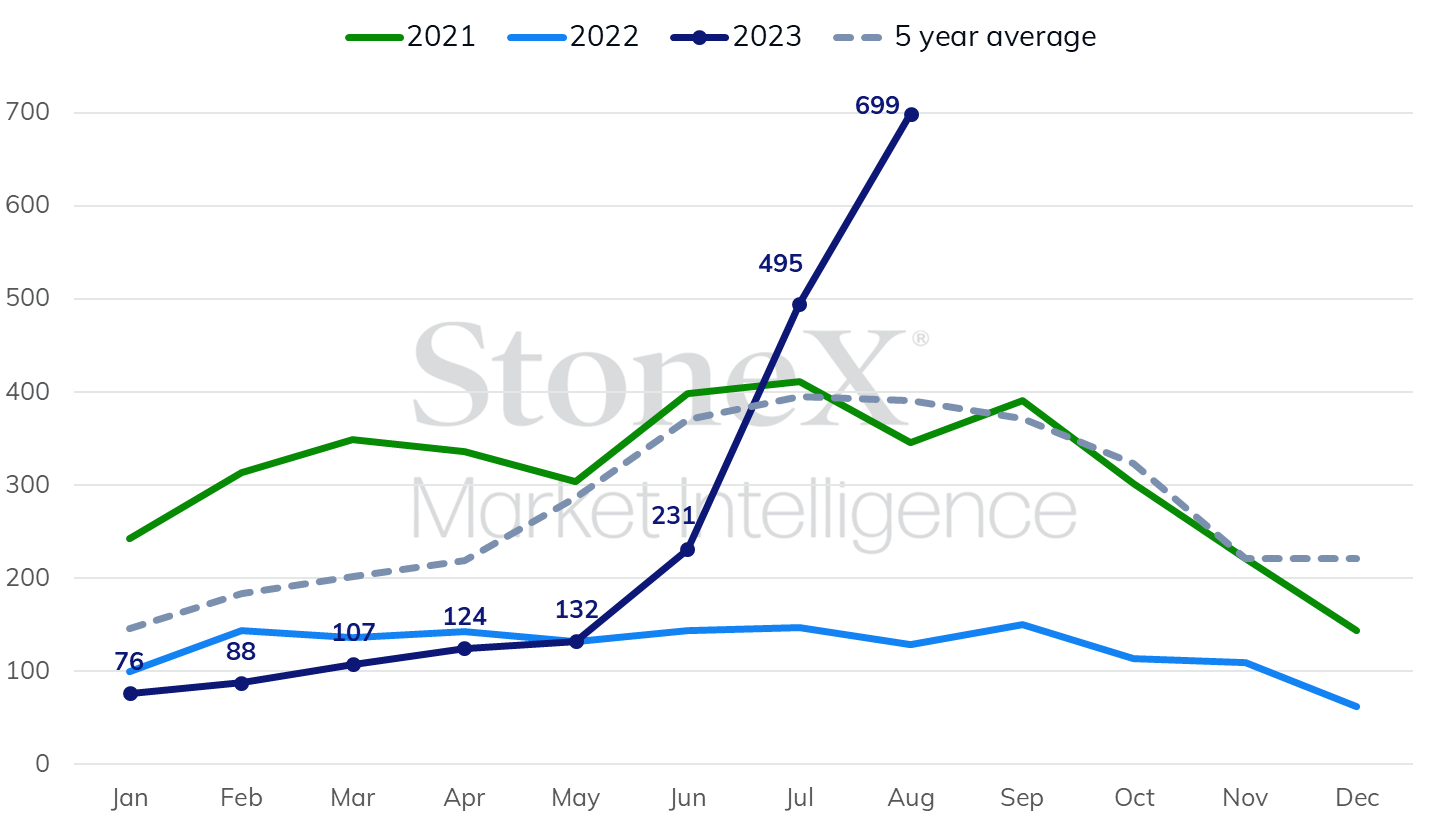
However, the highlight was another big jump in Robusta coffee shipments. Robusta coffee exports totaled almost 699,000 bags, a significant increase of 443% compared to August last year, 79% compared to the average of the last five years and the highest monthly figure in Cecafé's historical series. As has been highlighted in other weekly reports, high prices on the London exchange and availability on the Brazilian domestic market have put pressure on Robusta coffee differentials in the country, which have been operating at significantly weakened levels since mid-April, making the Brazilian commodity more competitive on the international market compared to Indonesia and Vietnam. It seems that this dynamic will continue at least until the new Vietnamese crop enters the market, with harvesting beginning in mid-November and sales starting in mid-December, which should to some extent alleviate concerns about the availability of coffee from Southeast Asia.
Seasonality of Brazilian Robusta coffee exports ('000 bags)