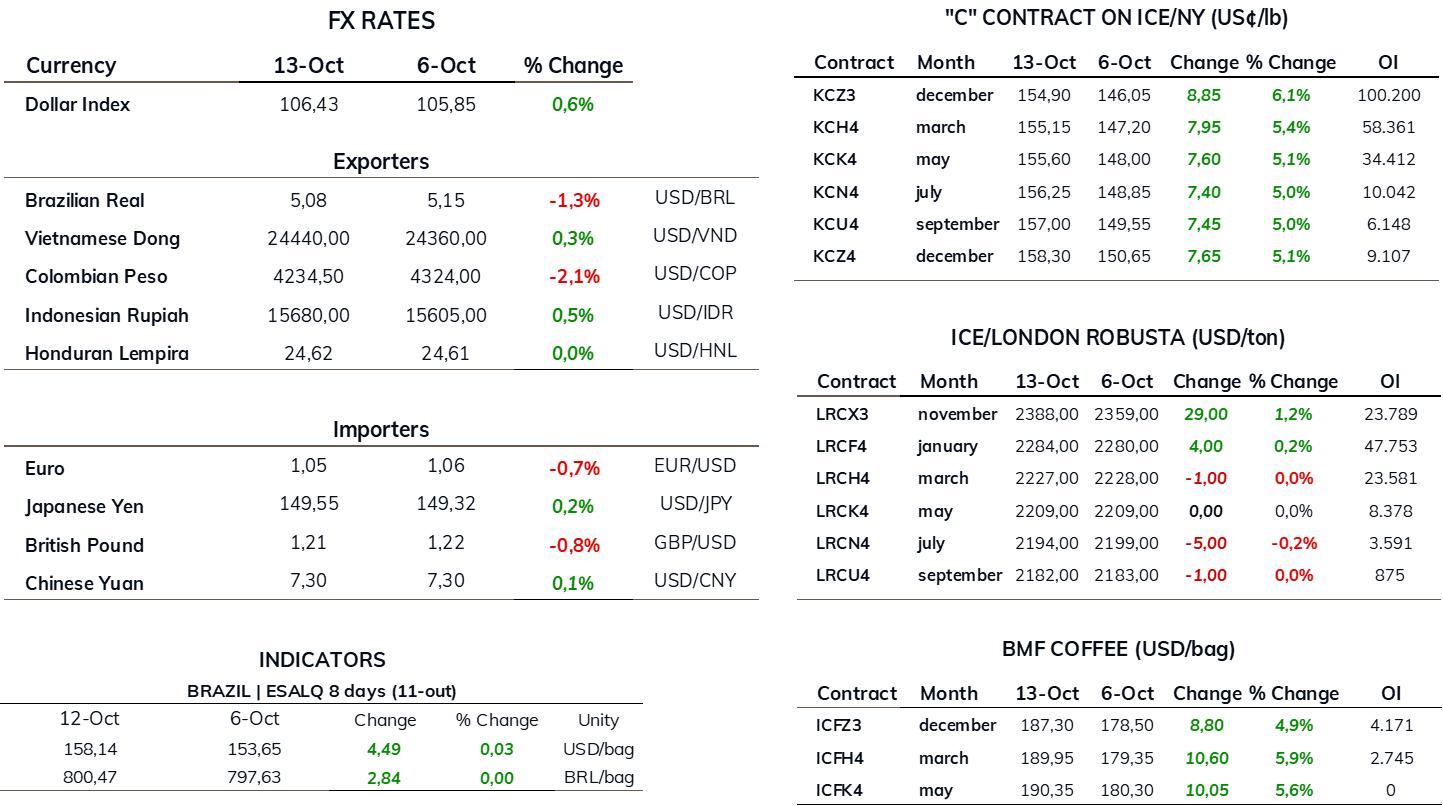
• Arabica coffee rose 6.1% to close at 154.90 c/lb
• Robusta coffee prices showed mixed results
• Cepea recorded a rise of 2.1% for Arabica and a fall of 1.5% for Robusta
• Weather in Brazil remains the focus of market attention
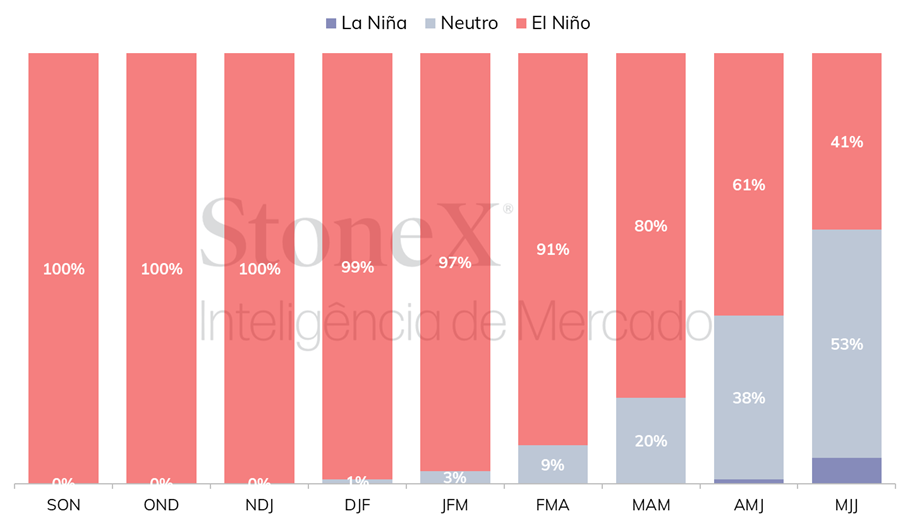
• El Niño has a 61% chance of continuing until April, May and June 2024
• Potentially weakened consumption remains a focus of attention
• Brazilian exports fell 5.3% in September
• Robusta coffee shipments up 317%
• Arabica coffee exports down 20.3%
• Dollar down 1.3% on the week, to USDBRL 5.08
Last week, Arabica coffee futures posted significant gains on the New York terminal, ofreflecting a short covering movement by speculative agents and lower activity in Brazil due to the Our Lady of Aparecida holiday (12). Coffee futures were also supported by the fall in the dollar during the week, which fell 1.3% to USDBRL 5.08.
In London, Robusta coffee futures showed a mixed result, with the front-month contracts rising but the more distant remaining almost unchanged or falling slightly. For Robusta coffee, the market continues to be pressured by the large volumes exported by Brazil, as can be seen in the Cecafé reports, and due to the upcoming start of the Vietnamese crop, whose harvest is due to begin in the middle of next month.
In New York, the most active contract, for December, gained 885 points (6.1%), closing the week quoted at 154.90 c/lb. For Robusta coffee, the most liquid contract, maturing in January, showed gains of just USD 4/t (0.2%), closing the week quoted at USD 2,284/t.
Weekly intraday (most active contract) – October 09 to 13
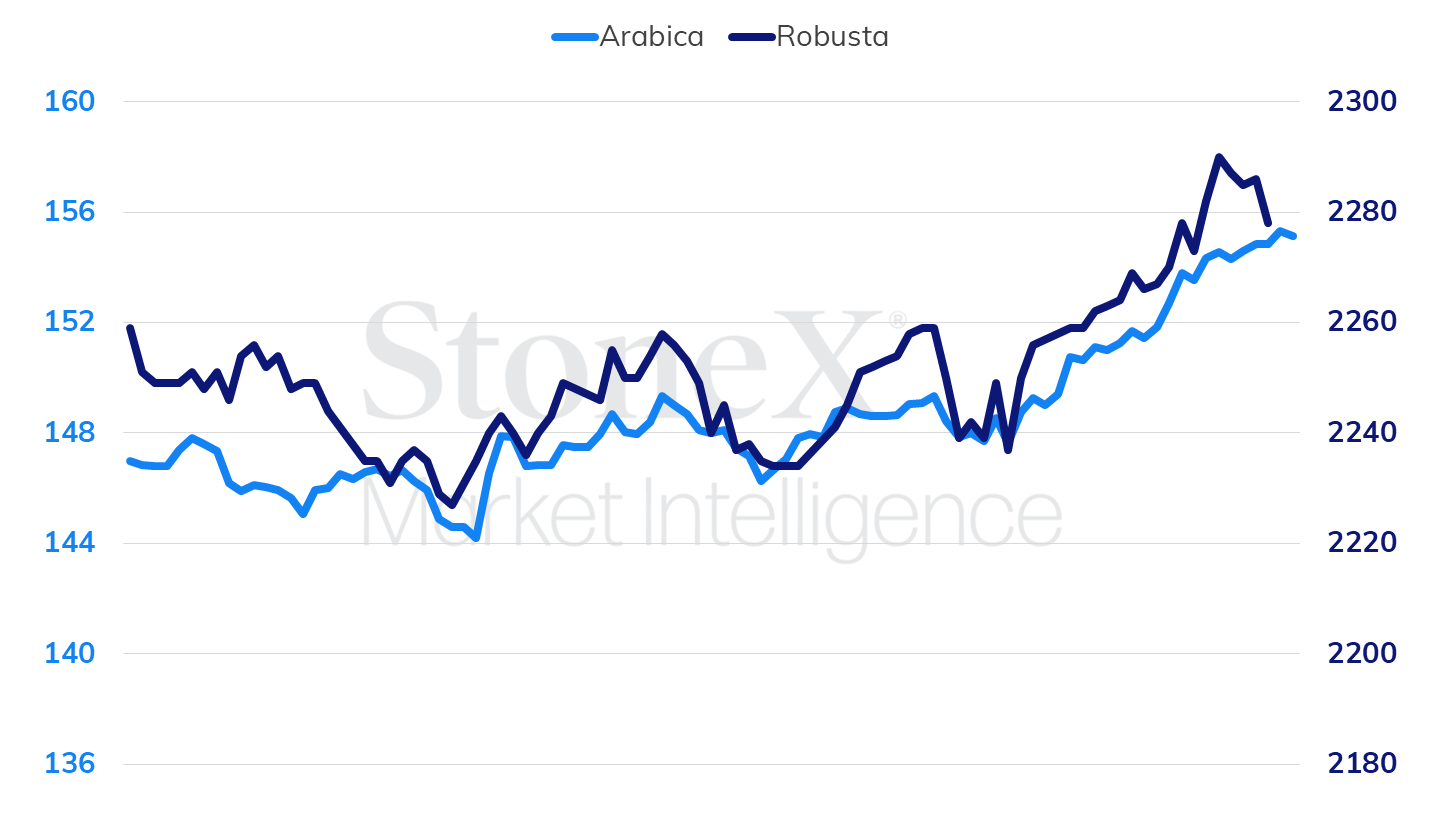
In the Brazilian domestic market, as well as in the foreign market, coffee prices ended the week with mixed results. The Cepea indicator for Arabica coffee obtained gains of 2.1% in the week, closing on Friday (13) quoted at BRL 819.47/bag. The Cepea indicator for Robusta coffee posted losses of 1.5%, closing the week at BRL 636.45/bag.
From a fundamental point of view, the scenario remains unchanged. Agents' attention is focused on weather conditions in Brazil as Brazilian work progresses through the initial stages of the development of the 2024 crop. The maintenance of a favorable weather tends to fuel optimism with the volume of the upcoming crop, while any weather adversity can frustrate these expectations and act positively for quotes.
Although the weather has improved in recent weeks, the occurrence and maintenance of El Niño could impact coffee production in producing regions, especially in areas that produce Robusta. NOAA's latest update shows a probability above 60% for the factor to be maintained until the AMJ quarter (April, May and June). Furthermore, the models indicate that the specific may have a strong intensity at the end of this year and beginning of 2024, critical periods for the development of the harvest.
Probability of El Niño/La Niña
In addition to the weather, potentially weakened consumption remains a warning point. Inflation on coffee prices in recent years was the main villain behind lower growth and/or decline in coffee consumption in the main consuming countries. While in Brazil and the US retail coffee prices are already in a deflationary process, in Europe price inflation is still high, reaching 11.3% in August, according to Eurostat data.
In this context, coffee import volumes in the main consumers were lower in 2023. According to the USDA, coffee imports in the US in the first eight months of this year totaled 14.5 million bags, a volume 12.6% lower than what was seen in the same period in 2022. Eurostat data indicate that the European Union imported 27.05 million bags until July, a volume 6.5% lower than that seen in the same period last year.
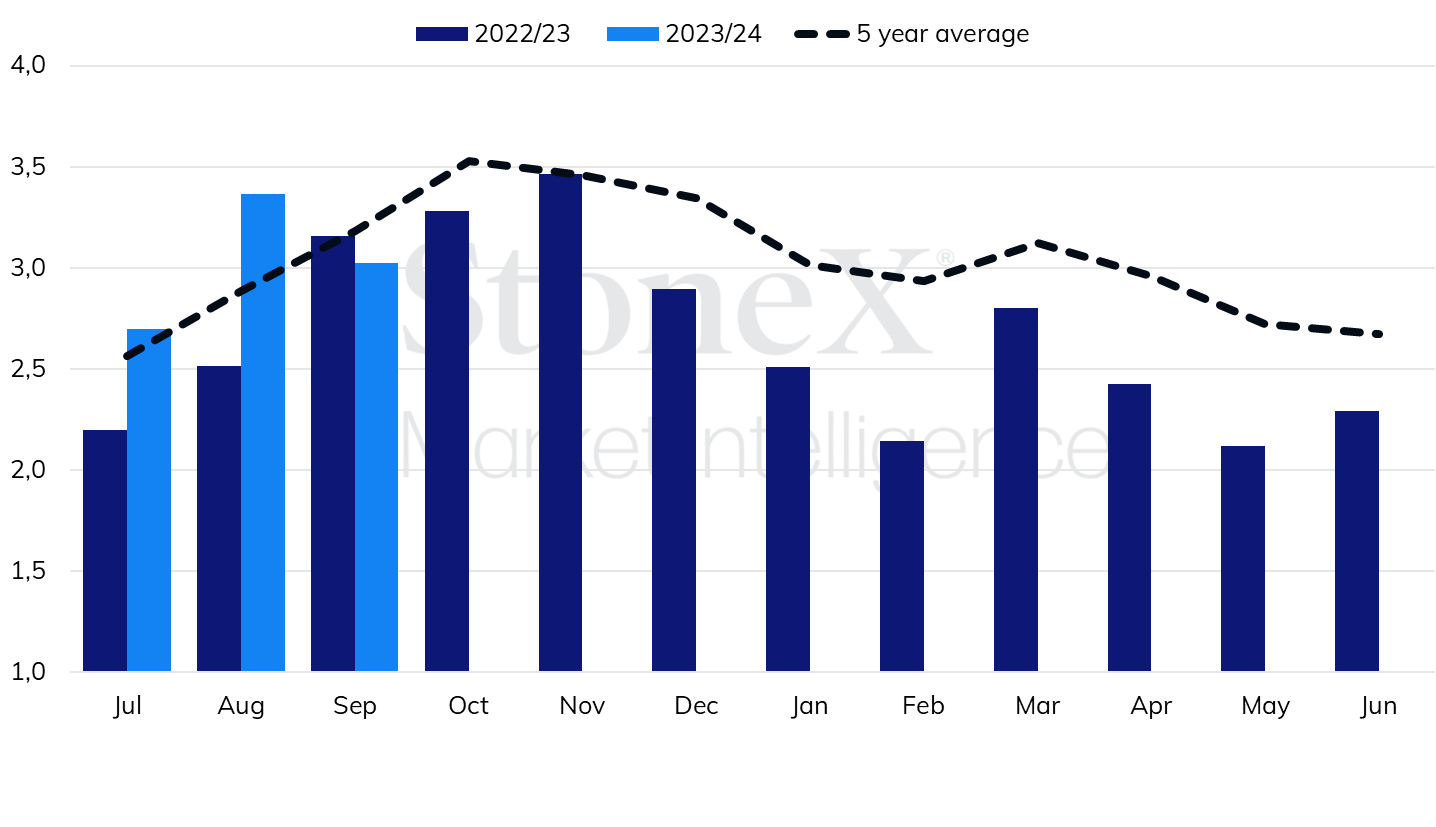
According to the latest official Cecafé report, Brazil exported 3.3 million bags of coffee, representing a drop of 5.3% compared to the same month in 2022. Of these, 3.02 million bags were raw coffee, 265,000 bags of soluble coffee and the remainder of roasted and ground coffee. Export revenue in September totaled 638 million dollars or BRL 3.14 billion, which represented a decline of 27.6% compared to revenue in September 2022.
Of the total raw coffee exported, Arabica exports decreased by 20.3%, totaling 2.4 million bags. Arabica coffee exports remain weakened due to producers' reluctance to sell coffee at current price levels and unattractive differentials for the FOB export market. For some players, the reduced volume of Brazilian exports is also associated with weakened demand in the main consuming countries. Furthermore, the high level of the basic interest rate burdens the carrying of inventories, which discourages the acquisition of large volumes by companies.
Brazilian green coffee exports (million bags)
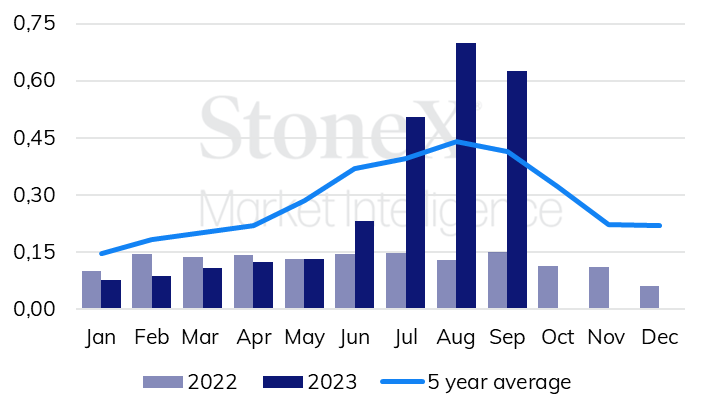
On the other hand, Brazilian exports of Robusta coffee once again showed strong growth in the annual comparison, reflecting a favorable scenario for Brazilian exports of this type. In September, Brazil exported almost 625,000 bags of Robusta coffee, a volume 317% higher than that observed in September 2022. The supply shock in Asia is the main reason behind the advances in Brazilian exports of this type. The crop failure in Indonesia and tight carryover stocks in Vietnam promoted a strong increase in price differentials in Asia, making these origins less competitive compared to Brazil.
Brazilian exports of Robusta coffee (million bags)
Regarding industrialized coffee, exports of roasted and ground coffee fell by 18.2% in the month, totaling 3,300 bags (equivalent to a 60kg bag of raw coffee). Exports of soluble coffee also showed losses, falling 15.9% in the month, with exports totaling the equivalent of 265,40 bags of raw coffee.