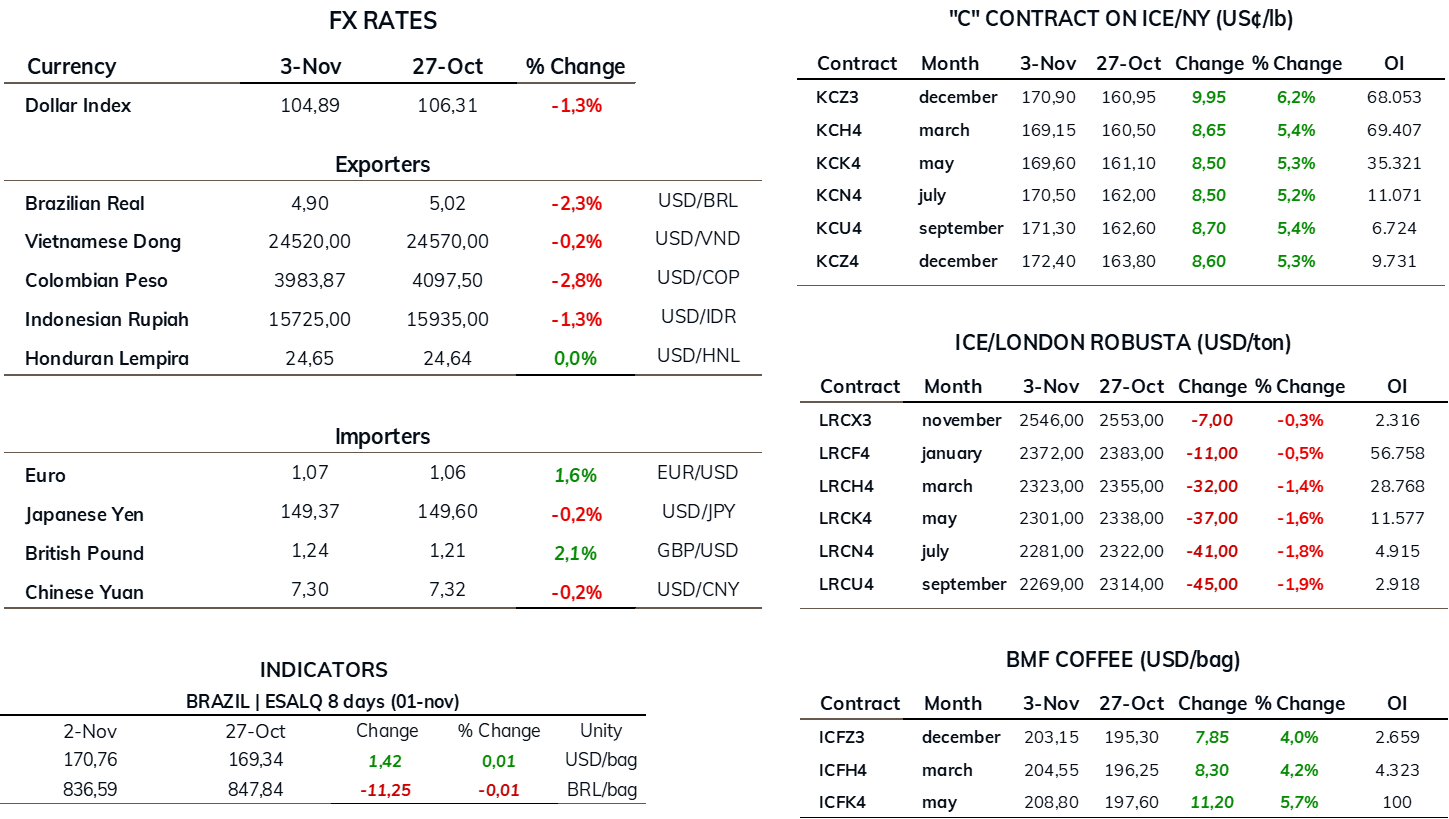
• Arabica coffee up 6.2% on the week to 170.90 c/lb
• Robusta coffee prices fell 0.5% on the week
• Cepea recorded a rise of 2.4% for Arabica coffee and a fall of 0.9% for Robusta
• Certified Arabica stocks reach lowest volume since May 1999
• Olam sees a surplus of 5.7 million bags in 23/24 and 13.5 million in 24/25
• Sucafina projects Brazilian crop at 67.7 million bags in 23/24 and 72.6 million in 24/25
• Market waits for Brazil's export data to be released
• Macro environment, with Fed decision and US employment data, puts pressure on the dollar index and favors commodities complex
• Sharp dollar drop in the Brazilian market influences coffee prices
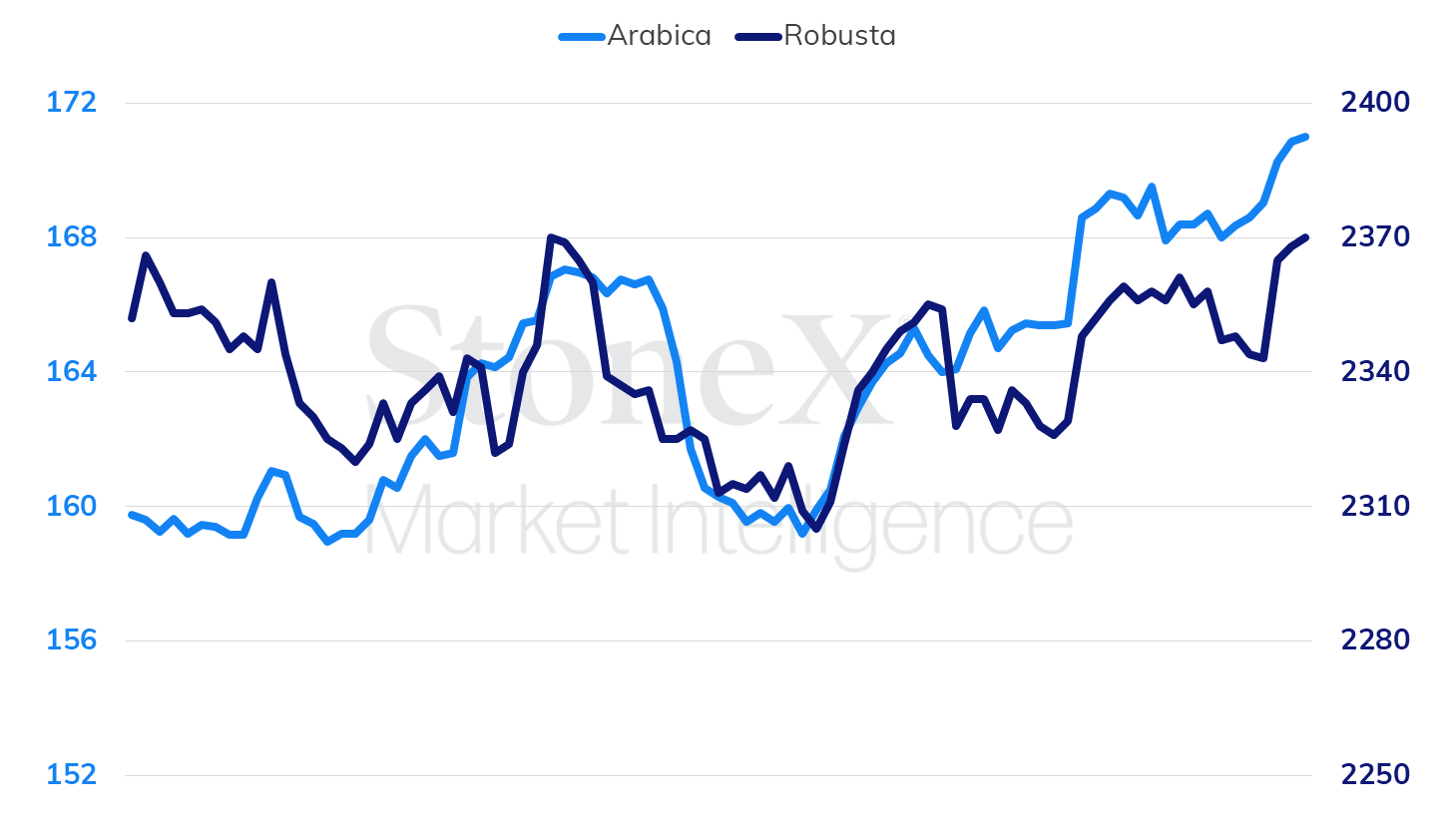
Last week, Arabica coffee futures prices once again made strong gains on their main trading exchange. Prices on the ICE in New York rose amid the drop in certified coffee stocks, the dollar's decline during the week, the inverted switch in the first contracts and the absence of Brazil during the holiday. For Robusta coffee, the decline seen in the week, whose variation was not as intense as in New York, was related to the expectation of robust volumes in Brazilian exports of the variety in October, which may be confirmed by Cecafé data to be released in the coming weeks.
In New York, the most active contract, for December, posted gains of 995 points (6.2%), closing Friday (03) quoted at 170.90 c/lb. In London, Robusta coffee prices for the January contract posted losses of USD 11/t (-0.5%), closing the period quoted at USD 2372/t. In addition, the Dollar Index, which compares the dollar with a basket of currencies from developed countries, fell by 1.4% to 104.89 points. In this context, the USDBRL pair fell by 2.3% over the week, closing at USDBRL 4.90.
Weekly intraday (most active contract) - 30/10 to 03/11
Movements in the macroeconomic scenario, following the Federal Reserve's monetary policy decision in the United States, influenced both the commodities complex and the exchange rate last week. The decision to maintain the US interest rate at between 5.25% and 5.50% p.a., with an indication from the Fed's Chair Jerome Powell that if the rise in yields on US Treasuries is sustained over a longer period the FOMC may not make any further interest rate adjustments put pressure on the dollar against most global currencies.
In addition, the lower-than-expected US labor market data released on Friday (3), with 150,000 new jobs created in October against expectations of 179,000, supported the view that the US economy may be cooling down and that further interest rate increases will no longer be necessary. In this sense, global agents' greater appetite for risk stimulated both the sharp 2.3% drop in the exchange rate in Brazil and the sharp 1.4% drop in the dollar index, which closed at its lowest level since September. As a result, the sharp devaluation of the US currency, which had a negative impact on export revenues in the Brazilian market, helped to reduce short-term sales and push coffee futures in New York to their highest level since June.
On the Brazilian domestic market, prices followed international movements and ended the period with mixed results. Considering the balance of the week, the Cepea indicator for Arabica coffee was up 2.4%, closing Friday at BRL 862.18/bag. For Robusta coffee, the indicator fell slightly by 0.9% to BRL 641.44/bag. According to Cepea, the sharp increase in Arabica coffee prices in the month, which rose 10.69% in October, provided more liquidity for negotiations on the domestic market, given the more attractive price level for coffee producers.
In addition to the inverted switch between the first and second contracts, which indicates that agents are concerned about coffee supply in the short term, mainly due to the fact that winter is approaching in the Northern Hemisphere, a period in which there is an increase in consumption, part of the rise at the New York terminal was also linked to the drop in certified stocks of Arabica coffee. According to ICE, last week certified coffee stocks fell by more than 34,000 bags (8.7%), down 19% month-on-month, to a total of 360,000 bags, the lowest volume since May 1999.
Certified stocks of Arabica coffee (million bags)
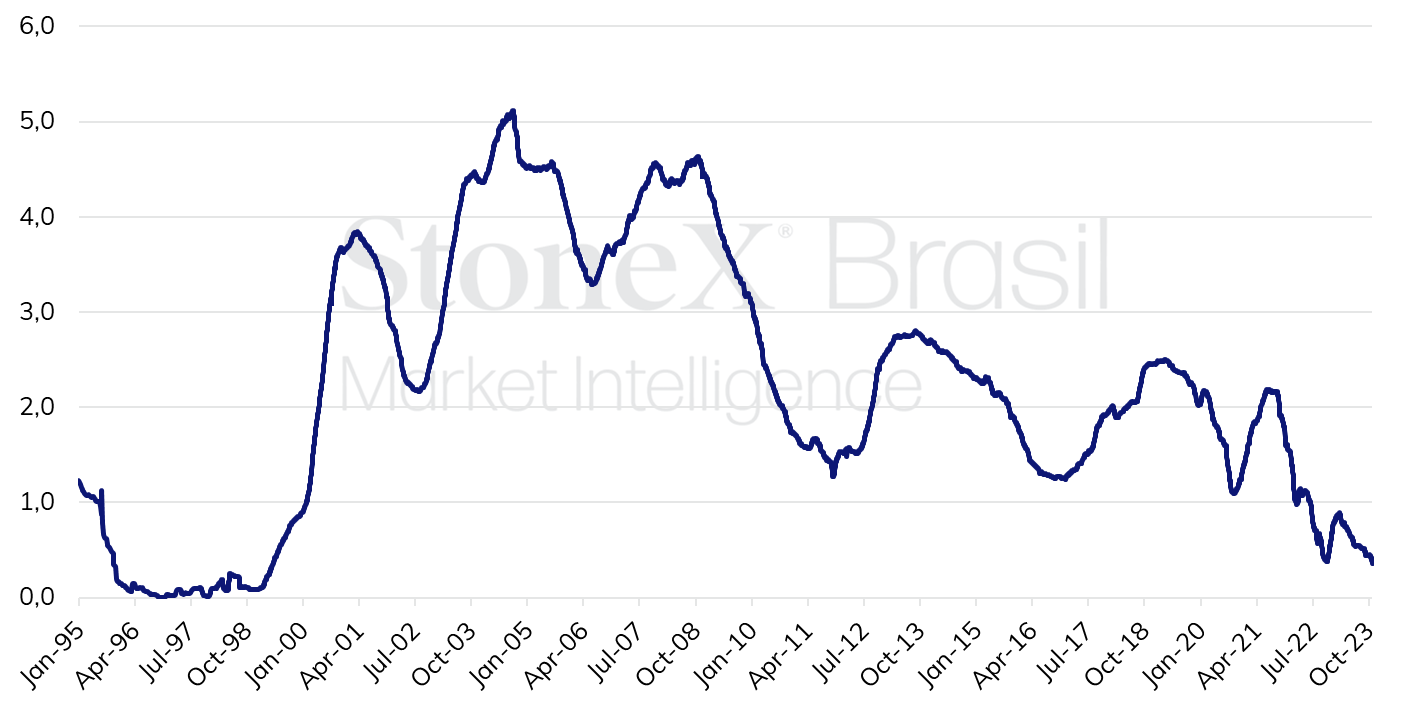
Although certified stocks are not directly linked to a supply and demand factor, but rather to a market condition of the differentials between the exchange and the physical market, the drop in stocks has a bullish bias for prices in New York. For new coffees to be certified and added to the stock market's inventories, a condition of weakened price differentials in the producing countries is necessary. In addition, while at times there was an increase in stocks without adequate market conditions, which would be an indication that already decertified coffees were being recertified on the exchange, the new rule published by ICE banned the recertification of coffees from December 1st, which tends to make it difficult to increase stocks in the short term.
Last week, some companies in the sector released their estimates for Brazilian production and the global coffee balance during the 87th Coffee Summit, which took place in Cartagena, Colombia. According to Olam, the world coffee balance should change from a deficit of 2.8 million bags in 22/23 to a surplus of 5.7 million bags in 23/24 and to a further surplus of 13.5 million bags in 24/25, amid an increase in Brazilian coffee production. According to the company, world coffee production is expected to total 176.2 million bags and consumption 170.5 million bags in 23/24. The company estimates that Brazilian production should total 69.6 million bags in 23/24 and 76.5 million bags in 24/25.
Also during the Coffee Summit in Colombia, Sucafina released its estimates for the Brazilian coffee crop, totaling 67.7 million bags in 23/24 and 72.6 million bags in 24/25, representing an increase of 7.2%. Arabica coffee production is expected to jump from 43.8 million bags in 23/24 to 49.5 million bags in 24/25. For Robusta coffee, production for 23/24 is projected at 23.9 million bags, which should rise to 24.15 million bags in 24/25. In addition, the company projects a recovery in Colombian coffee production to 12.5 million bags in 24/25, compared to production of 11.2 million bags in 23/24.