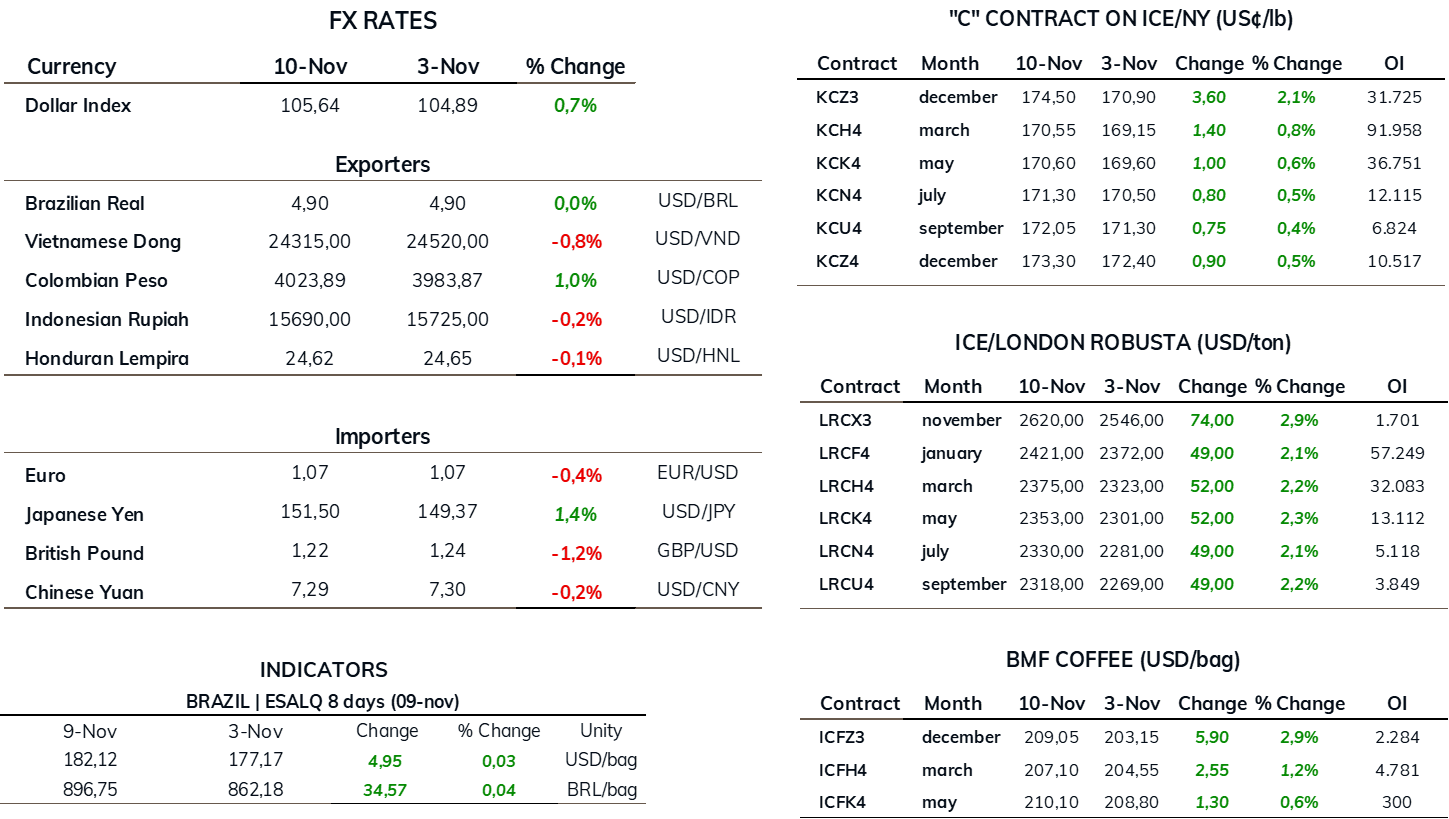
• Arabica coffee up 0.8% on the week to 170.55 c/lb
• Robusta coffee prices up 2.1% on the week
• Cepea registers a 3% rise for Arabica coffee and a 1.7% rise for Robusta coffee
• Weather and certified stocks support coffee prices
• Agents' optimism about the 2024 crop has a downward bias on prices
• Sucden Financial sees Arabica surplus and Robusta deficit in 24/25
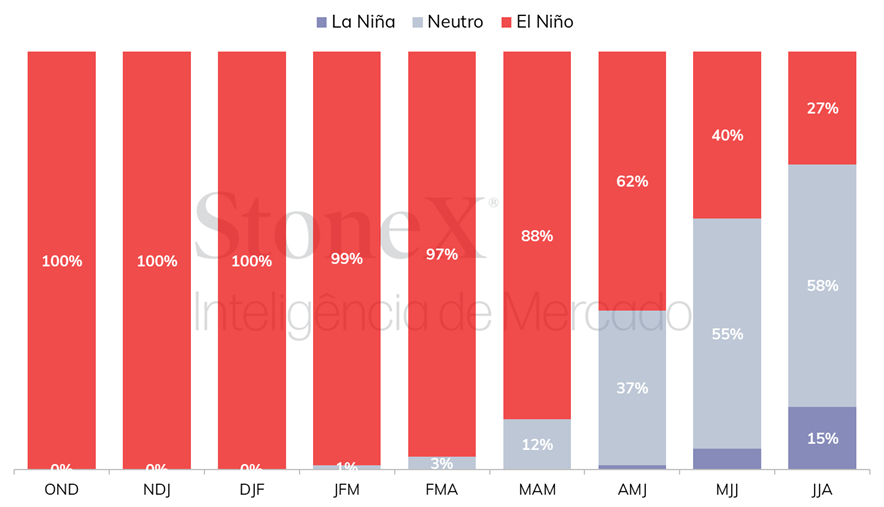
• El Niño is more than 60% likely to continue until April, May and June
• IBGE updates estimate of stocks in Brazil in the first half of 2023
• Dollar rises slightly this week
• Discussions on the LDO in Brazil and the release of the CPI in the US may influence the macro scenario and commodities
Last week, Arabica and Robusta coffee futures prices ended the week higher. From the point of view of fundamentals, the low level of certified coffee stocks and the impacts of El Niño, which has generated dry weather in Asia and a new heatwave in Brazil, have acted positively for prices. However, the prospect of an ample crop next season amid weakened demand has a downward bias on prices.
In New York, the most active contract, for March, posted gains of 140 points (0.8%), closing Friday (10) quoted at 170.55 c/lb. In London, Robusta coffee prices for the January contract showed gains of USD 49/t (2.1%), closing the period quoted at USD 2421/t. During the period, the Dollar Index gained 0.7%, while the USDBRL pair advanced slightly to USDBRL 4.91.
Weekly intraday (most active contract) - 06/11 to 10/11
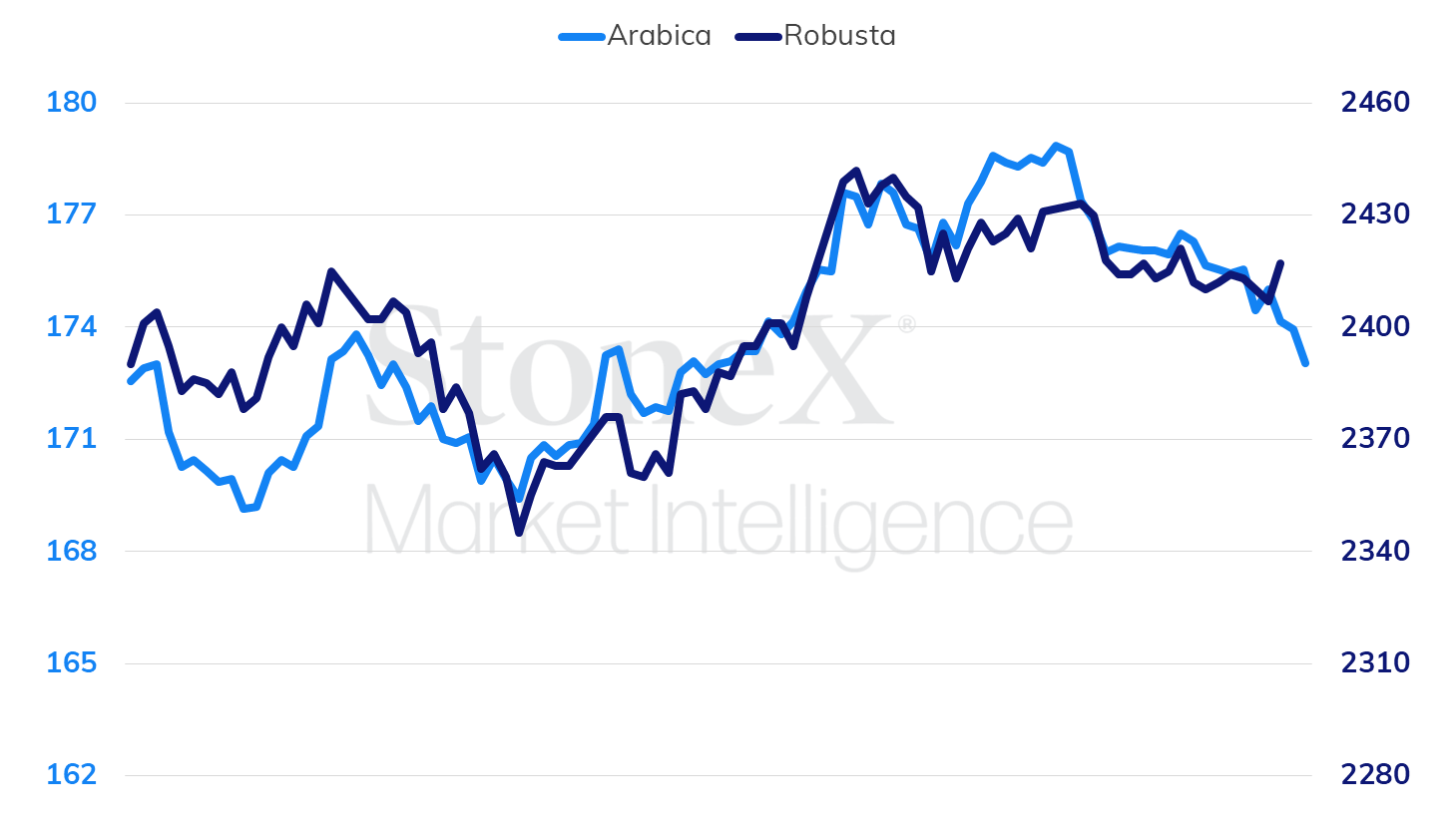
On the Brazilian domestic market, prices followed international movements and ended the period higher. Considering the balance of the week, the Cepea indicator for Arabica coffee was up 3%, closing Friday at BRL 888.46/bag. For Robusta coffee, the indicator rose by 1.7% to BRL 652.06/bag.
During the presentations at events that have taken place in recent weeks, various agents have put forward their outlook for Brazilian coffee production in 2024/25, with several optimistic views on supply being presented. As mentioned last week during an event in Colombia, Olam projected Brazilian production in 2024/25 at 76.5 million bags, which would result in a global balance with a surplus of 13.5 million bags. For Sucafina, Brazilian production should reach 72.6 million bags in 24/25. Last week, during Sintercafe in Costa Rica, Sucden Financial estimated that Brazil could produce 50 million bags of Arabica coffee next season, which would result in a surplus for the variety. On the other hand, the Robusta coffee market would face a deficit scenario, reflecting the greater demand for the variety in the world.
Concerns about the weather in Brazil have acted as a bullish factor for prices. This week, the weather continues to be the focus, with the onset of a heat wave in a large part of Brazil's coffee belt. The high temperatures and dry weather are a reflection of El Niño's impact on the climate. The latest update from the US agency NOAA indicated that there is a probability of over 60% of the phenomenon extending into the months of April, May and June. According to the latest update, the phenomenon will be of strong intensity during critical periods of the production cycle, between November and February, when Brazilian crops are expected to go through the stages of fruit setting, expansion and filling.
Probability of El Niño/La Niña (%)
Last week, IBGE updated its survey of agricultural storage in Brazil. According to the report, coffee represented the fifth largest stock among the products monitored, totaling 847,000 tonnes or 14.1 million bags of stored product in the first half of 2023, a drop of 0.3% compared to the previous six months, but 10.1% compared to the first half of 2022. For Arabica coffee, the IBGE estimates 9.8 million bags in storage, down 13% compared to the previous semester and up 9.4% compared to the first half of last year. For Conilon coffee, the IBGE estimated 4.3 million bags, up 32% on the previous semester and 11.5% on the same period in 2022. The higher overall volume of coffee compared to the first half of the previous crop reflects the weaker performance of exports in 2023, which fell by 18.9% compared to the same period last year, leading to a greater accumulation of stocks.
Looking at the macroeconomic scenario, the dollar ended the week slightly up 0.3% on the Brazilian currency market to close at BRL 4.914. The exchange rate was mainly influenced by the 0.24% increase in the Broad National Consumer Price Index (IPCA) in October, slightly below agents' estimates. As a result, the outlook is for the Central Bank to maintain the pace of cuts of 0.50 percentage points in Brazil's benchmark interest rate, reducing the interest differential between Brazil and the United States and reducing the attractiveness of fixed-income investments in the country. In addition, concerns about Brazil's fiscal scenario, with possible changes to the 2024 Budget Guidelines Law (LDO), which will be on the radar in the coming days, and the Fed Chair's tough tone abroad, showing distrust about whether the current level of interest rates in the US is enough to control US inflation, lent support to the dollar.
This week's indicator agenda includes the release of the US Consumer Price Index (CPI) for October, on Tuesday (14). The median projection for the CPI is a monthly rise of 0.1% for the general index, with the accumulated rising from 3.7% to 3.3%, and with the core CPI rising by 0.3%, with the accumulated remaining at 4.1%. If confirmed, the indicator tends to reinforce the perception of a "soft landing" in the US economy, with inflation gradually being brought under control and with stable growth, which tends to reduce fears of further increases in the country's interest rates and favor risk assets, such as emerging country currencies and commodities. On the other hand, a higher-than-expected result tends to strengthen the dollar and could put pressure on the commodities complex, negatively influencing coffee prices.