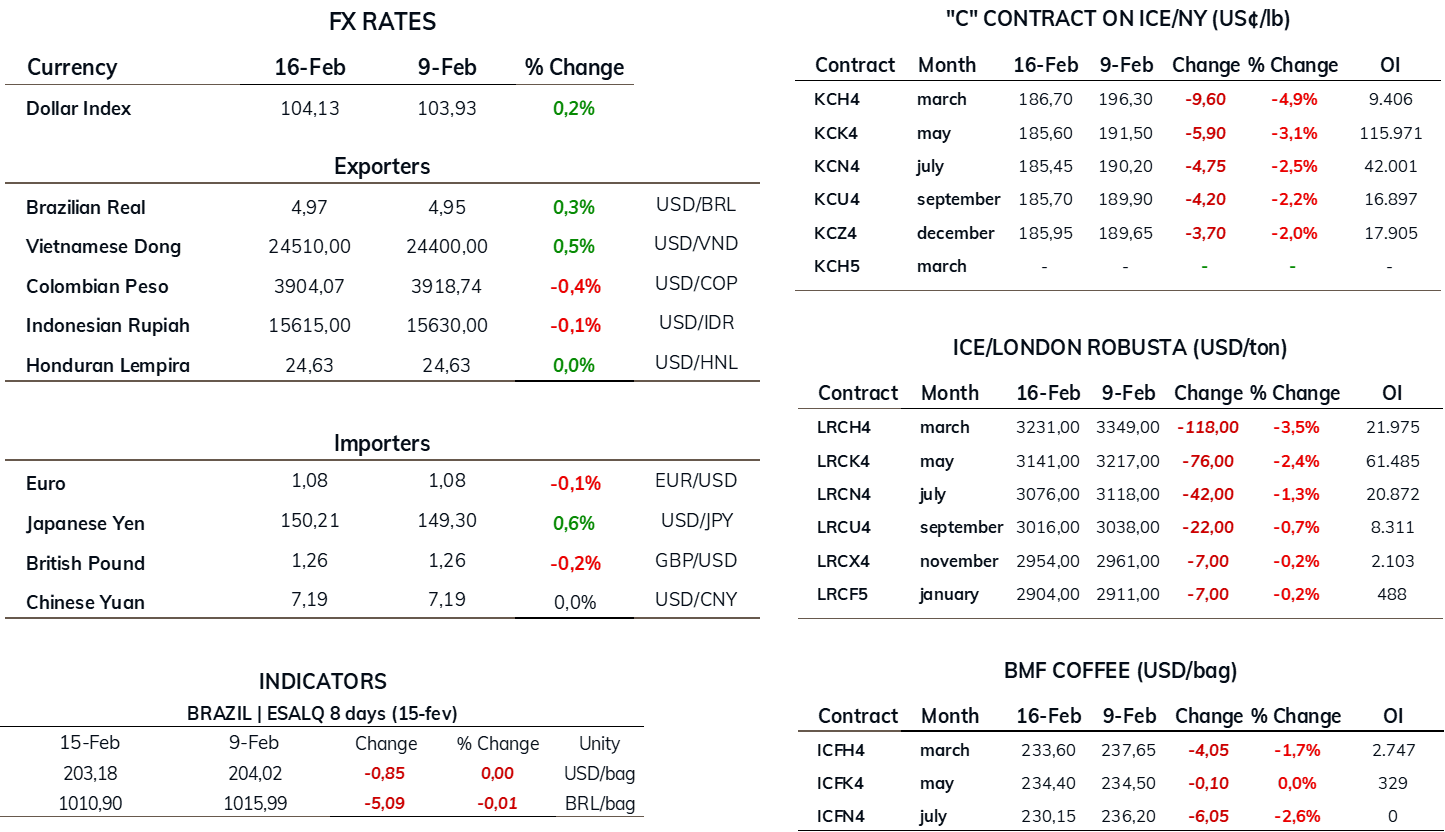
• Arabica coffee down 3.1% on the week in New York, closing at US₵ 185.60/lb
• On the London exchange, Robusta coffee fell 2.4% to USD 3141/t
• Cepea indicator for Arabica coffee down 1.4%
• Cepea indicator for Robusta coffee down 0.2% to R$ 848.25/bag
• Dollar up 0.3% on the week to USDBRL 4.97
• Certified stocks of Arabica rose 3.2% over the last week
• Certified Robusta stocks fell by more than 20% in the week
• Brazilian coffee exports up 39% in January
• Projections for production in Brazil and stocks to remain a central theme
Last week, coffee futures prices followed a downward trend and ended the period with losses in New York and London. The volumes traded last week were reduced due to the absence of Brazil for part of the week, reflecting the Carnival holiday. Coffee prices were affected by the release of export data from Brazil, which showed a 39% increase in the month of January. In addition, part of the movements were impacted by technical factors, such as the roll over of contracts amid the approach of the first notice day, which takes place on Wednesday (21). Although some fundamentals have a bullish bias, such as lower production in Indonesia and Vietnam, this news has already been absorbed by market participants.
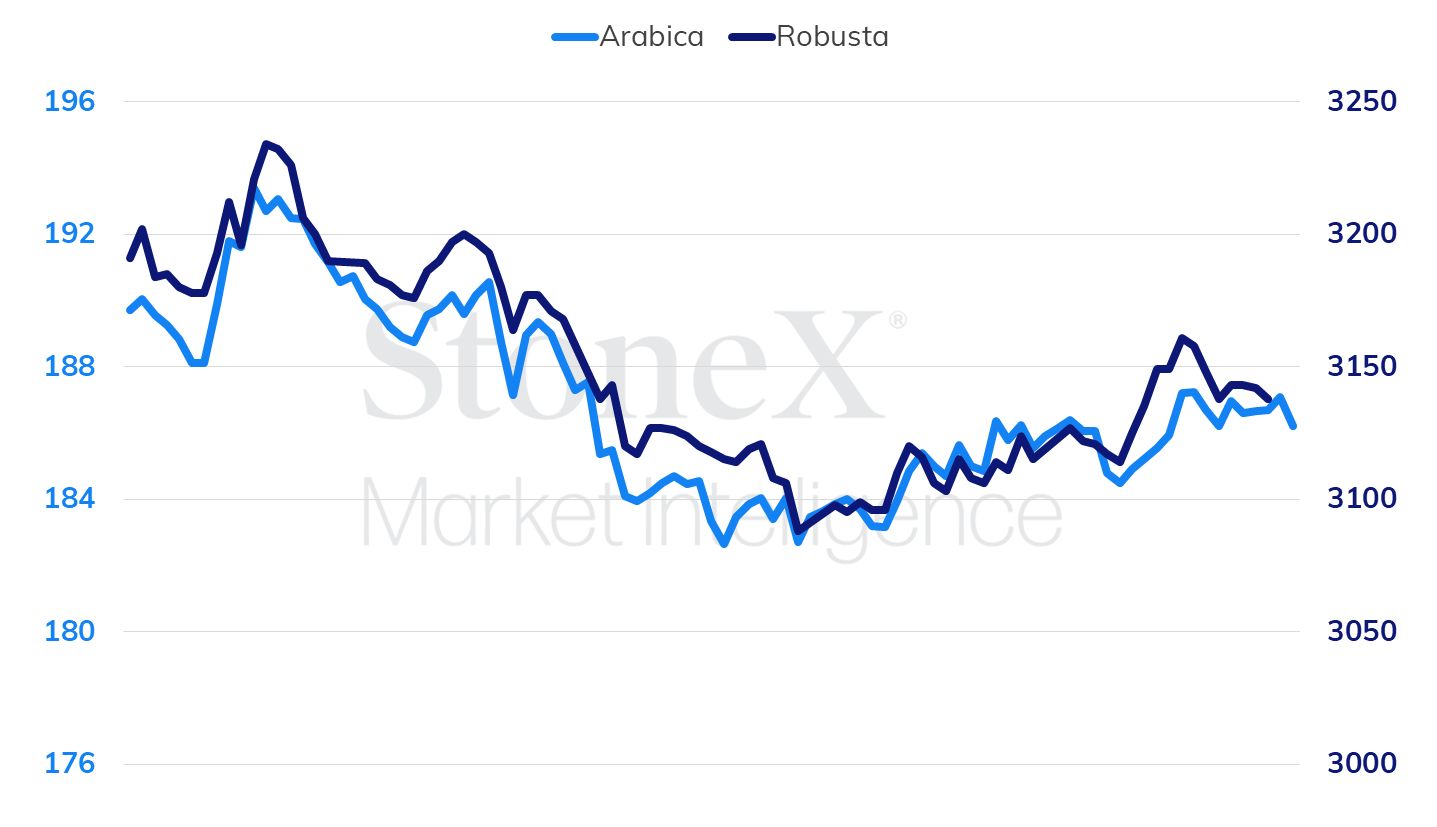
In addition, despite remaining at a historically low level, certified stocks of Arabica coffee have increased substantially in recent weeks. During the week, the rise in the dollar also contributed to putting pressure on future coffee prices. In the weekly balance, the most active contract in New York, for May, lost 590 points (-3.1%), closing the period quoted at US₵ 185.60/lb. In London, the scenario was no different, with the most active contract falling USD 76/t (-2.4%) to USD 3141/t.
In Brazil, Arabica coffee prices followed the trend observed abroad, but to a lesser extent. However, Robusta coffee prices remained almost stable. The Cepea indicator for Arabica coffee fell by 1.4% to R$ 1013.91/bag. The same indicator for Robusta coffee fell by just 0.2% to R$ 848.25/bag.
Weekly intraday (most active contract) - Feb. 12 to Feb. 16
In last Friday's report (16), ICE reported that certified stocks of Arabica coffee totaled 307,260bags, a historically low volume, but one that has been growing. Certified stocks of Arabica coffee rose 3.2% in the last week and 23% since the beginning of the month. Brazil has been the main origin behind the advances in certified stocks; in recent weeks stocks from Brazil have exceeded 114,000 bags, representing an increase of 9.4% in the week and 74.3% since the beginning of the month. In addition, the report showed that stocks pending classification increased by 115% in the week, with Brazil accounting for 79% of the pending stocks reported on Friday (16). Despite this scenario, some agents are still betting on stocks remaining at lower levels.
On the other hand, according to ICE data, certified stocks of Robusta coffee ended the week down. Last Friday's (16) report on stocks as of Thursday (15) showed a drop of more than 20% in the week, to 334,800 bags, with an accumulated drop of more than 29% since the beginning of the month. For Robusta coffee, production problems in Asia have led to a significant increase in price differentials, which discourages the certification of new coffees.
As mentioned in other editions of this report, Brazil's coffee export data had a lot of repercussions on the market and contributed to putting pressure on coffee prices during the week. According to Cecafé, Brazil exported 3.96 million bags of coffee in January, 39% more than the total exported in January 2023. It exported 3.2 million bags of Arabica coffee (+31.1%), 457,80 bags of Robusta coffee (+503.5%) and 295,400 bags of processed coffee (-9.6%). In the crop year to date (Jul-23 to Jan-24), Brazil exported 26.98 million bags of coffee, 20.5 million bags of Arabica coffee (+6.5%), 4.4 million bags of Robusta coffee (+461.3%) and 2.07 million bags of processed coffee (-6.1%).
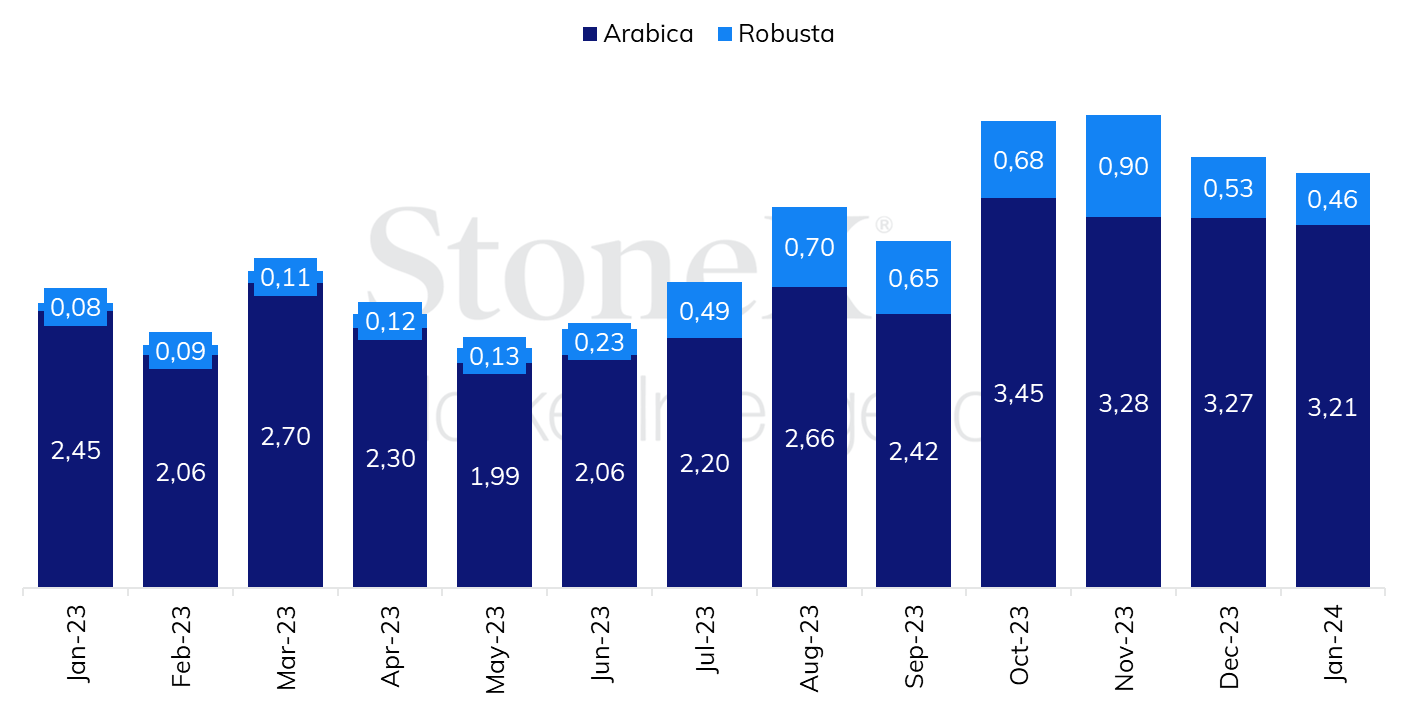
In terms of revenue, Brazil exported R$ 3.94 billion in January, an increase of 23.2% compared to January of the previous year. However, revenue for the year-to-date crop was 4.6% lower, totaling R$26 billion. Considering revenue in dollars, there was an increase of 1.8%, so the decline is mainly due to the fall in the dollar since the start of the crop year.
Looking at the volume, it is easy to see that there was a big increase in exports of Robusta coffee. This scenario is a reflection of the production problems caused by the weather in southwest Asia, both in Vietnam and Indonesia, which reduced production in these countries and impacted on their competitiveness on the international market. As a result, Brazil continues to be the most competitive origin of Robusta coffee in the world, which shows that the country's exports should remain strong in the coming months.
Over the next few weeks, market participants will continue to focus on the forecast for Brazilian coffee production in 2024. To date, several organizations, both public and private, have released their projections for the crop, with the range between estimates exceeding 12 million bags, ranging from 58 million bags, according to Conab, to volumes in excess of 70 million bags, according to private organizations. StoneX will release its official projections for the 2024/25 crop on February 20.
Despite all the weather problems, the prospect of a larger crop in 2024 contributes to optimism that the supply-demand balance will be looser next season, at least for Arabica coffee, since Robusta coffee should continue to be in limited supply while production in Asia does not recover. Certified stocks of Arabica coffee will also be closely monitored, since if stocks were to rise further, this would have a downward bias for prices in New York. On the other hand, stocks of Robusta coffee are likely to remain under pressure due to supply problems in Asia.