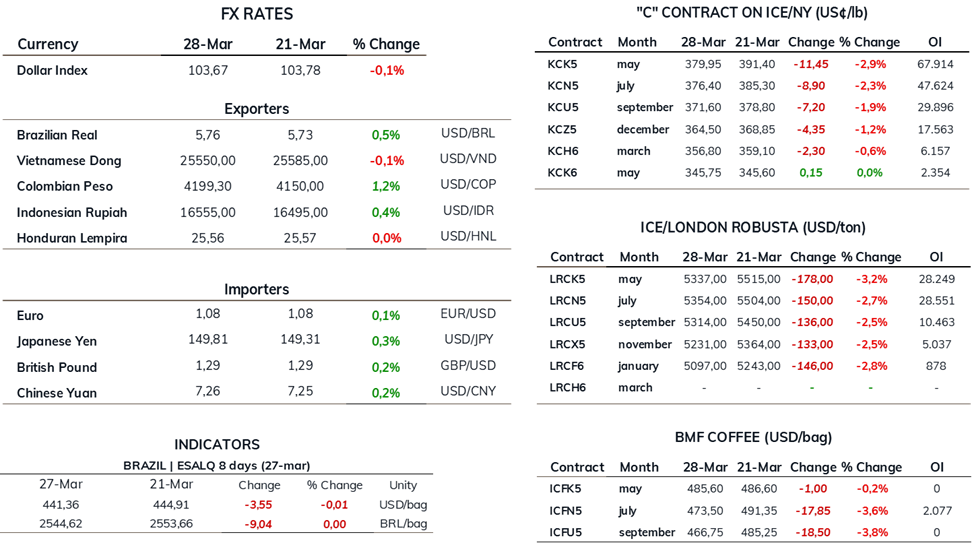
• May contract in New York fell 2.9% during the week to US¢ 379.95/lb
• Robusta in London dropped 3.2%, closing at USD 5,337/ton
• Arabica fell 1.7% in the Brazilian physical market; robusta dropped 1.9%
• Tight supply and logistical bottlenecks continue to support prices
• Improved weather and approaching harvest are putting downward pressure on prices
• Global consumption remains a concern amid rising retail coffee prices
• StoneX will release updated Brazilian crop estimates on April 2
• StoneX estimates Ethiopia’s 2024/25 production at 7.8 million bags
After rising the previous week, coffee futures ended the last week lower. Prices fell amid improved weather conditions in Brazil, with weather models indicating the return of significant rainfall across the coffee belt, and a more favorable weather outlook in Vietnam. The world’s second-largest coffee producer is currently in the flowering phase and the beginning of fruit development. Additionally, a 0.5% appreciation of the dollar in the Brazilian domestic market also contributed to pressure prices.
In New York, the most active contract, with May delivery, ended the session on Friday, March 28, at US¢ 379.95/lb, a 2.9% decline compared to the previous Friday. In London, the May robusta contract dropped 3.2%, closing at USD 5,337/ton. However, prices in New York for the March contract rose 1.8% since the beginning of the month, while robusta prices remained nearly unchanged.
Weekly Intraday (most active contract) – March 24 to March 28
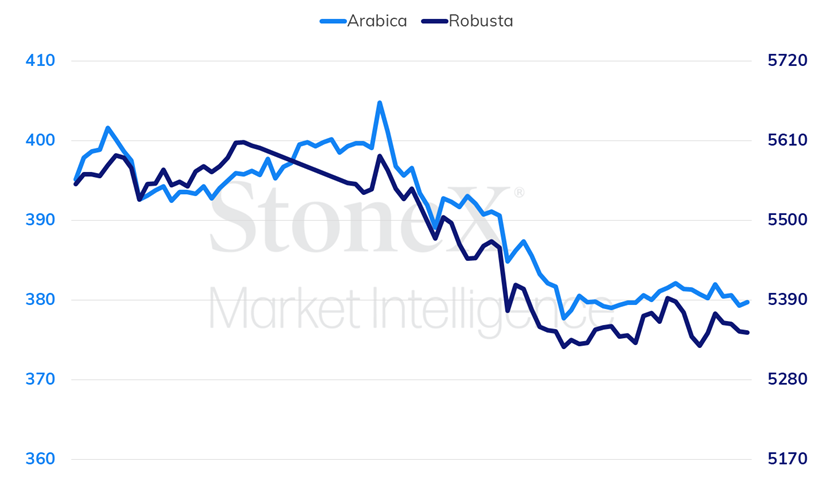
Following the international trend, coffee prices in the Brazilian domestic market also declined. The Cepea indicator for arabica closed the week at just over R$ 2,510/bag, representing a 1.7% decrease compared to the previous Friday. Robusta prices were quoted at nearly R$ 1,978/bag, a 1.9% drop.
From a fundamental’s perspective, there were no major changes. The market remains supported by a tight supply, due to reduced inventories and lower production in the previous season. Furthermore, persistent logistical bottlenecks continue to act as a supportive factor for prices.
On the other hand, improved weather conditions and the approaching harvest in Brazil — especially for robusta, which is expected to show significant production growth next season — offer some relief regarding tight supply concerns and contribute to downward pressure on prices. Another bearish factor is the uncertainty surrounding global coffee consumption, amid high inflation in retail prices. In Brazil, inflation on roasted and ground coffee has exceeded 66% over the past year and continues to rise in Europe and the United States, raising concerns and uncertainty.
In the coming weeks, export data from key producing countries for the month of March will be closely monitored, especially given concerns about the impact of logistical issues. The start of the harvest in Brazil will also be monitored, with expectations that it may begin early in some regions.
It’s important to highlight that on April 2, StoneX will release its updated estimate for Brazil’s 2025/26 coffee crop. Between August and October 2024, StoneX conducted a crop survey and released its first forecast in early November, projecting a nearly 21% increase in robusta production (25.6 million bags) and a more than 10% decline in arabica output (40 million bags). The updated report will be based on new field visits conducted by the StoneX team between January and March 2025.
On Monday, StoneX also released its estimate for Ethiopia’s 2024/25 coffee production. The country’s crop year runs from October to September, so the 2024/25 season began in October 2024 and will end in September 2025. Ethiopia is the fifth-largest coffee producer globally, and when considering only arabica, it ranks third worldwide. StoneX conducted field survey to assess production development and estimate total output. Data were collected from the main producing regions: West, Southeast, South, and East.
In the West, the largest producing region, production is expected to fall by 4.5% to 3.4 million bags, due to negative biennial cycle. A similar situation is seen in the Southeast, with a 12.3% decline to just over 900,000 bags, also due to biennial effects. Arabica coffee in Ethiopia exhibits biennial behavior, just like in Brazil. In contrast, the South and East are in a positive biennial cycle: the South is expected to see a 43% increase, reaching just over 3 million bags, while the East should grow nearly 20%, reaching 418,000 bags.
Thus, Ethiopia’s total coffee production for 2024/25 is estimated at 7.8 million bags, a 9.7% increase compared to the previous season. Read the full report here.
-
What we are reading:
-
Adverse Climatic Conditions Drive Coffee Prices to Highest Level in Years
-
ADECAFEH Revises Honduras Coffee Exports Forecast to 4.8 Million Bags
-
Torrential Rains in Colombia Since the Start of 2025 Most Likely To Reduce Coffee Output
-
Honducafe Expects to Export 1 Million Bags of Coffee for 2024-2025
-
Peru Coffee Exports in January-February Plummets 66% On Year
INDICATORS