• Global coffee prices retreat amid recession fears
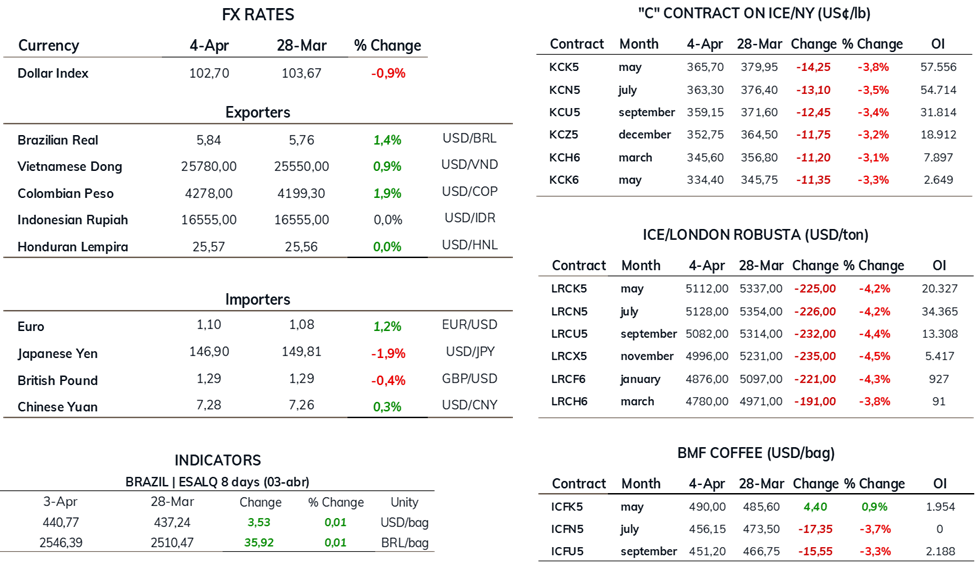
• New York weekly drop of 3.8%, closing at US¢ 365.07/lb
• London declines 4.2%, closing at USD 5,112/ton
• U.S. dollar rises 1.4% for the week, quoted at BRL 5.84
• Robusta drops over 13% in the Brazilian physical market
• StoneX cuts 2025/26 Brazilian coffee crop estimate to 64.5 million bags
• Early start of 2025/26 harvest observed; pace expected to pick up in April
• Brazilian exports grow 5.2% in March, according to Secex
Coffee prices ended the week lower amid a shift in the global macroeconomic environment following the announcement of new tariffs by the United States. Additionally, the approaching harvest in Brazil also exerted downward pressure on prices. One of the main drivers was the wave of risk aversion that took hold of the market after U.S. President Donald Trump announced tariffs on products from several countries. Brazil, for instance, was taxed at 10%, the same rate applied to Colombia. Indonesia faced a 32% tariff and Vietnam, 46%. Economists fear these tariffs may lead to a global economic recession, which triggered a broad-based selloff in global markets.
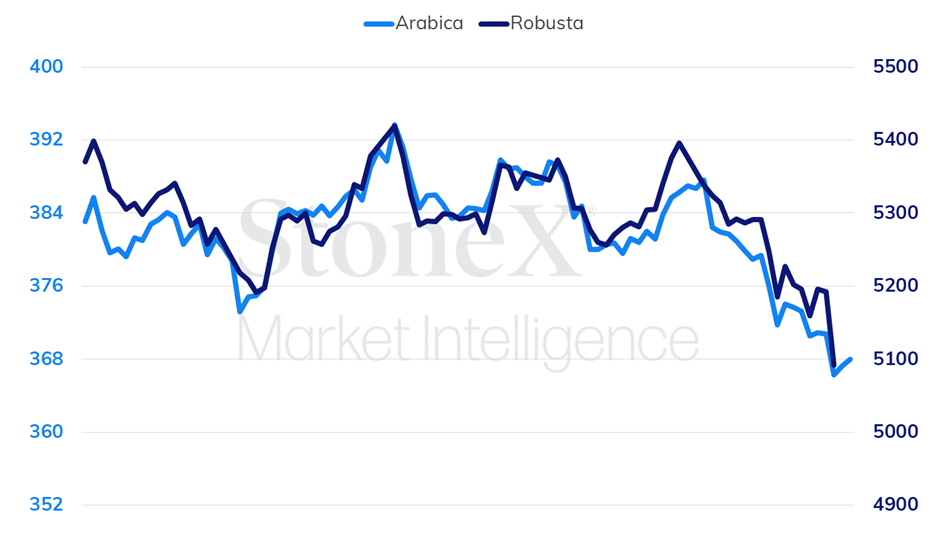
Within this broader macroeconomic shift, one of the week’s highlights was Friday’s price action. In New York, for example, coffee prices dropped more than 5% in a single day, equivalent to a 1955-point loss. This decline was also linked to a strong appreciation of the U.S. dollar in the same session. On Friday, April 4, the dollar closed with a 3.78% gain, quoted at USDBRL 5.84. It’s worth noting that the USDBRL exchange rate tends to have an inverse correlation with coffee futures prices.
In New York, the most active contract ended the week down 3.8%, at US¢ 365.70/lb. In London, the benchmark contract also fell, declining 4.2% to USD 5112/ton. Meanwhile, the dollar finished the week up 1.4%, quoted at BRL 5.84.
Weekly Intraday (most active contract) – March 31 to April 4
In the Brazilian domestic market, the scenario was slightly different. The Cepea indicator for arabica coffee remained virtually unchanged, with a slight drop of 0.1%, quoted at just over BRL 2,508 per 60-kg bag. This movement suggests that, despite international market declines, the dollar’s appreciation helped support domestic arabica prices. Additionally, the expected decline in the 2025/26 crop continues to offer support.
On the other hand, robusta coffee saw a sharp drop. The Cepea indicator for robusta posted a weekly decline of more than 13%, closing at BRL 1718 per bag. This decline is linked to the strong increase in Brazilian robusta production, as already indicated by StoneX estimates, as well as the early start of the harvest, which also puts pressure on domestic prices.
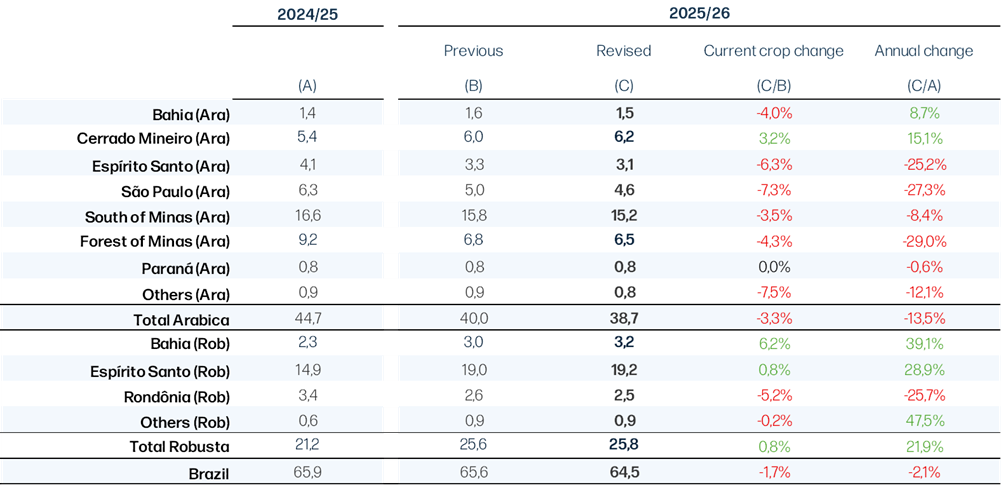
Last week, on April 2, StoneX released its updated estimate for the 2025/26 Brazilian coffee crop. After field visits to key producing regions between January and March 2025, the consultancy cut its arabica forecast by 3.3%, from 40 to 38.7 million bags — a 13.5% drop compared to the 2024/25 crop. In contrast, the robusta estimate was raised by 0.8%, reaching 25.8 million bags, representing a nearly 22% increase year-over-year. As a result, total Brazilian coffee production was revised to 64.5 million bags for 2025/26, down 1.7% from the previous estimate and 2.1% lower than the last season.
One notable point for arabica was the sharp decline in output expected in São Paulo state, whose forecast was lowered by 7.3% to 4.6 million bags. Other arabica-producing regions also saw downward revisions, including southern Minas Gerais, the Matas de Minas region, and southern Espírito Santo. In the case of Matas and Espírito Santo, negative bienniality and climatic impacts were the main factors.
For robusta, production growth was particularly strong in Espírito Santo and Bahia, supported by favorable weather and widespread use of irrigation. Rondônia, in contrast, experienced a nearly 26% decline in output due to adverse weather conditions. Without these issues, Brazilian robusta production could have been even higher. The full report is available on the Market Intelligence Portal: Coffee Crop Survey in Brazil 2025/26.
StoneX Coffee Production Estimates (million bags)
Source: StoneX.
Another major headline during the week was the imposition of tariffs by the United States. As highlighted in the StoneX report, the imposition of 46% tariffs on Vietnam and 32% on Indonesia could open space for increased Brazilian robusta exports. However, the Vietnamese government has already begun negotiations with the United States in an attempt to reverse the decision, expressing a willingness to eliminate tariffs on their end. The outcome of these discussions remains uncertain and could significantly impact global coffee market dynamics.
Besides tariffs, logistics remain a key factor supporting futures prices, with ongoing export challenges. Monitoring shipment data is essential for understanding market flow. According to Brazil’s Secretariat of Foreign Trade (Secex), the country exported 3.65 million bags of coffee in March, a 5.2% increase compared to March 2024. Official Cecafé data has not yet been released and is expected on the afternoon of April 9.
In addition to exports, the market is now focusing on the progression of the 2025/26 harvest. The coffee harvest is expected to begin around April 20 in most arabica and conilon regions. Due to uniform grain development and favorable weather conditions since October, the harvest is anticipated to start earlier than usual. In some warmer regions, or those with earlier flowering due to climatic factors, there are already isolated reports of harvesting activity. However, these cases remain limited to specific areas.
Harvesting is expected to accelerate in the coming days, and if rainfall does not interfere with the pace of operations, significant volumes of new crop coffee should begin arriving on the market in May. The quality of beans this season is expected to be noticeably better than the previous crop, especially in terms of bean size. This will temporarily ease the current supply tightness.
Harvest Progress in Brazil Over Recent Years
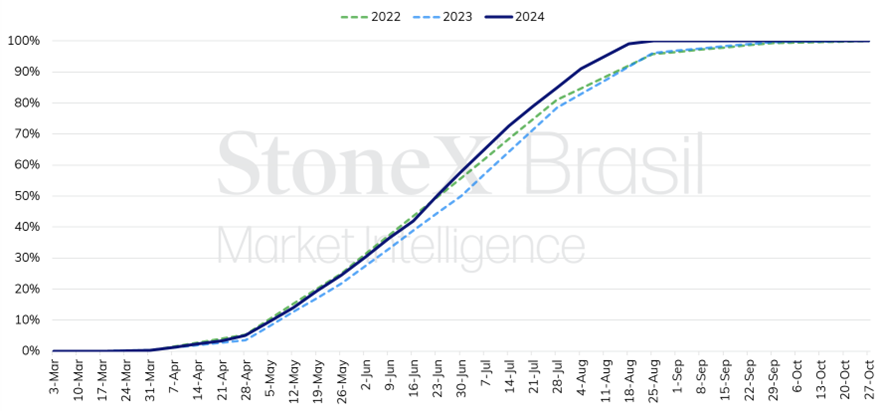
Source: StoneX and Conab. Design: StoneX
Lastly, another key factor to monitor is the weather. Although winter is still some time away, forecasts should be closely watched, particularly regarding frost risks, which can significantly impact both production and prices. The global macroeconomic environment will also remain a major influence, with uncertainty surrounding U.S. tariffs, global trade developments, and market volatility continuing to weigh on sentiment.
-
What we are reading:
-
Colombia’s Main Harvest in 2025 to Be Hit by Rains: FNC General Manager
-
US Consumption of Coffee, Cocoa May Fall: Peru’s Coffee, Cocoa Chamber
-
New Report Highlights Fastest Growth in 5 Years for the European Branded Coffee Shop Market
-
Uncertainties Surrounding Coffee Tariffs Have Coffee Market on Edge
-
Brazilian Robusta Coffee Exports May Gain Momentum with New U.S. Tariffs
INDICATORS