• Arabica prices rise 0.6% in NY; robusta falls 1.2% in London
• Tight supply and low stocks support coffee prices
• Robusta harvest progresses faster; arabica harvest lags behind
• Brazilian green coffee exports drop 29.1% in April
• USDA projects production growth in Honduras and Uganda
• Market monitors global consumption and weather conditions in Brazil
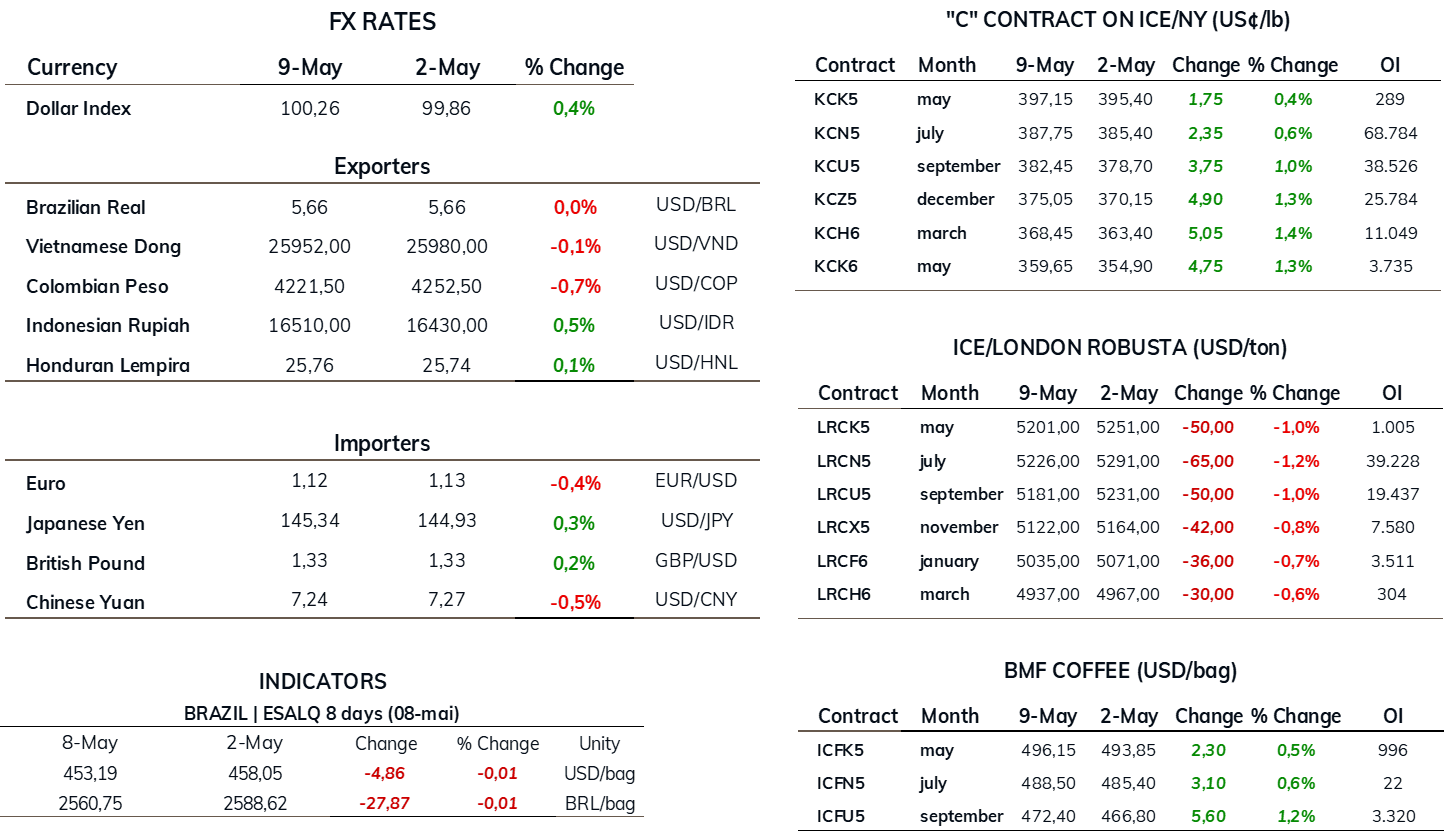
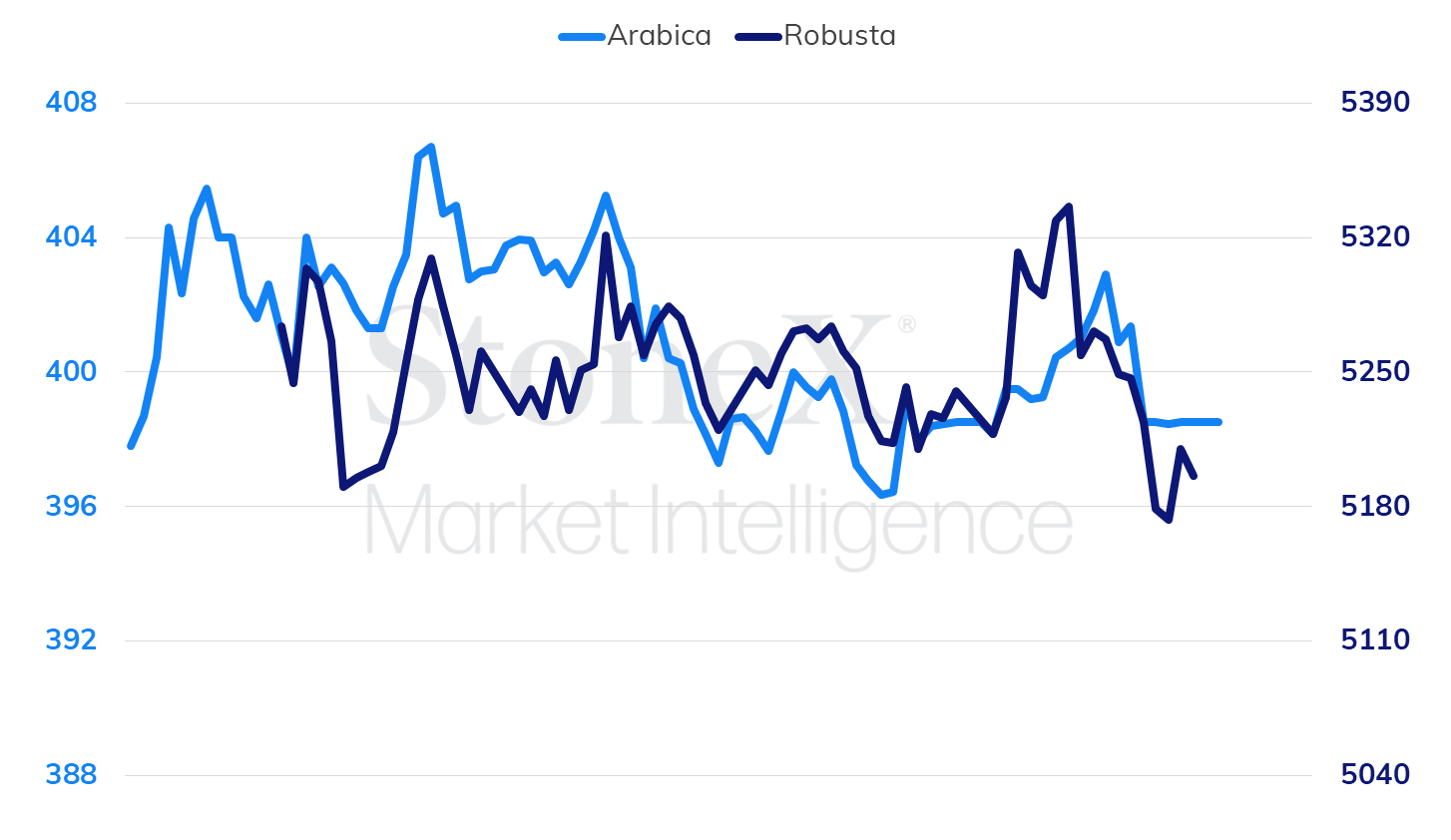
The futures prices of arabica and robusta coffee ended last week with mixed performances. In New York, the most active contract rose 0.6%, closing at US¢ 387.75/lb. In London, the most traded contract, with July delivery, closed the week at USD 5,226 per ton, a 1.2% decline compared to the previous week.
From a fundamental perspective, tight supply and low stock levels remain key factors supporting prices in the international market. Additionally, market participants continue to monitor the progress of the harvest in Brazil. Although the crop is smaller – which tends to support prices – the increase in robusta production and the harvest’s progress provide some short-term relief. The market is also closely watching the impacts of higher prices on global consumption and weather conditions in Brazil.
Weekly Intraday (most active contract) – 05/05 to 09/05
In the Brazilian physical market, the Cepea indicator for arabica coffee posted a 1.4% drop, closing the week slightly above BRL 2,553 per bag. For robusta, the decrease was milder, just 0.1%, with the indicator closing the week near BRL 1,667 per bag.
Another relevant factor for the coffee market relates to the macroeconomic and exchange rate scenario. Since the announcement by the United States government regarding the imposition of tariffs on products imported from various countries, the market saw a risk-off movement, which negatively pressured coffee prices. Later, with the easing of trade tensions, investors returned to seeking riskier assets, supporting price recovery.
In terms of exchange rates, the so-called trade war between the United States and China contributed to the depreciation of the dollar against other currencies, which also had a positive impact on coffee prices in New York. More recently, the announcement of an agreement between the two countries, which includes tariff reductions and a 90-day truce in trade disputes, provided support for the dollar, partially reversing its previous depreciation.
These exchange rate fluctuations remain one of the main factors influencing future coffee prices, especially considering that the dollar has an inverse correlation with New York prices: a stronger dollar tends to pressure prices downward, while a weaker dollar tends to support higher prices.
In Brazil, the market is following the release of official export data by the Brazilian Coffee Exporters Council (Cecafé). Preliminary data from Secex indicated a 32% drop in Brazilian green coffee exports in April, totaling about 2.9 million bags. The figures released today by Cecafé show a 29.1% decline, with shipments totaling 2.78 million bags.
In addition to the lower availability of coffee in the domestic market, Brazil has also faced logistical challenges that have hindered export performance. According to Cecafé, more than 600,000 bags were not shipped in March, resulting in estimated losses of nearly BRL 9 million.
Detailed data show a 17.4% drop in arabica exports, totaling 2.68 million bags, and an 84.9% decline in robusta exports, with 103.6 thousand bags shipped, reflecting the limited supply scenario and the off-season period. Meanwhile, processed coffee exports fell 10.8% in the same comparison, to 308.5 thousand bags. On the other hand, export revenue increased by 59.9% to BRL 7.75 billion, driven by higher prices compared to the same period last year.
Brazilian Green Coffee Exports (million bags)
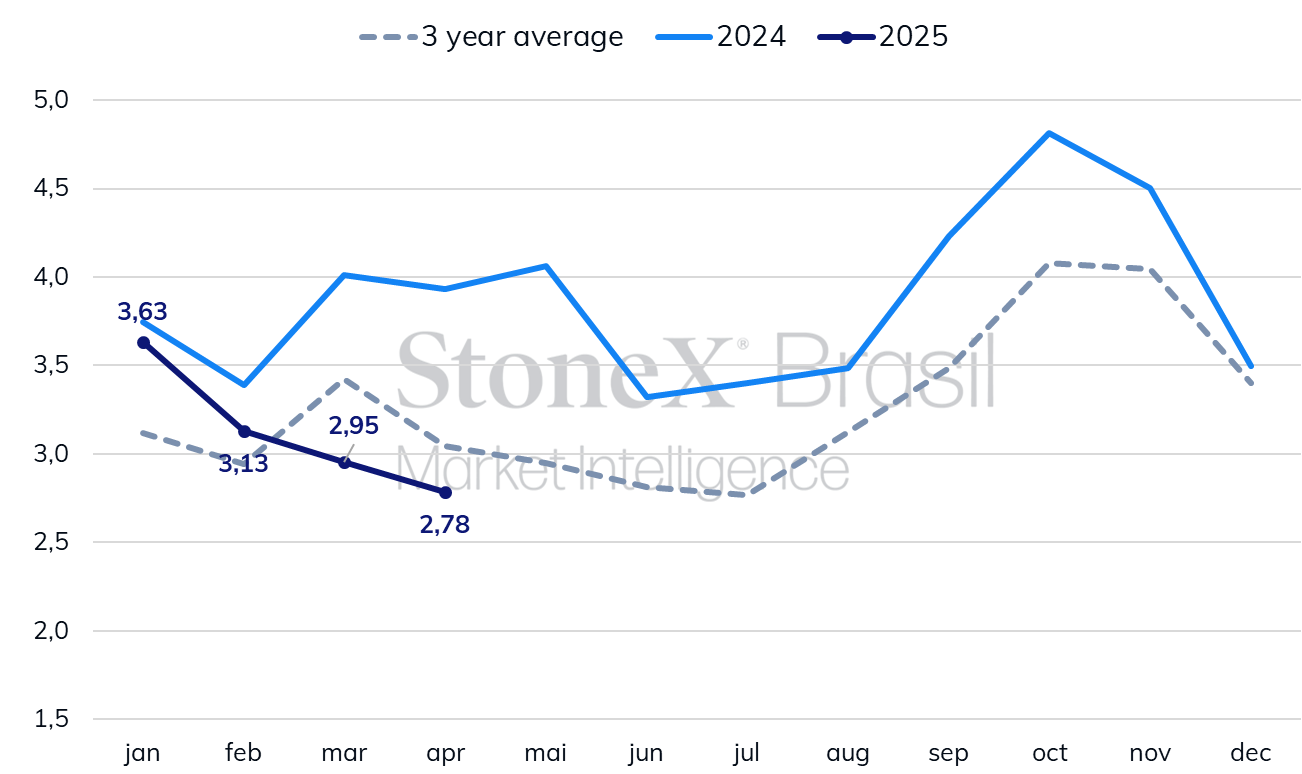
Source: Cecafé. Compiled by StoneX.
Also last week, the United States Department of Agriculture (USDA) released new updates in its agricultural attaché reports, this time focusing on Honduras and Uganda.
For the 2025/26 season, the USDA estimates that Honduras will produce 5.8 million bags of coffee, representing an increase of over 5% compared to the previous season. Honduran exports are also expected to grow, with a projected 2.6% increase, totaling more than 5.5 million bags.
Regarding Uganda, the USDA projects a 2.6% production increase, reaching nearly 6.9 million bags. The country’s exports are expected to follow this upward trend, with a 2.6% increase, totaling more than 6.5 million bags.
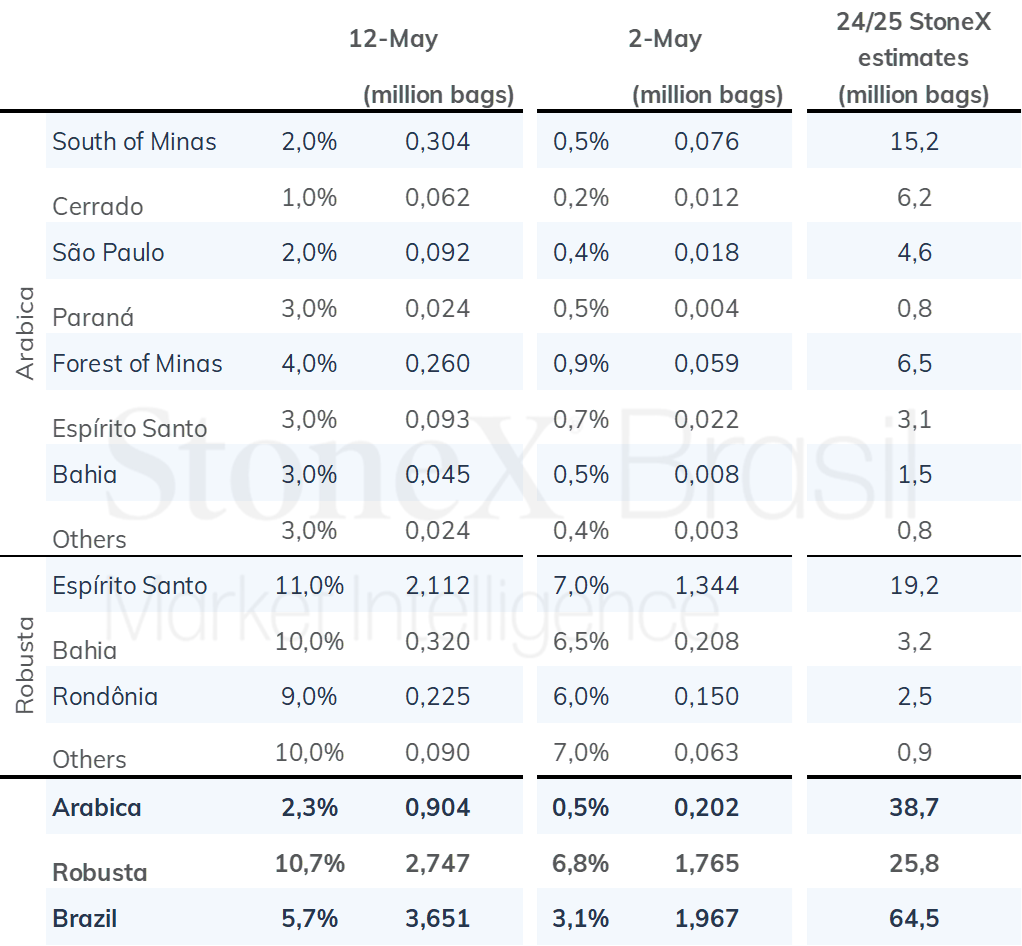
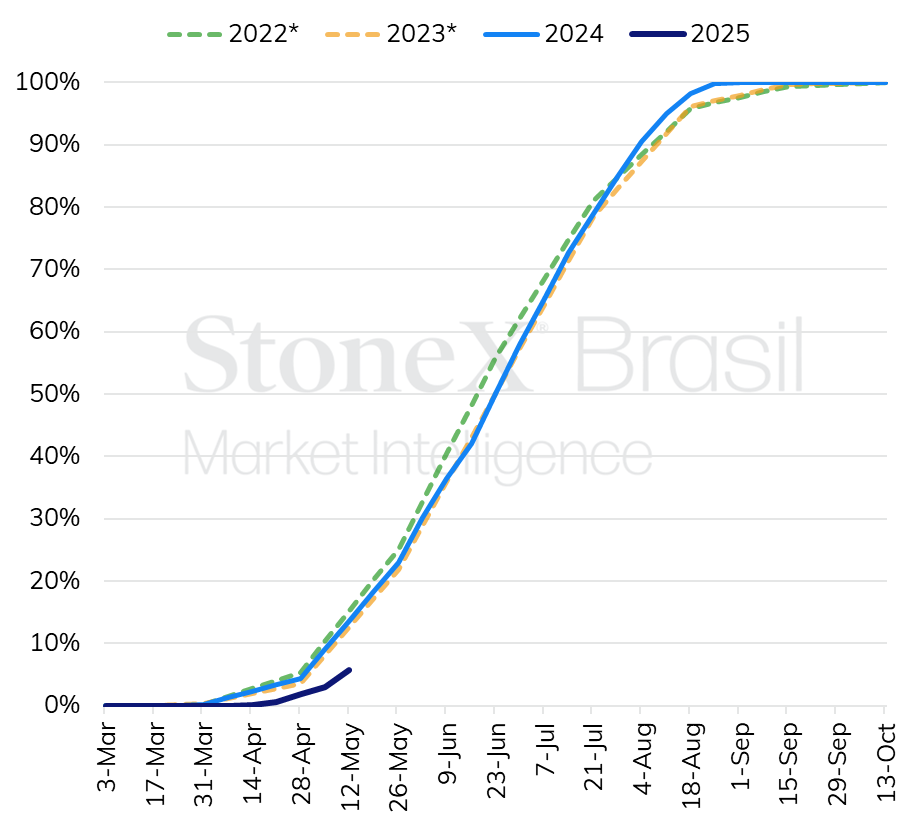
Regarding the harvest in Brazil, due to the good uniformity and development of the fruits in both arabica and conilon (robusta) coffee plantations, the initial expectation was for an earlier harvest, which indeed has been confirmed. However, according to a survey conducted by StoneX, the pace of harvest progress has differed between the two varieties.
While conilon areas are seeing a faster pace, arabica-producing regions are experiencing a slower progression. The rains recorded in April and early May affected harvesting activities, especially in mountainous regions. Additionally, a high percentage of green beans is still observed in later-maturing varieties, particularly in the South of Minas Gerais, where the harvest continues at a slower pace.
Harvest Progress in Brazil
Source: StoneX.
-
What we are reading:
-
Guatemala’s Coffee Exports Total 1.451 million Bags In New Coffee Year As of April 30
-
Guatemalan Coffee Exporter Comments on Last Week’s USDA Report
-
USDA Attache: Uganda’s 2025-2026 Coffee Crop Pegged at 6.875 Million Bags
-
USDA Attache: Honduras 2025-2026 Coffee Crop Pegged at 5.8 Million Bags
INDICATORS