• Coffee futures prices fell last week
• The Brazilian domestic market also registered lower prices
• USDA released its attaché report for five more countries
• Harvest progress tends to ease supply pressures
• Models point to a drop in temperatures at the end of the month
Last week, coffee futures prices were pressured amid a slight increase in the dollar and the progress of the coffee harvest in Brazil. Despite the lower production of arabica coffee, the strong increase in robusta production partially offset arabica losses. Furthermore, the harvest progress is expected to bring some short-term relief to the restricted supply scenario Brazil has been facing.
Another bearish factor was the release of financial results from some companies in the sector, which showed a decline in revenue, potentially indicating a reduction in consumption.
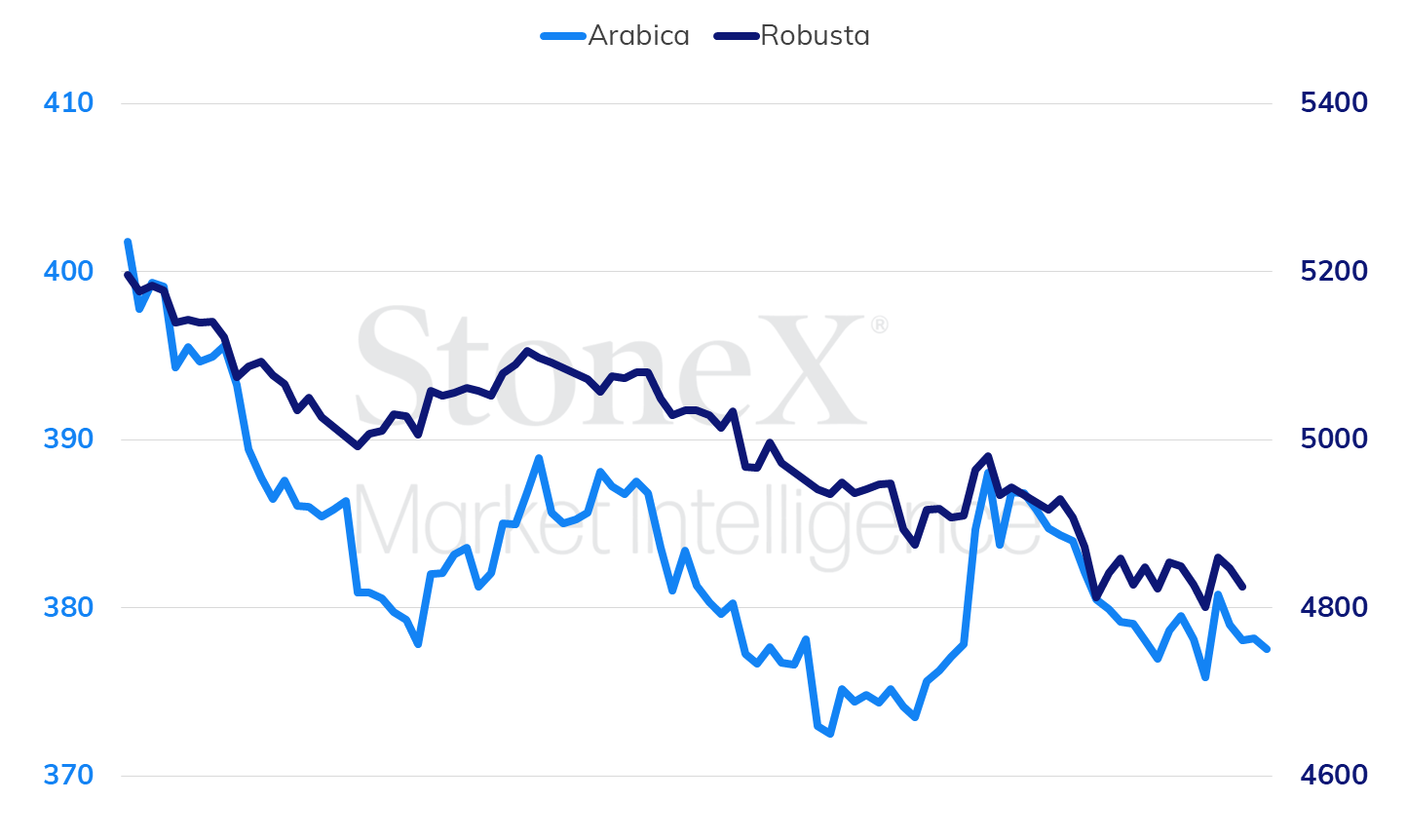
In New York, the most active contract, maturing in July, closed on Friday (16) at US¢ 365.65/lb, recording a drop of 2,210 points (-5.7%). In London, the July contract fell 6.9%, closing at USD 4,865/ton. The USDBRL pair experienced a volatile week, closing Friday with a 0.1% increase at BRL 5.66.
Weekly Intraday (most active contract) – 05/12 to 05/16
Following international movements, coffee prices in the Brazilian domestic market also declined. The Cepea indicator for arabica coffee fell 2.2%, closing at BRL 2,473.66/bag. The robusta indicator posted an even sharper decline of 4.1%, closing at BRL 1,519.40/bag. Robusta prices are being pressured by the progress of the harvest in Brazil, which is expected to reach a record volume of 25.8 million bags in 2025, according to estimates from StoneX.
Also last week, the United States Department of Agriculture (USDA) released its attaché report for Colombia, Nicaragua, Kenya, Costa Rica, and El Salvador. According to the USDA, Colombian coffee production reached 13.2 million bags in 2024, representing an increase of 2.3% compared to the previous estimate. For 2025, the department projects a 5.3% decline to 12.5 million bags, citing excessive rainfall as the main factor behind the reduction in the country’s productive potential. The USDA also forecasts that Colombian coffee exports will decrease by 4.1% in 2025/26, totaling 11.8 million bags.
For Nicaragua, the department revised its 2024 estimate downward by 4.7%, to 2.6 million bags, and kept the 2025/26 production estimate unchanged. Production in Kenya is expected to rise by 13.3% in 2025, totaling 850 thousand bags. Production in Costa Rica was estimated at 1.2 million bags, representing a 9.9% decline. Meanwhile, production in El Salvador is expected to increase by 6.4%, reaching nearly 600 thousand bags.
USDA Estimates Released by the Attachés
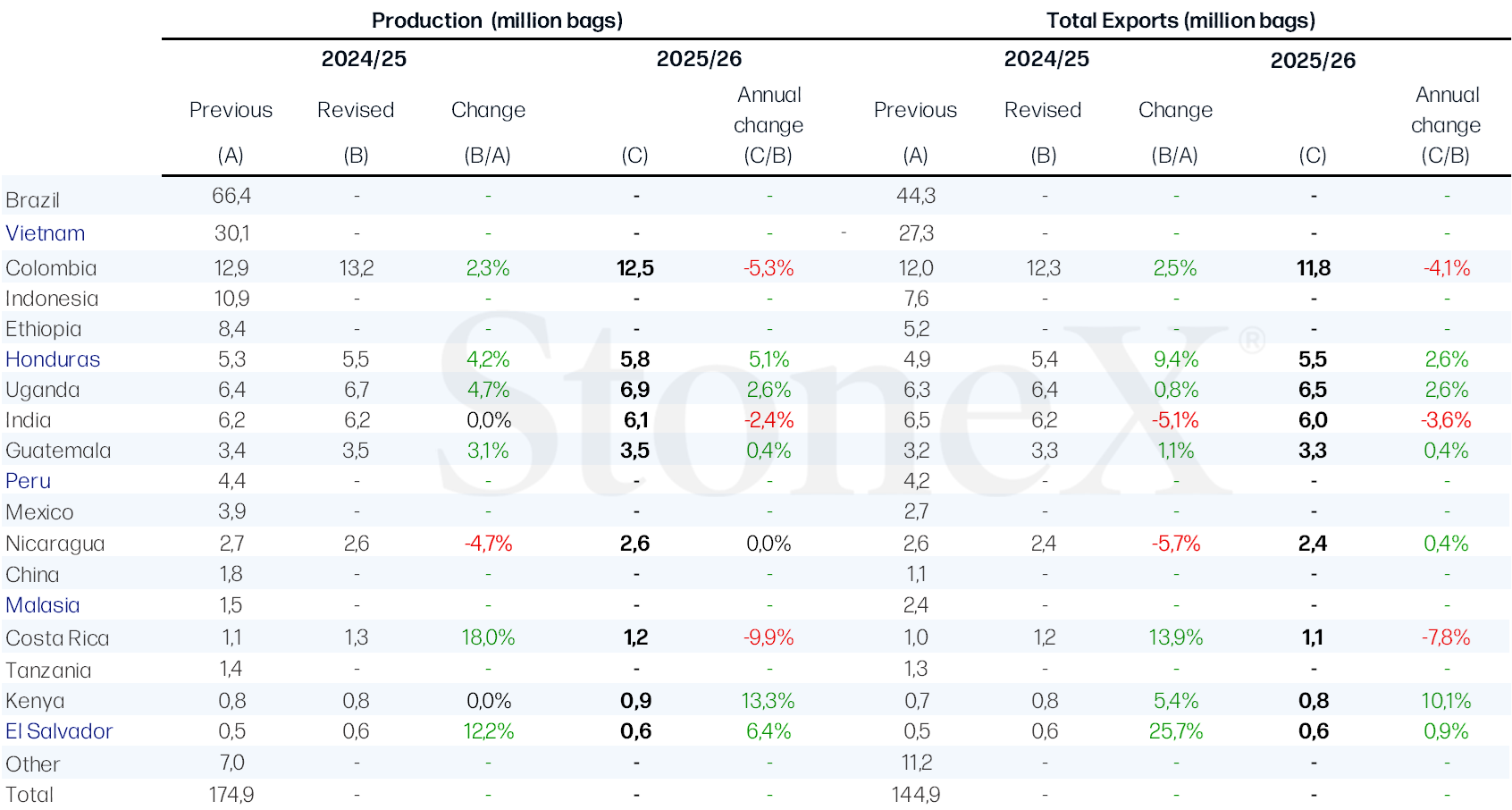
Source: USDA. Compiled by StoneX.
From a fundamentals perspective, the short-term outlook points to an improvement in supply due to the progress of the Brazilian coffee harvest, which tends to put downward pressure on prices. On the other hand, weather concerns may provide support for prices and generate greater volatility in the coffee market.
Forecast models have been pointing to the arrival of a polar air mass in Brazil at the end of May and the beginning of June. Although it is still too early to predict the occurrence of frosts, projections indicate a sharp drop in temperatures, which may increase the frost risk in the country. Therefore, it is extremely important to monitor updates on weather conditions in Brazil. For more details, read the report: "Cold Front Triggers Temperature Drop in South-Central Brazil"
Interactive Weather Reports You Need to Follow
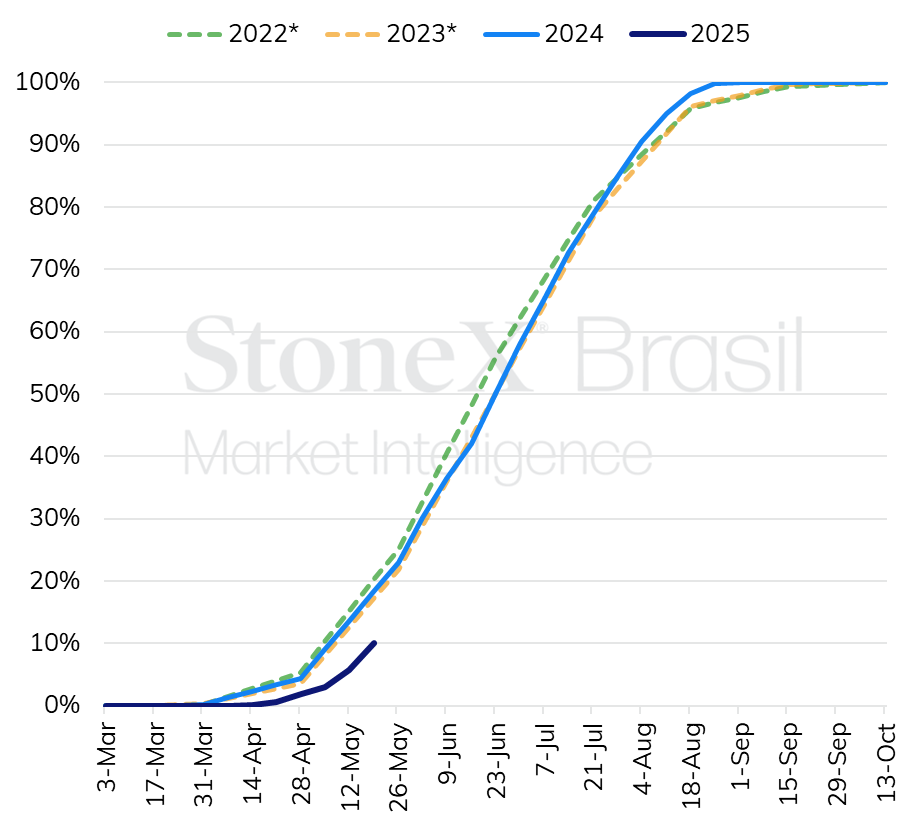
Regarding the pace of the harvest, StoneX data show that as of May 19, approximately 10% of Brazil’s coffee crop had been harvested, representing around 6.5 million bags. The pace is slower than observed last year when about 18% of the crop had been harvested by this time. The harvest is progressing faster for robusta coffee, which has already reached 16.5% (4.25 million bags). On the other hand, the arabica coffee harvest has reached only 5.8% (2.24 million bags). Rainfall observed throughout April is the main factor responsible for the delay in the Brazilian harvest.
Harvest Progress in Brazil
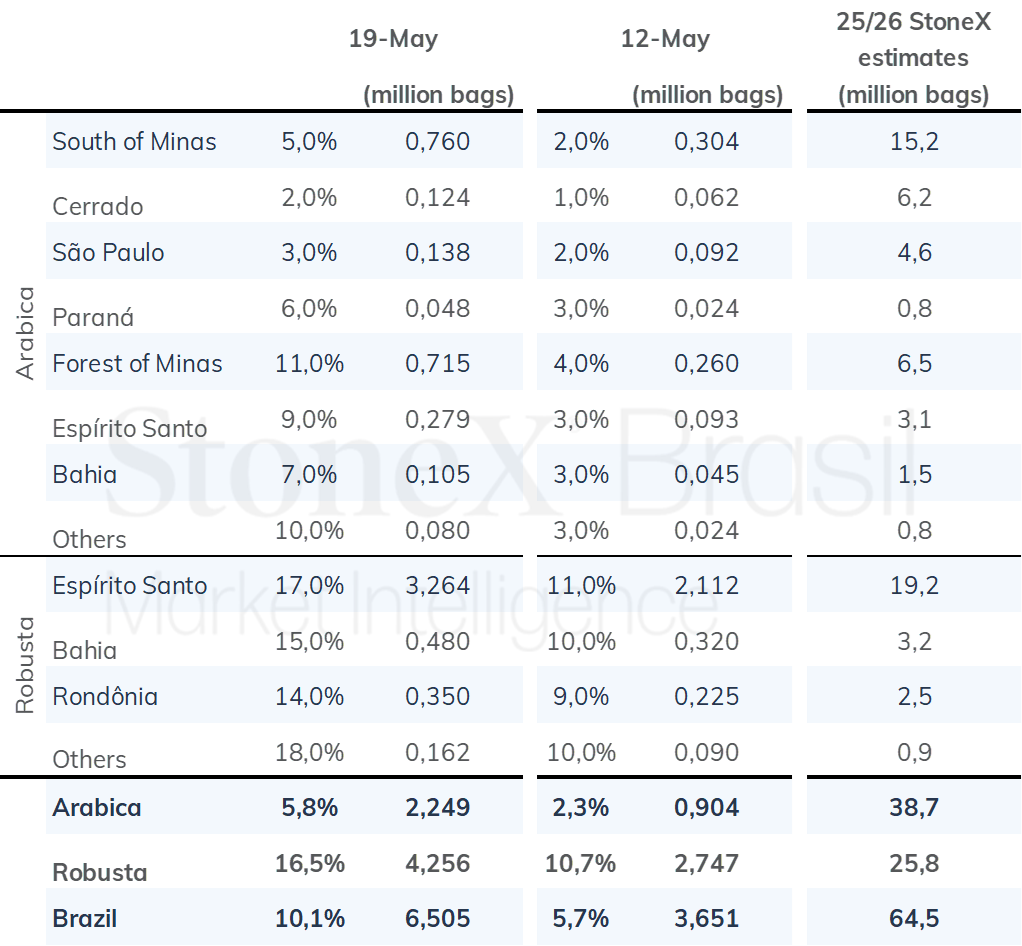
Source: StoneX.
-
What are we reading?
-
USDA Attache: Nicaragua’s 2025-2026 Coffee Crop Pegged at 2.58 Million Bags
-
USDA Attache: Colombia’s 2025-2026 Coffee Crop Pegged at 12.5 Million Bags
-
USDA Attache: Kenya’s 2025-2026 Coffee Crop Pegged at 750,000 Bags
-
IBGE Raises Forecast for Brazil’s 2025-2026 Coffee Crop to 55 Million Bags
INDICATORS