• USDA projects surplus, but final stocks don’t reflect estimated volumes
• Prices fall with harvest progress and weakened domestic demand
• Cold front sparks initial rally, but impact was limited
• Weather models diverged; American model proved most accurate
• Robusta harvest progresses faster than arabica
• Robusta exports rebound, but remain below 2024 levels
• Weaker dollar adds pressure to domestic market
• StoneX to release its own global balance report in the coming weeks
Coffee futures prices ended last week lower, influenced by Brazil’s harvest progress and the outlook for weakened global consumption. However, the week was marked by intense volatility, especially following a polar air mass that passed through Brazil’s coffee-growing regions on the night of the 25th. On Monday, prices opened sharply higher due to concern that the cold front could hit the coffee belt.
Various weather models projected different scenarios. INPE indicated a broader frost risk, including areas in southern Minas Gerais. The European model pointed to similarly low minimum temperatures, while the American model forecasted that the polar air would remain restricted to the country’s southern region, not significantly impacting coffee areas.
Indeed, the American model was more accurate: the cold mass concentrated in southern Paraná and Santa Catarina, where sub-zero temperatures were recorded. In the coffee belt, no widespread damage occurred; only some high-altitude micro-regions saw frost, but these areas have limited coffee production. As a result, the market reacted with relief, and prices—after rising Monday—fell significantly by Tuesday and Wednesday.
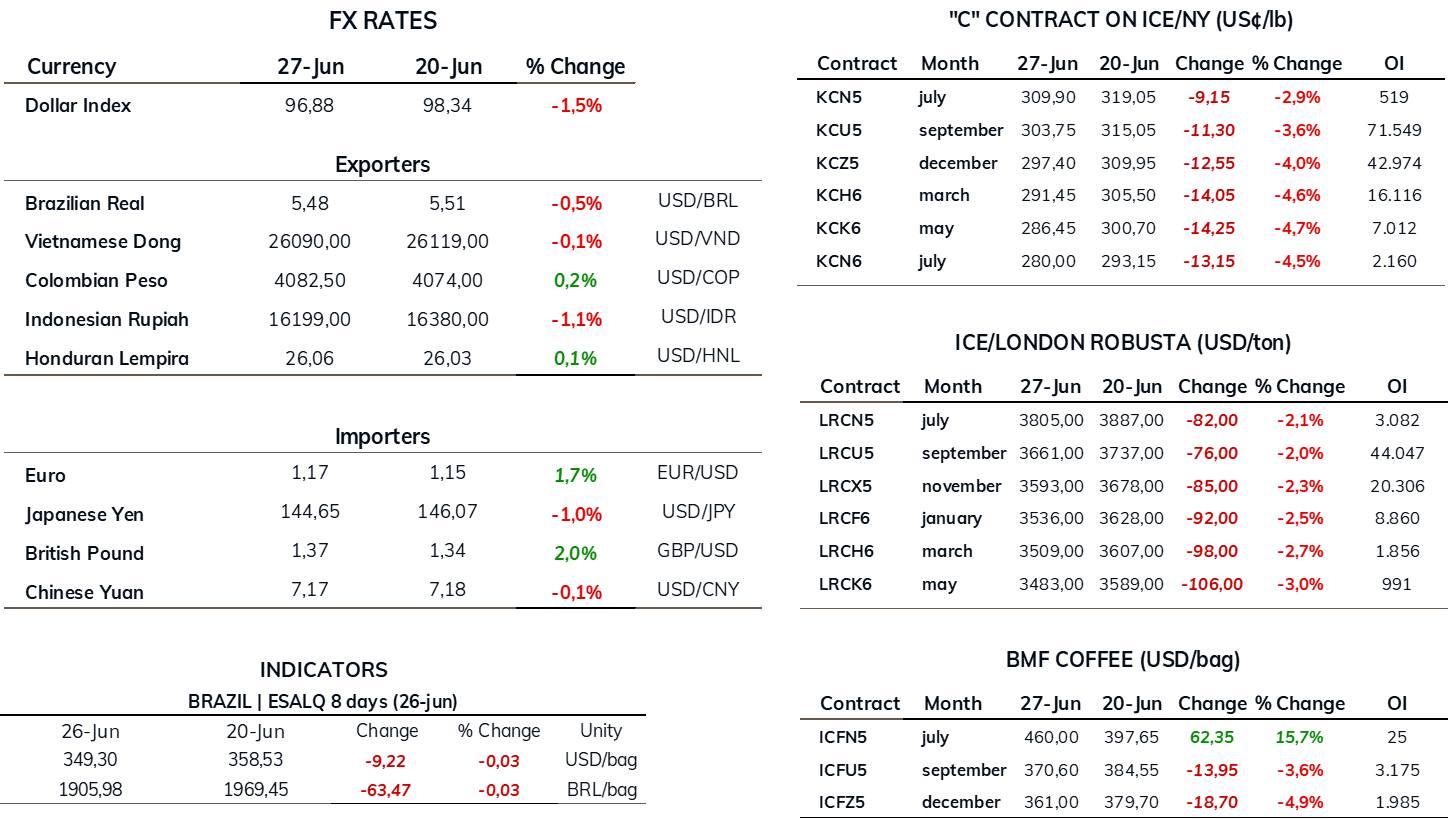
By week’s end, the most active contract in New York (September delivery) had fallen 1,113 points (-3.6%), settling at US¢ 303.75 per pound. In London, the equivalent contract also due in September dropped $76 per ton (-2%), closing at $3,661 per ton. In Brazil’s domestic market, pressure was even stronger due to a 0.5% drop in the dollar, which ended the week at R$5.48. The Cepea indicator for arabica fell 4.7%, trading just above R$1,877 per bag, while robusta declined 4.6%, trading at around R$1,114 per bag.
Arabica and robusta coffee futures prices (US¢/lb and USD/ton)
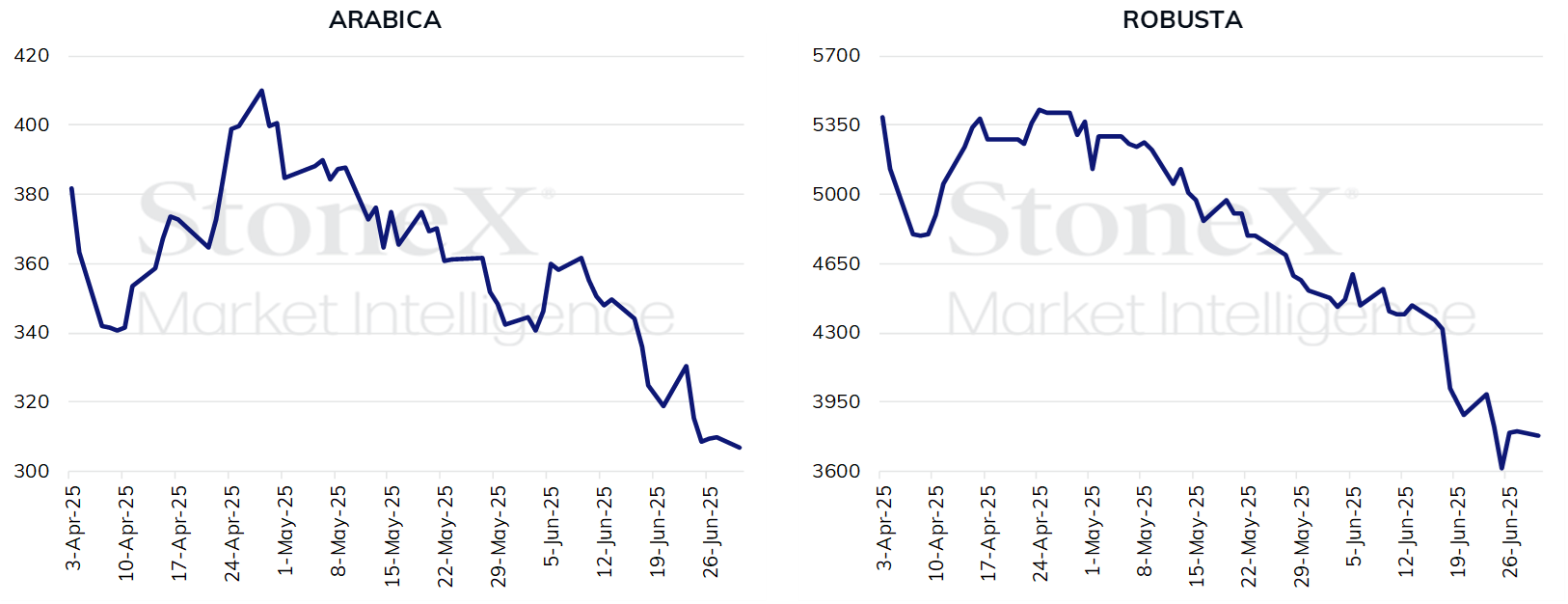
The scenario continues with an advancing harvest and weakened demand. Last week, the Brazilian Coffee Industry Association (ABIC) reported a drop of over 5% in coffee sales during the first quarter of 2025, highlighting a nearly 16% drop in April alone. On the other hand, the faster harvest pace increases supply in the domestic market, keeping prices under pressure.
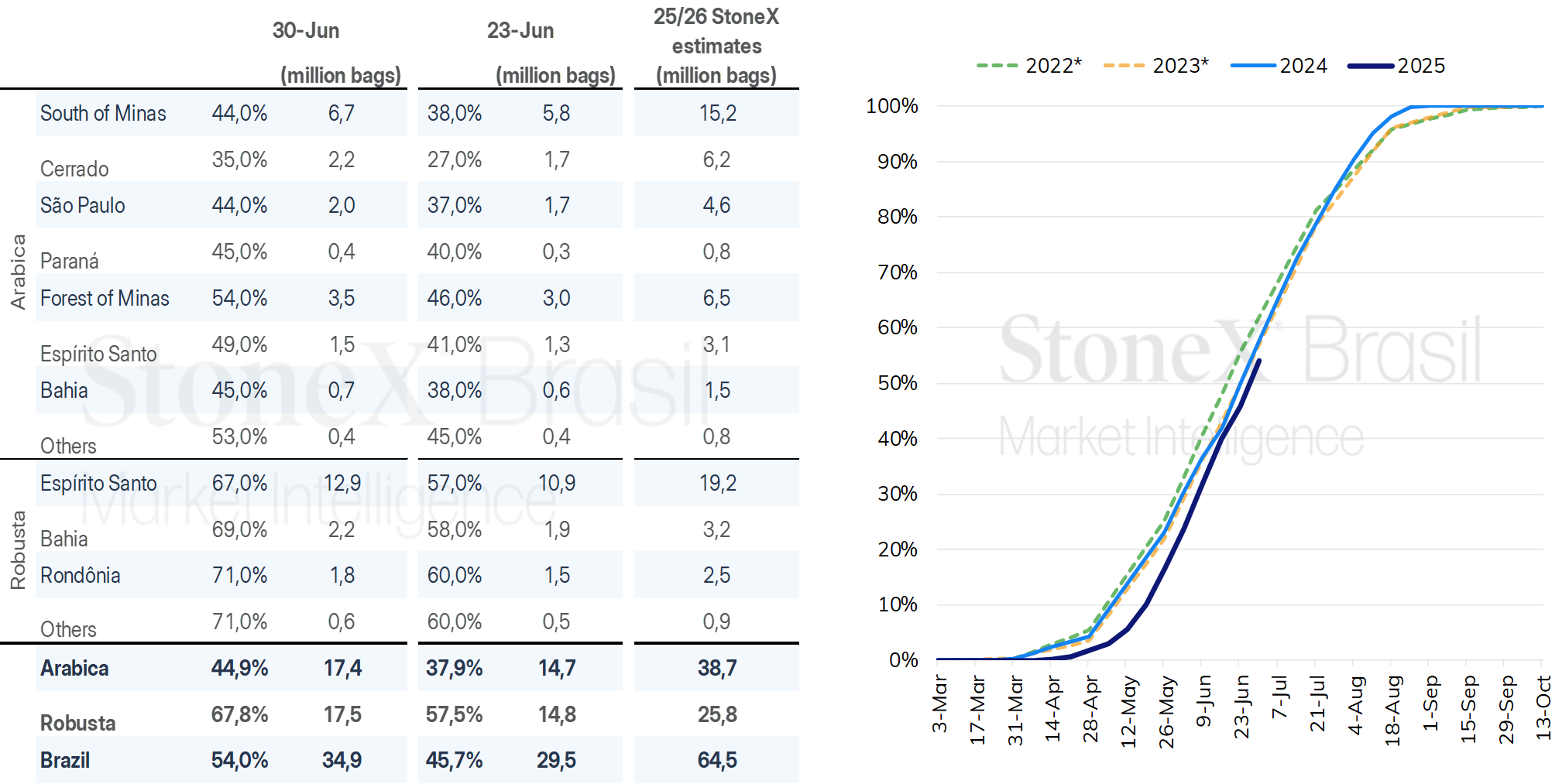
According to StoneX data, by June 30, 54% of the national crop had been harvested—nearly 35 million bags. Robusta leads, with 68% harvested (about 17.5 million bags). Arabica harvest was at 45%, or around 17.4 million bags. The expectation is for arabica to maintain an accelerated pace in July, further pressuring prices.
Coffee harvest pace in Brazil
Source: StoneX.
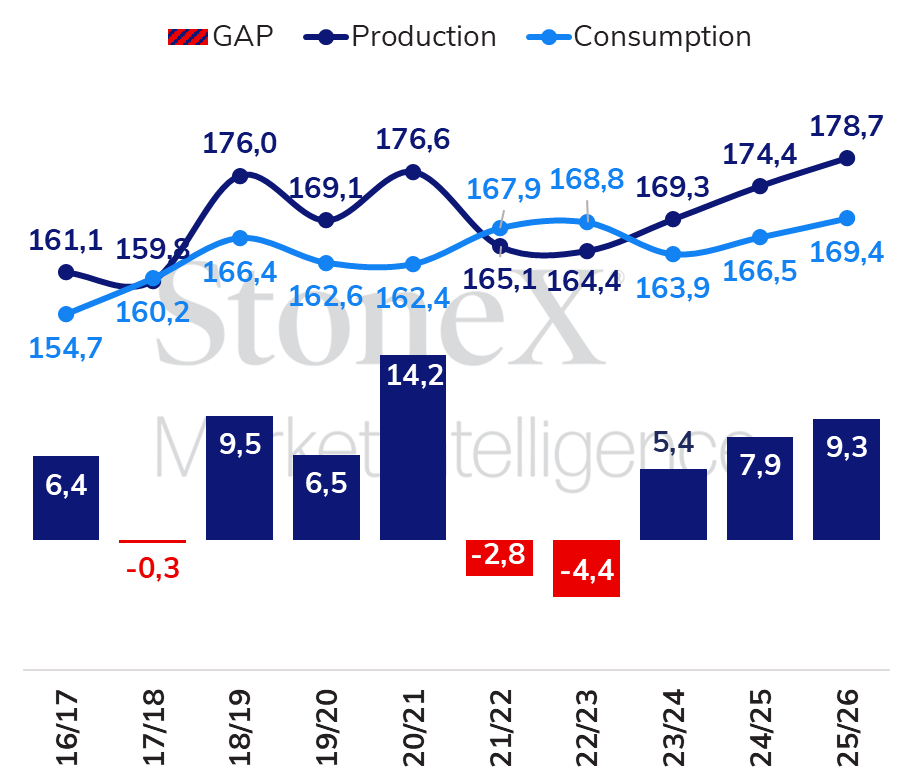
The U.S. Department of Agriculture (USDA) released its projections for the global coffee supply and demand balance for the 2025/26 cycle. According to the agency, global production is expected to grow 2.5% to 178.7 million bags, while consumption would rise 1.7% to 169.4 million bags, resulting in a surplus of 9.3 million bags. The report also mentions significant surpluses in prior years: 5.4 million in 2023/24 and 7.9 million in 2024/25.
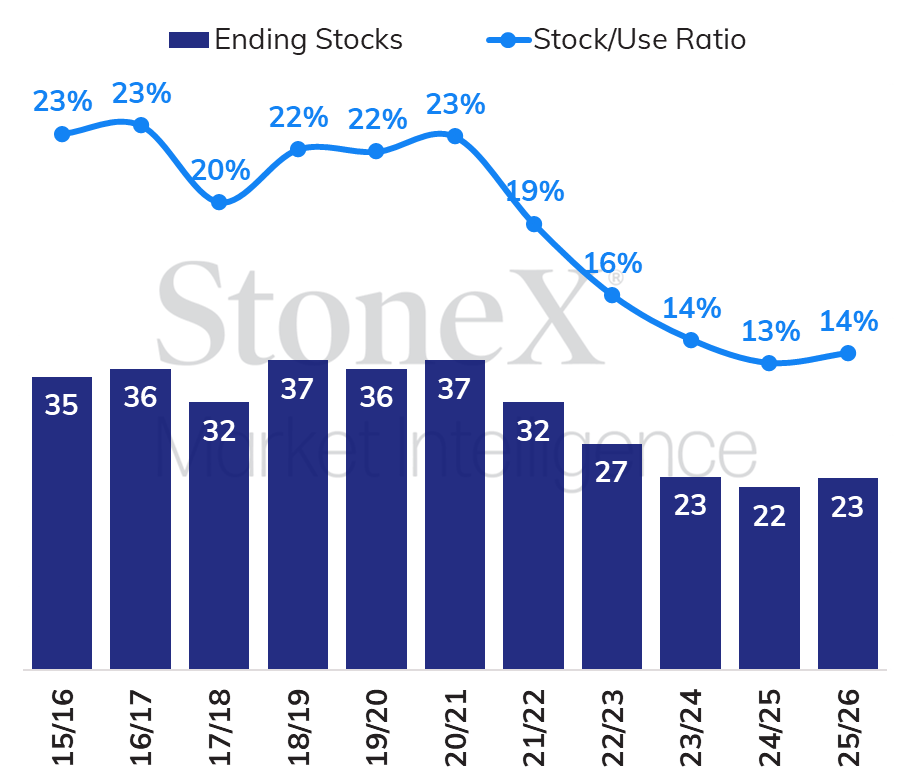
However, these figures present contradictions. Despite the stated surpluses, final stock levels didn’t rise accordingly. The same report shows stocks fell from 27 million bags in 2022/23 to 23 million in 2023/24, which contradicts the claimed surplus. In 2024/25, stocks dropped again to 22 million bags—even with an alleged 8 million surplus. For 2025/26, the report projects a 9.3 million bag surplus, but final stocks would increase by only 1 million. These inconsistencies have raised market concerns. StoneX sees a different supply-demand balance and will release its own report with global estimates soon via its intelligence portal.
USDA Global Coffee Supply & Demand (million bags)
Source: USDA. Compiled by: StoneX.
In the coming weeks, the market will continue monitoring Brazil’s harvest, which tends to further pressure prices. Concerns about the Brazilian winter also remain. Although still distant, some weather models already suggest a new cold front between July 8–10, which could rekindle fears of crop damage and support prices. Additionally, export data will remain in focus.
Preliminary figures suggest a recovery in robusta exports compared to May, though still far below 2024 levels. According to Cecafé, 202.7 thousand bags of robusta were exported in May 2025; by June 27, over 375 thousand bags had been shipped—an 85% monthly increase, yet well below the 823 thousand exported in June 2024.
As for arabica, Cecafé data show 1.43 million bags exported by June 27, compared to 2.4 million in May and nearly 2.5 million in June 2024. The current scenario signals a beginning of recovery for robusta, while arabica exports remain weak and should gain momentum in the coming weeks as harvest progresses, still at a slower pace.
INDICATORS