Quarterly Commodities Outlook is available for free now.  Download your report  →

StoneX logo

Coffee Weekly Report

By: StoneX Intelligence Brazil, StoneX Intelligence Brazil

Coffee market opens the week higher, driven by US import tariffs
 
Fernando Maximiliano
 
Translation generated by AI
Announcement of up to 50% tariffs on Brazilian imports and additional duties on other key suppliers boosts coffee prices, reignites US inflation concerns, and disrupts the global coffee supply chain

•    Coffee prices rise following US tariff announcement
•    Trump imposes 50% tariff on Brazilian coffee
•    Dollar appreciates amid macroeconomic scenario and trade tensions
•    Vietnam exports pressure robusta coffee prices
•    Accelerated harvest increases supply and pressures prices in Brazil
•    US search for new origins may raise global prices
•    Market monitors tariffs, exchange rate, exports, and weather
•    Early flowering already observed in Espírito Santo
•    Cecafé's official export data to be released tomorrow, July 15


After ending last week lower, coffee futures opened higher this Monday, reflecting the impacts of US President Donald Trump’s tariffs on Brazilian imports.

Throughout last week, the market was under pressure until Wednesday’s session, when the US president announced that he would impose tariffs on Brazilian coffee imports. From Thursday onward, this news acted as a bullish driver for prices.

On the weekly balance, the most active contract in New York, maturing in September, ended the week down 310 points, or 1.1%, closing Friday at US¢ 286.5 per pound. In London, the drop was 12.5%, down to USD 3,216 per ton.

Reflecting the macroeconomic backdrop and the tariff announcement, the dollar ended last week up 2.5%, quoted at R$ 5.56. In Monday's session, the market continued to rise, with the dollar up 0.3% to R$ 5.57.

Regarding the robusta coffee market, a factor contributing to price pressure was the surge in Vietnam’s exports in May (+107.9%) and June (+69.5%).

Coffee futures prices: Arabica (US¢/lb), Robusta (USD/ton
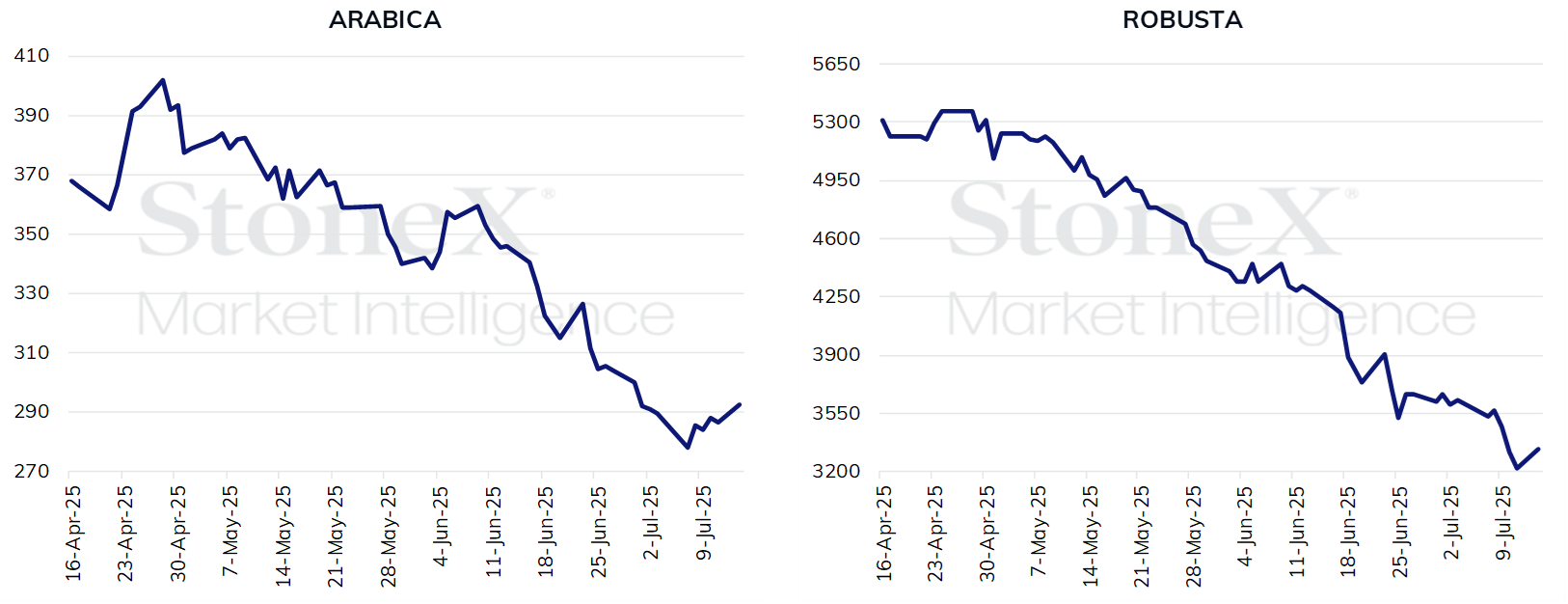
image 115817
Source: Cmdty View. Prepared by: StoneX.

In the Brazilian domestic market, the Cepea indicator for arabica coffee posted a slight drop of 0.5% to R$ 1,728.50 per bag. Meanwhile, the Cepea indicator for robusta coffee fell more sharply, by 6.8%, to R$ 1,012.75 per bag.

Pressure on coffee prices, particularly in Brazil's domestic market, is related to the harvest progress and increased coffee availability in the domestic market. As of July 14, 73.3% of the Brazilian crop had already been harvested, with robusta further along (88.8%) and arabica at 62.9%.

The faster progress of the robusta harvest increases its availability in the domestic market and contributes to price pressure. Additionally, despite the drop in Brazil's arabica production, robusta output is expected to grow nearly 22%, reaching 25.8 million bags, adding further pressure on prices.

Coffee harvest progress in Brazil
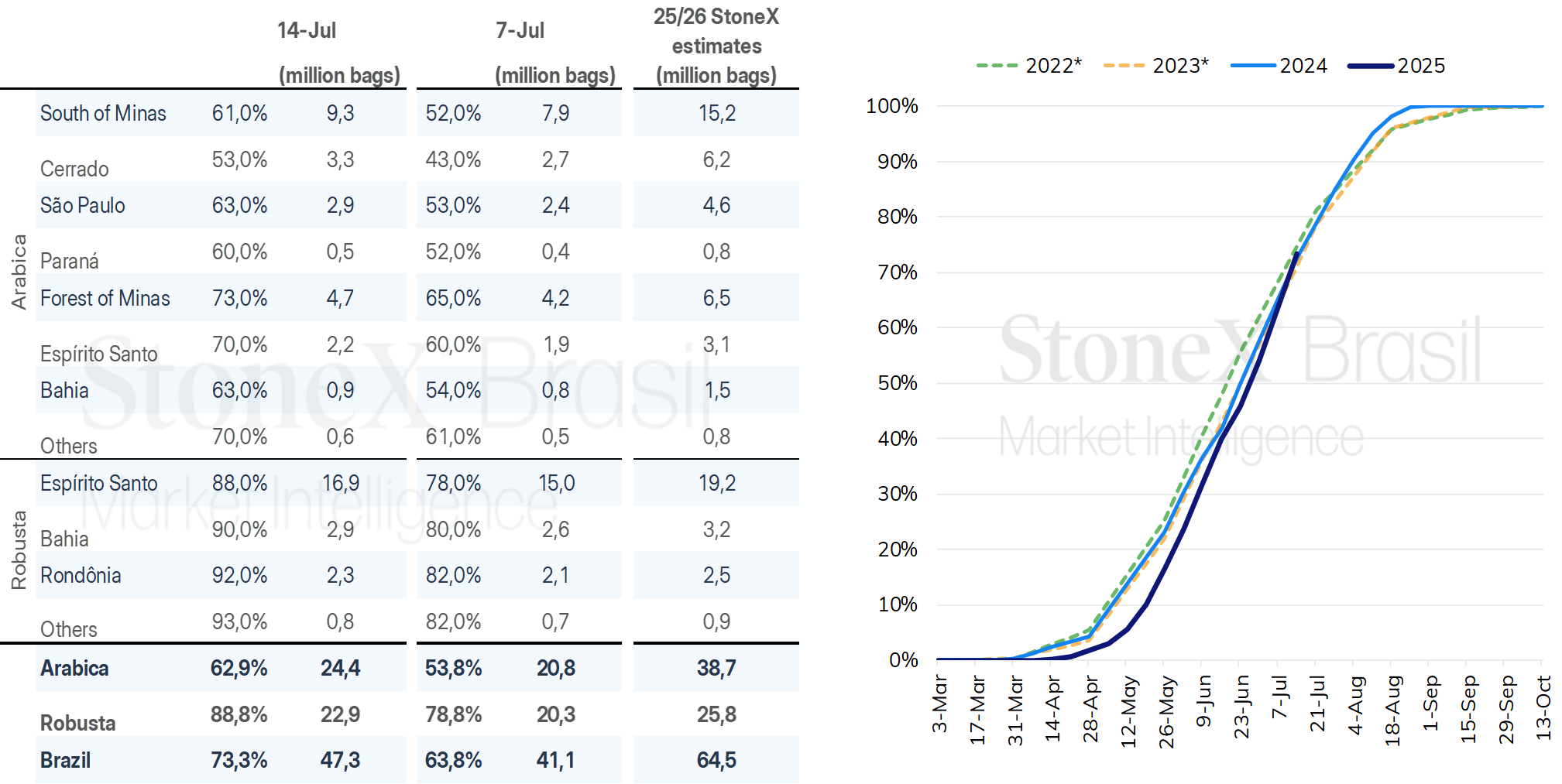
image 115818

Source: StoneX. 

The coffee market continues to react to President Donald Trump's announcement last Wednesday regarding the 50% tariff on Brazilian coffee imports. These tariffs would have a severe impact on the sector, given the strong trade relationship between Brazil and the US in the coffee market.

In 2024, more than 16% of Brazil’s coffee exports—over 8 million bags—were destined for the United States, its largest customer and the world’s biggest coffee consumer. On the American side, Brazil accounted for 34% of all US coffee imports.

If these tariffs are implemented, they would reduce the competitiveness of Brazilian exports and severely impact the American industry, which relies heavily on Brazilian coffee. Most US coffee imports are arabica, making it difficult for the country to find alternative suppliers.

To illustrate, in 2024, over 80% of US coffee imports were arabica. The second-largest global arabica producer, Colombia, produces between 12 and 13 million bags—far below Brazil’s 40 to 50 million—and already ships most of that to the US.

Thus, it would be very difficult for the US to replace Brazil as a source for its arabica demand. The American coffee industry employs over 2.2 million people and, according to NCA data, every dollar spent on imported coffee generates $43 within the domestic economy.

Besides industry, American consumers would also feel the impact, facing inflationary pressure on coffee prices, which have already been rising in recent years.

It’s worth noting that, in addition to Brazil, the US also imposed tariffs on other major suppliers: 10% on Colombia, 20% on Vietnam, 32% on Indonesia, 30% on Mexico, and 30% on the European Union. Mexico is also an important supplier of green coffee to the US, while Europe exports industrialized coffee.

These measures further increase costs for importers and the American coffee industry, which now faces pressure from multiple directions.

In practice, if these measures are actually implemented, the outlook is bullish for coffee prices in New York, as the exchange reflects the US domestic market. At the same time, the coffee that would no longer be exported to the US would pressure prices in the Brazilian market due to increased domestic supply. Meanwhile, prices in other origins could rise as US buyers seek alternatives to Brazilian coffee.

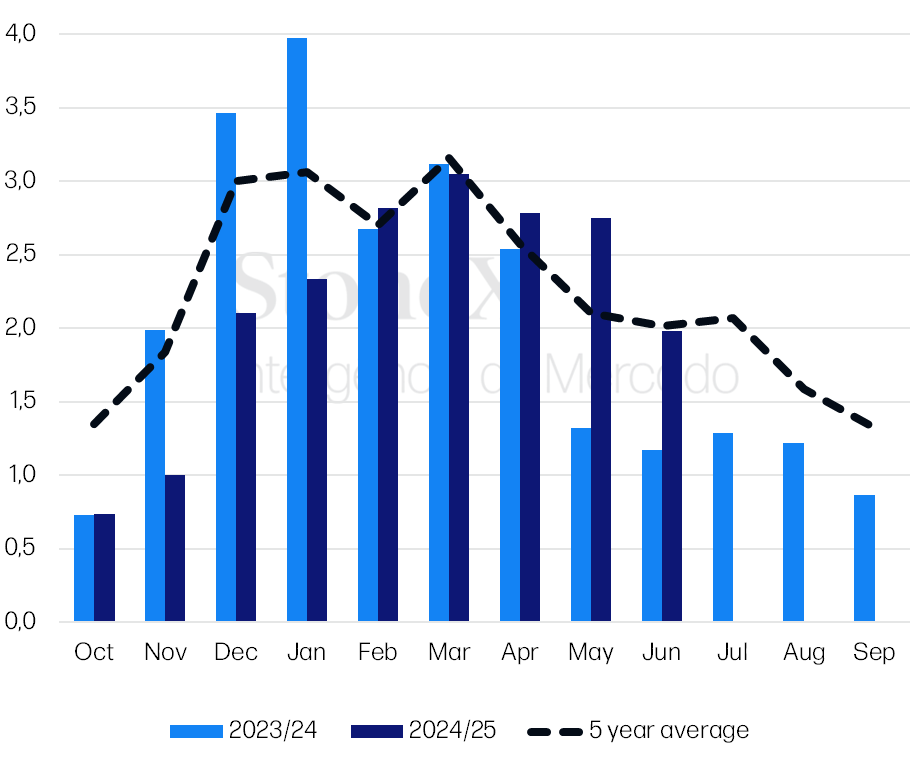
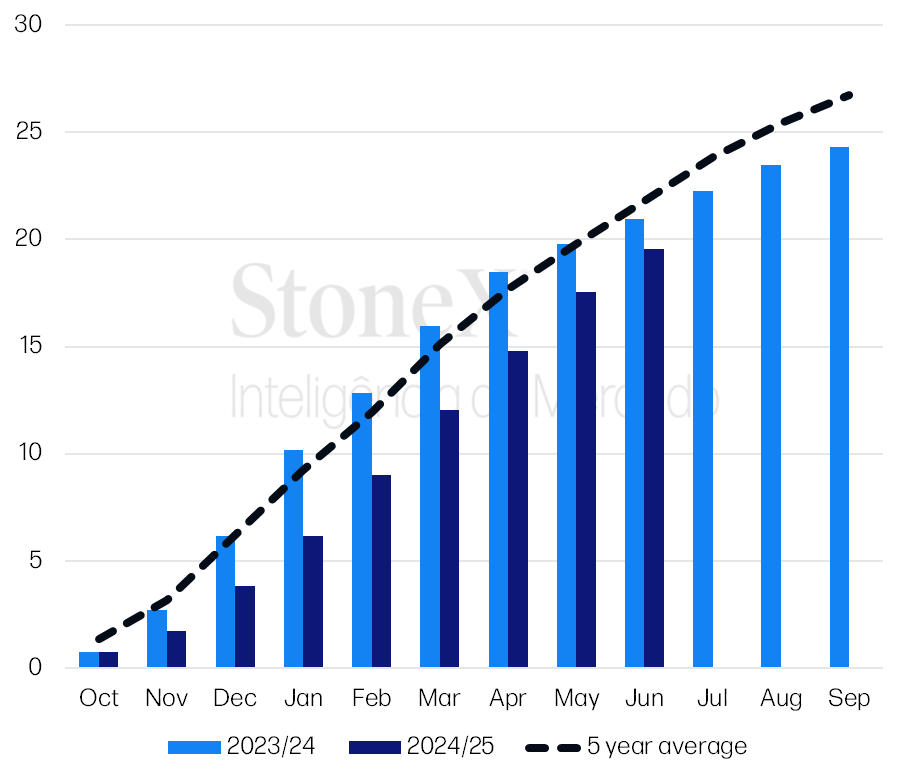
Regarding the robusta market, Vietnam—one of the world’s top exporters—has shown notable changes in export performance throughout the crop year. While early in the cycle (October to September), exports were weak, with declines of 49.7% in November, 39% in December, and 41% in January, the last few months saw a rebound, with growth of 9.8% in April, 107.9% in May, and 69.5% in June.

This export recovery in Vietnam has a bearish effect on robusta prices. However, on a cumulative basis, Vietnamese exports are still 10.3% below the average and 6.8% below the previous season.

In June, Vietnam exported 1.98 million bags, compared to 1.17 million in the same month last season. Cumulatively through June, 19.55 million bags have been exported this crop year, compared to 20.96 million at the same point in the previous season.

Vietnam coffee exports: monthly (left) and cumulative crop year (right
  • image 115819
    Source: Vietnam Customs. Prepared by StoneX.
  • image 115820

The coffee market will continue to monitor the developments surrounding the tariffs and their impacts on the trade chain, the dollar, exchange rates, and macroeconomic factors.

Attention will also be given to Brazil's official export figures, which are scheduled for release tomorrow, July 15, at 4 p.m., in a press conference held by Cecafé.

Additionally, the market is watching weather conditions. In the coming months, rainfall will be essential to ensure proper flowering in arabica regions. In Espírito Santo, rains in early July have already triggered an early flowering in robusta coffee areas.

INDICATORSimage 115821
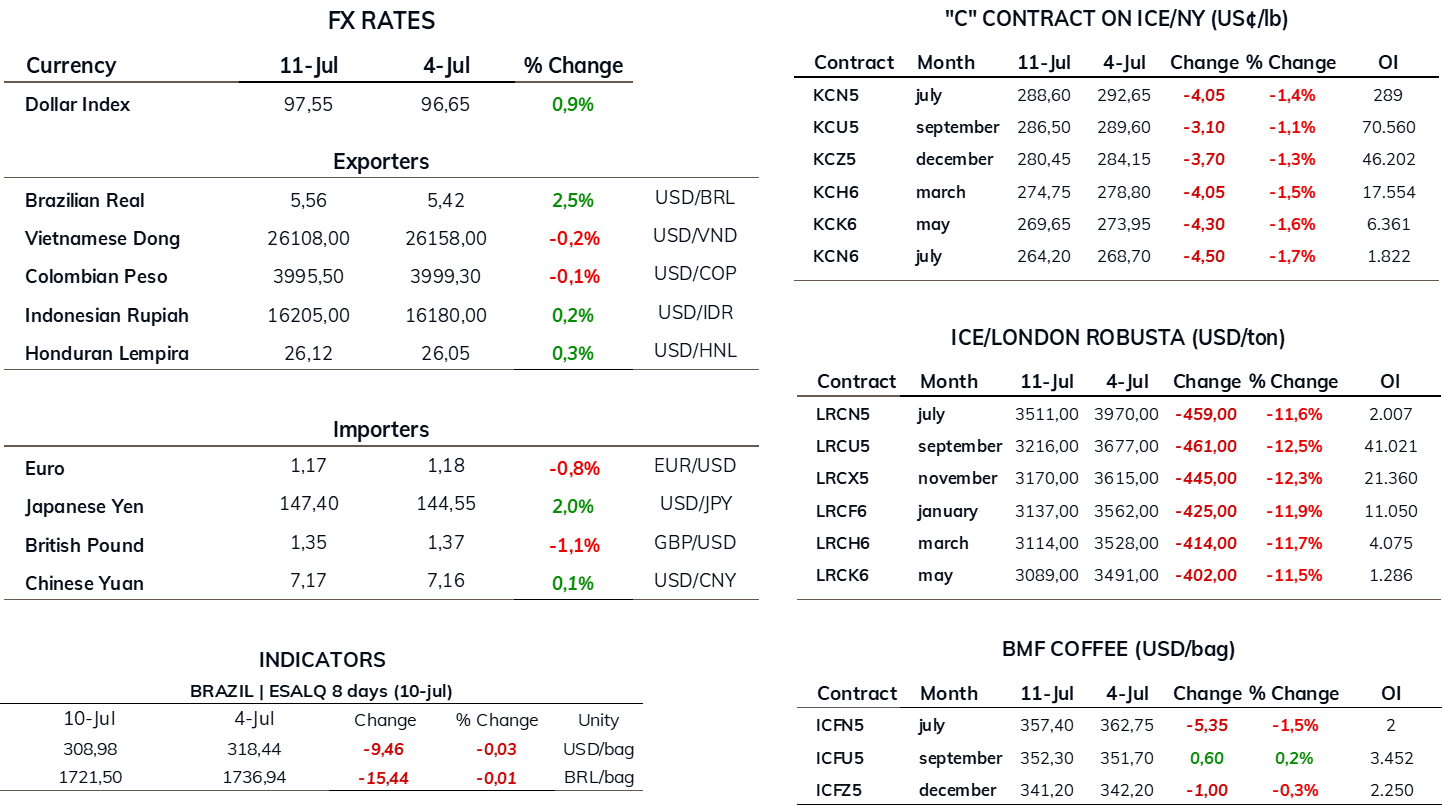
Sources: ICE/NY; ICE/EU; B3; Commodity Network Trader’s Pro.


  • Coffee

The StoneX Group Inc. group of companies provides financial services worldwide through its subsidiaries, including physical commodities, securities, exchange-traded and over-the-counter derivatives, risk management, global payments and foreign exchange products in accordance with applicable law in the jurisdictions where services are provided. References to over-the-counter (“OTC”) products or swaps are made on behalf of StoneX Markets LLC (“SXM”), a member of the National Futures Association (“NFA”) and provisionally registered with the U.S. Commodity Futures Trading Commission (“CFTC”) as a swap dealer. SXM’s products are designed only for individuals or firms who qualify under CFTC rules as an ‘Eligible Contract Participant’ (“ECP”) and who have been accepted as customers of SXM. StoneX Financial Inc. (“SFI”) is a member of FINRA/NFA/SIPC and registered with the MSRB. SFI is registered with the U.S. Securities and Exchange Commission (“SEC”) as a Broker-Dealer and with the CFTC as a Futures Commission Merchant and Commodity Trading Adviser. References to securities trading are made on behalf of the BD Division of SFI and are intended only for an audience of institutional clients as defined by FINRA Rule 4512(c). References to exchange-traded futures and options are made on behalf of the FCM Division of SFI . StoneX is a trading name of StoneX Financial Ltd (“SFL”). SFL is registered in England and Wales, Company No. 5616586. SFL is authorized and regulated by the Financial Conduct Authority [FRN 446717] to provide to professional and eligible customers including: arrangement, execution and, where required, clearing derivative transactions in exchange traded futures and options. SFL is also authorised to engage in the arrangement and execution of transactions in certain OTC products, certain securities trading, precious metals trading and payment services to eligible customers. SFL is authorised & regulated by the Financial Conduct Authority under the Payment Services Regulations 2017 for the provision of payment services. SFL is a category 1 ring-dealing member of the London Metal Exchange. In addition SFL also engages in other physically delivered commodities business and other general business activities which are unregulated and not required to be authorised by the Financial Conduct Authority. StoneX Group Inc. acts as agent for SFL in New York with respect to its payments services business. StoneX APAC Pte. Ltd. acts as agent for SFL in Singapore with respect to its payments services business. ‘StoneX’ is the trade name used by StoneX Group Inc. and all its associated entities and subsidiaries.
 
Trading swaps and over-the-counter derivatives, exchange-traded derivatives and options and securities involves substantial risk and is not suitable for all investors. Past performance of any futures or option is not indicative of future success. Indicators are not a trading system and are not published as a specific trade recommendation. The information herein is not a recommendation to trade nor investment research or an offer to buy or sell any derivative or security. It does not take into account your particular investment objectives, financial situation or needs and does not create a binding obligation on any of the StoneX group of companies to enter into any transaction with you. You are advised to perform an independent investigation of any transaction to determine whether any transaction is suitable for you. No part of this material may be copied, photocopied or duplicated in any form by any means or redistributed without the prior written consent of StoneX Group Inc.
 
© 2026 StoneX Group Inc. All Rights Reserved.

Satellite view of Earth at night showing illuminated cities across Asia and the Middle East

Discover more insights

Our subscribers have access to comprehensive market analysis from StoneX spanning commodities, equities, currencies and more.

Related articles for Coffee

Perspective: Morning Commentary for August 7

August 7 – The U.S. economy unexpectedly lost 23k jobs in July, dramatically below market expectations of an 80k increase and marking the worst Non-Farm Payrolls print since February. Furthermore, May and June were both revised sharply downward, with combined revisions showing 103k fewer jobs than previously reported. Outside of the healthcare sector, which added 22k jobs in July, the losses were very broad-based. Government payrolls saw the largest decline, shedding 53k jobs in July, the largest seen since October 2025, while June was revised down to show a loss of 10k jobs as well. The private sector at least saw growth, adding 30k jobs in July, now matching the month prior after it was revised down from the 49k initially reported, and substantially missing forecasts of 78k jobs being added. This is a sharp reversal in course from the largely better than expected U.S. labor data seen earlier this week.

Mike Castle
Mike Castle
  • Grains & Oilseeds
  • Energy
  • Dairy
  • Renewable Fuels
  • Cocoa
  • Coffee
  • Cotton
  • Sugar
  • Meats & Livestock
  • Forest Products

Daily Coffee Report 8/6/26

Daily coffee report

StoneX Coffee Team
StoneX Coffee Team
  • Coffee

Perspective: Morning Commentary for August 6

August 6 – This morning’s stronger-than-expected U.S. labor data offered markets some relief, reinforcing confidence in the economy while giving the Fed greater flexibility to raise rates should inflationary pressures reaccelerate in next week’s July data. Stock futures are pointing to a mixed open to start the day, with the tech-heavy Nasdaq showing the most weakness. The VIX has fallen notably from yesterday’s spike above 18.4 as it starts the day hovering just below the 16-mark. The dollar is quietly higher as it trades just above 99.8, holding in the tight range seen thus far this week as traders continue to digest data to shape expectations for the Fed’s next move, which we’ll dive into in more depth below. Long-term treasury yields have relaxed slightly from their recent spike, with 30-year yields starting the day trading just above 5.19%, while 10-year yields trade above 4.64%, and 2-year yields sit below 4.22%. Crude oil is modestly higher to start the session after sharp declines earlier in the week, with nearby WTI up 1.8% to trade at $76.40 and nearby Brent up 2.4% to trade at $81.40. Meanwhile, the ags are quietly mixed to start the day.

Mike Castle
Mike Castle
  • Grains & Oilseeds
  • Energy
  • Dairy
  • Renewable Fuels
  • Cocoa
  • Coffee
  • Cotton
  • Sugar
  • Meats & Livestock
  • Forest Products
StoneX: We open markets

Our market expertise, advanced platforms, global reach, culture of full transparency and commitment to our clients’ success all set us apart in the financial marketplace.

Reach

With access to 40+ derivatives exchanges, 180+ foreign exchange markets, nearly every global securities marketplace and numerous bi-lateral liquidity venues, StoneX’s digital network and deep relationships can take clients anywhere they want to go.

Transparency

As a publicly traded company meeting the highest standards of regulatory compliance in the markets we serve; our financials and record of accomplishment are matters of public record. StoneX’s commitment to “doing the right thing over the easy thing” sets us apart in the industry and helps us build respect, client trust and new partnerships.

Expertise

From our proprietary Market Intelligence platform, to “boots on the ground” expertise from award-winning traders and professionals, we connect our clients directly to actionable insights they can use to make more informed decisions and achieve their goals in the global markets.