• Harvest progress in Brazil pressures physical market prices
• U.S. tariff uncertainties remain in the spotlight
• Possible weak La Niña may impact global rainfall patterns
• Arabica coffee depends on return of rains in September
• Tight global stocks raise concerns for the 2025/26 offseason
• Tariffs may raise prices in the U.S. and affect Brazilian exports
• Market monitors weather, flowering, and U.S. trade decisions
After ending the previous week on a high, driven by President Trump’s announcement of 50% tariffs on Brazilian coffee, coffee futures prices fell last week. This movement was strongly influenced by the progress of the harvest in Brazil and ongoing uncertainties regarding the so-called American “tariff bomb.”
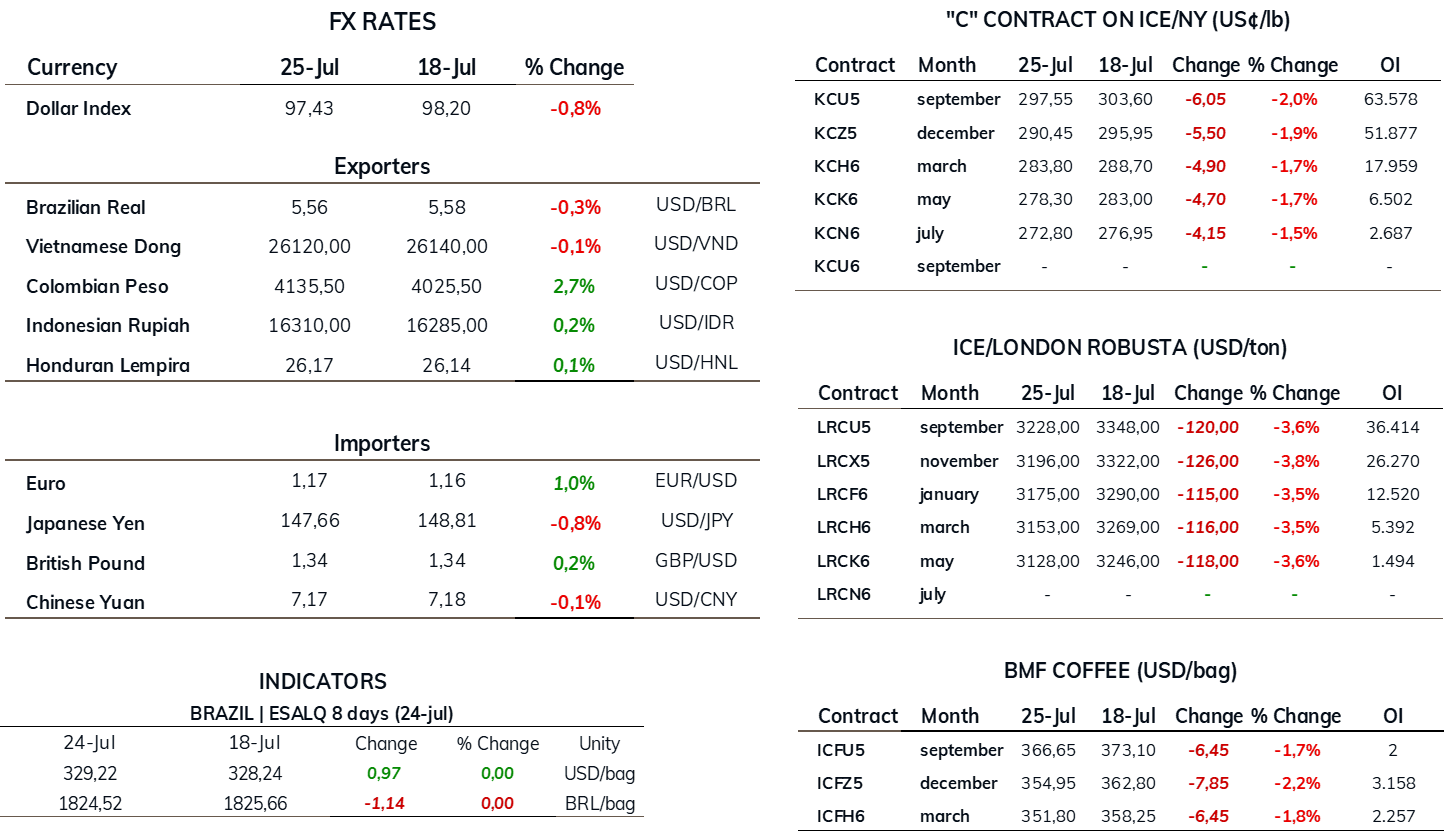
In New York, the most active contract (September maturity) fell 605 points, or 2%, closing Friday at US¢ 297.55 per pound. In London, the September contract dropped 3.6%, ending the week at USD 3,228 per metric ton. During the same period, the dollar index fell 0.8% (97.43 points), and the dollar depreciated 0.3%, quoted at BRL 5.56.
In this Monday's session, robusta coffee futures rose again, although the market still lacks a clear direction. At the time of writing, the September contract in New York was up 365 points (+1.2%), quoted at US¢ 301.20 per pound. Robusta rose USD 109 per ton (+3.38%), reaching USD 3,337 per ton.
Following the international trend, coffee prices also fell in the Brazilian domestic market. The Cepea indicator for arabica dropped 0.88%, being traded around BRL 1,810 per bag. Robusta declined 1.09%, to just over BRL 1,002 per bag. The harvest progress and increased physical coffee availability continue to pressure domestic prices.
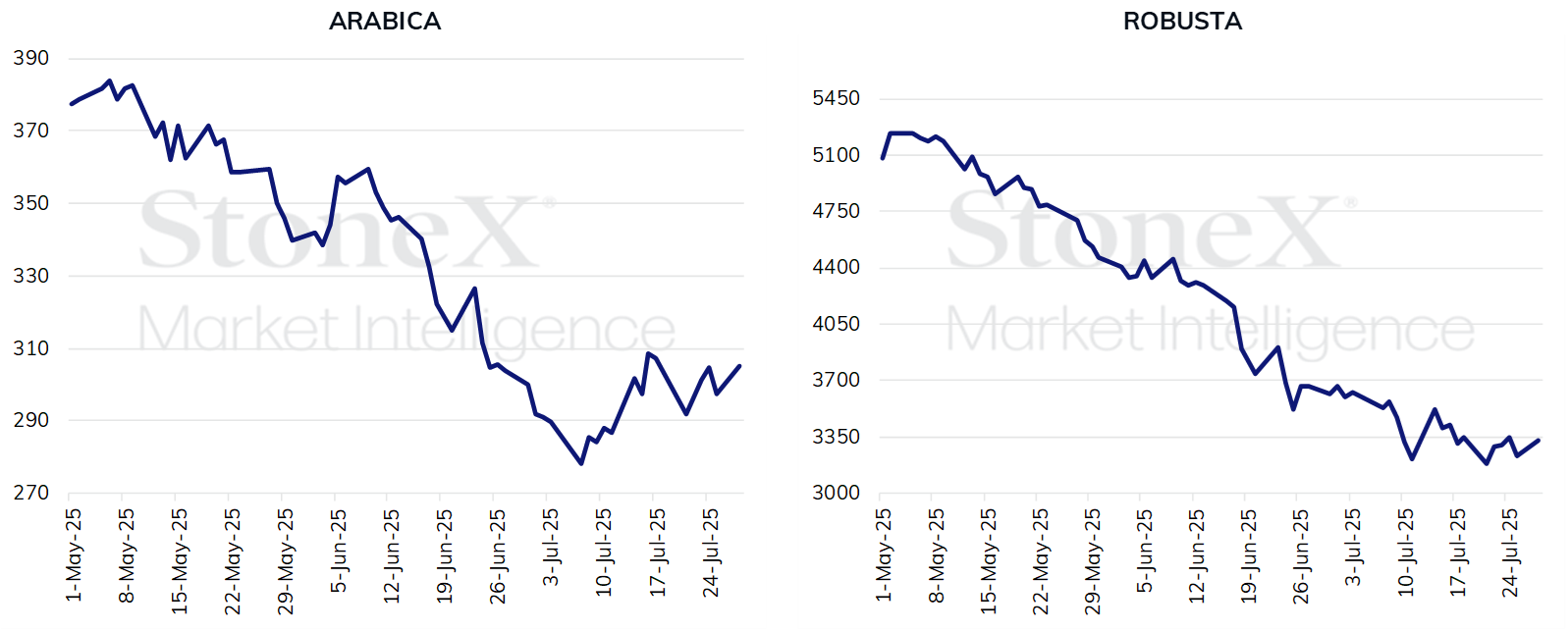
Coffee futures prices: Arabica (US¢/lb), Robusta (USD/ton
Market Fundamentals Under the Influence of Weather, Harvest Progress, and Low Stocks
The fundamentals scenario remains practically unchanged. The harvest progress in Brazil has eased short- to medium-term supply, putting pressure on prices. Additionally, there are expectations for recovery in Asian production, especially in Vietnam, reinforcing the bearish outlook.
On the other hand, there is concern about the offseason period for the 2025/26 season, as this crop is not expected to replenish global stocks. This factor acts as bullish support for prices in the medium to long term.
Weather remains one of the major factors. We are still in the Brazilian winter, and meteorological models indicate the arrival of a new polar air mass between July 30 and August 2. Despite the forecast of lower temperatures in producing regions, there is still no expectation of widespread frosts in Minas Gerais. However, this scenario requires constant monitoring.
Another point of attention is the possibility of a weak and short-lived La Niña occurring between the end of spring and the beginning of summer. Although models indicate a neutral Pacific condition, there are signs of slight cooling. This phenomenon may influence rainfall patterns in different parts of the world: increased rain in Southeast Asia and the Amazon, and drier conditions in southern Brazil. The effects are still uncertain but deserve attention. Read the report “Is La Niña Coming Back? Understand the IRI and NOAA Forecasts for 2025 and 2026.”
Expectations about the return of rains are also gaining relevance, as we enter the critical flowering period. Any delay in rainfall or temperature rise may compromise the development of arabica flowering, as occurred in 2024. Flowering has already been observed in robusta regions, which have irrigation systems.
If the weather cooperates, it may lead to widespread flowering and renewed optimism about the 2026 production potential—a bearish factor for prices. Conversely, any adverse weather during this period could have a bullish effect, reinforcing the importance of weather monitoring.
U.S. Tariffs Add a New Layer of Uncertainty
The U.S. government's announcement of possible 50% tariffs on imports from Brazil brings additional uncertainty to the market. If tariffs take effect, internal prices in Brazil are expected to come under pressure due to the redirection of unsold supply. At the same time, prices in the U.S. would tend to rise, impacting New York contracts and potentially contributing to higher consumer inflation in the U.S.
Brazilian exporters, producers, and the U.S. industry would be the main affected parties. The market is closely watching negotiation efforts aimed at convincing Washington that coffee cannot be produced in the U.S. and should therefore be exempt from these tariffs. So far, there is an expectation of tariff implementation starting August 1. This new element has the potential to distort global coffee market dynamics, affecting not only Brazil and the U.S. but also other origins that could meet American demand.
The market will remain focused mainly on the weather in Brazil and the developments in the U.S. tariff negotiations. Export data for July, expected in the coming weeks, both from Brazil and other producing countries, will also be on the radar.
Harvest Progress
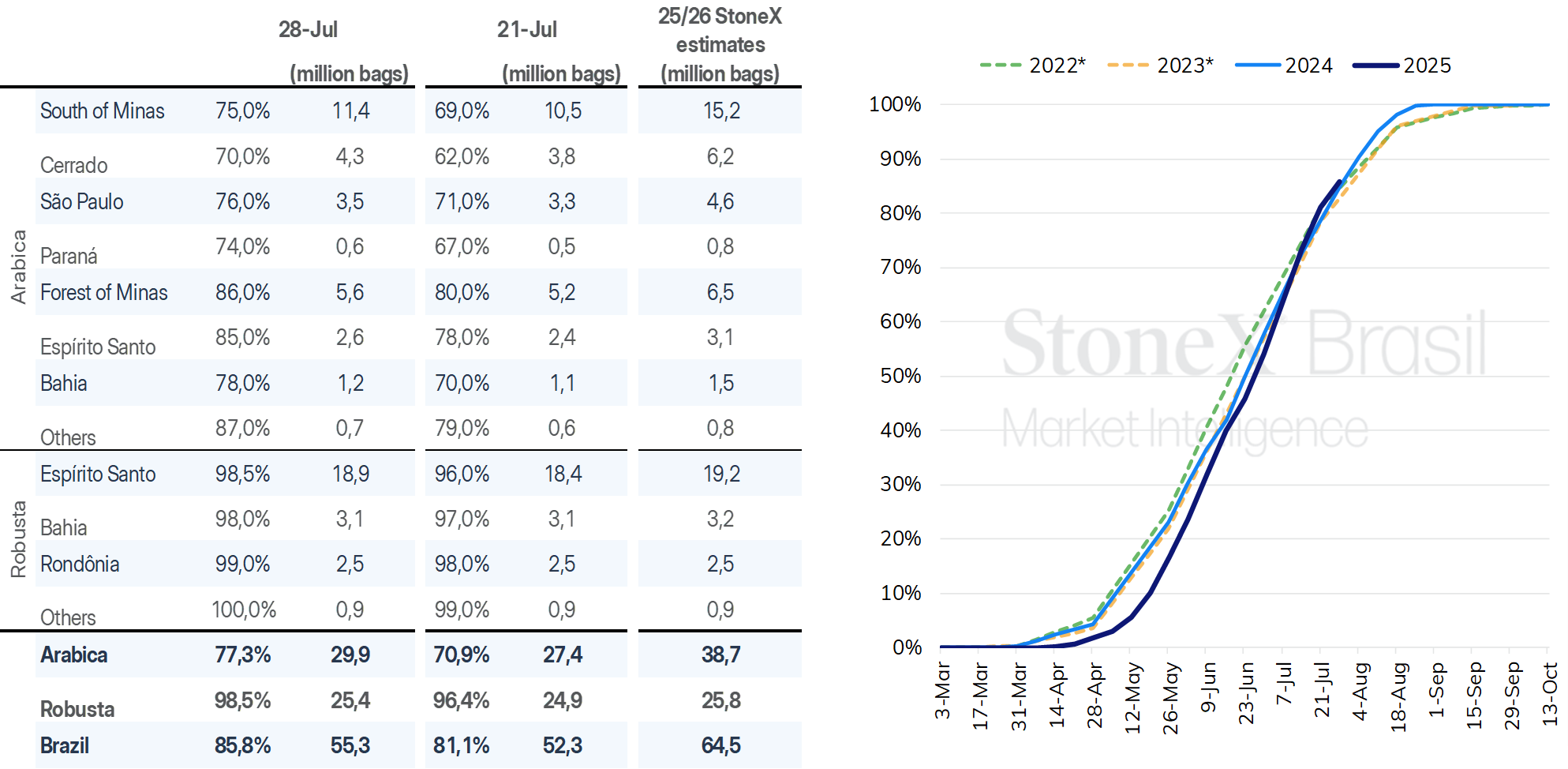
The harvest in Brazil is progressing at a strong pace, helping to alleviate the tightness observed earlier this year. According to StoneX data, as of July 28, 85.8% of the crop had been harvested, equivalent to 55.3 million bags.
The robusta harvest is practically complete (98.5%), with an estimated 25.4 million bags harvested. Arabica reached 77.3%, or 29.9 million bags. For robusta, the states of Espírito Santo, Bahia, and Rondônia have practically completed their harvest. Among arabica regions, Matas de Minas (86%) and southern Espírito Santo (85%) are leading. The Cerrado region is further behind, with 70% of the crop harvested.
Coffee harvest progress in Brazil
Source: StoneX.
INDICATORS