Coffee Futures Rise at Start of Decisive Tariff Week
Translation generated by AI
• Coffee begins the week higher amid U.S. tariff uncertainties
• Tariffs on Brazilian coffee set to begin August 6
• Sector seeks to include coffee in the list of tariff exceptions
• China authorizes 183 Brazilian companies to export coffee
• 45.7% increase in Chinese imports in June
• Brazil’s harvest reaches 89.8% of total crop
• Brazilian exports fall 29% in July vs. 2024
• 2026/27 crop depends on regular rainfall
Coffee futures rose on Monday, marking the start of a decisive week for the sector, particularly in light of uncertainties surrounding tariffs imposed by President Donald Trump on Brazilian coffee imports. In the previous week, prices showed mixed performance, reflecting precisely this instability regarding the implementation of the tariffs.
Initially, the tariffs were scheduled to take effect on August 1. During the week, an interview with the U.S. Secretary of Commerce brought optimism by mentioning that products not produced in the country, such as coffee and cocoa, could be exempt. However, the official decree—though it postponed the enforcement date to August 6 and included exceptions like orange juice, fuel, and airplanes—did not include coffee.
Therefore, under the current decree, coffee will be taxed at 50% in the U.S. Despite the exclusion, entities like Cecafé and the National Coffee Association (NCA), along with the Brazilian government, are continuing negotiations to have the product included in the exception list. The success of these negotiations remains uncertain.
As highlighted in previous editions of this report, the imposition of tariffs on Brazilian coffee tends to pressure domestic prices in Brazil downward while increasing prices in the U.S. market. This would result in higher quotations in New York and ultimately greater inflation for end consumers in the U.S.
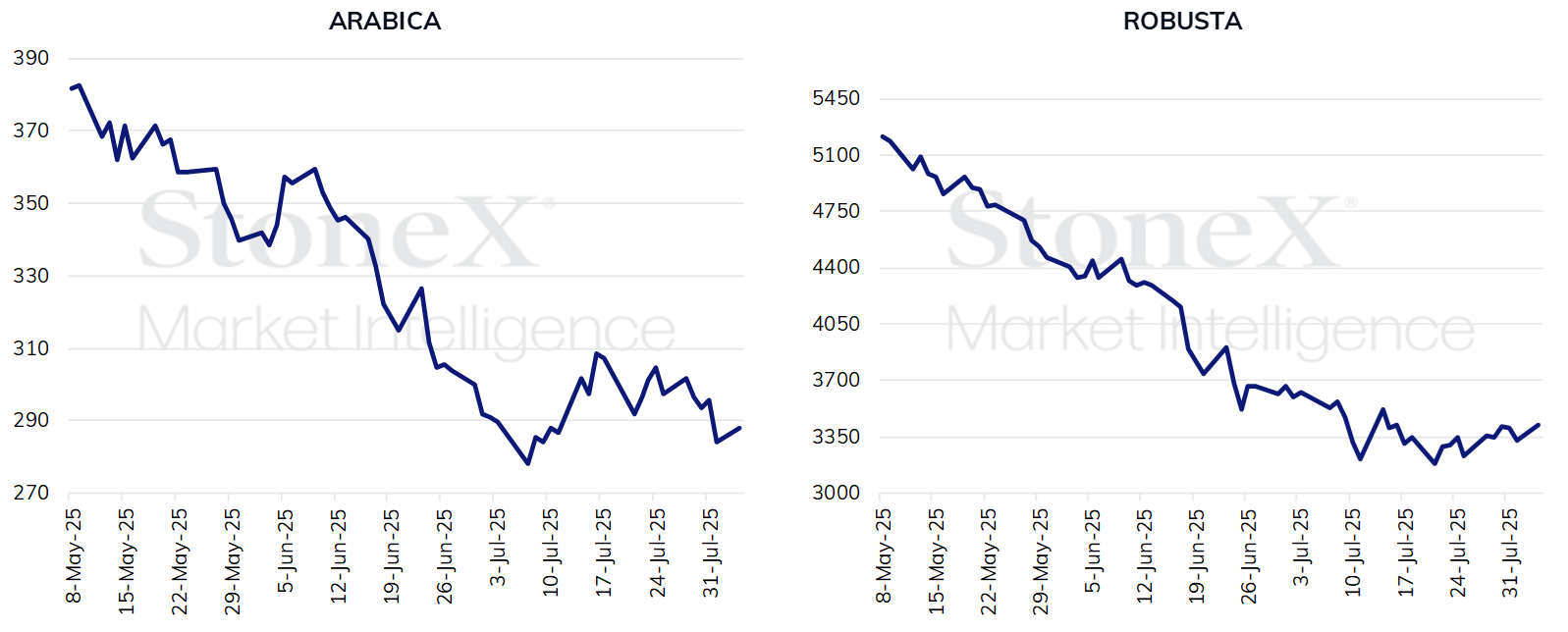
Last week, prices followed a mixed trend. In New York, the September contract dropped 1.335 points (a 4.5% decline), closing at US¢ 284.20 per pound. In London, the most active contract rose over $100 per ton, or 3.2%, reaching $3,330 per ton. In Brazil’s domestic market, performance was similar. The CEPEA indicator for arabica coffee fell 2.1%, closing just above R$1,772.00 per 60-kg bag. Meanwhile, robusta appreciated 2.7%, ending at R$1,029.60 per bag.
Coffee futures prices: Arabica (US¢/lb), Robusta (USD/ton
Source: Cmdty View. Prepared by: StoneX.
Following the U.S. announcement of tariffs on Brazilian coffee, China authorized 183 new Brazilian companies to export coffee to its market. The move signals an opening in trade by China at a strategic moment, as alternatives are being discussed for redirecting Brazilian exports should the U.S. tariffs take effect.
Although China has seen substantial coffee consumption growth in recent years, with positive future projections, the Chinese market still cannot absorb volumes equivalent to those currently imported by the U.S. For example, Chinese government data shows that in June, 439.2 thousand bags of coffee were imported—a 45.7% increase over the same month last year. However, in the first half of 2025, imports totaled 1.82 million bags, a 6.4% decrease compared to the same period in 2024.
From a fundamentals perspective, the scenario remains mostly unchanged. The progress of the harvest in Brazil has eased short- and medium-term supply pressure, negatively influencing prices. However, weather remains a crucial factor for the market.
Rainfall during the second half of the year will be key for flower bud development, directly impacting the production potential of the 2026/27 crop. Although soil moisture levels are better than in critical years such as 2021 and 2024, long-term climate models indicate sporadic, irregular, and low-volume rainfall—especially in the main arabica-producing regions: southern Minas Gerais, São Paulo, and Cerrado Mineiro. For further details on soil conditions and forecasts for August and September, refer to the Weather and Climate Weekly Report.
According to StoneX data, as of August 4, Brazil had harvested 89.8% of its crop, totaling 57.9 million bags. The robusta harvest is nearly complete (over 99%), while arabica has reached 83.5%. The regions with the most delay in arabica harvesting are Cerrado Mineiro (78%) and southern Minas Gerais (81%).
Coffee Harvest Progress in Brazil
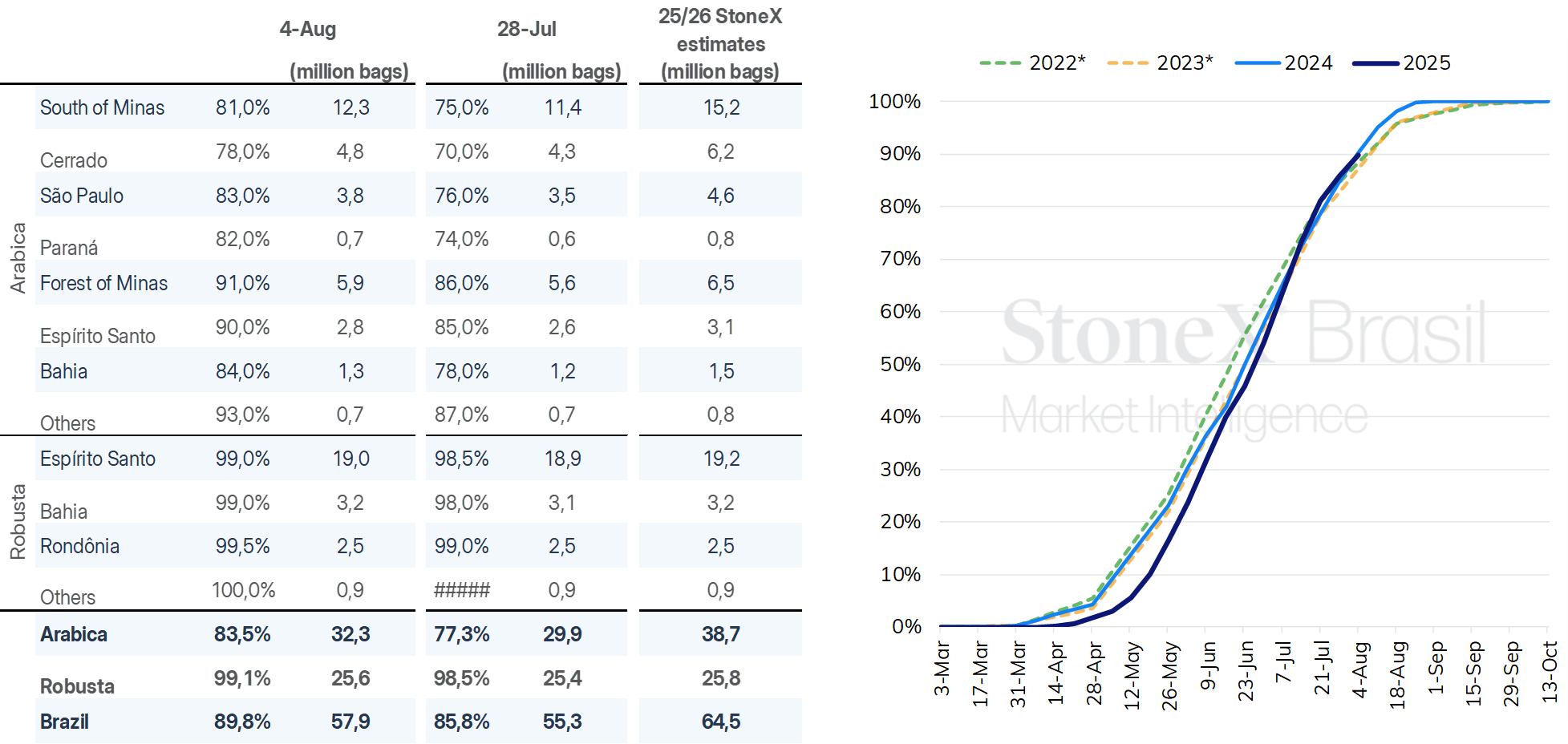
Souce: StoneX.
INDICATORS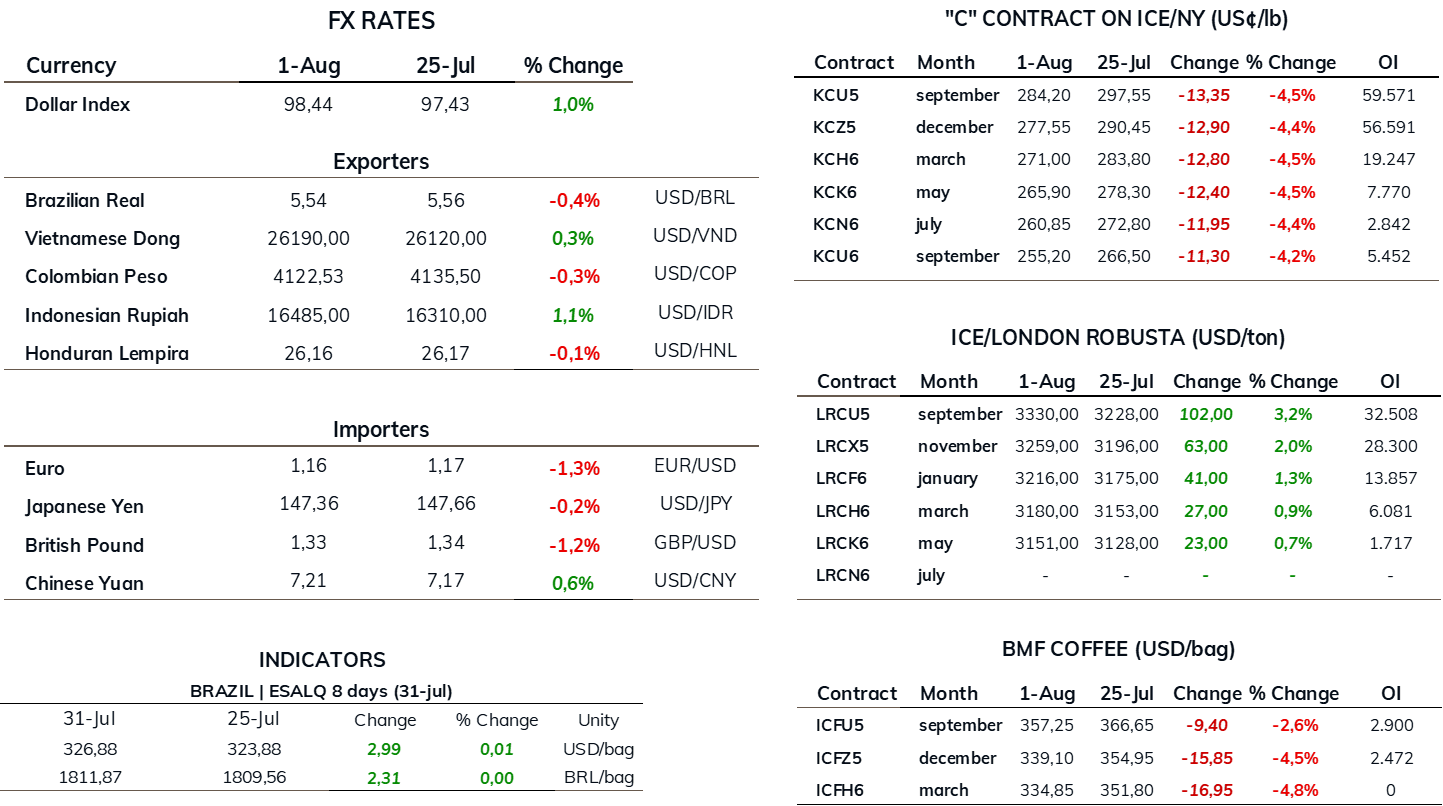
Sources: ICE/NY; ICE/EU; B3; Commodity Network Trader’s Pro.