After falling last week, coffee futures rise with the Brazilian real recovering
Translation generated by AI
• Favorable weather improves outlook for Brazil’s 2026/27 crop
• Risk of sudden drought raises concerns under La Niña influence
• Diplomatic rapprochement between Brazil and the U.S. may ease tariffs
• Brazilian exports rise more than 20% in monthly comparison
• Annual export decline reflects lower supply and U.S. tariffs
• Vietnam increases exports by 58.5% in September
Coffee prices ended last week lower, reflecting a combination of climatic and geopolitical factors. Improved rainfall prospects in Brazil and signs of diplomatic rapprochement between the Brazilian and U.S. governments generated expectations that the tariffs imposed by the United States on Brazilian coffee imports could be lifted. In addition, the escalation of trade tensions between the United States and China triggered a global risk-off movement and a stronger dollar.
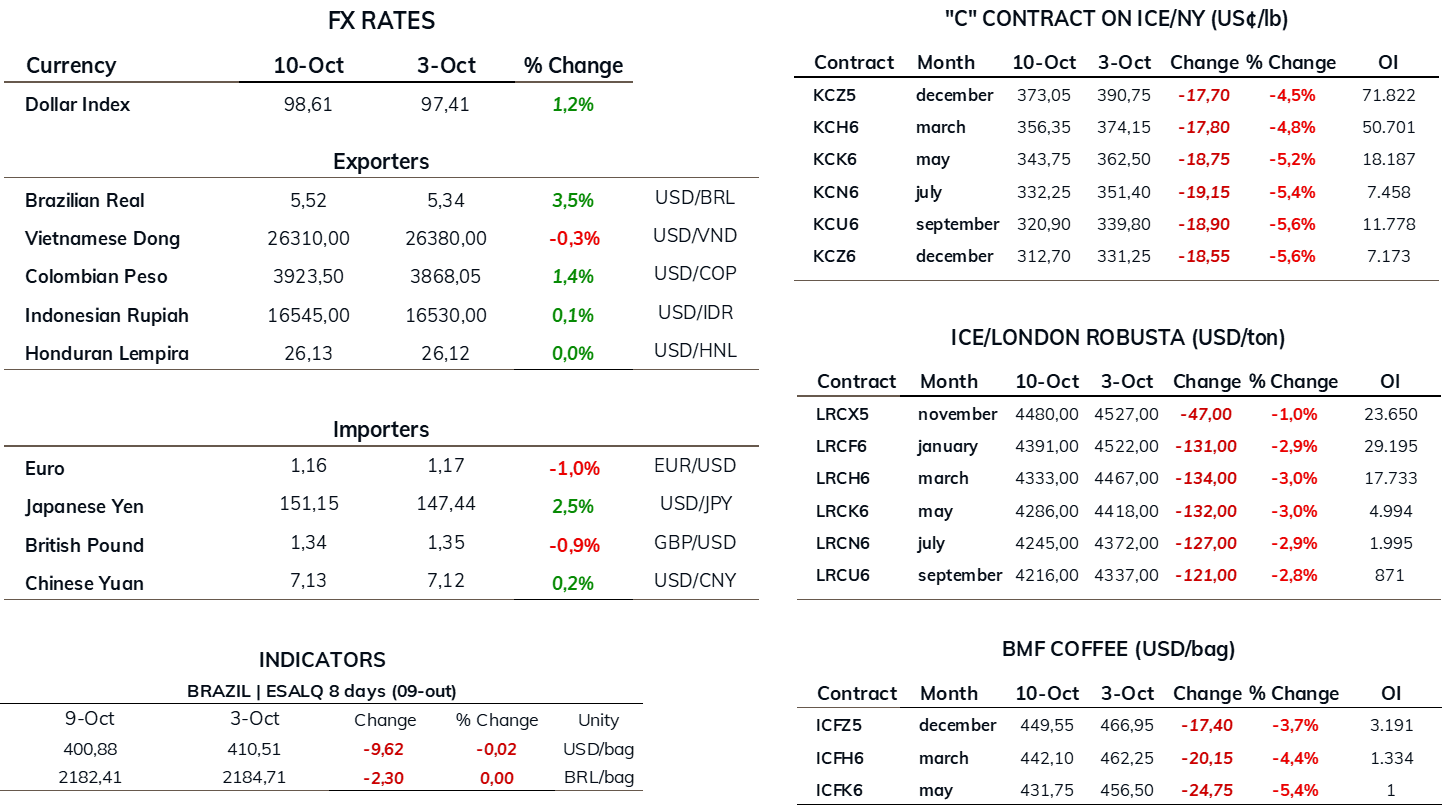
With the intensification of the trade war between the two powers, China tightened its rules for rare earth exports, while the United States threatened to impose tariffs of up to 100% on Chinese products. This scenario strengthened the dollar and negatively affected the commodities market. The DXY index, which measures the performance of the U.S. currency against a basket of developed-economy currencies, rose 1.2% to 98.61 points. The dollar also advanced 3.5% against the Brazilian real, closing the week at R$ 5.52. As mentioned in previous analyses, the appreciation of the U.S. currency tends to pressure coffee futures prices, as it discourages selling from producing countries.
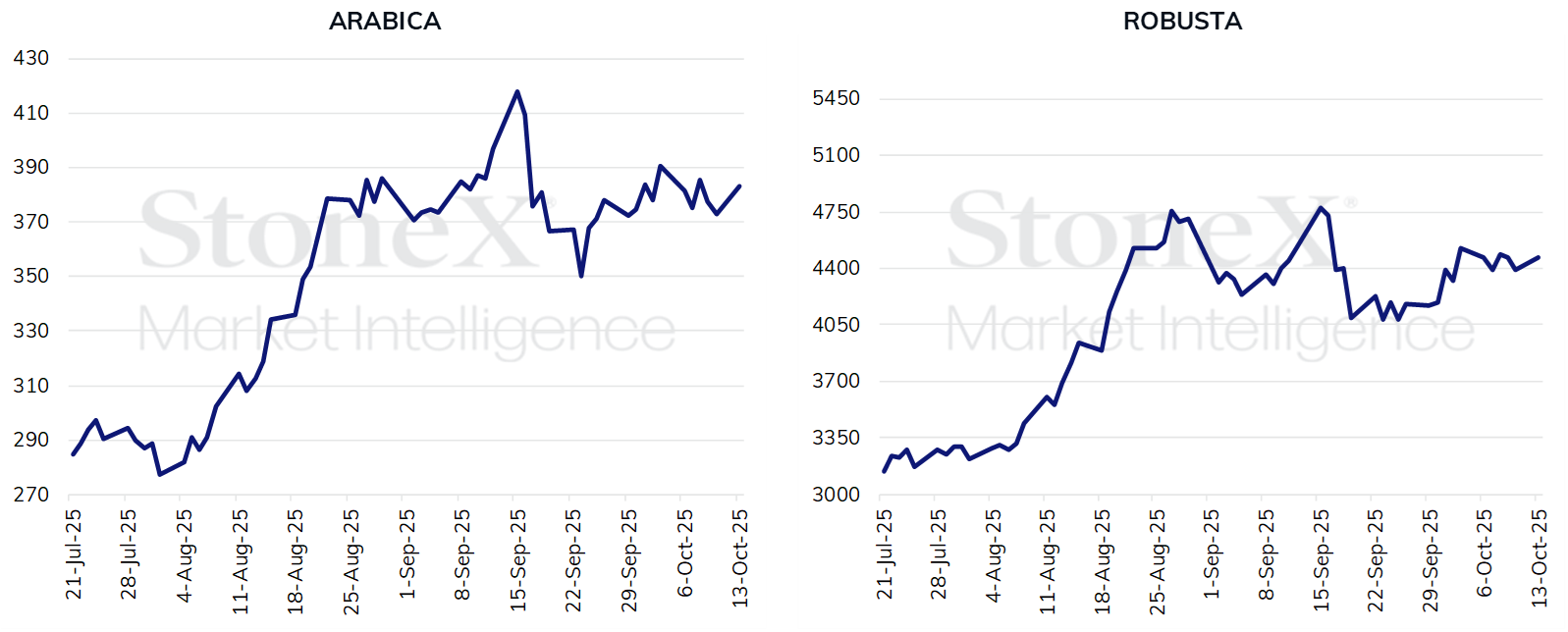
In New York, the most active contract, for December delivery, fell 1,770 points, or 4.5%, to 373.05 U.S. cents per pound. In London, the most traded contract, now for January delivery, declined by 131 dollars per metric ton, or 2.9%, to 4,391 dollars per ton.
This Monday, coffee futures closed higher, recovering part of the losses from last week. The arabica contract for December delivery gained 1,215 points, equivalent to 3.26%, closing at 385.20 U.S. cents per pound. In London, the most liquid contract, for January delivery, rose 76 dollars per ton, or 1.73%, ending the day at 4,467 dollars per ton. The upward movement was mainly driven by the dollar’s depreciation during the session. After rising 2.82% on Friday and closing at R$ 5.52, the U.S. currency retreated 1.33% this Monday, trading at R$ 5.44 at the time of writing this report.
Arabica coffee futures prices (US¢/lb) and robusta coffee (USD/ton)
Source: Cmdty View. Prepared by StoneX.
The decline observed in international markets contrasted with the mixed performance of the Brazilian domestic market over the past week. According to the Cepea indicator, arabica coffee posted a slight gain of 0.3%, closing the period at R$ 2,191.74 per 60-kg bag. Robusta coffee, on the other hand, remained practically stable, ending the week at R$ 1,388.41 per bag.
Weather conditions in Brazil continue to be a determining factor. Meteorological models point to consistent rainfall volumes in the main producing regions, which favors flowering and supports expectations for a good 2026/27 crop. Although the La Niña phenomenon is expected to persist until early next year, projections indicate meaningful precipitation that should benefit crop development. Even so, prolonged periods of drought or excessive heat could alter this scenario, keeping weather as a critical variable for prices and productivity. A relevant risk associated with La Niña is the potential occurrence of sudden drought, known as a *flash drought*, which could negatively impact crop development and compromise yield potential during key growth stages.
On the diplomatic front, the market reacted positively to the call between the U.S. president and the Brazilian president. The gesture was interpreted as a sign of a possible resolution of the tariffs imposed by the United States. U.S. Secretary of State Marco Rubio was appointed as the lead negotiator, with Brazil represented by Foreign Minister Mauro Vieira and Vice President and Industry Minister Geraldo Alckmin. This rapprochement has the potential to reduce trade barriers and, consequently, ease tariff restrictions on Brazilian coffee imports.
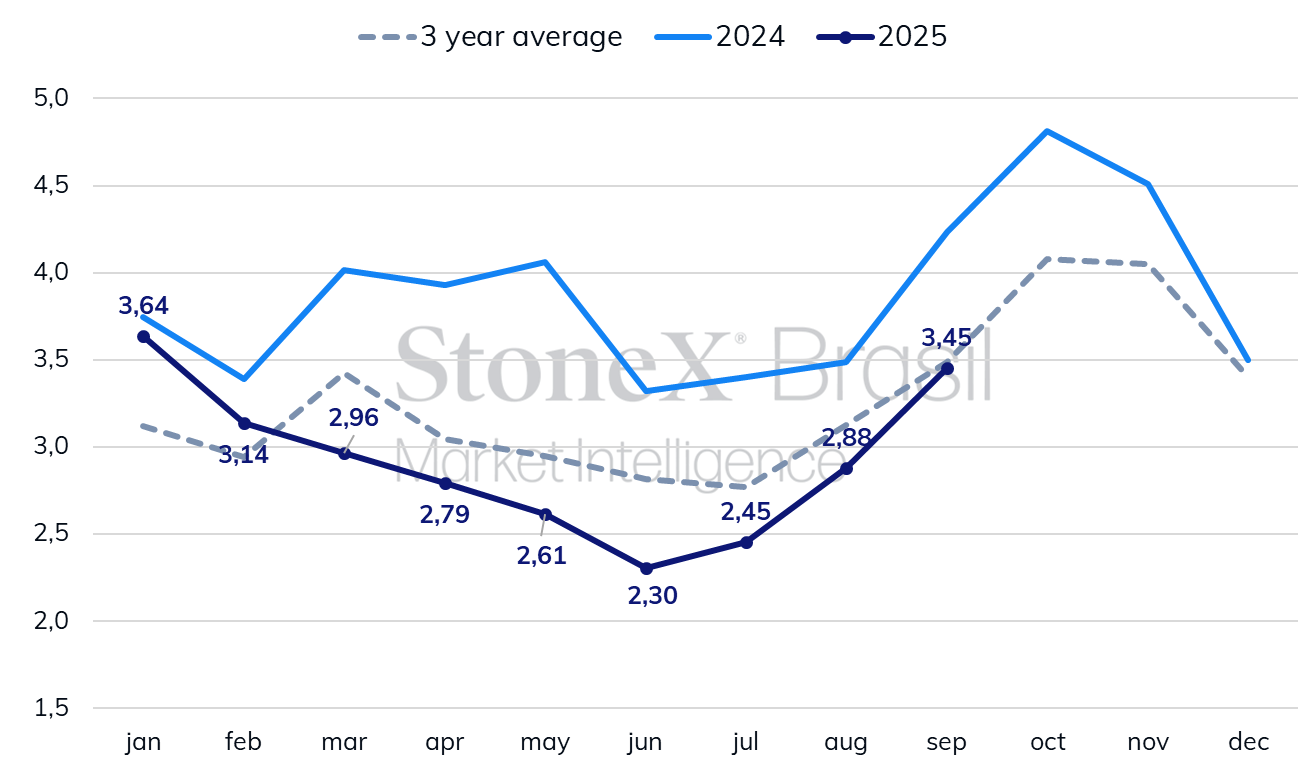
Regarding export data, the Brazilian Coffee Exporters Council (Cecafé) reported that the country exported 3.75 million bags in September, an 18.4% decline compared to the same month in 2024. Revenue, however, increased 7.6%, totaling R$ 7.35 billion. Exports of green coffee reached 3.45 million bags, of which 2.96 million were arabica (down 10%) and 489,700 were robusta (down 47.8%). Exports of processed coffee fell 19.5% to 295,500 bags.
Brazilian coffee exports (million bags)
Source: Cecafé. Prepared by StoneX.
It is important to note that, on a monthly comparison, Brazilian exports rose by more than 20%, continuing the recovery trend observed since June. This increase reflects the seasonal pattern of coffee exports, which traditionally intensify in the second half of the year as product availability grows. Thus, the volume of 3.45 million bags of green coffee exported in September aligns with the sector’s typical seasonal curve, reinforcing the gradual upward trend in Brazilian shipments over recent months.
Among export destinations, shipments to the United States plummeted by 52.8%, totaling 332,800 bags, directly reflecting the impact of tariffs. There were also declines in exports to Germany (16.9%), Italy (23%), and Belgium (52.6%). Conversely, exports to Colombia surged by 567.6%, reaching 107,280 bags, highlighting a reconfiguration of trade flows in response to restrictions imposed by the U.S. market.
Finally, data from Vietnam’s customs authority indicated exports of 1.35 million bags in September, an increase of 58.5% compared to the previous year. For the crop year to date, the country shipped just over 20 million bags, representing a 1.13% decline on an annual basis. The surge in Vietnam’s exports in September helped meet part of global demand, also contributing to the pressure on Brazilian robusta exports.
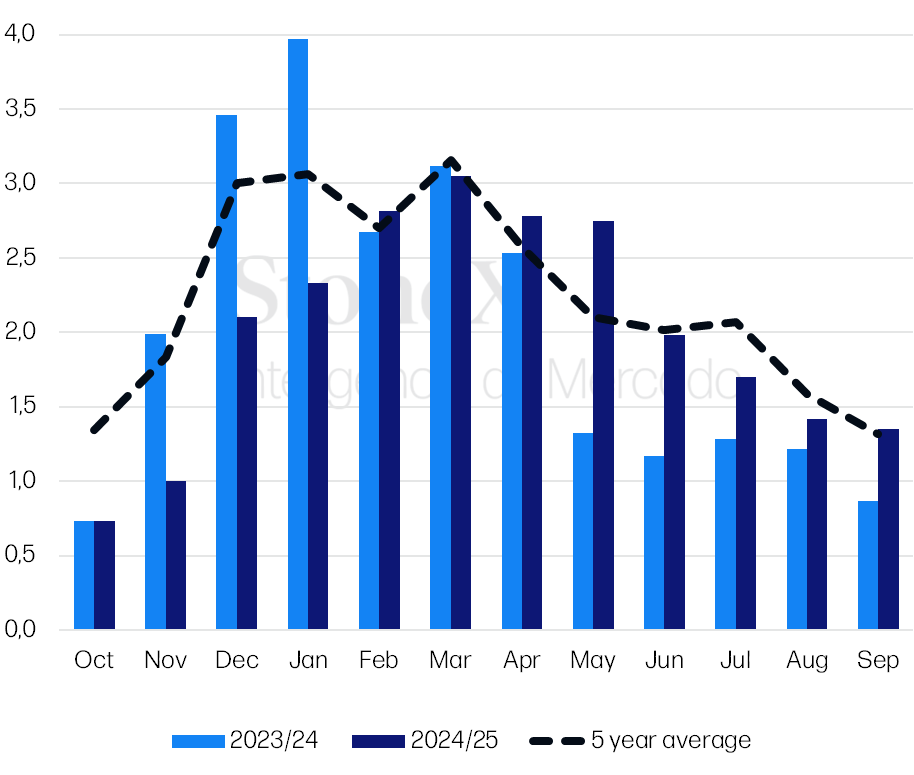
Vietnamese coffee exports (million bags
Source: Vietnam Customs. Prepared by StoneX.
INDICATORS TABLE
Sources: ICE/NY; ICE/EU; B3; Commodity Network Trader’s Pro.