Market remains volatile with tariffs, production in Brazil, and harvest in Vietnam
Translation generated by AI
• Market begins the week with mixed performance in New York and London
• Uncertainty surrounding U.S. tariffs dominates investors' focus
• Additional 40% tariff remains without official confirmation from the U.S.
• Market on alert for potential impacts on Brazilian exports
• StoneX projects a 13.5% increase in Brazil's 2026/27 crop
• Colombian production drops 10%, but stocks increase in October
• Rainfall in Vietnam challenges harvest and sustains global attention
On Monday, as this report was being prepared, the market showed mixed behavior. The March contract in New York registered a 0.6% decline, while the most active contract in London rose by 4.4%. This movement reflects uncertainties surrounding U.S. tariff policies, which continue to be the central focus in the market. Stakeholders are still analyzing the scope of changes announced by the U.S. government while simultaneously keeping an eye on the harvest developments in Vietnam and crop conditions in Brazil.
Last week, coffee futures prices retreated amidst a landscape dominated by tariff discussions and the possibility of changes to U.S. trade policies. The expectation of tariff reductions, partially confirmed on Friday, heightened volatility and led to bearish corrections in the quotations. At the same time, preliminary crop estimates also contributed to the adjustment sentiment.
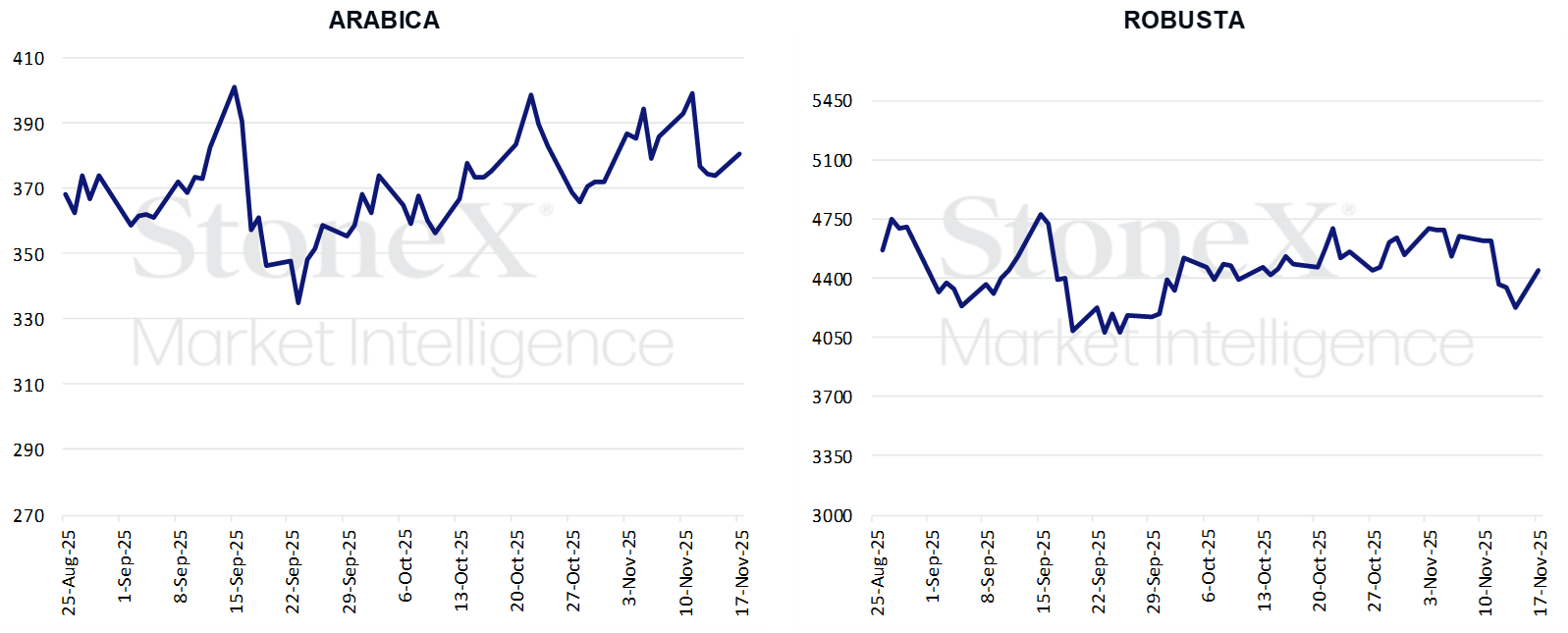
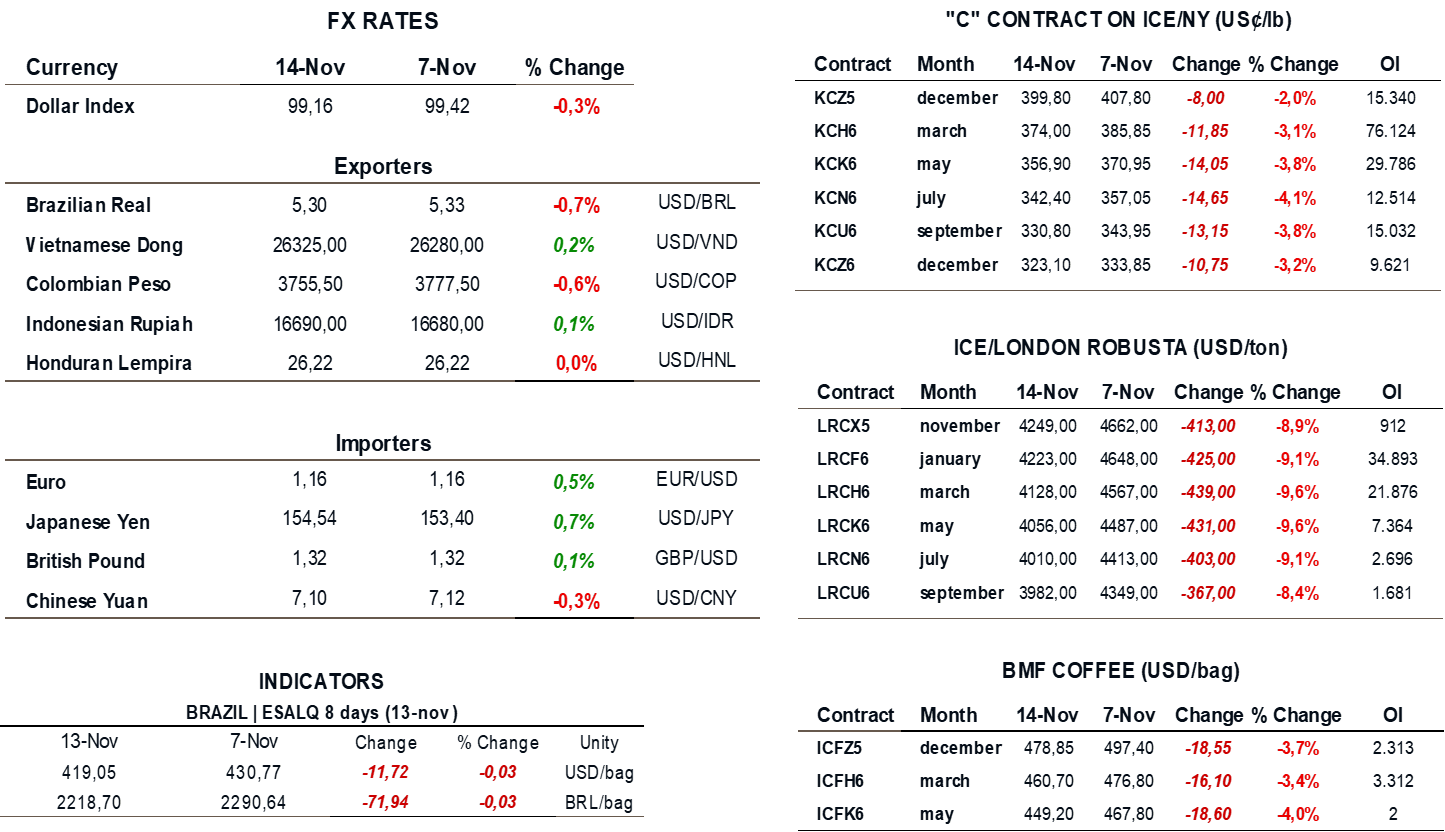
In New York, the March arabica coffee contract ended the week down 3.1%, equivalent to 1185 points, closing at US¢ 374 per pound. In London, robusta experienced a sharper decline of 9.1%, finishing at USD 4,223 per ton. Pressure on robusta was tied both to trade policies and the beginning of the harvest in Vietnam, the world's largest producer of this variety. In the Brazilian domestic market, the Cepea indicator for arabica dropped 3.8%, closing at R$ 2,204.71 per sack, while robusta fell 6.6%, priced at R$ 1,316.18 per sack.
Futures prices for arabica coffee (US¢/lb) and robusta coffee (USD/ton)
Source: Cmdty View. Prepared by: StoneX.
In October, the monthly balance was positive. New York accumulated a 3.7% appreciation, and London, 8.5%. In the Brazilian domestic market, the Cepea arabica indicator rose 3.72%, while the robusta indicator climbed 4.73%.
The primary influence on the market last week was the uncertainty surrounding tariffs imposed by the United States on Brazilian coffee. U.S. Secretary Bessent had previously hinted at an intention to eliminate tariffs on products not produced domestically, including coffee, sparking expectations of relief for Brazilian exports. However, the official announcement released later referred only to the revocation of the April measure, which had imposed a 10% tariff on Brazilian coffee, without clarifying the status of the additional 40% tariff established in August.
According to the Brazilian Coffee Exporters Council (Cecafé) and the Brazilian Specialty Coffee Association (BSCA), the change would only apply to the initial 10%, with the 40% tariff remaining in place. This lack of clarity keeps the market on edge, as the full removal of tariffs would have a bearish effect on prices, while partial maintenance tends to support prices in New York. The topic remains the primary driver of volatility.
Although tariffs dominated the headlines, the week also brought relevant production insights. StoneX released its first estimate for Brazil's 2026/27 crop, projecting a 13.5% increase in total production, expected to reach 70.7 million sacks. Arabica production is forecasted to grow by 29.3% to 47.2 million sacks, whereas robusta is anticipated to decline by 8.9% to 23.5 million sacks. The robusta drop is attributed to plant exhaustion following the strong 2025 harvest. StoneX will conduct another field survey between January and March, which may lead to revisions in its projections.
Brazil Coffee Crop Survey | 1st estimate for 2026/27
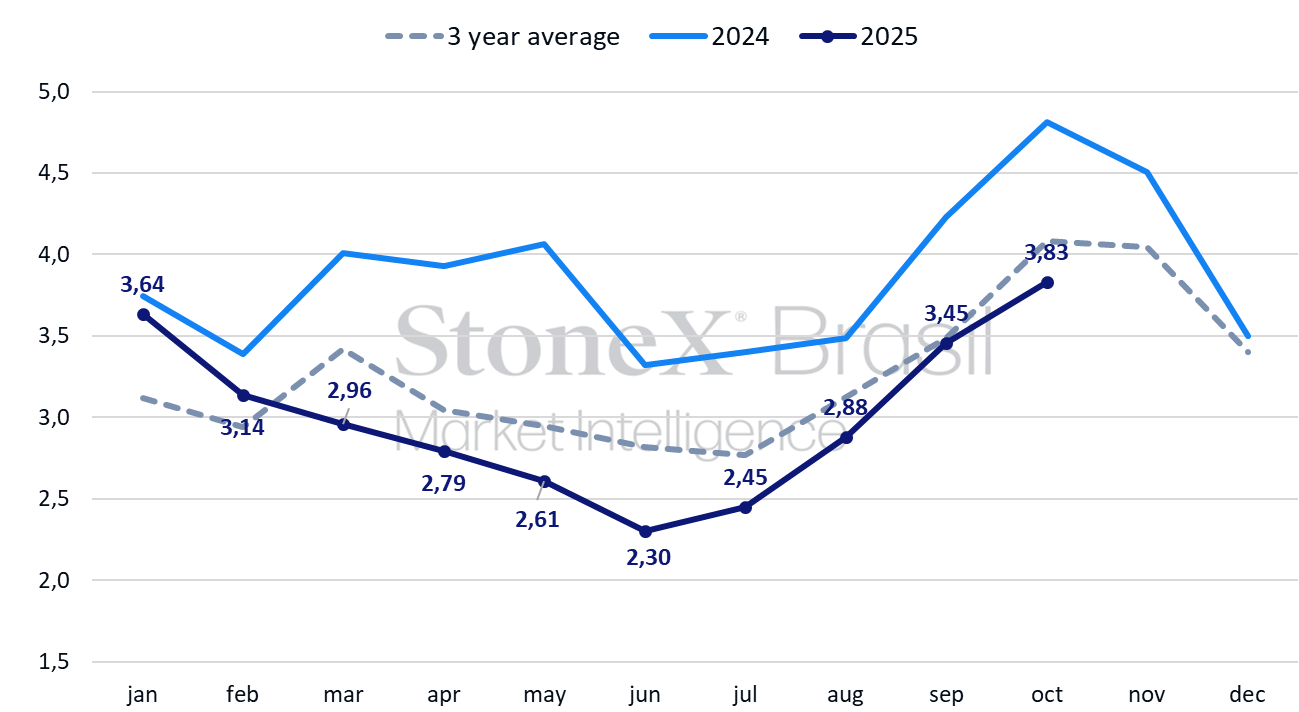
In Colombia, October production amounted to 1.2 million sacks, a 10% drop compared to the same month in 2024, but a 5.7% increase from September. Colombian stocks rose 16% month-over-month, reaching 1.154 million sacks. Meanwhile, in Brazil, Cecafé reported that exports totaled 4.14 million sacks in October, a 20% decline compared to 2024. Despite the decrease in exported volume, revenue grew 7.8%, reaching R$ 8.9 billion. Robusta exports fell 52% to 446.6 thousand sacks, while arabica exports declined 12.9% to 3.38 million sacks. Sales of processed coffee also dropped 14.4% to 309.4 thousand sacks. Exports to the U.S. decreased by 54.4%, and to Germany by 54.9%, while exports to Italy (14.8%), Japan (47%), China (176.4%), and Colombia (308.4%) increased.
Brazilian raw coffee exports (millions of sacks)
Source: Cecafé. Prepared by: StoneX.
The market remains highly sensitive to tariff decisions but also monitors the progress of the harvest in Vietnam, the world's second-largest coffee producer and the leading robusta supplier. After experiencing heavy rainfall in recent weeks, with accumulations of up to 600 millimeters in 15 days, precipitation has decreased to around 200 millimeters over the last 14 days. Forecasts suggest new volumes could reach 300 millimeters in the next two weeks in coffee-growing regions. Monitoring this harvest is crucial, as the country plays a key role in balancing global supply. The U.S. Department of Agriculture (USDA) projects a roughly 7% increase in Vietnamese production this season, reinforcing its potential recovery after years of climate-related impacts.
Thus, the coffee market continues to reflect volatility driven by a combination of political, production, and climate factors. Uncertainties surrounding tariffs remain the main focus, while stakeholders closely observe Brazil's crop developments and Vietnam's harvest progress.
INDICATOR TABLE
Sources: ICE/NY; ICE/EU; B3; Commodity Network Trader’s Pro.