Amid High Volatility, Coffee Prices Show Mixed Results
Translation generated by AI
• Strong volatility dominates the international coffee market
• New York retreats after U.S. lifts tariffs on Brazilian coffee
• London advances amid heavy rains in Vietnam
• Arabica prices drop 1% while robusta rises 2.4% in Brazil
• Excessive rainfall in Vietnam delays harvest and logistics
• Market remains volatile, with focus on weather and exports
Coffee prices have been navigating through a period of intense volatility, driven by a mix of bullish and bearish factors. Last week, international markets moved in opposite directions. In New York, prices were pressured by the announcement of the removal of tariffs on Brazilian coffee, while in London, heavy rains in Vietnam supported upward momentum.
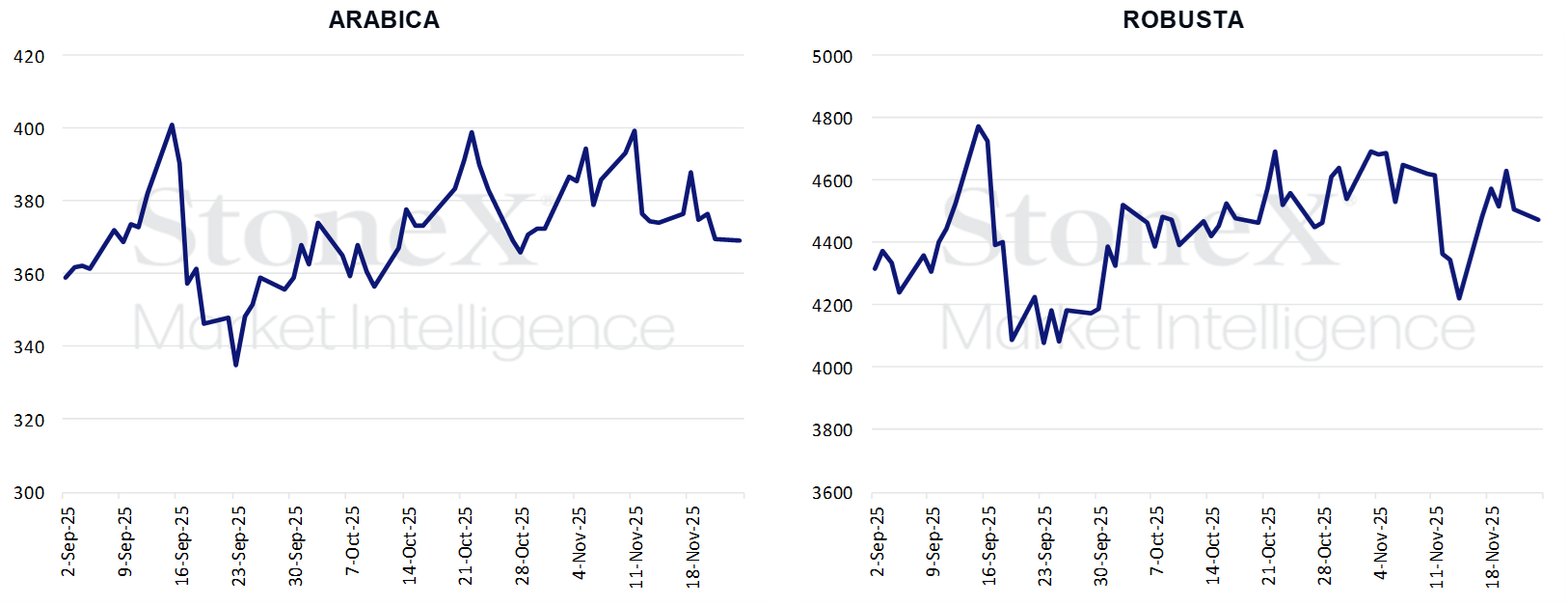
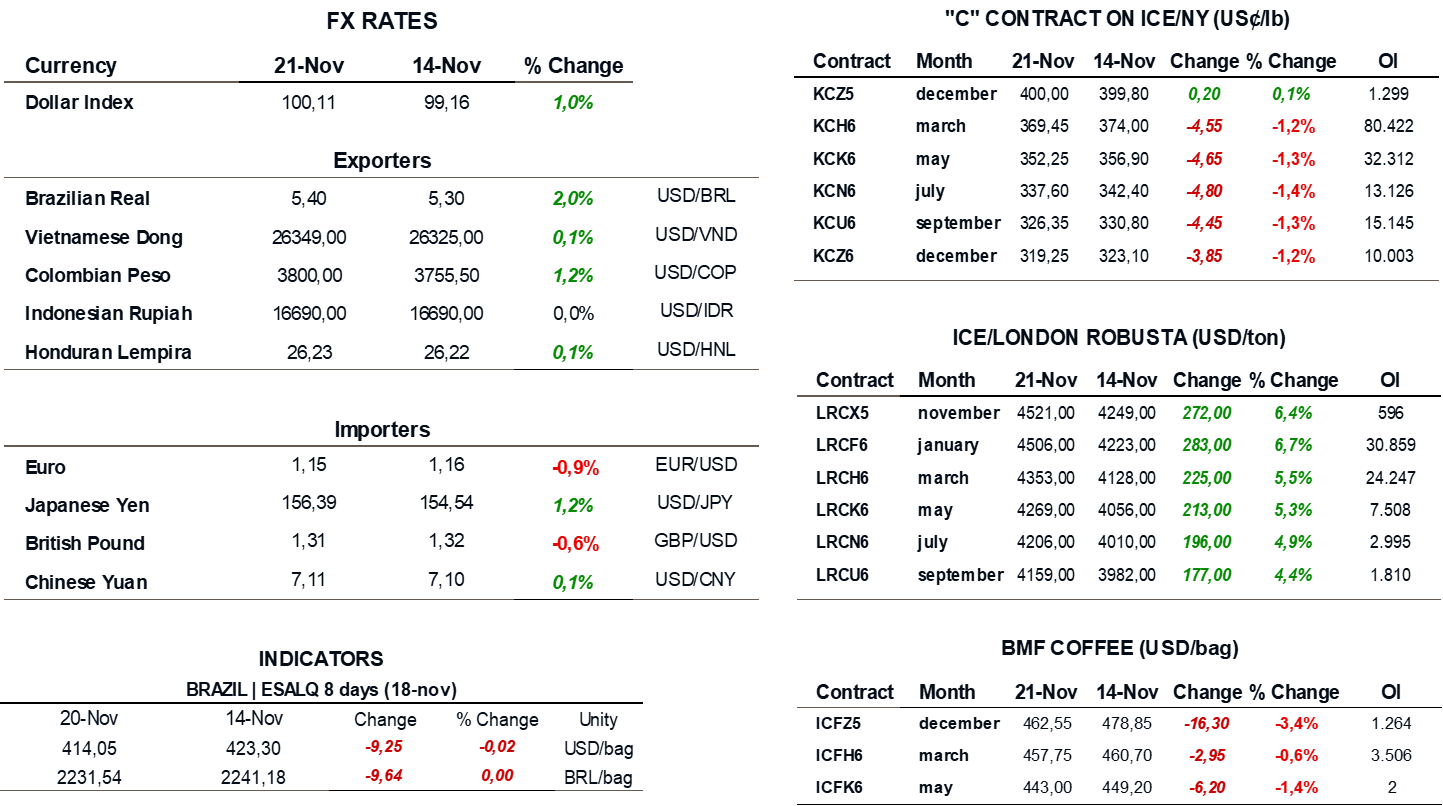
The most active March contract in New York closed the week down 1.2%, priced at US¢ 369.45 per pound. Meanwhile, in London, the equivalent contract gained 6.7%, reaching USD 4,506 per ton. On the currency front, the dollar strengthened 2% against the Brazilian real, ending the week at 5.40 reais. In the domestic market, prices mirrored external fluctuations. The CEPEA indicator for arabica coffee dropped 1% to R$ 2,181.70 per bag, while robusta rose 2.4%, reaching R$ 1,347.28 per bag.
On Monday’s trading session, the mixed trend persisted. The March contract in New York was up 2.0%, trading at US¢ 376.8 per pound, while the equivalent position in London fell 0.49%, to USD 4,486 per ton.
Futures Prices for Arabica Coffee (US¢/lb) and Robusta Coffee (USD/ton)
Source: Cmdty View. Analysis: StoneX.
Regarding fundamentals, on the bullish side, lower production in Brazil projected for 2025 and reduced stock levels create a scenario of scarcity until the next harvest arrives. Certified coffee stocks remain at low levels, which supports upward pressure on prices. Although there has been a slight recent increase in these stocks, price differentials at origin remain high, limiting further certifications. In Vietnam, excessive rainfall is also driving prices higher, as it delays the harvest and impacts quality and logistics. Additionally, the influence of the La Niña weather phenomenon brings risks of sudden dry spells in Brazil, which could compromise crop development.
On the bearish side, the main factor is the expectation of supply recovery for the 2026 season. StoneX estimates a 13.5% increase in Brazilian production, reaching 70.7 million bags. Although this figure is slightly below some market forecasts, it represents potential relief for the global balance. Other organizations also project higher availability for the next cycle. Meanwhile, global consumption is showing signs of decline. ABIC reported a drop in sales in Brazil due to high prices, and data from other countries, such as Japan, the United States, and European Union members, indicate similar trends. StoneX estimates a global consumption reduction of 3% in 2025, contributing to a bearish outlook for prices. Weather conditions in Brazil have generally favored the development of the 2026 crop, reinforcing a more optimistic view on future supply.
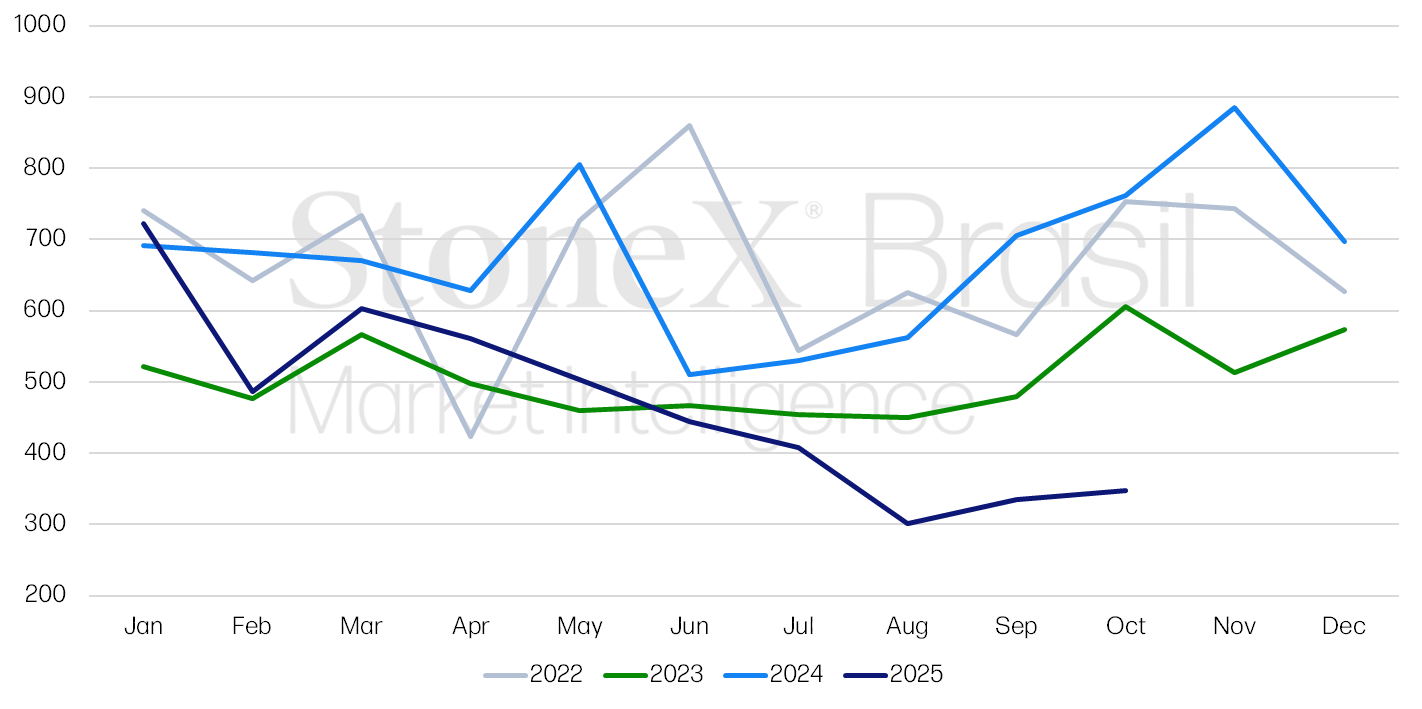
On Thursday, the 20th, the United States announced the removal of tariffs on various Brazilian products, including coffee. The measure exerted downward pressure on prices in New York. These tariffs had previously restricted Brazilian exports, reducing shipments to the U.S. market by 45% to 50%, and redirecting some volumes to other destinations, particularly Colombia. With the elimination of the tariffs, trade routes are expected to normalize, and export volumes to the U.S. are likely to recover.
Brazilian Coffee Exports to the U.S. (thousand bags)
Source: Cecafé. Analysis: StoneX.
Vietnam, which had faced production challenges due to weather events, showed signs of recovery in 2025/26, with a 7% production increase forecasted by the USDA. However, excessive rainfall has caused delays in the harvest, quality losses, and logistical challenges. Reports also mention flooded fields and localized damage to crops, though the full impact remains uncertain. The coming weeks will be crucial for assessing the extent of these losses.
The coffee market is expected to remain volatile in the coming weeks. Market participants will closely monitor weather conditions in Vietnam and Brazil, the evolution of Brazilian exports, the pace of sales recovery to the U.S., and the impact of inflation on global consumption.
INDICATOR TABLE
Sources: ICE/NY; ICE/EU; B3; Commodity Network Trader’s Pro.