After last week’s rally driven by weather concerns in Vietnam, the coffee market starts the new week with declines
Translation generated by AI
• Rainfall in Vietnam delays harvest and supports prices last week
• Market starts the week lower following speculative technical adjustments
• Bullish and bearish factors keep coffee price volatility high
• Global consumption weakens due to inflation’s impact on retail
• Brazilian exports decline in November, according to preliminary data
• European Parliament votes to postpone EUDR implementation
Coffee futures prices climbed last week amid concerns over heavy rainfall in Vietnam. The country recently began its harvest period but has faced significant precipitation in recent weeks, slowing the harvest pace, affecting crop quality, and creating logistical challenges. This crop is particularly important as Vietnam seeks to recover from previous years’ difficulties. USDA forecasts anticipate a production increase of approximately 7%.
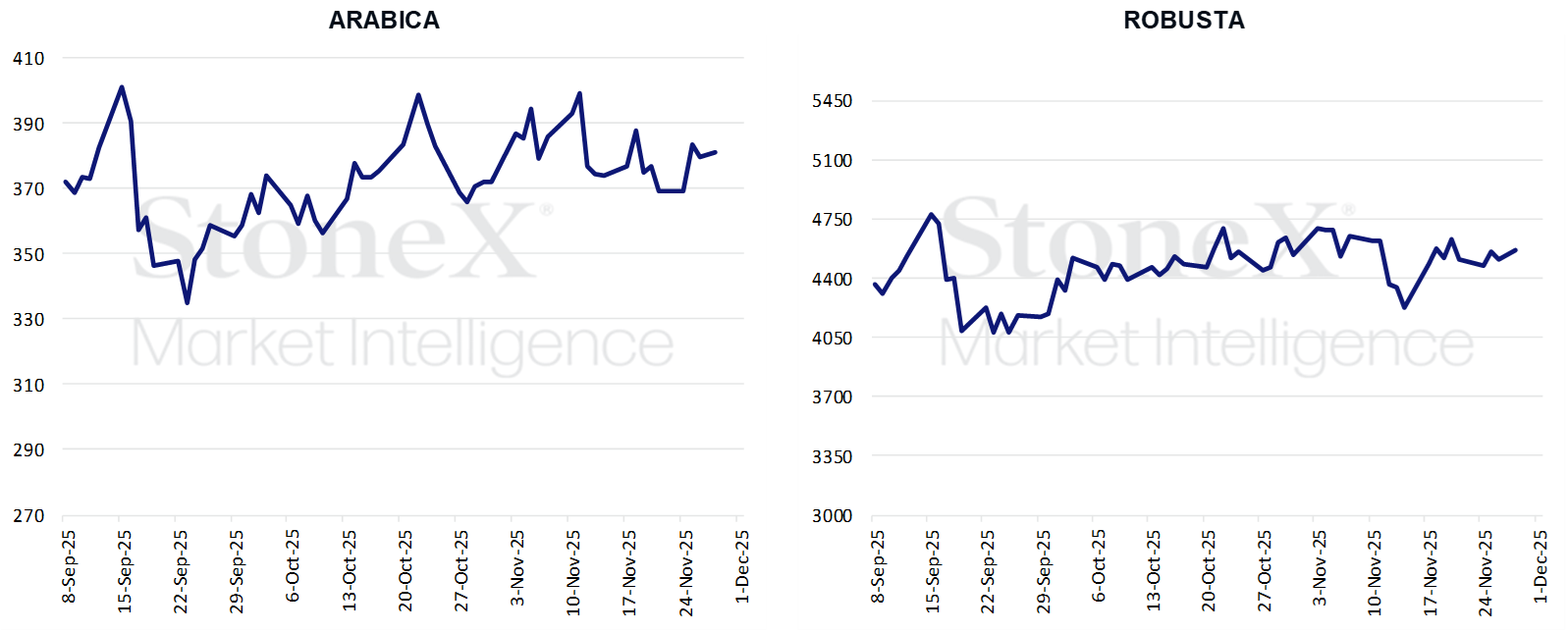
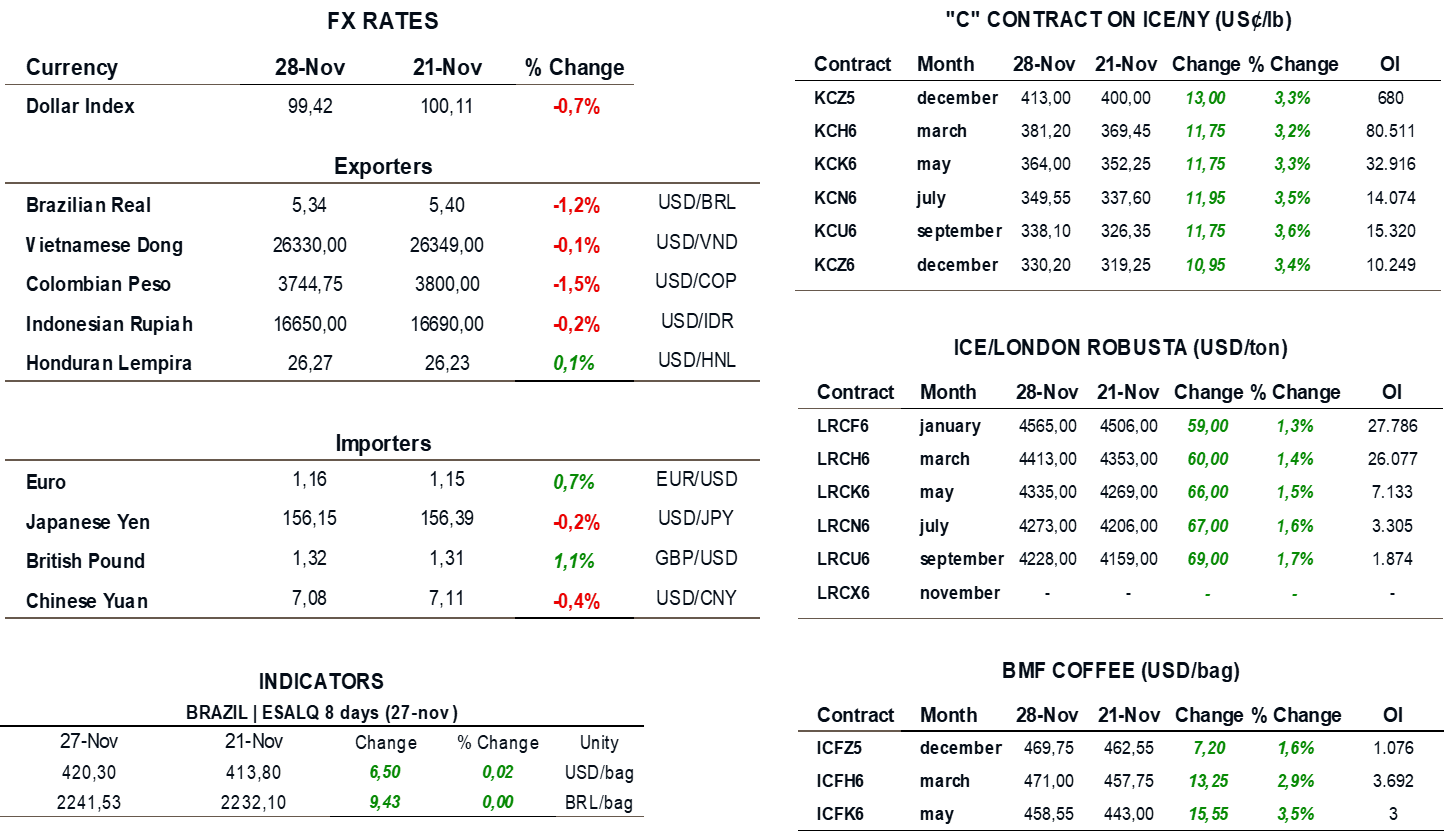
As a result, the market responded bullishly to the adverse weather conditions. Trading volumes remained limited due to the Thanksgiving holiday in the United States. In New York, the most active contract ended the week up 3.2%, at US¢ 381.20 per pound. In London, the January contract rose 1.3%, closing at USD 4,565 per metric ton. Month-to-date, New York coffee futures gained 2.4%, while London saw a 0.6% increase. In the Brazilian domestic market, arabica prices rose 3.3% over the week and 2.1% for the month, closing at BRL 2,252.95 per sack. Robusta appreciated by 4.2% for the week but fell 0.1% for the month to BRL 1,404.48 per sack. The dollar dropped 1.3% for the week and 0.8% for the month, closing at BRL 5.33.
On Monday’s session, December 1, a correction was observed, with the March contract in New York falling 1.13%, priced at 376.90 cents per pound, and the January contract in London dropping 2.37%, trading at USD 4,457 per metric ton at the time of writing this report. The decline occurred without significant changes in fundamentals and was primarily driven by short-term speculative activity and technical adjustments following last week’s gains.
Arabica coffee futures prices (US¢/lb) and robusta coffee (USD/ton)
Source: Cmdty View. Prepared by: StoneX.
Fundamentally, the market remains without major developments and continues to be influenced simultaneously by bullish and bearish factors, sustaining high volatility. On the bearish side, weaker global consumption due to inflation’s impact on consumer prices, the removal of U.S. tariffs on Brazilian coffee (boosting supply to the North American market), and the outlook for a more comfortable crop in 2026/27 stand out. StoneX projects a 13.5% increase in Brazilian production, potentially reaching 70.7 million sacks. Weather conditions in Brazil remain favorable for crop development so far, reinforcing the bearish outlook.
On the bullish side, historically low global inventory levels remain significant. StoneX estimated nearly 22 million sacks of global stock consumption between 2021 and 2024, without prospects for replenishment in 2025, keeping the balance tight. Weather concerns in Vietnam continue to influence the market, as heavy rains have caused harvest delays of about two weeks, deteriorating quality and introducing logistical hurdles. While there are reports of production losses, the reported volumes are relatively small given the crop size and are not currently the primary risk factor. However, concerns persist regarding the impact of La Niña and the possibility of dry spells in Brazil during the summer, which could compromise crop development for the 2026 harvest.
Recently, J.M. Smucker’s financial results showed a 21% increase in coffee sales revenue in the United States. This growth stemmed from a 27% price hike and a 6% drop in sales volume, illustrating inflation’s impact on consumption. A similar trend was observed in Brazil, where ABIC reported a retail sales decline of over 5% between January and August. In Japan, data showed a consumption drop of more than 3% during the same period, reinforcing weaker demand in volume terms.
In the coming weeks, the market will closely monitor weather conditions in Vietnam, the progress of the country’s harvest, and climate developments in Brazil. New crop estimates from various agents for the 2026/27 season are expected, and the market may respond to these revised projections. Preliminary Cecafé data from November 28 indicated shipments of 2.87 million sacks for the month, a 2.8% decrease from the previous month and a 41.3% drop compared to November 2024. Cecafé’s president highlighted that rebuilding shipment volumes to the U.S. could take several months following the removal of tariffs. The market remains shaped by a combination of climatic factors, supply and demand adjustments, technical movements, and high price volatility.
Market participants will also keep an eye on certified coffee stocks and the progress of European legislation on deforestation. Initially scheduled to take effect at the end of 2024, the EUDR's implementation was postponed to late 2025. However, in a recent vote, the European Parliament approved further delays, setting the start date to December 30, 2026, for large operators and June 30, 2027, for micro and small businesses. The decision still requires final drafting and official publication before coming into effect. The market is likely to closely follow regulatory developments given the potential impact on coffee trade.
INDICATOR TABLE
Sources: ICE/NY; ICE/EU; B3; Commodity Network Trader’s Pro.