Last week was relatively slow for the coffee market, which remained focused on Brazil’s weather conditions and Vietnam’s harvest, while awaiting Brazilian export data released by Cecafé late on Monday (19).
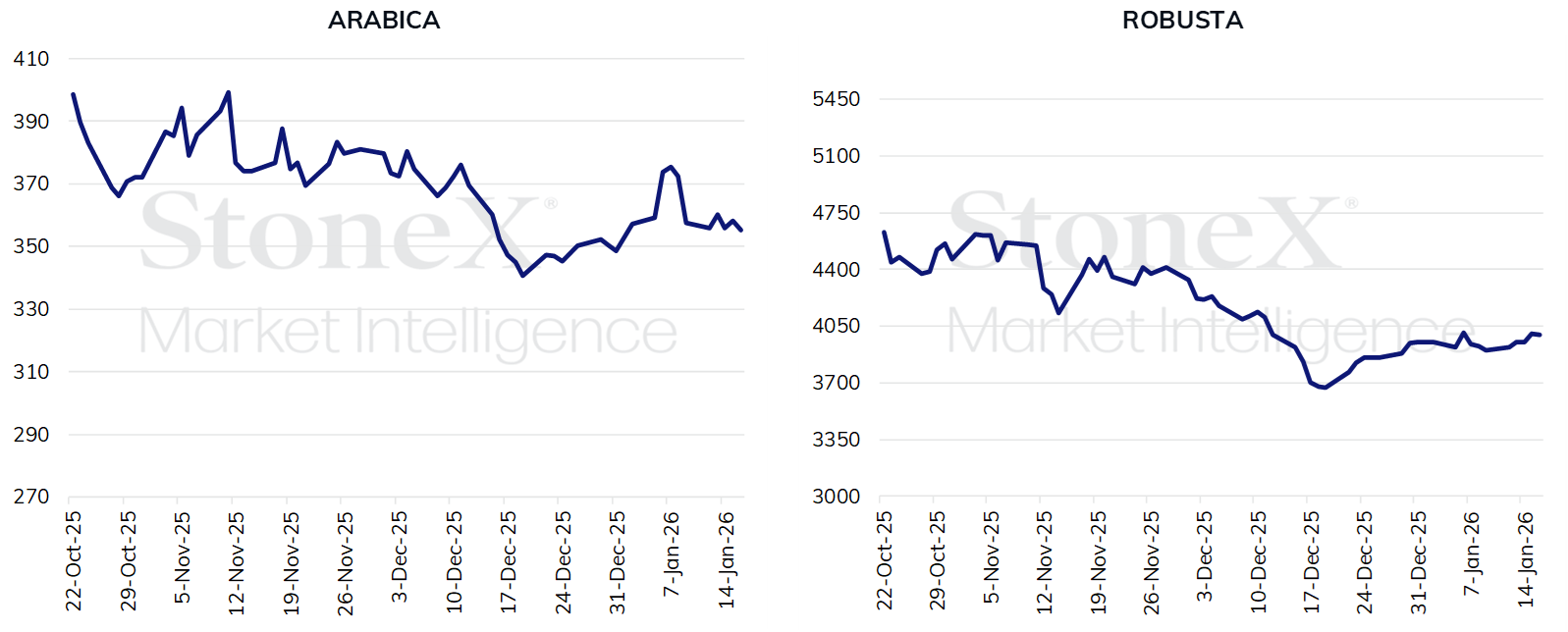
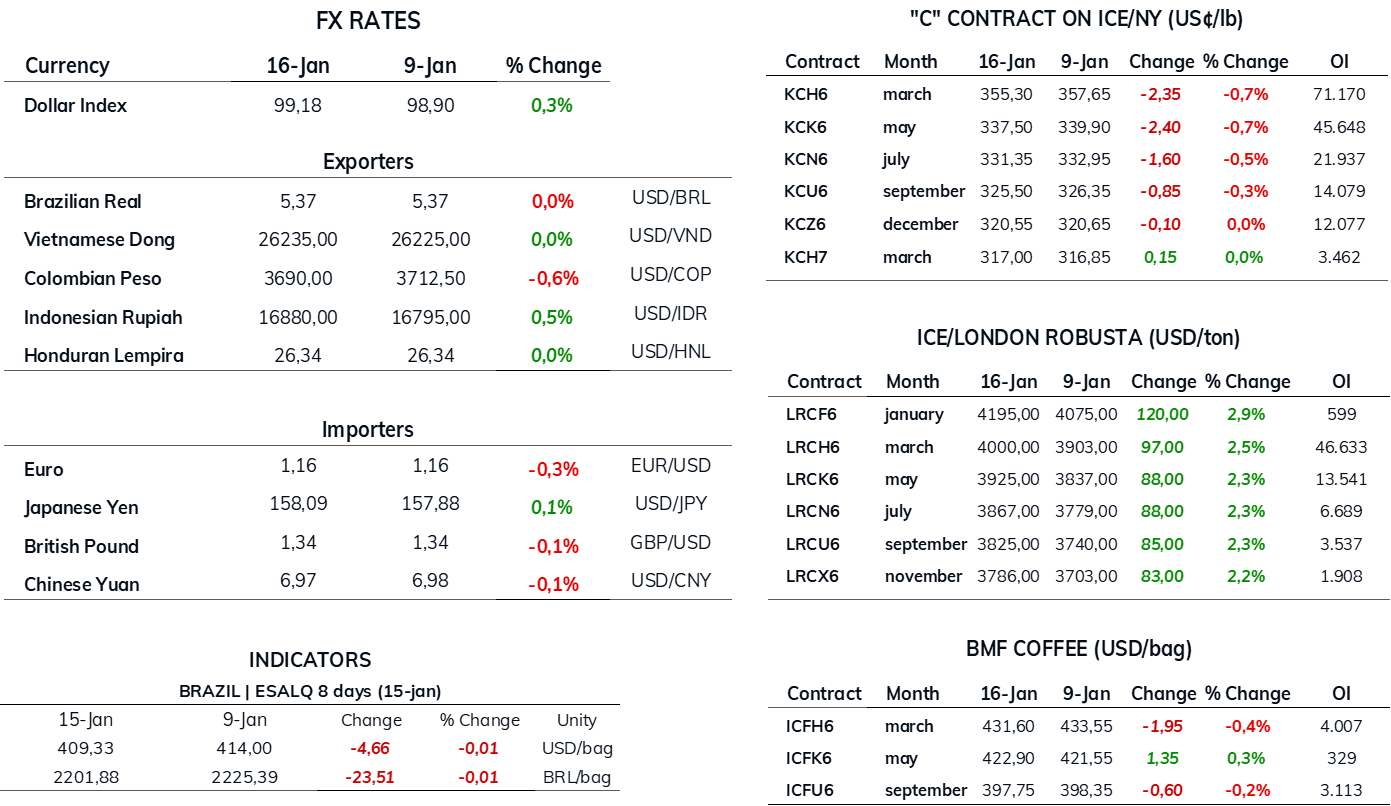
Arabica coffee traded without significant direction, fluctuating between gains and losses, as the market observed improved trading volumes in Brazil’s physical market. The March/26 contract closed at US¢ 355.3/lb, marking a slight decline of 0.7%.
Robusta coffee, on the other hand, rallied last week. Despite favorable fundamentals, with a sizable harvest in Vietnam, producers in the country continued to hold back coffee, aiming for better prices. Reduced liquidity supported higher prices, with the March contract closing at USD 4,000/ton, up 2.5% for the week.
In the Brazilian market, prices followed similar trajectories. The CEPEA indicator for arabica coffee dropped 2.0% to BRL 2,180/bag, while robusta rose 1.4%, ending the week at BRL 1,300/bag.
Risk of new tariffs
The absence of new statements or conflicts between US President Donald Trump and other South American leaders helped ease market concerns, as stakeholders look ahead to the meeting between the US leader and Colombian President Gustavo Petro, scheduled for early February.
However, earlier last week, the American president announced that the US would impose 25% tariffs on countries maintaining trade relations with Iran. This raised concerns that coffee — which was subjected to a 40% surcharge last year, adding to an initial 10% tariff applied to the country, resulting in 50% tariffs on exports to the US between August and mid-November — could once again face higher tariffs.
Potential impacts: While a new 25% tariff would likely not halt exports from South American countries, it could exert upward pressure on prices and prolong elevated inflation levels, just as the indicator begins to show signs of slowing in the US market.
Consumer inflation ends 2025 with signs of slowing
As mentioned earlier, one of the concerns surrounding a potential US tariff is its inflationary impact on consumer coffee prices. The year 2025 saw historically high coffee prices for consumers, reflecting elevated exchange prices since 2024. However, grocery store price indicators have been showing signs of slowing in major consumer centers, reinforced by December data:
- Brazil: IBGE reported that in December, the average price of roasted and ground coffee fell by 0.3% for consumers compared to the previous month, marking the 6th consecutive monthly decline. Inflation over 12 months, which reached 82% in May, ended the year at 25.7%.
- US: While previous months already showed milder increases, December marked a 2.2% drop in coffee inflation compared to the prior month. Accumulated inflation in the US, which peaked at 41.3% in September, closed the year at 33.6%, with the potential for further declines in early 2026.
- Eurozone: December saw a monthly drop of 0.5%. Over 12 months, the index, which peaked at 21.2%, fell to 18.3% by year-end.
12-month accumulated inflation for roasted and ground coffee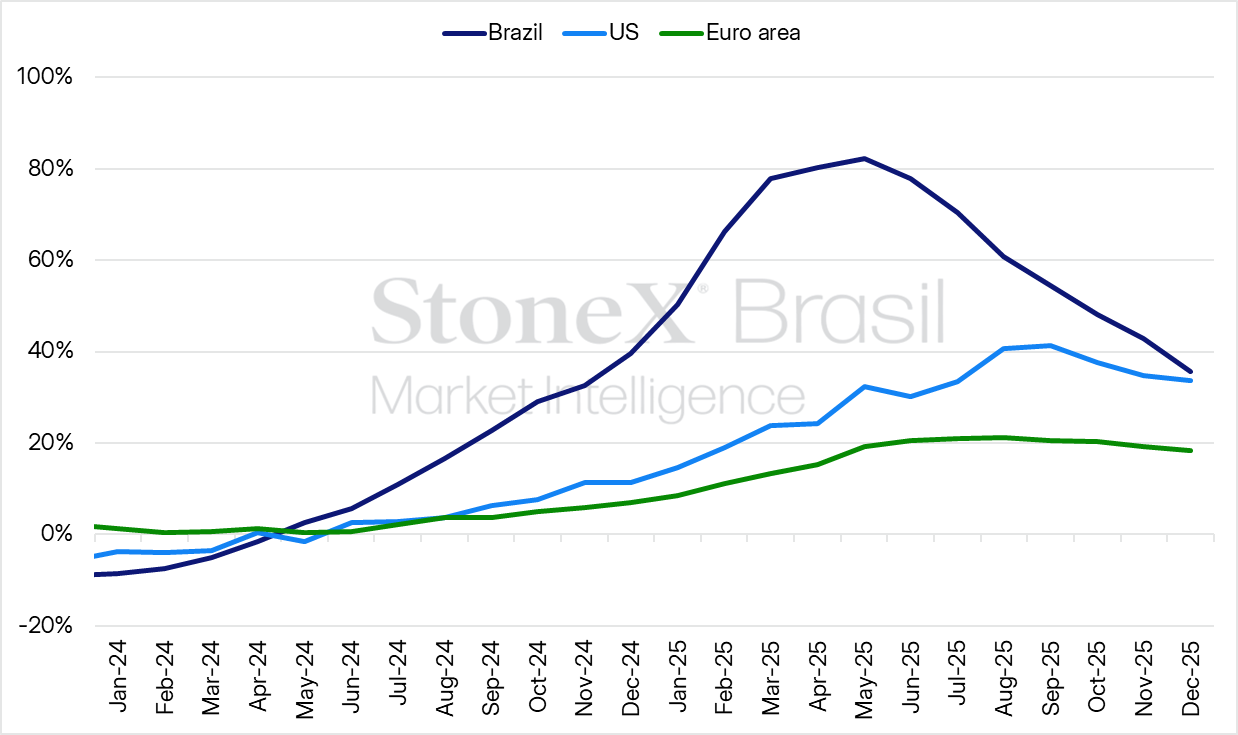
Sources: IBGE, BLS, and Eurostat. Prepared by StoneX.
Why this matters: Despite signs of declining sales in some countries — particularly in H1 2025 — global coffee consumption remained resilient, with relatively small contractions in response to high prices. Thus, in a year with supply expectations significantly higher than in 2025, a strong bearish factor, easing consumer inflation suggests a more favorable scenario for global demand, potentially supporting prices throughout the year.
Brazil ends 2025 with record coffee export revenue
On Monday (19), Cecafé released official export figures for December, totaling 2.89 million bags, down 12% from November and 15% compared to December 2024.
- Arabica: 2.67 million bags shipped, down 12% month-on-month and 6% year-on-year.
- Robusta: 222,000 bags, with monthly and annual declines of 14% and 61%, respectively.
Monthly green coffee exports from Brazil (million bags)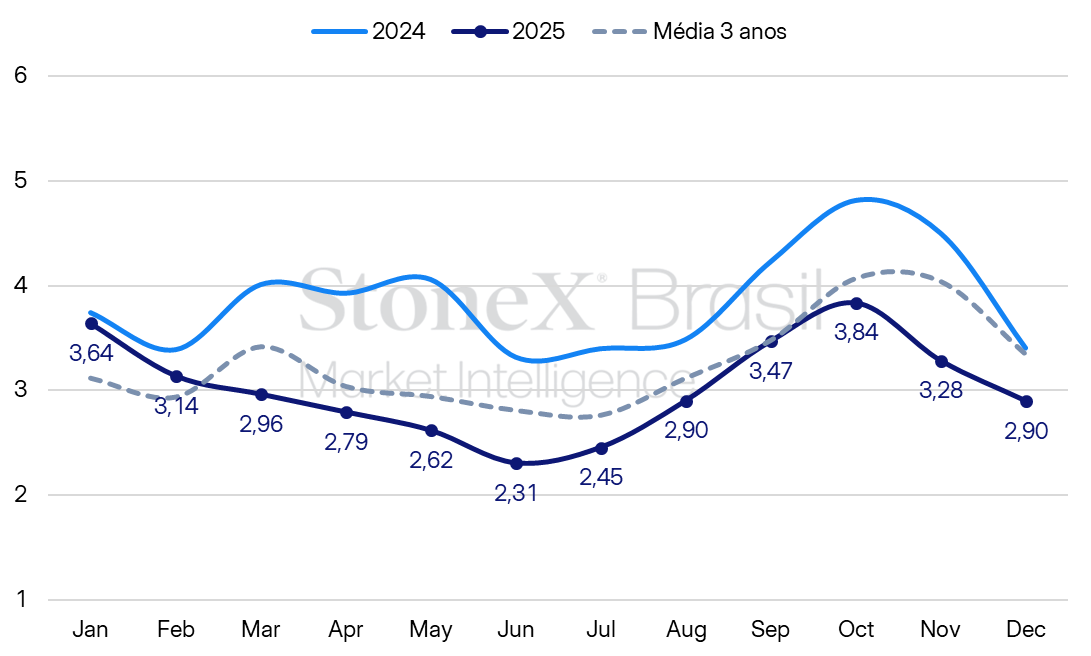
Source: Cecafé. Prepared by StoneX.
For the year, volumes were lower, totaling 36 million bags of green coffee, 21.6% less than the 46.3 million exported the previous year:
- Arabica: 32.3 million (‑12.6%)
- Robusta: 3.99 million (‑57%)
- Soluble: 3.4 million (‑17%)
Yearly accumulated coffee exports from Brazil (million bags)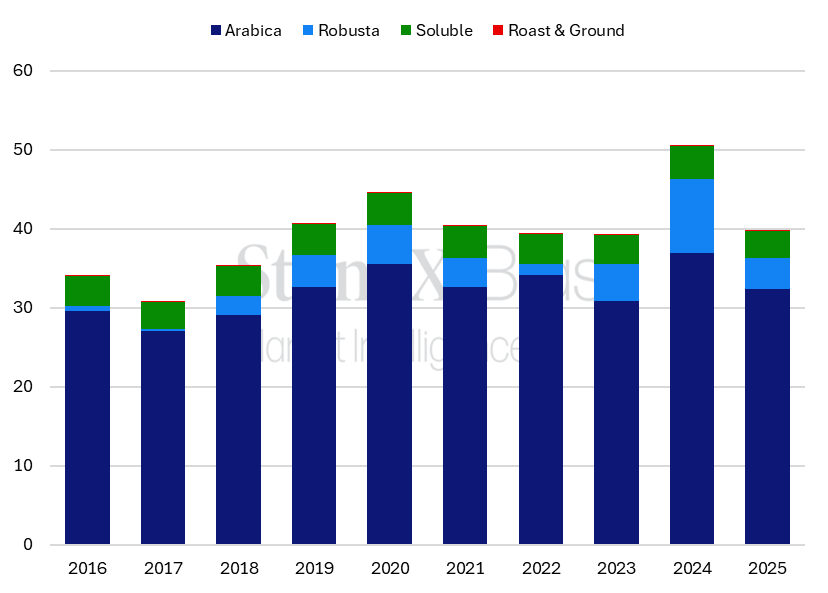
Source: Cecafé. Prepared by StoneX.
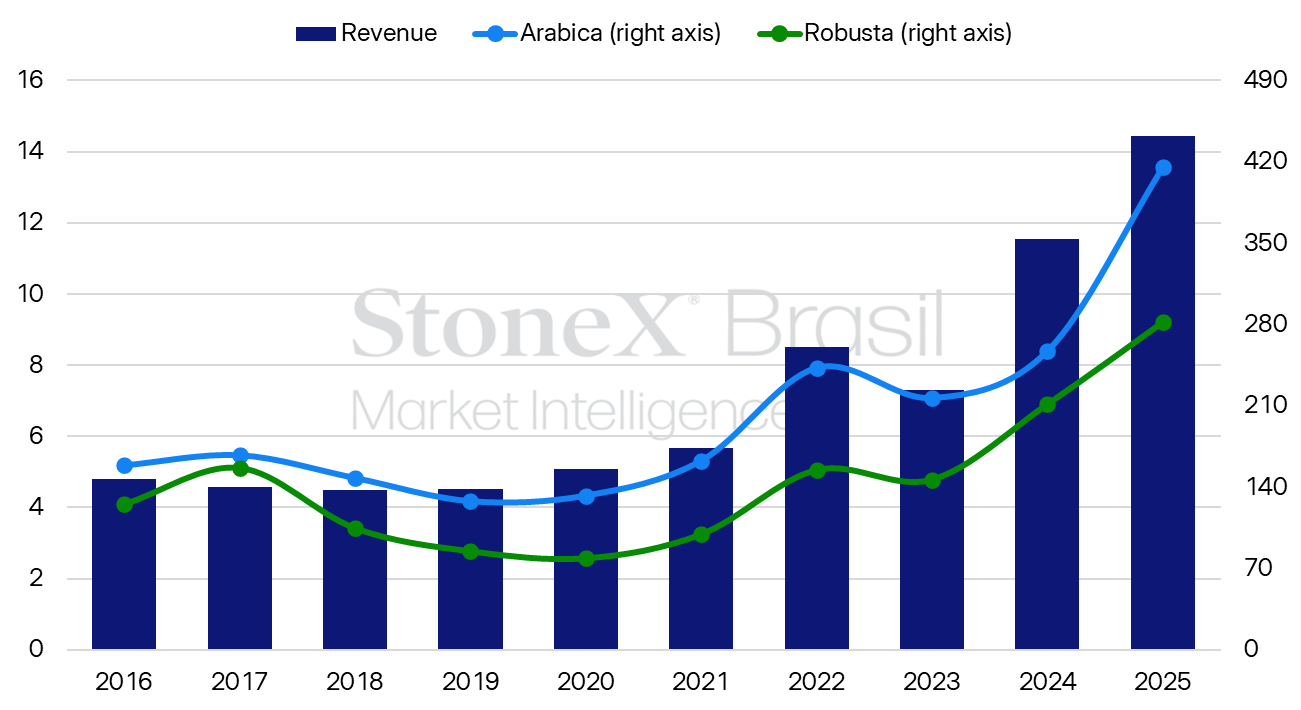
Despite significantly lower volumes compared to 2024, export revenue stood out: it rose by 25% to USD 14.4 billion, driven by higher average prices throughout the year. Cecafé data indicated average export prices of USD 415/bag for arabica and USD 282/bag for robusta, up 61% and 33%, respectively. Compared to 2023, revenue almost doubled, with a 98% increase.
Brazilian coffee export revenue and annual average price (USD billions)
Source: Cecafé. Prepared by StoneX.
Key destinations
The leading destinations for Brazilian coffee exports remain unchanged, although the US, impacted by tariffs, was surpassed by Germany in the top spot, followed by the US, Italy, Japan, and Belgium.
China’s presence among the top 10 destinations — specifically in 10th place — also stands out. While the volume remains relatively small, its year-over-year growth and increasing importance relative to other traditional partners underscore the likelihood that the Asian giant will continue gaining significance for Brazil.
It’s also worth noting that while the US and traditional European importers showed annual declines, some countries posted annual growth. Highlights include Japan (+19.7%), Turkey (+4.0%), and China (+19.5%).
Share of destinations in Brazilian coffee exports (million bags)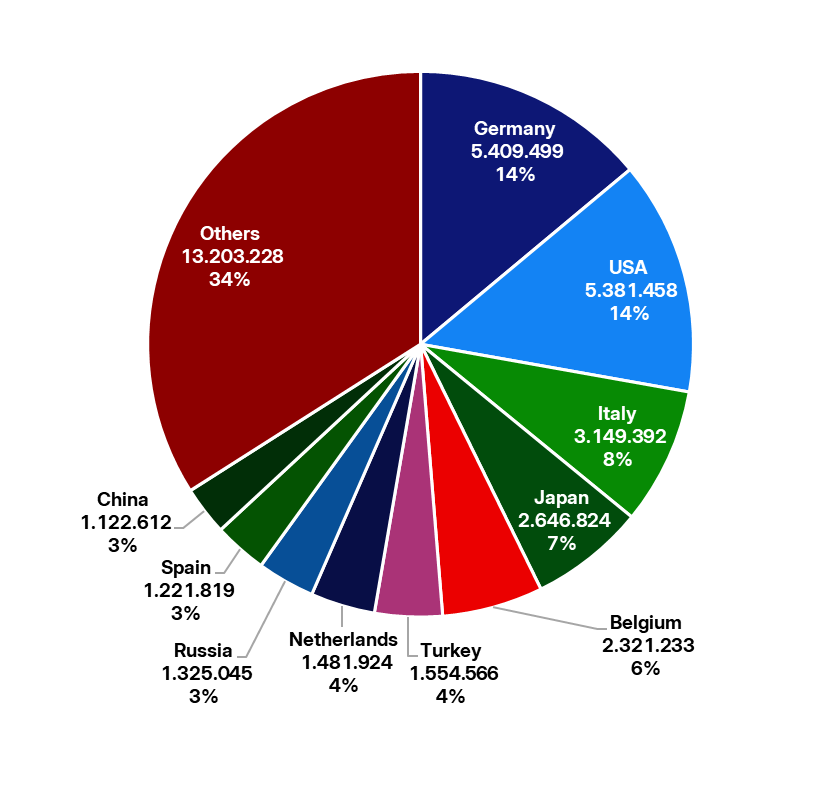
Source: Cecafé; prepared by StoneX.
For this week
With a slower start to the week due to inactivity at the New York Stock Exchange owing to the Martin Luther King holiday in the US, stakeholders are expected to continue awaiting updates on the potential 25% tariff.
Additionally, Brazil’s weather conditions remain under close watch. Significant rainfall is forecasted for the coffee belt, particularly in the Matas de Minas region, which could positively impact crop development. The South of Minas region still requires higher rainfall volumes, warranting some caution.
Robusta coffee closed Monday’s session at USD 4,016/t on the London exchange, up 0.4%, on a day of lower trading volumes. The expectation is that, as the month-end approaches, sales in Vietnam will regain momentum, potentially leading to some price corrections.
INDICATOR TABLE
Sources: ICE/NY; ICE/EU; B3; Commodity Network Trader’s Pro.