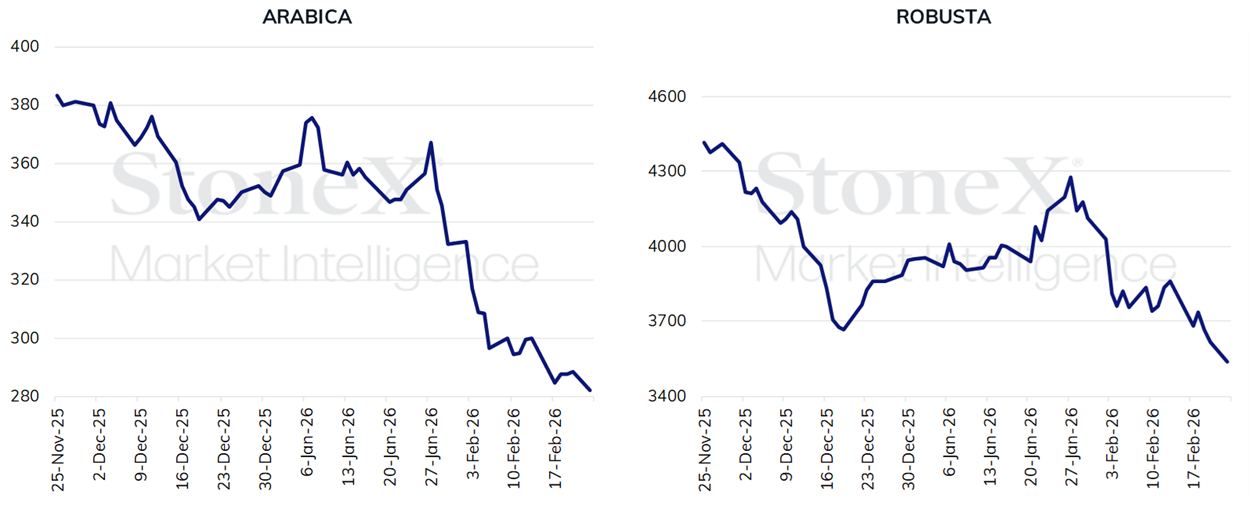
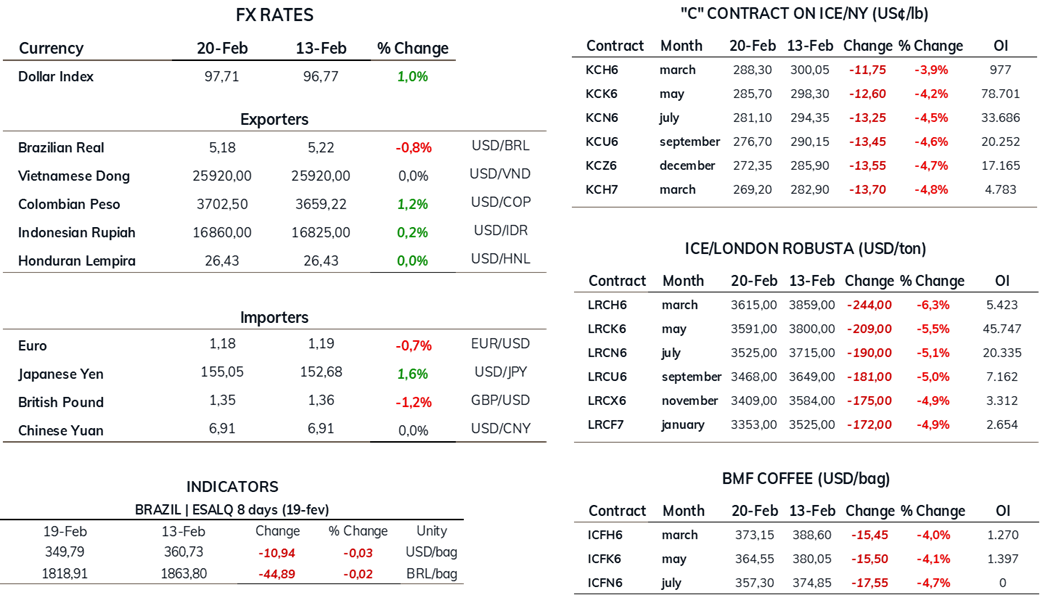
The past week was marked by declines in coffee futures at major exchanges, reaching the lowest levels since mid-2025 after successive recent drops. Arabica ended the period at USc 288.3/lb, a 3.9% decrease. Robusta closed at USD 3,615/t, down 6.3%. This movement reflected a lower risk premium environment and ongoing profit-taking, consistent with optimism regarding coffee availability in upcoming cycles.
U.S. “Reciprocal” Tariff Rollback
Late last week, the U.S. Supreme Court voted 6-3 to overturn the “reciprocal tariffs” imposed by Donald Trump in 2025, concluding that the administration overstepped its authority by using the International Emergency Economic Powers Act (IEEPA) to create tariffs without Congressional approval.
Overview: The measure, challenged by companies and governors and rejected by three lower courts, was deemed incompatible with IEEPA’s purpose, which does not authorize the creation of commercial tariffs. The decision brings months of uncertainty to an end, ordering the immediate suspension of tariffs and defying expectations that the conservative-majority Supreme Court might favor the administration.
In the coffee market, the main exporting countries faced the following tariffs:
- Brazil: 50% on soluble coffee; 10% on other products.
- Vietnam: 20%
- Colombia: 0%
- Indonesia: 19%
It remains unclear how the U.S. tariff policy will evolve, as the administration claims to have various options to reinstate tariffs. Last Saturday, President Donald Trump announced via social media that he would raise global import tariffs to 15%, citing Section 122 of the Trade Act of 1974, which addresses balance of payments imbalances. Initially, the increase will be valid for 150 days, requiring Congressional approval for a longer implementation.
Why It Matters: This change may affect coffee pricing for key U.S. suppliers.
- Vietnamese and Indonesian coffee may become slightly cheaper, while Colombian coffee — previously exported tariff-free and significantly boosted in 2025 due to Brazil’s 50% tariff — could lose competitiveness.
- In 2025, U.S. imports of Brazilian coffee dropped 23.2% to 5.6 million sacks, while Colombian imports rose 25% to 5.2 million sacks, the highest volume since 2019.
- As Brazil and Colombia account for about half of U.S. green coffee purchases, a 5 percentage point increase for Brazilian coffee and 15% for Colombian coffee may pressure prices for U.S. importers and consumers.
- The country is experiencing slowing inflation and strong demand recovery. Therefore, higher consumer prices could have some impact on this recovery.
The Situation for Brazilian Soluble Coffee: Previous reports highlighted how Brazilian exports to the U.S. were impacted by the 50% tariffs. Even after negotiations reduced tariffs in November, soluble coffee remained subject to the 50% rate.
- The U.S. typically represents 18%-20% of Brazilian soluble coffee exports; in 2025, it accounted for 15.7%.
- Soluble coffee exports to the U.S. totaled 535,000 sacks in 2025, a 31% drop compared to 2024 and far below the five-year average, where all years exceeded 700,000 sacks.
- In 2026, performance remains weak: the 249,000 sacks exported represent a 32% year-on-year decrease compared to January 2025, marking the worst result for the month since 2019.
Why It Matters: With tariff reductions from 50% to 15%, the Brazilian soluble coffee industry is poised to regain competitiveness against its rivals. Higher volumes could gradually return, potentially providing additional support to product prices.
Monthly and Annual Brazilian Soluble Coffee Exports to the U.S. (in thousand sacks)
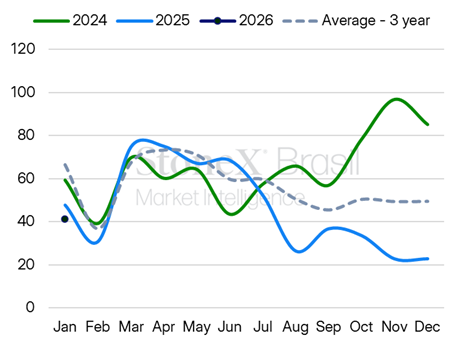
Source: Cecafé. Prepared by: StoneX.
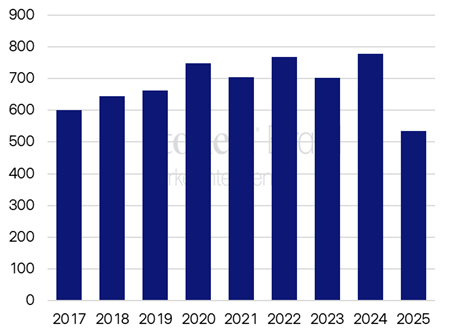
Source: Cecafé. Prepared by: StoneX.
FNC Forecasts Decline in Colombian Coffee Production:
According to the National Federation of Coffee Growers of Colombia (FNC), excessive rainfall in the country’s coffee-growing regions is expected to significantly impact the 2025/26 harvest, reducing production to 12.8 million sacks.
- The projection indicates a sharp decline compared to the record 14.87 million sacks harvested in the 2024/25 crop.
- Colombia has been experiencing persistent rainfall since the fourth quarter of last year.
- Conditions worsened in January and February with the arrival of a cold front from the north, causing widespread flooding and disrupting the critical flowering phase.
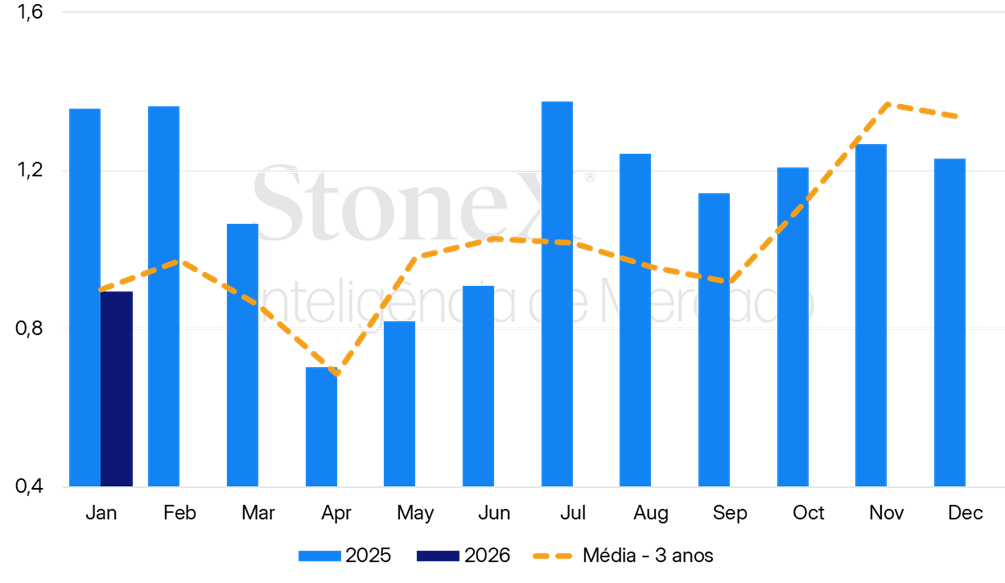
Tracking Colombian Harvest: In the first four months of the 2025/26 crop year (October to January), cumulative production fell 26.5%, dropping from 6.25 million sacks during the same period in 2024/25 to 4.6 million sacks in the current season.
- The USDA’s latest estimate projects Colombian production at 13.8 million sacks in 2025/26, compared to 14.8 million in 2024/25, an approximate 7% decline.
- Current tracking suggests weaker performance than anticipated in forecasts, pointing to a downside risk for projections.
Why It Matters: Lower-than-expected production in the world’s second-largest Arabica producer is likely to support international prices.
- This effect could intensify if Brazilian production also disappoints at the start of the 2026/27 crop year, reinforcing a tighter supply scenario.
Colombian Coffee Monthly Exports (in thousand sacks)
Source: FNC. Prepared by: StoneX.
Climate Outlook: Increasingly Clear El Niño Chances
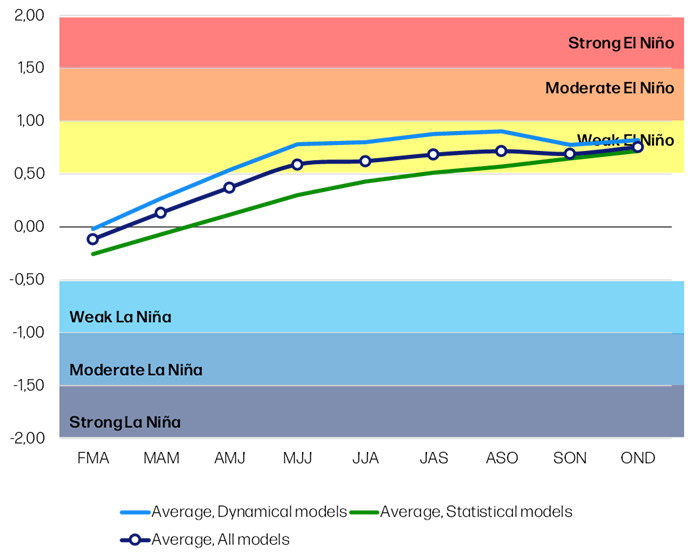
The latest update from the International Research Institute for Climate (IRI) reinforced indications from other reports pointing to a higher likelihood of an El Niño event in the second half of 2026.
In general, El Niño refers to the warming of Pacific Ocean waters. As analyzed in the latest Weekly Weather and Climate Bulletin, climate consensus suggests that when an El Niño event materializes, regional climate anomalies tend to become more persistent and, in some cases, more intense.
This suggests that areas already showing signs of deficits or irregularities may see these conditions intensify if this projection materializes later in the year.
Projected Surface Temperature Variations in the Pacific Ocean (in °C)
Source: IRI/CPC, NOAA. Prepared by: StoneX.
Why It Matters: While it is still early, the continued increase in probabilities is likely to draw more market attention, especially if projections also increase the expected intensity of the event.
As such, the market may begin factoring the event into prices in the coming months. Briefly summarizing the potential impacts on key producing regions:
Brazil
- The southern coffee belt may experience more rainfall; the southeast may be generally warmer, with lower frost risk. In low intensity scenarios, this could benefit Arabica coffee.
- Robusta regions, particularly in Espírito Santo, may face hotter and drier conditions.
Southeast Asia
- Dry conditions during the critical harvest period could impact productivity, especially in Vietnam.
- Indonesia does not show a clear correlation.
Colombia, Mexico, and Central America
- Drier climate conditions.
- Could be positive following periods of excessive rainfall, as in Colombia’s case.
INDICATOR TABLE
Sources: ICE/NY; ICE/EU; B3; Commodity Network Trader’s Pro.