

Daily Coffee Report 10/2/26
Daily coffee report

StoneX Coffee Team
- Coffee
By: Leonardo Rossetti, Market Intelligence Analyst

The coffee market closed the week divided between expectations of ample medium-term supply and immediate availability restrictions. In New York, certified stocks remained near lows since late 2023, while the earthquake in Colombia added a new relevant logistical complexity to the arabica market in the short term. On the other hand, the progress of the Brazilian harvest, drier weather, and demand concerns limited price recovery. In London, robusta performed weaker, pressured by the prospect of greater Asian availability and less support from arbitrage with arabica.
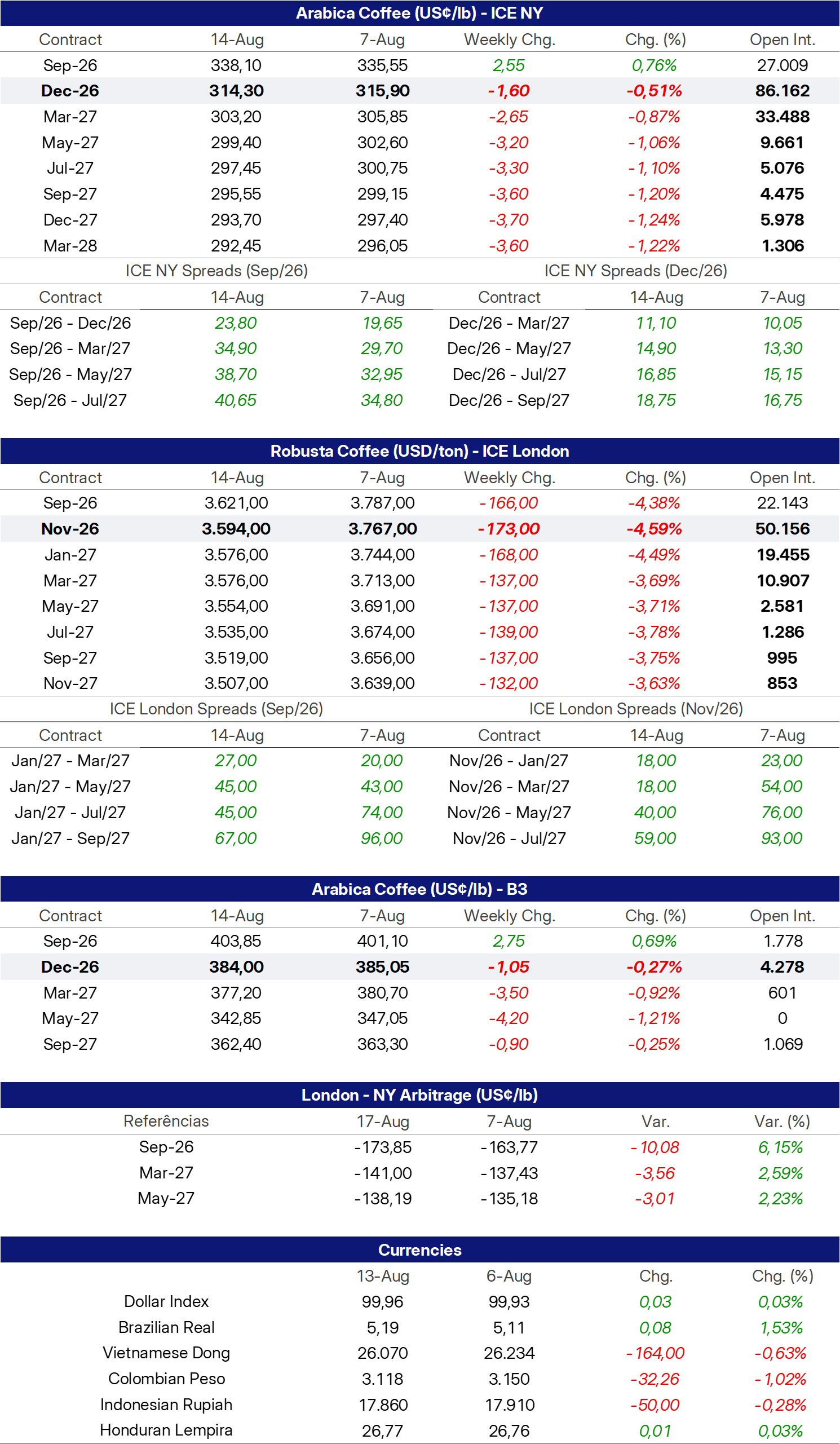
Arabica: The Dec/26 arabica contract closed the week at US¢ 314.3/lb, down 0.5%. Prices tested approximately three-week highs at the beginning of the period, supported by reduced certified stocks and shipping difficulties in Colombia. ICE-registered stocks were reported at about 242.7 thousand bags, the lowest level since late 2023. The rejection of Brazilian lots during the classification process, combined with the absence of significant new certifications, reinforced the perception that the supply available for immediate delivery remains limited.
On the other hand, the record Brazilian harvest in 2026/27 continues to act as a cap on upside potential, especially as the harvest progresses and drier weather favors field operations. Brazilian commercialization remains slower than expected given the projected volume.
Robusta: The Nov/26 robusta contract in London ended the week at USD 3,594/t, down 4.6%. The contract reached its lowest level in approximately a month and a half.
The move reflected pressure from Asian supply and the perception that robusta availability could improve with Vietnam’s upcoming harvest. In the Vietnamese origin, prices also registered a decline. Remaining stocks are low at the end of the cycle, but contained demand and prospects for the next harvest limited premiums.
Vietnamese prospects remain mixed. In some areas of the Central Highlands, producers and traders estimate a drop of approximately 20% in the next production due to dry weather and irrigation difficulties. In other regions, excessive rains may have favored pest occurrence. The combination of lower demand, reduced stocks at origin, and expected new supply kept robusta under pressure.
Arabica coffee futures prices (US¢/lb) robusta coffee (USD/ton)
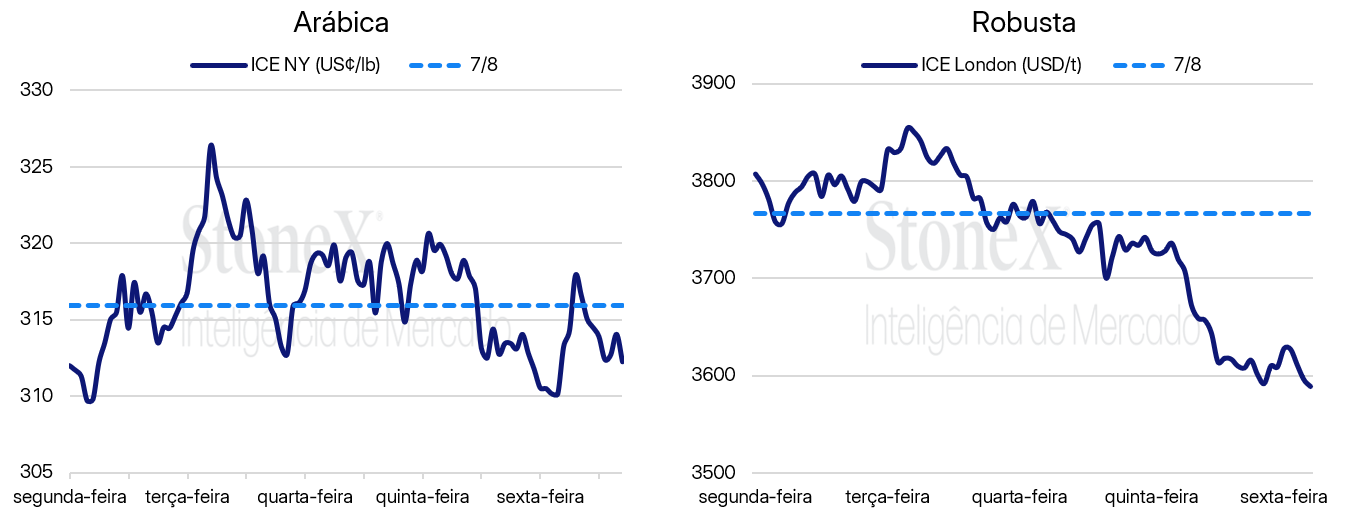
Physical market: The Brazilian physical market showed divergent behavior. The Cepea arabica indicator rose 3.6% to R$ 1,794.15/bag, reflecting producer resistance to selling and lower immediate availability of higher-quality coffees. The Cepea robusta indicator fell 3.7% to R$ 1,049.17 per bag, following the decline in London futures and pressure from Asian supply. The difference in performance reinforces arabica's relative support in the domestic market.
Monday opening: Coffee starts the week higher in both exchanges, with arabica leading the movement and exceeding US¢ 318/lb in the December maturity. In the past two weeks, arabica seems to be finding significant support at the 20-period moving average, which may continue to act as a support point to maintain the lateral trend observed in the market. Meanwhile, in London, the November maturity underwent corrections after last week’s sharp drop, marking a 1.5% increase, ending at USD 3,644/t.
While weather in Brazil and the start of blooming will take center stage, Colombian shipping normalization and the pace of Brazilian sales remain on the radar.
Rainfall recorded in different coffee-growing regions of Brazil has favored the emergence of new flowering, which is expected to advance over the coming days. In terms of precipitation, weather conditions remain favorable. So far, El Niño has not posed a major problem for producing areas, which, overall, continue to show good vegetative conditions and satisfactory crop development.
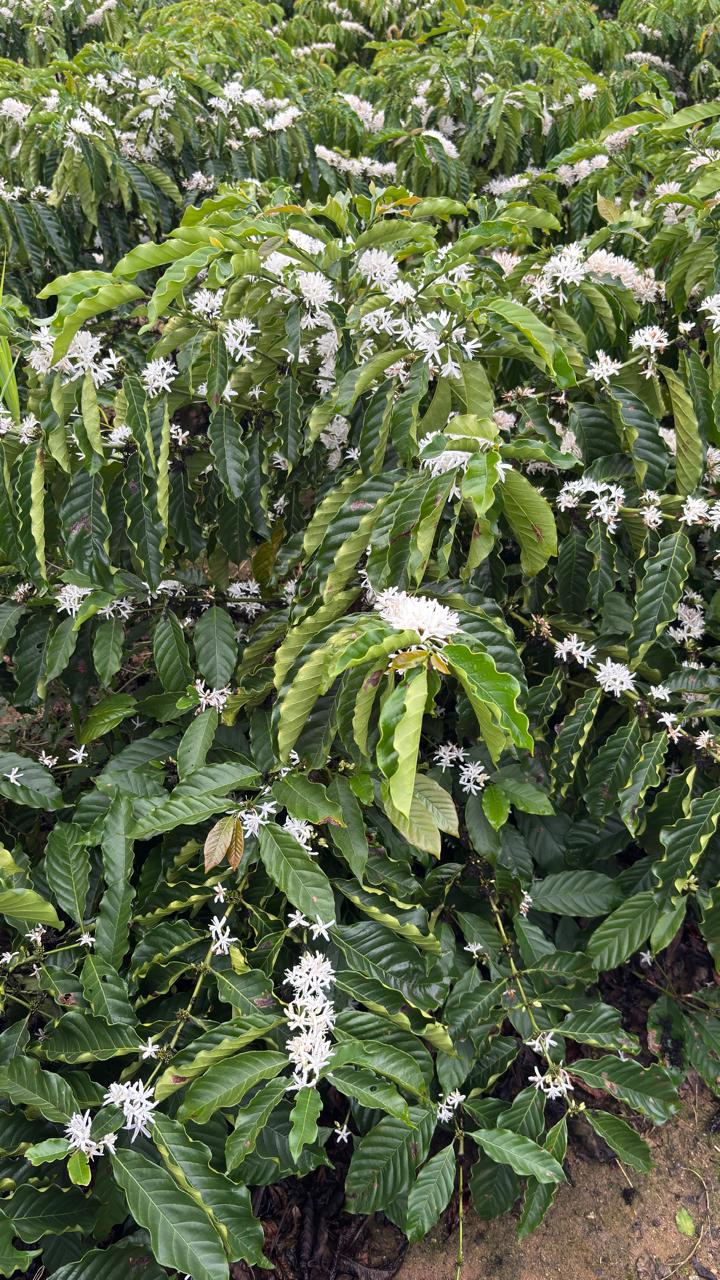
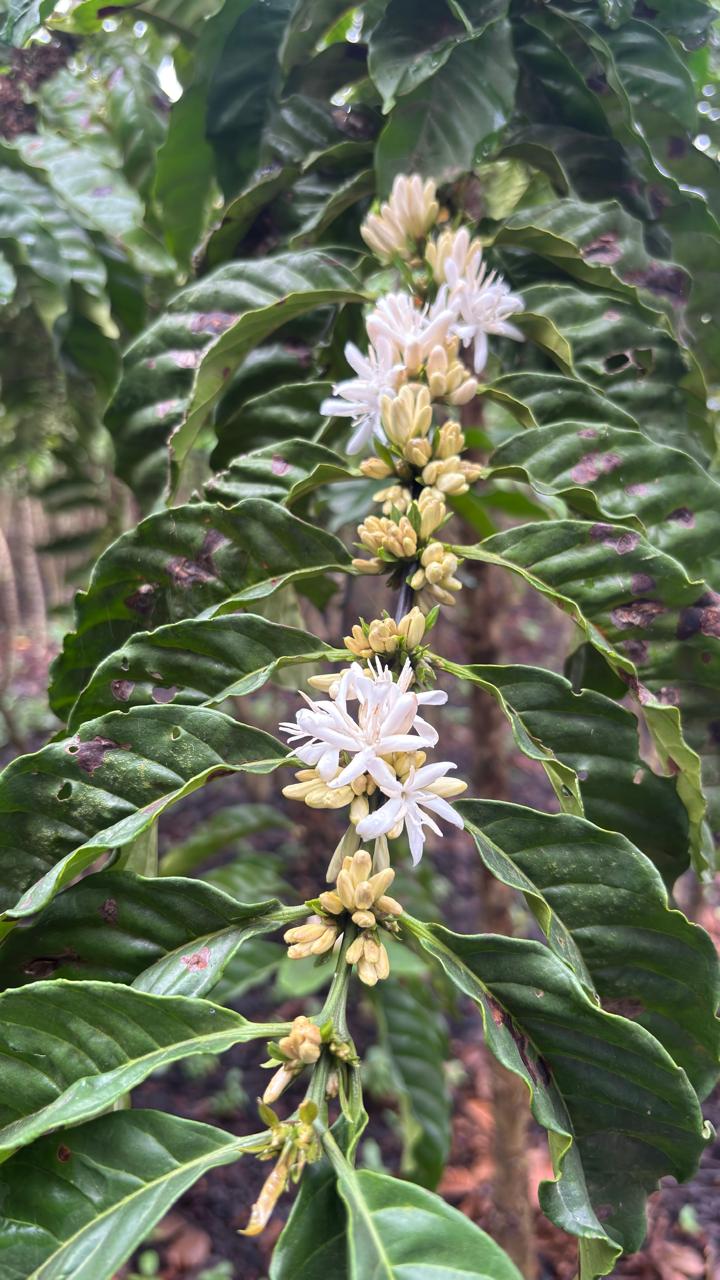
Conilon: Producing regions of conilon in Espírito Santo and Bahia, as well as robusta areas in Rondônia, have a more advanced flowering calendar compared to arabica regions. As such, flowering is already at more advanced stages. Recent rainfall observed in Espírito Santo has positively contributed to crop development. In recent days, StoneX’s field team visited the region and noted a high percentage of flowers already emitted, surpassing half of the expected potential, along with plants showing good vegetative vigor and favorable sanitary conditions, as illustrated in the images below.
New flowering in arabica: Some areas in Matas de Minas recorded heavier rainfall volumes over the last weekend. These accumulations should already be sufficient to trigger new flowering in the coming days. Additionally, the forecast for further precipitation in the region next week, especially starting on the 22nd, is expected to reinforce this process and stimulate flowering development across a significant portion of the crops. As a result, Matas de Minas is expected to stand out as one of the most advanced regions in terms of flowering progress among arabica-producing areas.
For the Cerrado, rainfall is also forecast starting on the 25th, although in more moderate volumes, while South Minas currently shows fewer signs of significant precipitation. Upcoming updates to weather forecast models will continue to be closely monitored in the coming days.
Flowering in coffee-producing municipalities in Northern Espírito Santo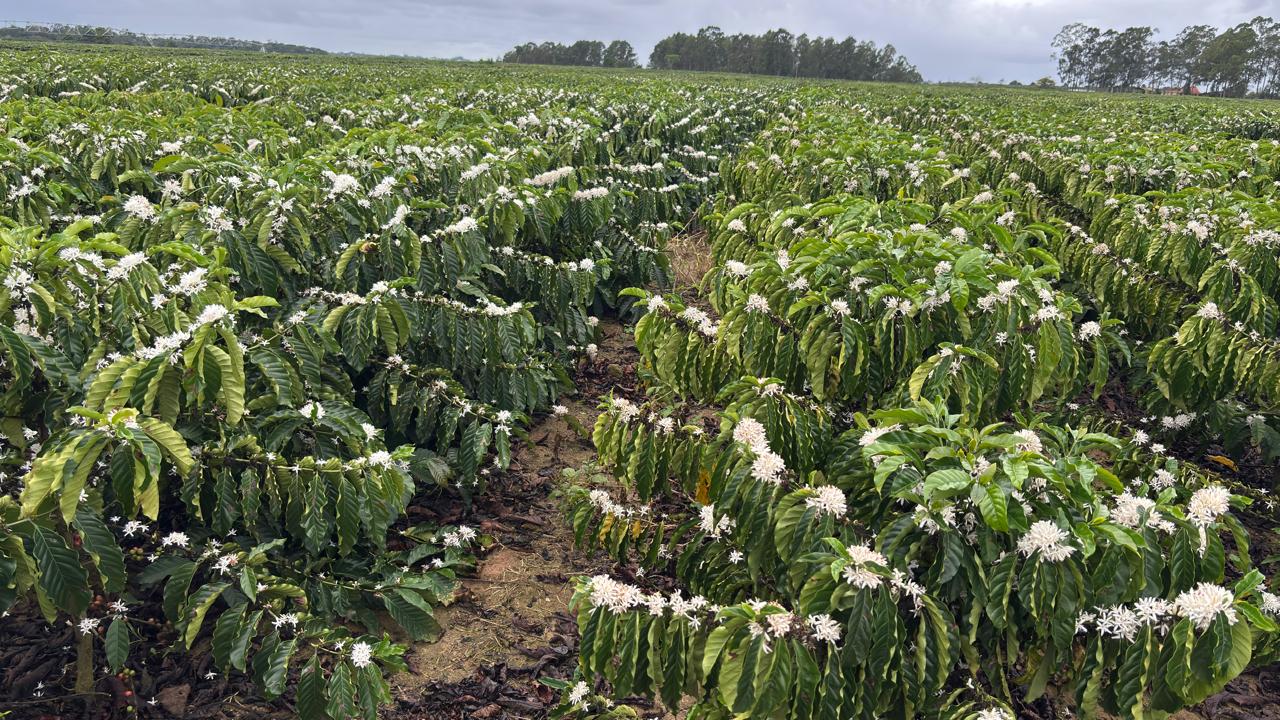
The rise in the dollar against the real tends to boost revenues for Brazilian producers and exporters when international prices are converted to the domestic currency. This mechanism usually stimulates commercialization, as each dollar received represents more reais. With greater physical availability, this movement can pressure differentials and limit future prices.
Why this matters: Exchange rates directly influence selling decisions at origin. When the real strengthens, producers receive fewer reais per exported bag and tend to postpone commercialization. Conversely, a depreciation of the Brazilian currency improves domestic remuneration and may accelerate coffee flows to exporters and roasters.
Last week, the real showed moments of weakening, with the dollar exchange rate rising from approximately R$ 5.09 to R$ 5.22 per dollar on Friday. This movement contributed to a better commercialization pace, particularly for conilon coffee from Espírito Santo. Still, the currency remains more appreciated than at the beginning of the year, when the dollar traded above R$ 5.50, which helps explain producers’ resistance to selling quickly.
What to expect: Exchange rates will remain one of the main short-term drivers for commercialization pace. A new depreciation of the real could increase Brazilian availability and limit gains, while a resumption of currency appreciation tends to reinforce producer resistance.
Cecafé data showed an increase in Brazilian exports in the first month of the new crop year, though with revenue declines and highly uneven performance among varieties. The result combines a higher robusta flow with lower arabica shipments in a context of delayed harvest, rain in producing regions, and lower average prices.
In detail:
Access the interactive report to check all the details.
Monthly arabica coffee exports from Brazil (million bags)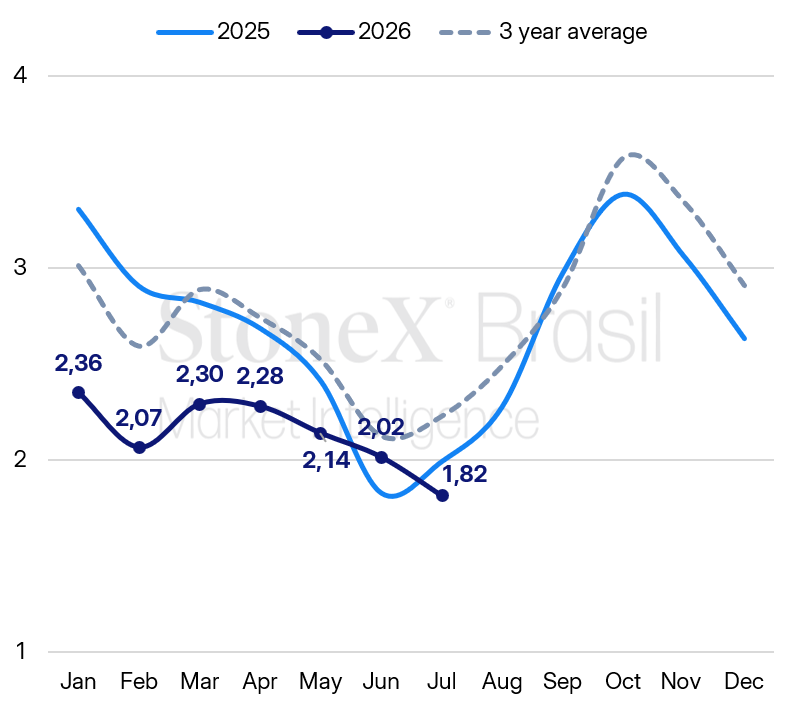
Monthly robusta coffee exports from Brazil (million bags)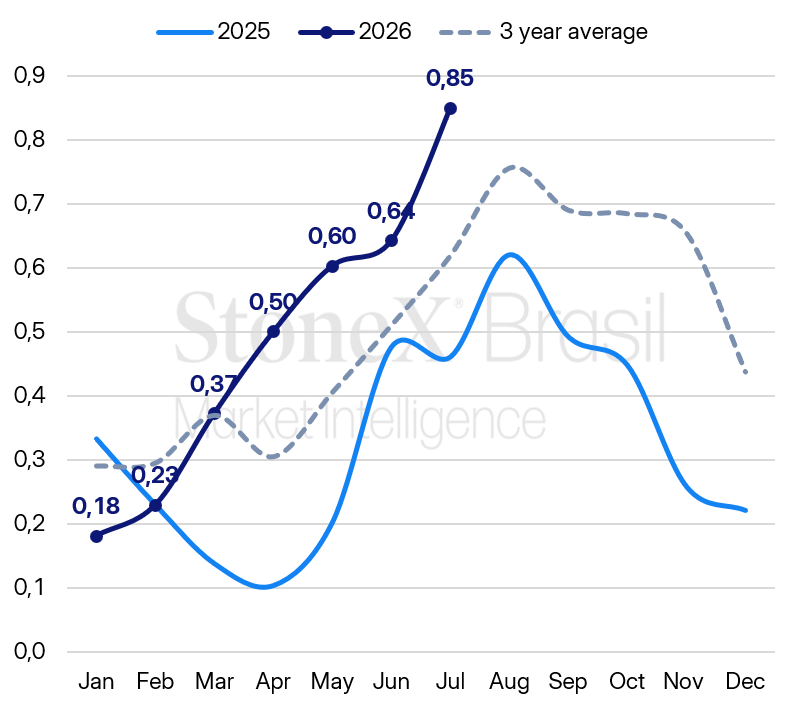
Why this matters: The increase in total volume does not represent a uniform recovery of Brazilian exports. Growth was concentrated in robusta, while arabica continued to face operational restrictions, delayed harvest, and lower availability of quality coffees.
The revenue decline, despite the growth in shipments in July, highlights the pressure of international prices on sector remuneration and producers' resistance to selling. At the same time, lower arabica exports reduce global availability precisely when ICE-certified stocks are at very low levels.
What to expect: The evolution of shipments will depend on the speed of completion of the Brazilian harvest, the quality of available lots, and producers’ willingness to sell. Accelerated arabica commercialization could ease part of the stock tightness, something expected mainly in the second half of August.
The 7.4 magnitude earthquake hit Colombia’s coffee-producing heartland and caused infrastructure damage, landslides, and transportation restrictions in regions like Caldas, Risaralda, and Chocó. The market impact was amplified by the partial interruption of operations at the Buenaventura port, responsible for approximately 60% to 70% of Colombia’s coffee exports.
Why this matters: Colombia is one of the world’s leading suppliers of high-quality arabica and accounts for about 25% of the coffee consumed in the United States. Difficulties transporting coffee from farms to warehouses, processing units, and the port reduced immediate availability and led buyers to consider alternative origins, especially Brazil. These events caused country differentials to rise last week, keeping washed coffee premiums significantly high for buyers.
The Buenaventura port began a gradual resumption of some operations but still showed restrictions for receiving full containers intended for export. Damage to warehouses and a processing unit in Armenia was also reported, indicating that normalization will depend not only on road recovery but also on restoring processing capacity.
What to expect: Local market operators estimate that coffee flow to Buenaventura could take approximately 15 days to normalize. Recovery of processing units may take longer. In the short term, the event tends to maintain a risk premium on arabica, especially while certified stocks remain low. The intensity and duration of this support will depend on opening alternative routes through Cartagena and Santa Marta and Brazil’s capacity to offset potential Colombian delays.
INDICATOR TABLE
The StoneX Group Inc. group of companies provides financial services worldwide through its subsidiaries, including physical commodities, securities, exchange-traded and over-the-counter derivatives, risk management, global payments and foreign exchange products in accordance with applicable law in the jurisdictions where services are provided. References to over-the-counter (“OTC”) products or swaps are made on behalf of StoneX Markets LLC (“SXM”), a member of the National Futures Association (“NFA”) and provisionally registered with the U.S. Commodity Futures Trading Commission (“CFTC”) as a swap dealer. SXM’s products are designed only for individuals or firms who qualify under CFTC rules as an ‘Eligible Contract Participant’ (“ECP”) and who have been accepted as customers of SXM. StoneX Financial Inc. (“SFI”) is a member of FINRA/NFA/SIPC and registered with the MSRB. SFI is registered with the U.S. Securities and Exchange Commission (“SEC”) as a Broker-Dealer and with the CFTC as a Futures Commission Merchant and Commodity Trading Adviser. References to securities trading are made on behalf of the BD Division of SFI and are intended only for an audience of institutional clients as defined by FINRA Rule 4512(c). References to exchange-traded futures and options are made on behalf of the FCM Division of SFI . StoneX is a trading name of StoneX Financial Ltd (“SFL”). SFL is registered in England and Wales, Company No. 5616586. SFL is authorized and regulated by the Financial Conduct Authority [FRN 446717] to provide to professional and eligible customers including: arrangement, execution and, where required, clearing derivative transactions in exchange traded futures and options. SFL is also authorised to engage in the arrangement and execution of transactions in certain OTC products, certain securities trading, precious metals trading and payment services to eligible customers. SFL is authorised & regulated by the Financial Conduct Authority under the Payment Services Regulations 2017 for the provision of payment services. SFL is a category 1 ring-dealing member of the London Metal Exchange. In addition SFL also engages in other physically delivered commodities business and other general business activities which are unregulated and not required to be authorised by the Financial Conduct Authority. StoneX Group Inc. acts as agent for SFL in New York with respect to its payments services business. StoneX APAC Pte. Ltd. acts as agent for SFL in Singapore with respect to its payments services business. ‘StoneX’ is the trade name used by StoneX Group Inc. and all its associated entities and subsidiaries.
Trading swaps and over-the-counter derivatives, exchange-traded derivatives and options and securities involves substantial risk and is not suitable for all investors. Past performance of any futures or option is not indicative of future success. Indicators are not a trading system and are not published as a specific trade recommendation. The information herein is not a recommendation to trade nor investment research or an offer to buy or sell any derivative or security. It does not take into account your particular investment objectives, financial situation or needs and does not create a binding obligation on any of the StoneX group of companies to enter into any transaction with you. You are advised to perform an independent investigation of any transaction to determine whether any transaction is suitable for you. No part of this material may be copied, photocopied or duplicated in any form by any means or redistributed without the prior written consent of StoneX Group Inc.
© 2026 StoneX Group Inc. All Rights Reserved.
Our subscribers have access to comprehensive market analysis from StoneX spanning commodities, equities, currencies and more.
Daily coffee report

October 2 – The bad news is good news trade is back in full effect, with stock futures surging to point to a notably stronger open following a significantly worse than expected tranche of U.S. labor market data in this morning’s September Nonfarm Payrolls report which we’ll dive into in more depth below. The VIX has broken sharply lower in response, now hovering around 15.5, its lowest level since last Friday. The dollar is following suit as this softens Fed rate expectations, now down 0.2% on the day to trade near 101.86 at the time of writing. Treasury yields are joining in on the drop as well, with the 2-year at 4.74%, 10-year at 5.184%, and 30-year at 5.57%. Crude oil is notably lower to start the day, with nearby WTI down 3.9% to trade near $89.30 and nearby Brent down 3.1% to trade near $99.10. Meanwhile, the ags are largely mixed to start the session, with parts of the wheat complex narrowly in the green at the break while corn and soybeans hang in the red.

Daily coffee report
Our market expertise, advanced platforms, global reach, culture of full transparency and commitment to our clients’ success all set us apart in the financial marketplace.
Reach
With access to 40+ derivatives exchanges, 180+ foreign exchange markets, nearly every global securities marketplace and numerous bi-lateral liquidity venues, StoneX’s digital network and deep relationships can take clients anywhere they want to go.
Transparency
As a publicly traded company meeting the highest standards of regulatory compliance in the markets we serve; our financials and record of accomplishment are matters of public record. StoneX’s commitment to “doing the right thing over the easy thing” sets us apart in the industry and helps us build respect, client trust and new partnerships.
Expertise
From our proprietary Market Intelligence platform, to “boots on the ground” expertise from award-winning traders and professionals, we connect our clients directly to actionable insights they can use to make more informed decisions and achieve their goals in the global markets.