• Coffee futures rally as U.S. tariff fears grow
• Robusta leads gains after 9% surge on Monday
• Corrections resume amid increasing supply pressure
• U.S. importers rush to receive shipments ahead of tariff deadline
• Brazil-U.S. trade talks remain slow days before deadline
• Indonesia secures tariff reduction deal with the U.S.
• Arabica harvest reaches 71%; robusta nearly completed
• Exports fall in June, but crop-year revenue hits record
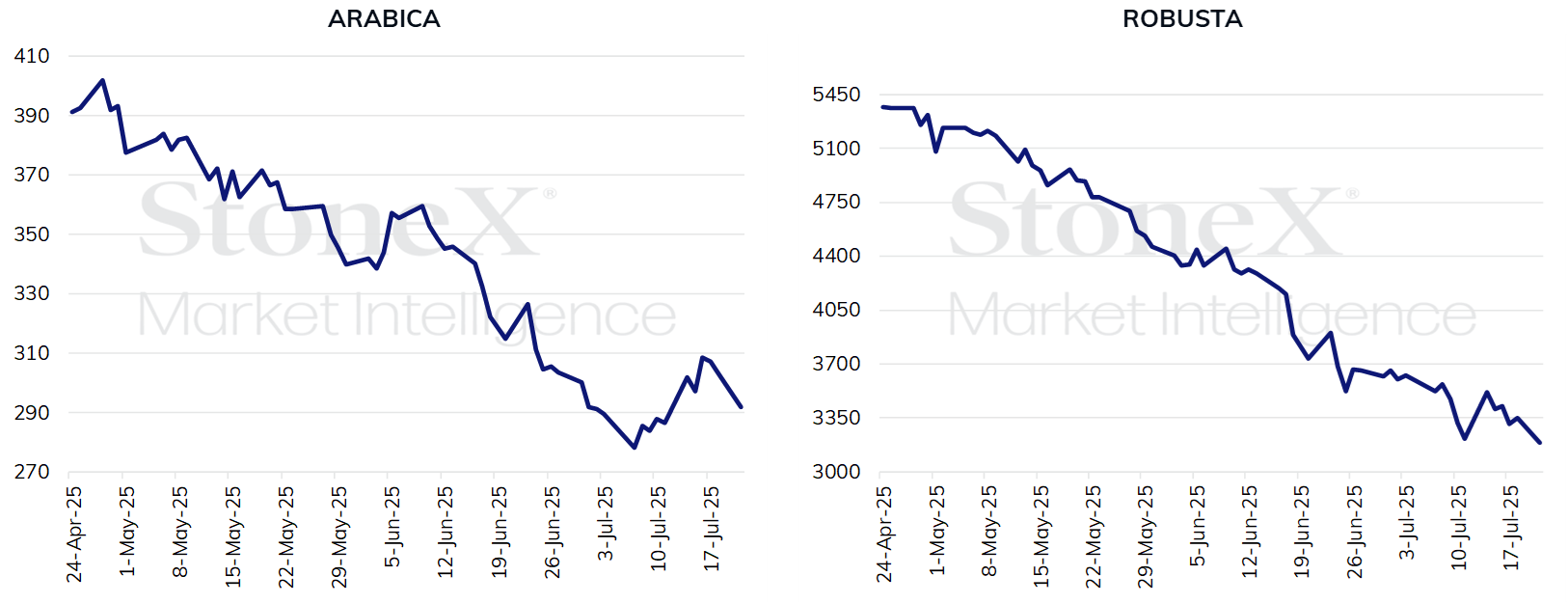
Despite a volatile week on the New York exchange, coffee futures ended the period higher, recovering from the losses of the previous week. The rally continues to reflect concerns over the 50% tariff on Brazilian goods announced by the U.S. government. The September contract closed at US¢ 303.6/lb, up 6.0%.
Robusta also posted weekly gains, with most of the increase driven by a 9% jump on Monday (14), amid fears that the U.S. tariffs could impact not only Brazilian coffee but other origins as well. The following sessions saw corrections, with the September/25 contract closing at USD 3,348/t, up 4.1% on the week.
On Monday (21), prices extended the corrections that began on Friday, mainly due to expectations of abundant supply. Arabica fell 3.8% on the day, while robusta dropped 4.8%. While higher availability is easing pressure on prices, the U.S.-Brazil trade dispute remains a key market driver. With the deadline approaching and no significant progress in negotiations, another bullish wave could develop.
Preços futuros de café arábica (US¢/lb) café robusta (USD/ton)
In recent weeks, U.S. importers have been fast-tracking deliveries of previously purchased Brazilian coffee in anticipation of the tariff’s enforcement. However, logistical constraints limit how much shipping and unloading can be accelerated, keeping market anxiety high. Some companies have reportedly redirected stocks from Canada and Mexico—originally meant for local consumption—to the U.S.
On the futures side, tariffs are expected to be bullish. In the physical Brazilian market, however, a potential drop in shipments to the U.S.—Brazil’s main coffee destination—could pressure domestic prices. Negotiations are ongoing, with Cecafé expressing cautious optimism regarding bilateral talks. Still, there’s a clear slowdown in new contracts as exporters avoid fresh deals with the U.S. amid uncertainty. This cautious stance is likely to persist until a clearer path forward is established.
One factor that deepened market pessimism was a letter from U.S. President Donald Trump to former Brazilian President Jair Bolsonaro, in which Trump reiterated linking the 50% tariff to Bolsonaro’s ongoing judicial trial. With investigations and precautionary measures escalating last week, fears have grown that the White House may take a firmer stance—or even implement the tariffs—in August.
Other major producers have made commercial headway with the U.S. Indonesia, for example, reached a deal with the Trump administration to reduce tariffs from 32% to 19%. Still, the country is pushing for exemptions on key commodities such as crude palm oil, cocoa, rubber, coffee, and nickel.
Harvest Progress
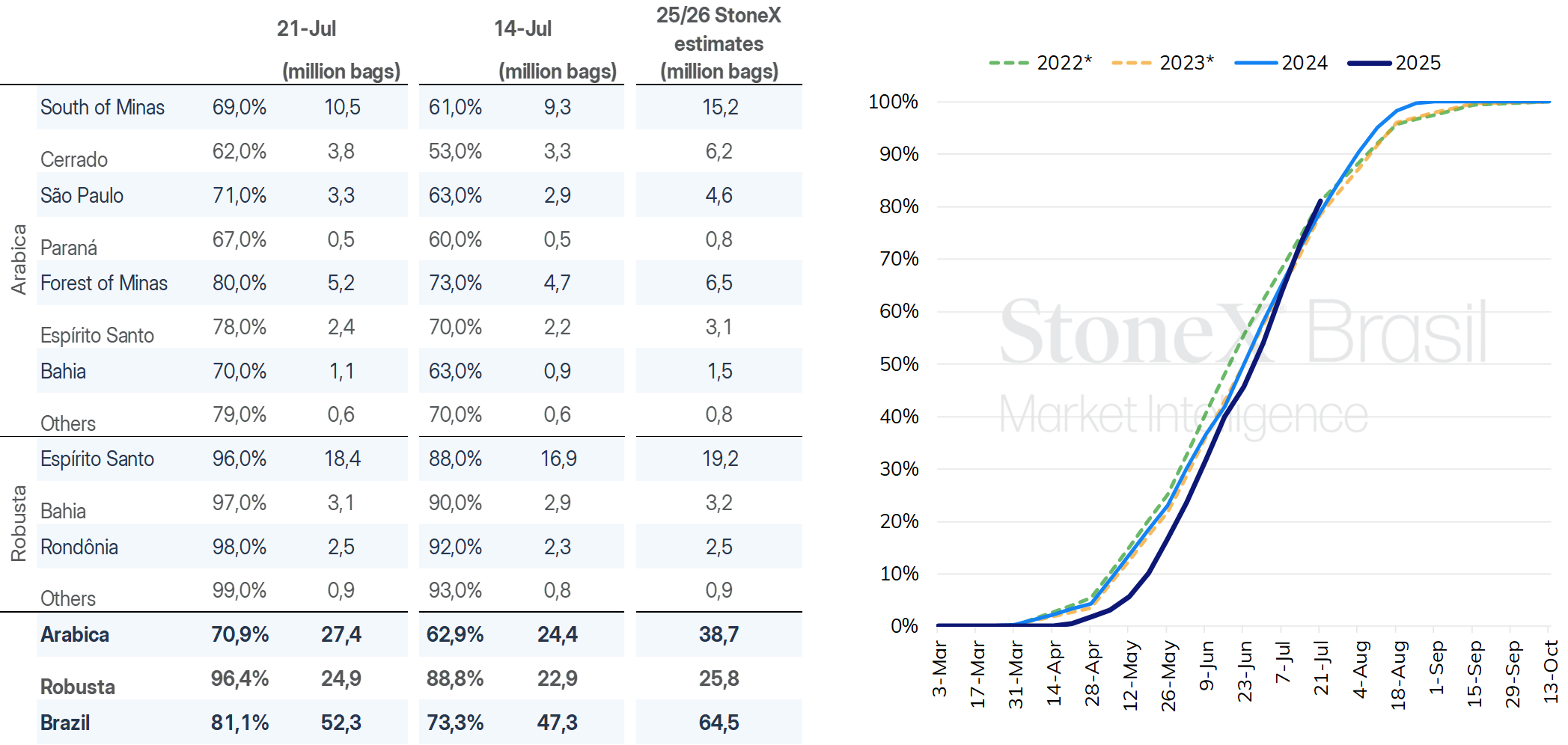
In Brazil, harvesting is nearing completion. According to StoneX, the robusta harvest is practically done, with 96% completed by the end of last week. Arabica harvesting advanced from 62.9% to 70.9%, bringing the national total to 81.1%. Among regions, Matas de Minas leads with 80% harvested, while the Cerrado lags behind at 62%.
Coffee Harvest Progress in Brazil
Source: StoneX.
Cecafé Releases Brazil’s Coffee Export Data for June
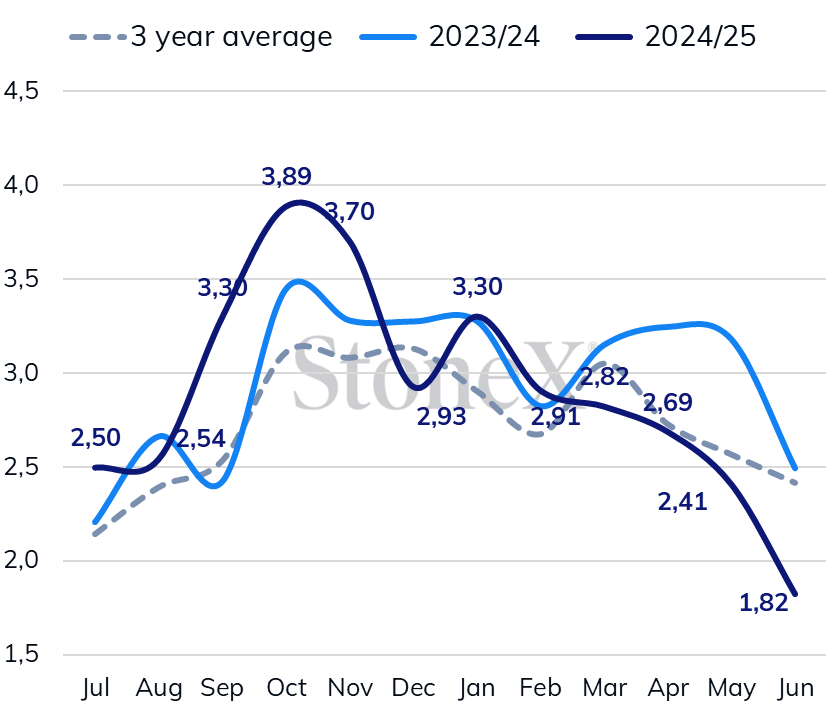
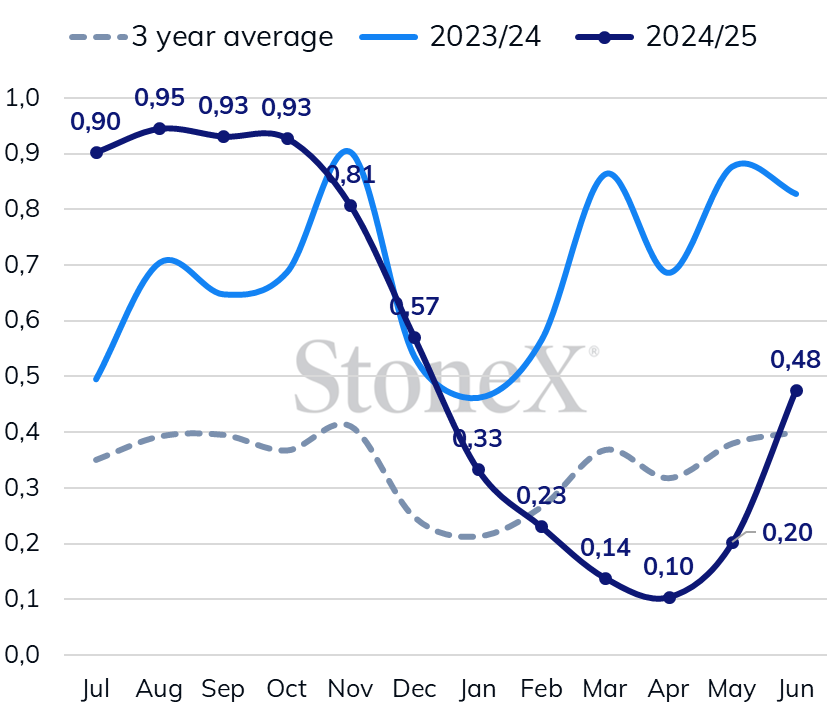
Cecafé released Brazil’s official June export data, consolidating crop-year 2024/25 figures. Green coffee exports totaled 2.3 million bags—30% below June 2024 and 18% under the three-year average. Of this total, 1.8 million bags were arabica (–24%) and 476,000 bags were robusta (–42% year-over-year, but +19% above the average).
The weak June performance reflects the ongoing deceleration seen in recent months. The first half of the crop year saw intense shipping activity—12.6% above the prior season and 29% over the three-year average—leading to reduced availability for the second half and contributing to price support.
Monthly Brazilian Exports of Arabica and Robusta Coffee, Respectively (Million Bags)
Source: Cecafé. Design: StoneX.
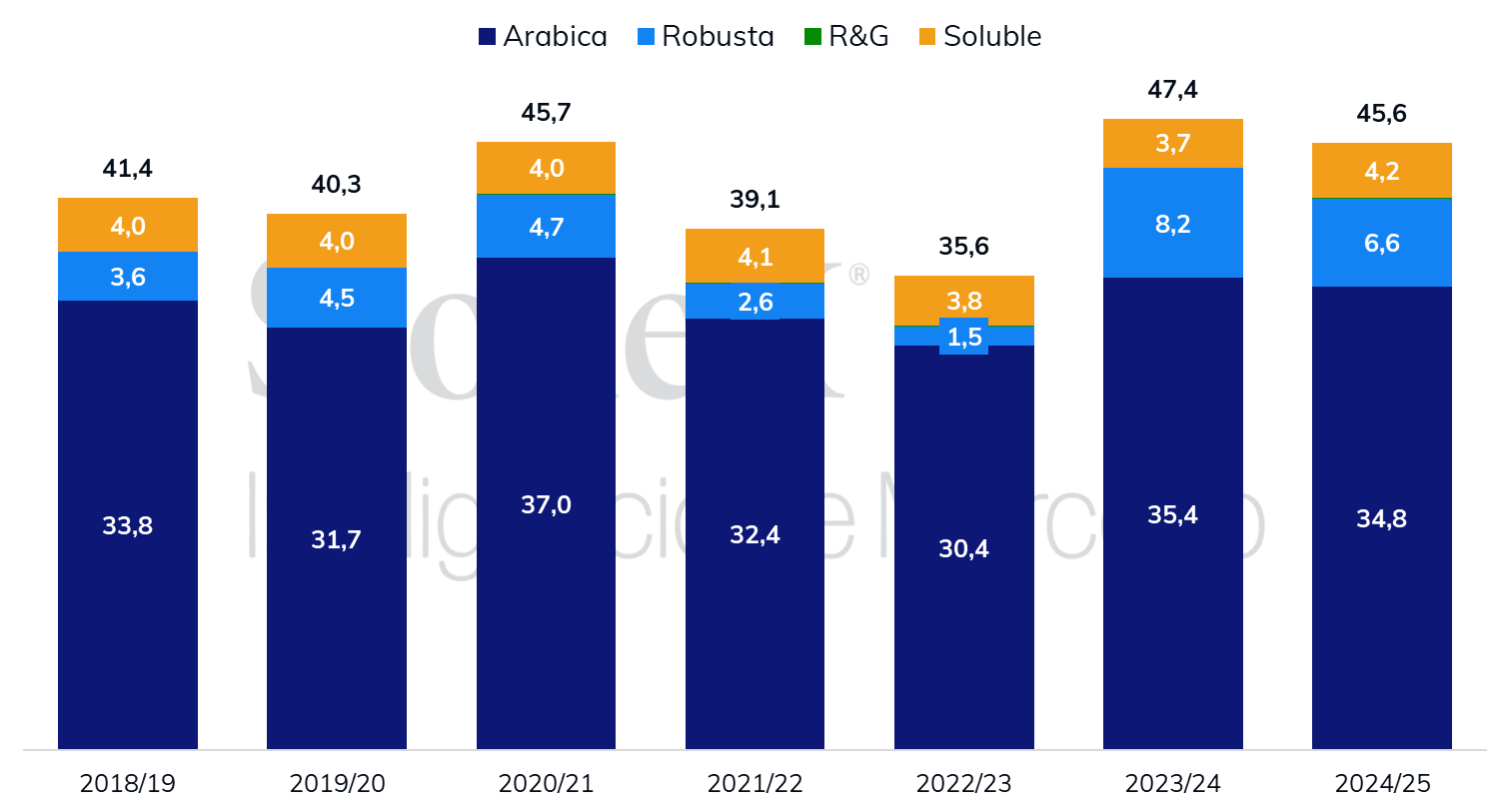
In total, the 2024/25 crop year exported 41.3 million bags of green coffee, a 5.3% decline compared to the previous season. Arabica shipments reached 34.8 million bags (–1.8%) and robusta 6.6 million (–20.3%), still above historical averages. Instant coffee exports rose 13.4%, totaling 4.1 million bags.
Brazilian Coffee Exports by Crop Year (Million Bags)
Source: Cecafé. Design: StoneX.
-
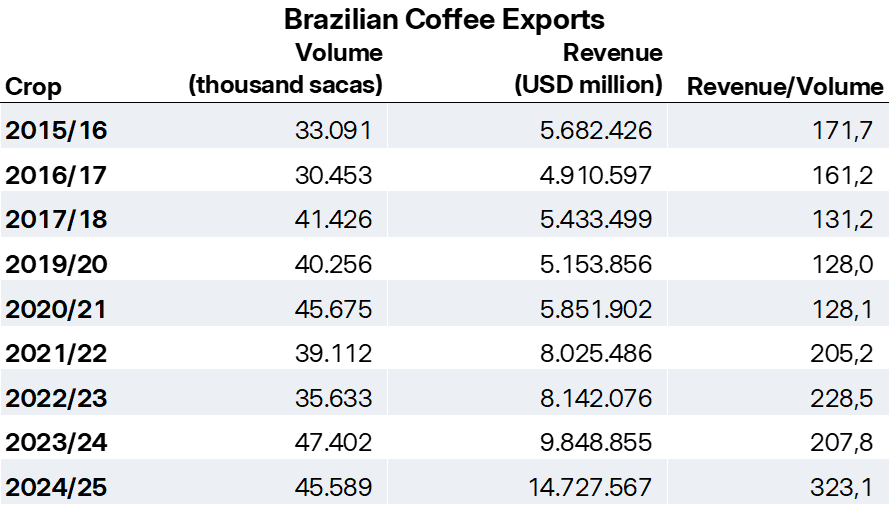
Despite lower volumes, foreign exchange revenue hit a record USD 14.7 billion, a 49.5% increase over the previous crop year. The average price was USD 323/bag, compared to USD 207/bag in 2023/24. The result supports the view that, even with lower-than-expected volumes—especially for arabica—high prices ensured solid returns, boosting the outlook for reinvestment, fertilization, and crop care.
Source: Cecafé. Design: StoneX.
Weather Outlook
The forecast of advancing cold fronts, combined with a negative AAO (Antarctic Oscillation) index, increases the risk of frost in southern Brazil over the coming days. However, there is uncertainty about how far the cold air will reach into the central-southern regions. The GFS model indicates more cloud cover over the South and the Zona da Mata in Minas Gerais, which could help retain nighttime warmth. Nonetheless, attention remains warranted for the Cerrado, São Paulo, and Paraná.
In Espírito Santo, the harvest is progressing well. However, areas that have already undergone flowering require close monitoring, as no significant rainfall is expected in the coming days. In Rondônia, after weeks of dry weather, some rainfall is forecast, which may improve soil moisture and aid irrigation supplies.
TABLE