Quarterly Commodities Outlook is available for free now.  Download your report  →

StoneX logo

CoffeeNetwork Revises Estimates for 22-23 Global Demand, Sees Surplus for 23-24

By: CommodityNetwork Team - USA, CommodityNetwork USA

CoffeeNetwork Revises Estimates for 22-23 Global Demand, Sees Surplus for 23-24
 
Alexis Rubinstein
Managing Editor
In this report, we will combine data from various sources along with our own credible analysis to deliver ranges for production and demand forecasts for the October 2023 to September 2024 crop year, which we think are most reasonable for today’s climate.
Production
For Brazil, in November 2022, the StoneX team visited coffee producing regions of Rondônia, south of Bahia and Espírito Santo. In the second half of the trip, in February 2023, they visited the areas in the Cerrado, southern Minas Gerais, Mogiana and Matas de Minas. Based on the findings, Brazil’s 2023-2024 coffee crop is estimated around 62.3 million bags. This figure was used in our global production calculation.
For the other major producers, we will see the impact from both the presence of La Niña and the transition to El Niño on coffee crops. 
For the world’s second largest producer, Vietnam, production should increase slightly from last year from 30 million bags to 31.2 million bags. The expectation is that rainfall will remain plentiful in the coming months and temperatures should hover in the average range providing beneficial conditions for the development of the crop. Additionally, improving yields could lead to a larger crop. 
Indonesia was significantly impacted by La Niña-induced excessive rainfall, which cut production by an expected 2 million bags. With the main harvesting of the crop beginning this month, fortunately, the 2023-2024 crop will avoid any further damage by El Niño related weather. 
Expectations of strong droughts in Colombia later this year have led some of the country's coffee growers and exporters to cut their production estimates for 2023-2024. The El Niño weather phenomena is producing high temperatures across the country, and the tendency is expected to worsen into June onwards when it will begin to consolidate. The country will face these El Niño conditions after experiencing La Niña for three consecutive years, causing torrential rains. CoffeeNetwork estimates that production in Colombia for 2023-2024 could fall to 11 million bags, down from the 13 million bags produced in the previous coffee year. 
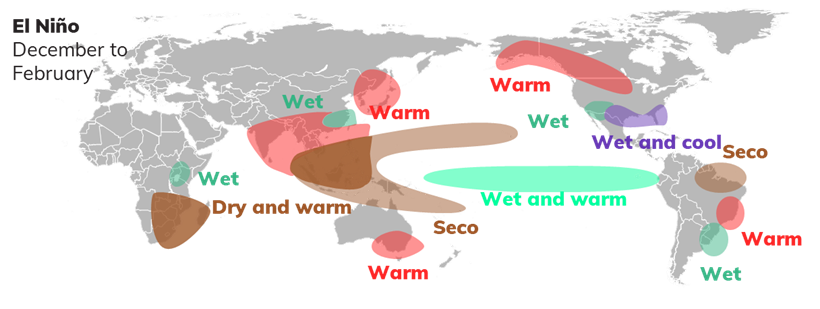
The impact of El Niño on Latin American coffee producing regions is generally a delay in the onset of seasonal rains, followed by either erratic or below average precipitation, which could cause uneven or delayed flowering. Colombia experiences flowering from February-March, whereas in Central America, flowering occurs in April-May. 
image 73805
Chart 1: Impact of El Niño (November to February), source: StoneX and NOAA
image 73806
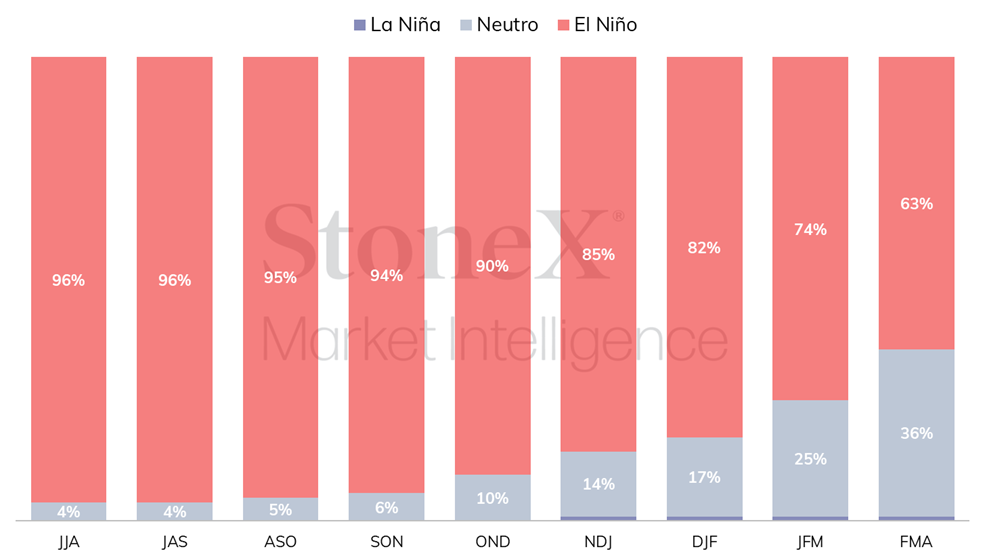
Chart 2: Likelihood of El Niño, source: NOAA
Taking into account our forecasts for each individual country, CoffeeNetwork sees global production for the 2023-2024 coffee year at 171 to 173 million bags. This represents an increase of 0.6% to 1.8% from the previous crop year when CoffeeNetwork estimated production between 170 and 172 million bags. 
Consumption

2022-2023 Revisions

We know…we sound like a broken record. But we have said it before and we will say it again – it is an unnecessarily massive challenge to try and calculate global coffee demand. There continues to be major voids in data and specific information needed to accurately assess the situation. And even in the areas where the data isn’t lacking, it’s far from transparent, and credibility and accuracy are almost always questioned.
But, we are not afraid to admit when we were wrong. And admittedly, we may have been too optimistic about global coffee consumption for the 2022-2023 crop year. In our last forecast in June 2022, we projected that demand for the October 2022 to September 2023 crop year would range between 164 to 165 million bags, representing a 0.5% to 1% increase year on year. However, as the time period progressed, we saw data pointing to slower demand globally, which prompted us to revise our estimates.
CoffeeNetwork now sees global coffee demand falling by 1% from the 2021-2022 crop year to the 2022-2023 crop year. Therefore, demand for 22-23 is now pegged at 162.36 to 163.35 million bags. 
Why the Revision?
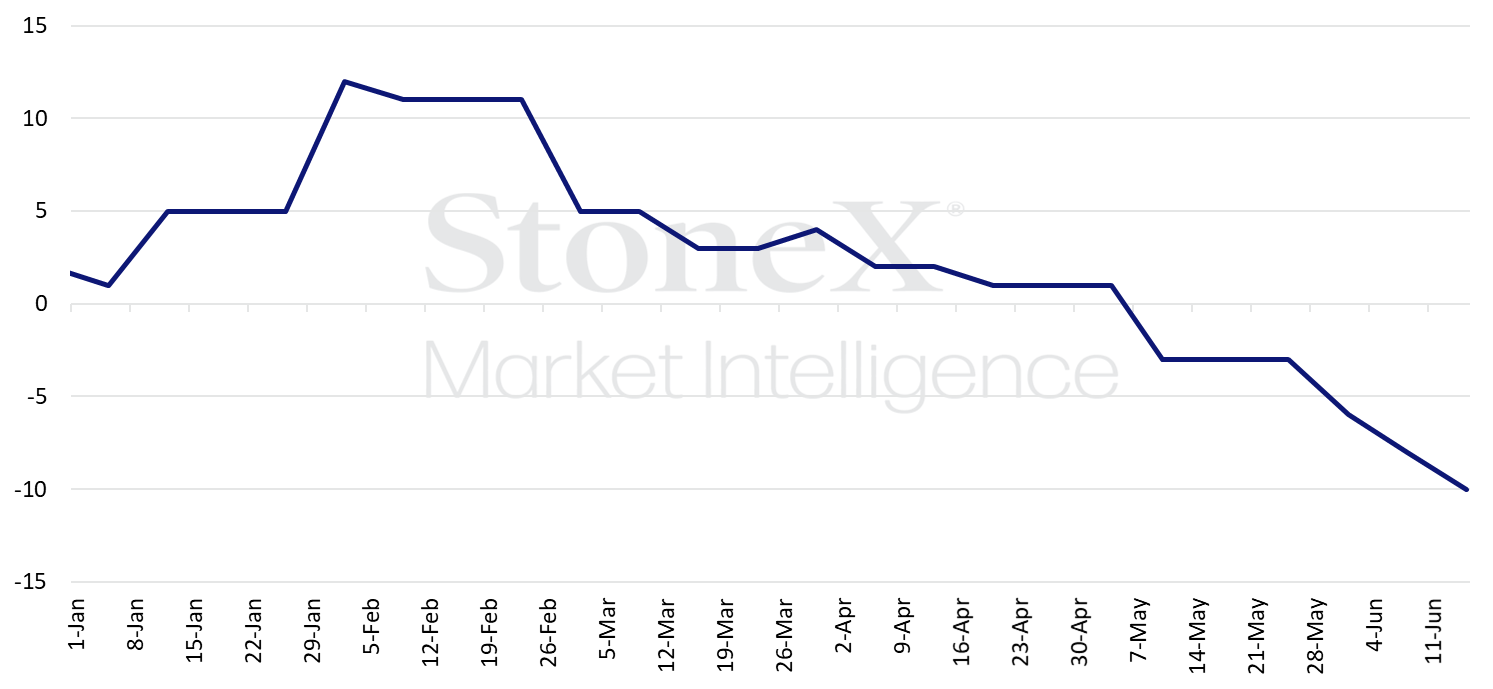
First, we took a look at differentials, which generally reflect origin-specific demand/supply outlooks. Within the last few weeks, about 8 months into the 2022-2023 crop year, we have seen differentials begin to collapse. The cause of the weakening differentials is lower demand from importers. Brazil, for example, started the beginning of the year with a premium of FOB +16 and was last seen at -9 for SW NY 2/3 FC 14/16 in South of Minas (a semi-washed coffee with similar quality to what the Exchange would certify). 
image 73812
Chart 3: Brazilian Arabica Coffee Differentials 
It is important to note, however, that while weakening differentials confirm lower demand from importers; lower demand from importers does not necessarily equate to lower global consumption. We are currently in the midst of a backwardation, meaning it is not favorable to carry over stocks. This, in addition to the high interest rate, makes the carryover even more expensive, making it financially unattractive to buy new coffee at the moment. So, it is entirely possible that the weakening differentials are a result of importers just drawing down their stocks, but, unfortunately, we don’t have reliable stock data to confirm nor deny this theory.
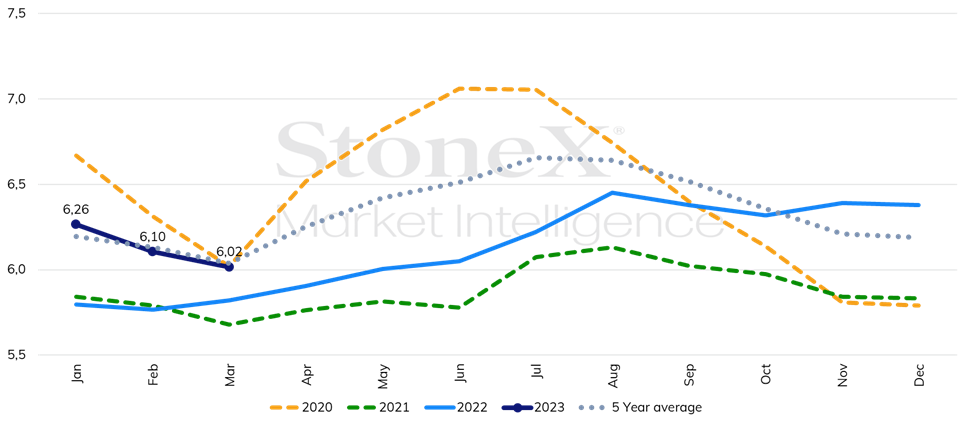
The Green Coffee Association stopped publishing reports on coffee stocks in the US as of April 2023, leaving only 6 months of data for the October 2022 to September 2023 crop year. What we can tell from those 6 months, however, is that stocks only fell 4.8%, or 303,885 bags, over the period. This drawdown in stocks does not infer strong demand.  
image 73807
Chart 4: Green Coffee Stocks in the US, source: GCA
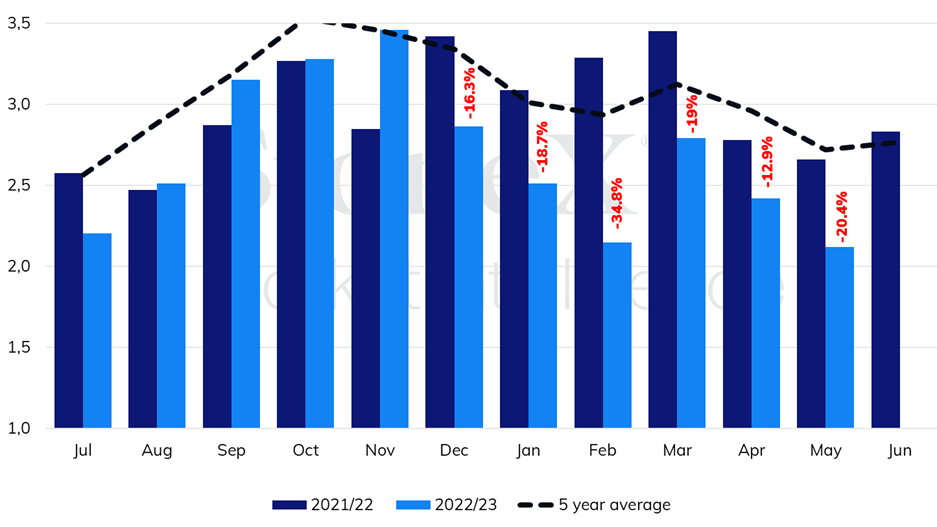
Fortunately, data from global exports and imports are both widely reported and generally accurate, and therefore, can be used efficiently as evidence to lower demand. Official data from Brazil’s Coffee Exporters Association, CeCafe, showed that coffee exports as of May 2023 were down 21.5% year on year. With two consecutive years of healthy crops, it is more likely that lower exports are a result of slowed demand as opposed to a lack of supply. 
image 73809
Chart 5: Green Coffee Exports from Brazil, source: CeCafe
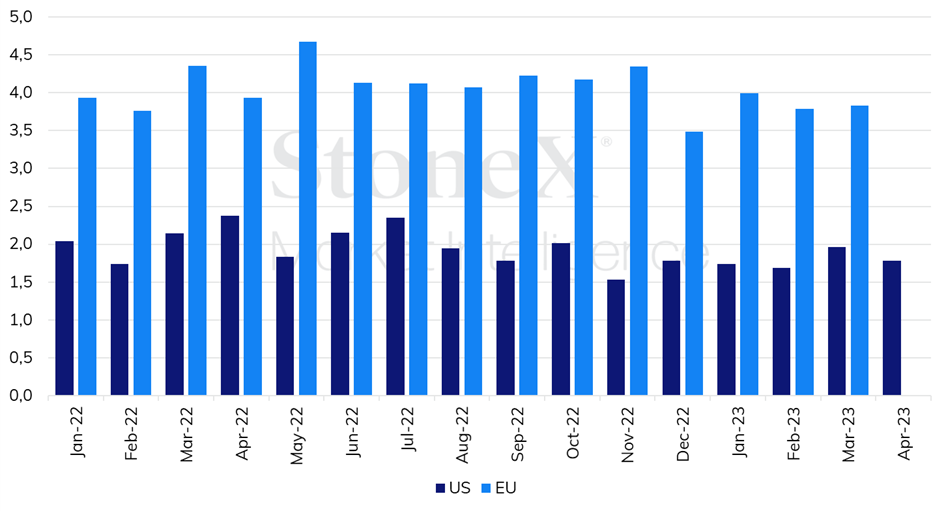
Imports for the EU and US were also lower than average. Coffee imports to the US have been steadily declining since the start of the crop year. Data from the USDA shows that US coffee imports are currently down 11.4% from October 2022 to April 2023. European coffee imports have followed a similar pattern, with the latest Eurostat data showing EU coffee imports down 8% since the start of the crop year. 
image 73810
Chart 6: Coffee imports to the US and EU, source: USDA and Eurostat
Another window into consumption is to look at the financial results of the major international coffee companies. But one must look more closely than just total revenue, as raising prices was a common practice last year and helped compensate for losses derived from lower volume of sales. Farmer Brothers reported total revenue for the fiscal third quarter was $124.2 million, a slight increase year-over-year, but down on a quarter-over-quarter basis. “We are beginning to see increasing success selling through higher priced coffee as our recent price increases take hold across our broader customer base,” the company said. Starbucks saw global comparable store sales increased 11%, primarily driven by a 6% increase in comparable transactions and 4% increase in average ticket. Keurig Dr Pepper’s net sales for the first quarter 2023 decreased 1.3% to $931 million, compared to $943 million in the year-ago period.  This performance reflected higher net price realization of 5.3%, more than offset by a 6.6% decline in volume/mix.  For Nestle’s coffee portfolio, organic growth was 2.9%, with pricing of 4.0%. RIG (real internal growth) was -1.1%, mainly due to post-pandemic normalization. Reported sales in Nespresso decreased by 2.2% to CHF 1.6 billion. JDE Peets reported financial results for full year 2022, which showed total sales increased by 11.3% on an organic basis. Organic sales growth reflects a price effect of 15.8% and a volume/mix effect of -4.4%. 

Forecast for 2023-204

Looking ahead to the October 2023- September 2024 crop year, there is the potential for global coffee demand to rebound and resume the long-rooted trend of increasing year on year.

Unfortunately, our forecast for coffee consumption for the 2023-2024 period will not be confirmed by certain data that could be useful, most notably, stock figures. 
Green coffee stocks in Europe are reported by the European Coffee Federation, but only includes data for stocks in the ports of Antwerp, Hamburg, Le Havre, Barcelona, Trieste, Genoa, Napoli, Tallin, London, Felixstowe, and Bremen. This means that, according to Eurostat data, at least 7 of the EU’s busiest container ports are left off the dataset. 

Brazil’s stock figures are equally as elusive. CONAB, the USDA and Brazil’s IBGE all publish data on coffee stocks, all with hugely varying figures. Data from IBGE shows stocks went from 18.6 million bags at the end of 2021 to 14.6 million bags by the end 2022, down 21.5%. USDA shows Brazil’s ending stocks falling from 4.1 million bags to 2.7 million bags. 

As mentioned above, the market will no longer have access to data for green coffee stocks in the US from April 2023 onwards.  

So, with this information, or lack thereof, we must look to other statistics for a better insight into global demand.

One of the main factors into the slowed demand we have projected in 2022-2023 was the soaring cost of coffee. Inflation of coffee prices in main consuming regions deterred consumption as economic concerns lingered. However, the global economic outlook has shifted more positive for the next crop year. If inflation weakens, and interest rates fall, a recovery in consumption is imminent. According to the International Monetary Fund (IMF), “global growth will bottom out at 2.8 percent this year before rising modestly to 3.0 percent in 2024. Global inflation will decrease, although more slowly than initially anticipated, from 8.7 percent in 2022 to 7.0 percent this year and 4.9 percent in 2024.” The price of coffee in the US, Brazil and EU is also pointing towards deflation, according to the most recent data. Should this trend continue into the 2023-2024 crop year, lower coffee costs will correlate with demand recovery. 

image 73811
Chart 7: Coffee price inflation in Brazil, US and EU; source: IBGE, Commerce Department, Eurostat
We also expect coffee prices on the international market to come down after having spent the majority of the 2022-2023 crop year above $170/lb, closing the first session of the 2022-2023 crop year on October 3, 2022 at $215.35, the highest level seen thus far for the period. If Brazil’s winter season ends with no major frost events, the expectation of higher global production should be bearish for coffee. 
Based on this, we believe that global coffee demand will start its recovery and resume its upward trajectory, increasing 0.5% year on year. Our forecast for 2023-2024 coffee demand is therefore 163.17 to 164.17 million bags.
Balance Sheet Review

2023-2024

Production forecast *initial*

2023-2024 Consumption forecast *initial*

2023-2024 Surplus/Deficit *initial*

2022-2023 Production forecast *final*

2022-2023 Consumption forecast *final*

2022-2023 Surplus/Deficit *final*


171-173


163.17- 164.17


+6.83-9.83


170-172


162.36-163.35


+6.65-7.64


  • Coffee

This material should be construed as market commentary and represents the opinions and viewpoints of the author, and does not reflect tailored advice associated with any specific account.


The views are current only through the date stated and are subject to change at any time based upon market or other conditions, and StoneX Group Inc. (“SGI”) disclaims any responsibility to update such views. Actual results, performance, or achievements may differ materially from those expressed or implied. Information is based on data gathered from what we believe are reliable sources. Past performance does not guarantee future results.


The StoneX Group Inc. group of companies provides financial services worldwide through its subsidiaries, including physical commodities, securities, exchange-traded and over-the-counter derivatives, risk management, global payments and foreign exchange products in accordance with applicable law in the jurisdictions where services are provided.


References to certain OTC products or swaps are made on behalf of StoneX Markets, LLC (SXM), a member of the National Futures Association (NFA) and provisionally registered with the U.S. Commodity Futures Trading Commission (CFTC) as a swap dealer. SXM’s products are designed only for individuals or firms who qualify under CFTC rules as an ‘Eligible Contract Participant’ and who have been accepted as customers of SXM.


StoneX Financial Inc. (SFI) is a member of FINRA/NFA/SIPC and registered with the MSRB. SFI is registered with the U.S. Securities and Exchange Commission (SEC) as a Broker-Dealer and with the CFTC as a Futures Commission Merchant and Commodity Trading Advisor. StoneX Financial (Canada) Inc. (SFCI) is registered in Canada and is a member of CIRO and CIPF. References to certain securities trading are made on behalf of the BD Division of SFI and are intended only for an audience of institutional clients as defined by FINRA Rule 4512(c). References to certain exchange-traded futures and options are made on behalf of the FCM Division of SFI. Wealth Management is offered through SA Stone Wealth Management Inc., member FINRA/SIPC, and SA Stone Investment Advisors Inc., an SEC-registered investment advisor, both wholly owned subsidiaries of SGI.

R.J. O’Brien & Associates, LLC (RJO) is registered with the CFTC as a Futures Commission Merchant and is a member of NFA.


StoneX Financial Ltd (SFL) is registered in England and Wales, company no. 5616586. SFL is authorized and regulated by the Financial Conduct Authority (FCA) (registration number FRN:446717) to provide services to professional and eligible customers including: arrangement, execution and, where required, clearing derivative transactions in exchange traded futures and options. SFL is also authorized to engage in the arrangement and execution of transactions in certain OTC products, certain securities trading, precious metals trading and payment services to eligible customers. SFL is authorized and regulated by the FCA under the Payment Services Regulations 2017 for the provision of payment services. SFL is a category 1 ring-dealing member of the London Metal Exchange. In addition SFL also engages in other physically delivered commodities business and other general business activities which are unregulated and not required to be authorized by the FCA.


This communication is issued in the European Economic Area by StoneX Financial Europe GmbH (SFEG). StoneX is the trade name used by STONEX GROUP INC. and all its associated entities and subsidiaries. StoneX Financial Europe GmbH (“SFEG”) is a securities trading firm registered in Germany under Company No. HRB 80844.


StoneX APAC Pte. Ltd. (“SAP”) (Co. Reg. No 200616676W) is regulated as a Dealer (PS20190001002) under the Precious Stones and Precious Metals (Prevention of Money Laundering and Terrorism Financing) Act 2019 for purposes of anti-money laundering and countering the financing of terrorism. SAP is an “Approved International Trading Company” authorized to act as a “Spot Commodity Broker” under the Commodity Trading Act.


StoneX Financial Pte Ltd (Co. Reg. No 201130598R) (“SFP”) is regulated by the Monetary Authority of Singapore and is a Capital Markets Service Licence holder (for dealing in capital market products), an Exempt Financial Adviser (for advising on investment products and issuing or promulgating analyses/ reports on investment products) and a Major Payment Institution (for domestic and cross-border money transfer services).


SFP may distribute analysis/report produced by its respective foreign affiliates within the StoneX Group of companies pursuant to an arrangement under Regulation 32C of the Financial Advisers Regulations Recipients should contact SFP at (65) 6309 1000 for any matters arising from, or in connection with, this webinar.


StoneX APAC Pte. Ltd. (“SAP”) (Co. Reg. No 200616676W) is regulated as a Dealer (PS20190001002) under the Precious Stones and Precious Metals (Prevention of Money Laundering and Terrorism Financing) Act 2019 for purposes of anti-money laundering and countering the financing of terrorism.


StoneX Financial (HK) Limited (CE No.: BCQ152) (“SHK”) is regulated by the Hong Kong Securities and Futures Commission for Dealing in Securities and Dealing in Futures Contracts.


StoneX Financial Pty Ltd (ACN 141 774 727) holds an Australian Financial Service License (AFSL: 345646) for Dealing in Securities, Exchange-Traded Derivatives Contracts, OTC Derivatives Contracts and Foreign Exchange Contracts, and is regulated by the Australian Securities and Investments Commission.


StoneX Securities Co., Ltd. (“SSJ”) (Co. Reg. No 010401047199) is regulated by the Japanese Financial Services Agency as a Type-I Financial Instruments Business Operator (Kanto Local Finance Bureau (FIBO)No.291’), is a member of the Financial Futures Association of Japan for dealing and broking FX and FX Option transactions, and is a member of the Japan Securities Dealers Association for dealing and broking stock indices and option transactions.


Trading swaps and over-the-counter derivatives, exchange-traded derivatives and options and securities involves substantial risk and is not suitable for all investors. Past performance of any futures or option is not indicative of future success. Indicators are not a trading system and are not published as a specific trade recommendation. The information herein is not a recommendation to trade nor investment research or an offer to buy or sell any derivative or security. It does not take into account your particular investment objectives, financial situation or needs and does not create a binding obligation on any of the StoneX group of companies to enter into any transaction with you. You are advised to perform an independent investigation of any transaction to determine whether any transaction is suitable for you. No part of this material may be copied, photocopied or duplicated in any form by any means or redistributed without the prior written consent of StoneX Group Inc.


The report/analysis herein is not directed to, or intended for distribution to or use by, any person or entity who is a citizen or resident of or located in any locality, state, country or other jurisdiction where such distribution, publication, availability or use would be contrary to law or regulation.


© 2026 StoneX Group Inc. All Rights Reserved.

Satellite view of Earth at night showing illuminated cities across Asia and the Middle East

Discover more insights

Our subscribers have access to comprehensive market analysis from StoneX spanning commodities, equities, currencies and more.

Related articles for Coffee

Perspective: Morning Commentary for August 7

August 7 – The U.S. economy unexpectedly lost 23k jobs in July, dramatically below market expectations of an 80k increase and marking the worst Non-Farm Payrolls print since February. Furthermore, May and June were both revised sharply downward, with combined revisions showing 103k fewer jobs than previously reported. Outside of the healthcare sector, which added 22k jobs in July, the losses were very broad-based. Government payrolls saw the largest decline, shedding 53k jobs in July, the largest seen since October 2025, while June was revised down to show a loss of 10k jobs as well. The private sector at least saw growth, adding 30k jobs in July, now matching the month prior after it was revised down from the 49k initially reported, and substantially missing forecasts of 78k jobs being added. This is a sharp reversal in course from the largely better than expected U.S. labor data seen earlier this week.

Mike Castle
Mike Castle
  • Grains & Oilseeds
  • Energy
  • Dairy
  • Renewable Fuels
  • Cocoa
  • Coffee
  • Cotton
  • Sugar
  • Meats & Livestock
  • Forest Products

Daily Coffee Report 8/6/26

Daily coffee report

StoneX Coffee Team
StoneX Coffee Team
  • Coffee

Perspective: Morning Commentary for August 6

August 6 – This morning’s stronger-than-expected U.S. labor data offered markets some relief, reinforcing confidence in the economy while giving the Fed greater flexibility to raise rates should inflationary pressures reaccelerate in next week’s July data. Stock futures are pointing to a mixed open to start the day, with the tech-heavy Nasdaq showing the most weakness. The VIX has fallen notably from yesterday’s spike above 18.4 as it starts the day hovering just below the 16-mark. The dollar is quietly higher as it trades just above 99.8, holding in the tight range seen thus far this week as traders continue to digest data to shape expectations for the Fed’s next move, which we’ll dive into in more depth below. Long-term treasury yields have relaxed slightly from their recent spike, with 30-year yields starting the day trading just above 5.19%, while 10-year yields trade above 4.64%, and 2-year yields sit below 4.22%. Crude oil is modestly higher to start the session after sharp declines earlier in the week, with nearby WTI up 1.8% to trade at $76.40 and nearby Brent up 2.4% to trade at $81.40. Meanwhile, the ags are quietly mixed to start the day.

Mike Castle
Mike Castle
  • Grains & Oilseeds
  • Energy
  • Dairy
  • Renewable Fuels
  • Cocoa
  • Coffee
  • Cotton
  • Sugar
  • Meats & Livestock
  • Forest Products
StoneX: We open markets

Our market expertise, advanced platforms, global reach, culture of full transparency and commitment to our clients’ success all set us apart in the financial marketplace.

Reach

With access to 40+ derivatives exchanges, 180+ foreign exchange markets, nearly every global securities marketplace and numerous bi-lateral liquidity venues, StoneX’s digital network and deep relationships can take clients anywhere they want to go.

Transparency

As a publicly traded company meeting the highest standards of regulatory compliance in the markets we serve; our financials and record of accomplishment are matters of public record. StoneX’s commitment to “doing the right thing over the easy thing” sets us apart in the industry and helps us build respect, client trust and new partnerships.

Expertise

From our proprietary Market Intelligence platform, to “boots on the ground” expertise from award-winning traders and professionals, we connect our clients directly to actionable insights they can use to make more informed decisions and achieve their goals in the global markets.