Colombia’s largest Coffee Regions Have Not Registered Rainfall, Some Downpours
Colombia’s largest Coffee Regions Have Not Registered Rainfall, Some Downpours
Coffee Network (Bogota) – Colombia’s largest coffee-producing regions of Huila and Antioquia rainfall have not recorded significant downpours since January, even though it has started to rain in other parts of the country.
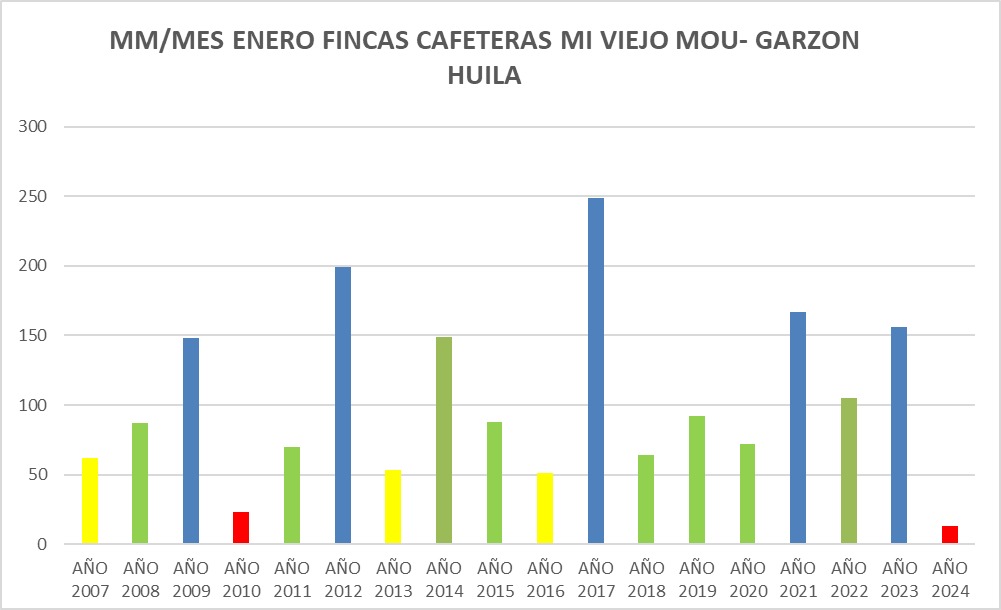
In Huila, Colombia’ largest-coffee producing department, the droughts have been the strongest since 2007 in the central areas of Huila, according to a graphic sent by Mauricio Rivera, general manager of the Huila coffee cooperative Coocentral. (See graphic)
It rained 13 millimeters in the central town of Garzon in January, the lowest level since 2010 when El Niño was also present when downpours had totaled 30 millimeters. That also compares with more than 150 mm in January of last year.
Riverasaid rainfall has not been reported in Huila yet. He confirmed that some coffee plantations are spoiled with the intense weather. Rivera believes that if rainfall does not come soon, thousands of coffee-hectares in Huila will be destroyed.
In the southeast of the Antioquia province, the largest producing area for this department- the second-largest producing province, two millimeters of rainfall was reported earlier this week. The amount of rainfall is insignificant for large coffee plantations located in the municipalities of Bolivar, Andes among others, large coffee grower Juan Alvaro Arboleda said.
Coffee plantations from the southeast of Antioquia can withstand eight consecutive weeks without rainfall to allow a massive flowering, but those plantations need rainfall in March or April to ensure a proper harvest in September-December when they report their main harvest.
Coffee plantations in Bolivar recorded a good flowering on 24 December, and another one last week. They expect good flowerings in February.
Antioquia also has a secondary harvest called mitaca. But that harvest is already damaged as coffee plantations are too dry, Arboleda noted.
“In fact, there are serious problems of quality in the mitaca, which was expected to be not as bad as in the past years,” he said.
Colombia has been experiencing intense drought since January with El Nino disturbances producing high temperatures. The El Nino weather pattern is expected to last until April, the IDEAM government weather office says. But February is expected to be the hottest month, Ideam added.
Colombia's dry season usually comes in the first quarter, but so far 2024 has been hotter than usual due to El Nino.
Rivers across the nation are also drying up, while the level reservoirs are also dropping.
Santander rainfall
Torrential downpours were reported in the Santander and Norte de Santander provinces on 31 January and 1 February, which are small producers of coffee. Rainfall has been so strong that it extinguished a forest fire in the paramo ecosystem of Santurban. Paramos are ecosystems above 3,900 meters high. Forest fires, however, burned more than 500 hectares there. Santander produces 5.5% of Colombia’s total coffee output and Norte de Santander 2.54%.
Maria Fernanda Rey, a large coffee grower in the municipality of La Mesa de Los Santos, said the rainfall came at the right time. The rainfall will allow coffee growers like her to fertilize the land of its plantations that were recently cut via the zoca method. She will also fertilize the land that is currently undergoing flowering.
In the Central province of Cundinamarca, about ten days ago recorded some rainfall in the town of Subia and three days ago a strong rainfall was recorded in Villeta, which mitigated the need for water and gave a small boost to the crops to sustain the small harvest that comes with the New Year
“Logically, at least three or four downpours would be needed in February to sustain the pepeo and begin to nourish the main harvest that arrives in May, in this part of the country, in the Sumapaz Region,” coffee grower Miguel Caldero from the Viota region said.
By Diana Delgado