Over the past six weeks, copper has singled itself out as the best performing base metal (tin excluded), posting gains of 5.6%, versus an average decline across the additional four metals of 1.4%. With less than three weeks of the year the to go, we believe that copper is on track to record a positive year-to-date price performance, albeit just, establishing it as the best performing base metal of 2023.
Copper has separated itself from the rest of the base metal suite over the last month driven by a softening in macro headwinds and strengthening fundamentals, which in turn, have caught investors’ attention.
1. Softening in Macro Headwinds
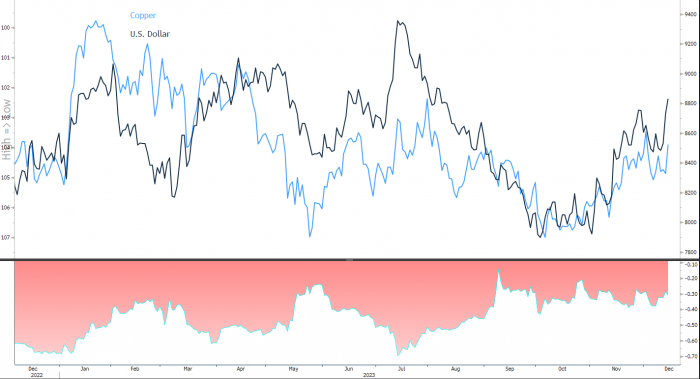
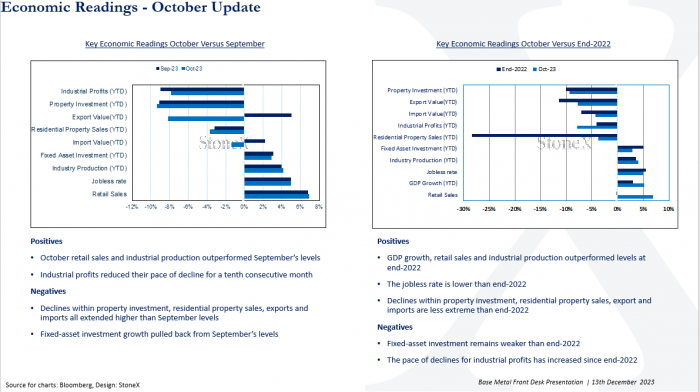
Macro headwinds have been the leading force behind base metal prices over the last 18 months, with a strengthening U.S. dollar, weak consumer appetite ex-China (on rising interest rates rates) and a modest recovery within China dampening the price outlook. However, over the last month, with rising expectations that western central banks may have approached the end of their hiking cycles, in addition to the release of supportive policy action within China (for the property market) and a weakening U.S. dollar, the macro outlook is thawing.
U.S. Federal Reserve Chairman Jerome Powell signalled in the December FOMC meeting that rate cuts were “not the base case anymore” and that discussions of cuts in borrowing costs are coming “into view”.
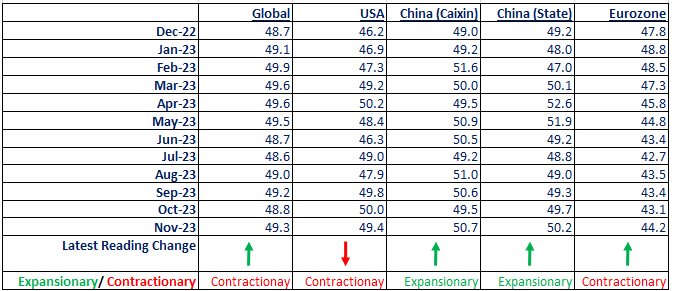
Please note: European December PMI set to rise to 44.6 (from 44.2), U.S. December PMI to rise to 49.5 (from 49.4).
• One of the Newest and Largest Copper Mines is Ordered to Shut Down
A question mark has been placed over the availability of copper ore supply in 2024, on the development that First Quantum’s Cobre Panama mine (on 25th November) was ordered to shut down operations as a result of the country’s Supreme Court ruling that an extension to the mine’s licence would be unconstitutional. Please note, Cobre Panama only began commercial production in 2019 and at full capacity was set to produce more than 300,000t of copper a year (along with gold, silver and molybdenum). In 2022, production rose to 350,438t, accounting for 1.6% of global mine production. Please note, attention will be focused on the upcoming general election in Panama next May, with current President Laurentino Cortizo ineligible for a second consecutive term.
• Production Guidance in 2024 is Being Reduced
To add to supply concerns, on 8th December Anglo American released its altered guidance for copper production in 2024 from 1,000,000-910,000t range to 790-730,000t, effectively removing ~200,000t in output. In addition to this, Anglo American stated that production is likely to fall even further in 2025 (before starting to improve), citing ongoing geological issues at its Quellaveco mine in Peru, in addition to a planned temporary closure of one its two processing plants at its Los Bronces mine in Chile, on the back of expensive-to-process low grade ore.
• Deals on Copper Treatment Charges Have Fallen for the First Time Since 2021
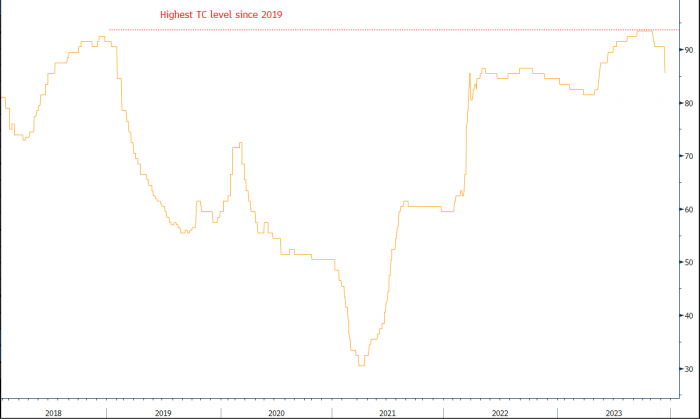
Background: Treatment charges (TCs) are a signal for future copper prices, with lower fees indicating that miners may be struggling to keep up with demand and vice-versa.
On 18th November, Antofagasta Plc signed a deal with Chinese smelter Jinchuan Group to supply copper concentrate contracts in 2024 at a rate 9% lower than in 2023 (at $80/t and 8 c/lb). While traditionally, the first settlement made between a large mining and smelting company serves as a benchmark for the rest of the industry, Reuters reported on 21st November that China’s Copper Smelters Purchase Team (CSPT), “refused to acknowledge the deal between Antofagasta and Jinchuan as a benchmark for global contracts”. However, in the aftermath of the news on Cobre Panama in the subsequent weeks, several major Chinese copper smelters (including Jiangxi Copper Co and Aluminium Corporation of China) agreed to the 9% reduction in processing fees.
Please note, while declining TCs are a sign of tightening ore supply, it doesn’t always equate to a tight refined market, as we must consider the level of growth in Chinese copper smelting capacity, which is forecast to rise 7.7% this year to 9.7Mta, a record high (after remaining unchanged last year during COVID-19 lockdowns). Having said this, where concerns arise is if smelting charges continue to decline, which could result in smelters becoming unprofitable.
• Chilean Mine Production on Track to Hit Lowest Level Since 2003
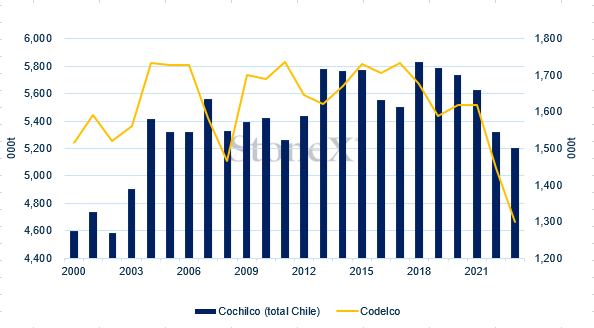
Further to this story is the reality that Chile, the largest copper producing country in the world, is on track to post its lowest annual level of mine production since 2003, citing low ore grades, social unrest, and project delays.
While ex-Chinese demand remains weak due in part to high interest rates in the U.S. and Europe raising the chance of potential recessions, consumption within China has been stronger than headlines have suggested with ‘apparent demand’ rising 2.6% Y/Y to its highest level on record. Please note ‘apparent demand’ is summation of domestic copper production and net imports.
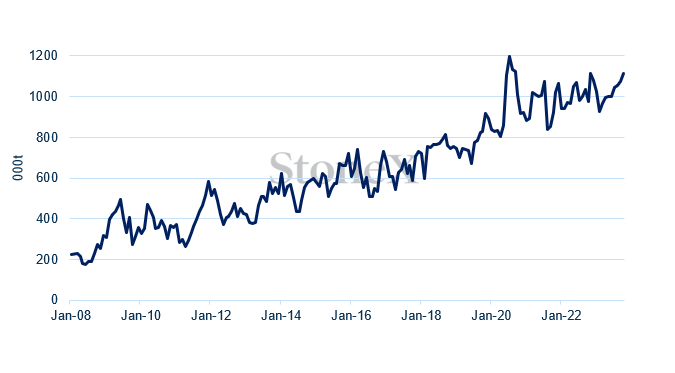
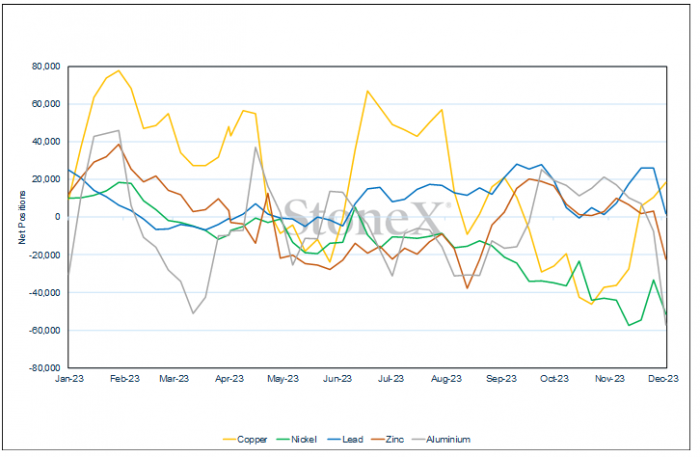
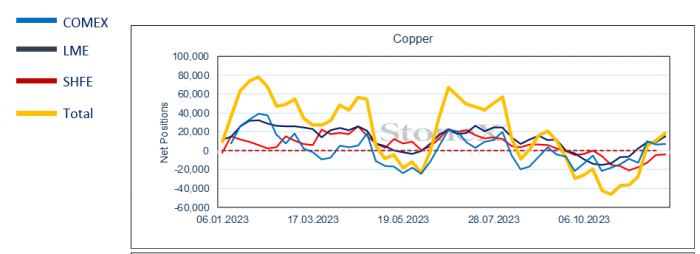
Copper has long been established as one of investors’ most favoured of the base metals, based on its utilisation within the green transition, which is set to cause a structural and difficult to reverse ‘supply gap’ by the middle of the decade. However, with rising concerns about weak demand next year, copper lost its shine over 2023, with investment firm net positions (across LME, COMEX and SHFE) posting an annual (net short) low by end-October. However, as it stands now, copper is leading the pack when it comes to speculative sentiment, moving into a net long position by 24th November.