BEARISH FACTORS
- Concerns about global recession;
- Creation of a Ukrainian export corridor through the Black Sea;
- Concern about a possible weakening of demand.
BULLISH FACTORS
- Restriction in grain supply due to the Black Sea conflict;
- Crop losses in the US;
- Expectations of lower production in the EU and China due to drought.
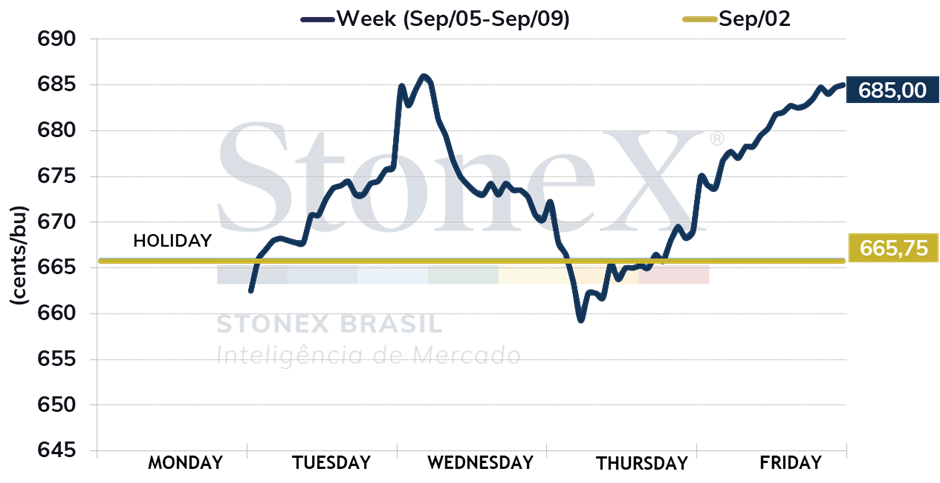
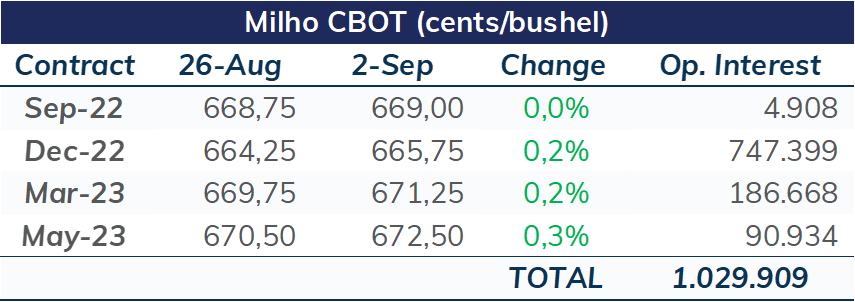
Last week, shorter in Chicago due to the Labor Day holiday in the US on Monday 5, corn oscillated between highs and lows to end the period higher. The December contract ended Friday (9) at 685 cents per bushel, high by 2.9%.
The outlook for the US crop continued to be a supporting factor for grain prices, as the outlook points to crop losses as new private estimates are released.
The weekly US crop follow-up released by the USDA maintained good/excellent corn crop conditions at 54%, seven p.p. below the five-year average for the period.
Intraday (15 min) - November/22 (CBOT)
The US crop is very important for the global supply and demand balance for corn since the country accounts for about one-third of what is produced globally. In addition, domestic consumption in the US is very high, with a great demand for ethanol.
Currently, the outlook is for US stocks to fall in the 22/23 cycle, with levels getting lower than those recorded in previous years.
On Monday, the USDA will update its WASDE report with the average market estimates expecting US corn yields to be 11.83 tonnes per hectare, down from 11 tonnes per hectare reported in August.
The market monitors the US crop for its relevance and in the context of conflict between Russia and Ukraine since Ukrainian exports of the grain are very relevant for world supply. However, even with the agreement for safe passage through the Black Sea, there are many uncertainties related to the volumes that Ukraine will be able to dispose of and how much the production of the 2022/23 cycle will be. In addition, Russia has questioned the agreement, arguing that the cargoes flowing through the Black Sea is not going to emerging countries but mainly to the European Union.
On the other hand, the demand could bring some relief to the corn balance sheet since there is the possibility of an economic slowdown around the world when countries are fighting inflation by taking monetary tightening measures, such as increasing interest rates, which tend to have recessive impacts. Even so, as corn is a food commodity, consumption does not tend to be so impacted by moments of crisis. On the other hand, the use of corn for ethanol production would tend to suffer more direct consequences from a possible recession.
The US is the main corn consumer for biofuel production, but other countries have initiatives in this sense, which have stalled more in the last years due to higher grain prices.
In China, the expectation was for the country to reach E10 (10% ethanol blend in gasoline), but, currently, the perspectives are in decline for 2023. As a result, the ethanol blend in gasoline is expected to stay at 1.8%, lower than the 2.8% reached eleven years ago. In addition, biofuel use in 2022 is about 4% lower compared to last year, amid the maintenance of the zero-tolerance policy against Covid-19. Furthermore, the country continues to impose lockdowns on large numbers of people whenever cases of the disease are detected, even though the number of positives is low compared to other countries.