Bearish drivers
- Favorable prospects for Brazilian production and falling premiums;
- Eased concerns related to the Black Sea grain export agreement (late midweek);
- Slower pace of US sales.
Bullish drivers
- Concern involving the Black Sea grain export agreement, interruption of inspections by Russia and ban on imports by some European countries (early in the week);
- Concern about delayed planting in the US;
- Improved US shipment pace.
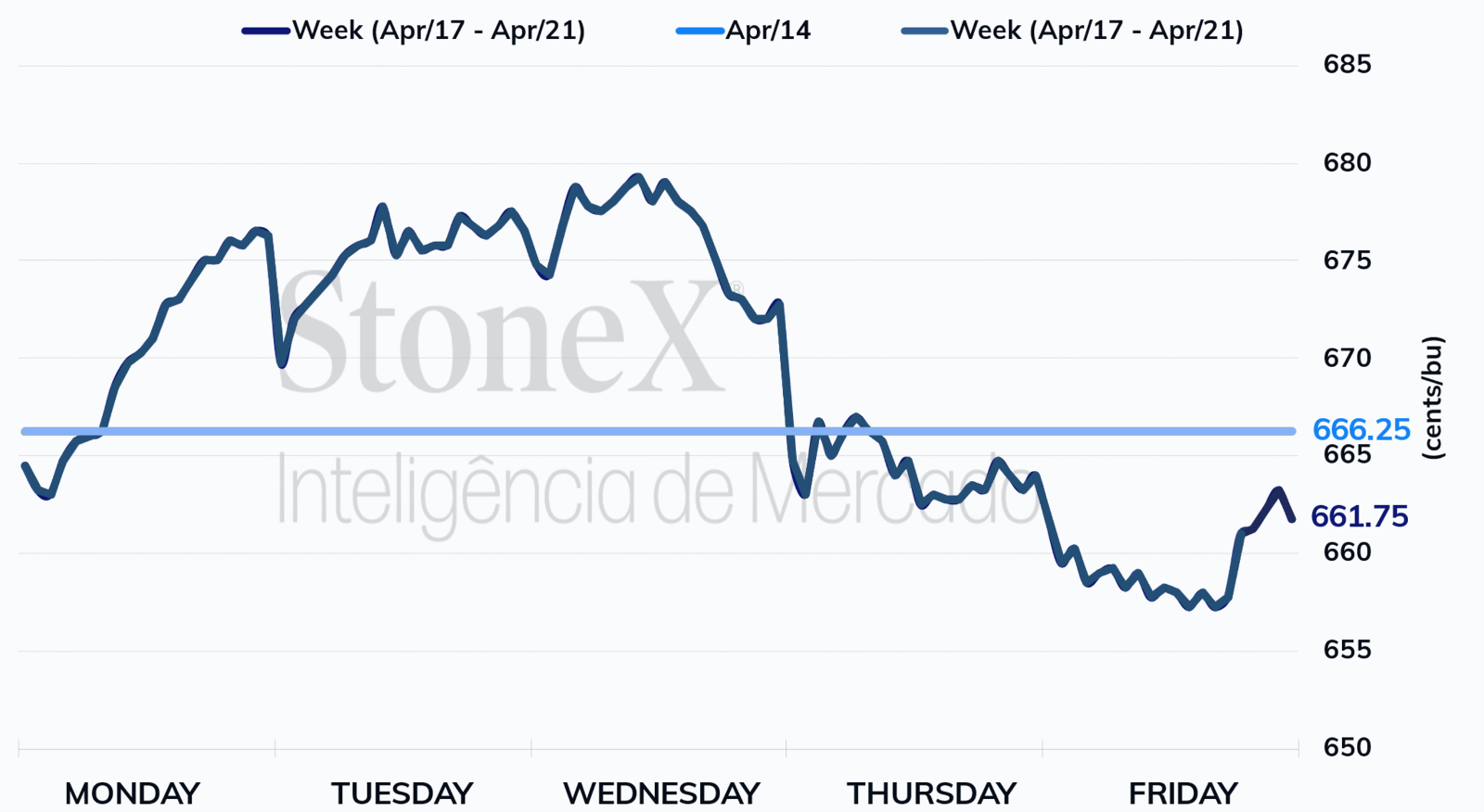
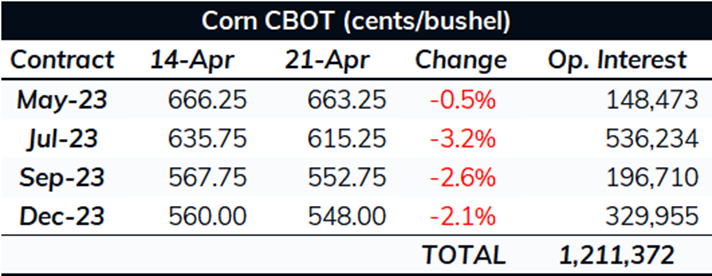
Last week, corn futures retreated in Chicago, with May/23 showing a devaluation of 0.5% in the period, ending Friday (21) quoted at 663.25 cents/bu. The more distant contracts posted more intense declines. July/23 contract registered a contraction of 3.2%, to 615.25 cents/bu, while September/23 retreated 2.6%, ending the week quoted at 552.75 cents/bu.
At the beginning of the week, futures even accumulated gains, receiving support from less favorable prospects for the progress of planting in the US, a swifter pace of US shipments, and doubts related to the agreement for the grain export through the Black Sea and the flow of Ukrainian grains. However, in the last half of the week, prices retreated, pressured by lower premiums in Brazil, lower-than-expected export sales in the US, and less concerns related to Ukrainian shipments.
Intraday (15 min) - May/23 (CBOT)
Source: CME. Design: StoneX.
US volume of corn shipments improves. As released in the USDA Export Inspection Report, the US shipped 1.2 million tonnes of corn in the week ended April 13, 376,100 tonnes more than a week earlier and 32,400 more than the same week last year. With this, the country slightly reduced the deficit of accumulated shipments compared to the 2021/22 season, to 11.82 million tonnes. As of April 13, the US exported 21.4 million tonnes of corn.
Planting progress is again below expectations but remains above average. Last Monday (17), the USDA released its Crop Progress Report, reporting that corn planting in the US reached 8% through April 16, 2 points below market expectations, but above the five-year average for the same period (5%). Earlier in the week, weather models pointed to higher rainfall and a colder pattern in the Midwest and a new round of snow in North Dakota and Minnesota, factors that could delay planting in the region. However, it was reported that the planting progress occurred as normal in the areas that received rain in the Midwest, which reduced the weight of the expectation of a slowdown in the pace of planting on quotes.
US ethanol production and stocks on the rise. According to data released by the EIA, US ethanol production advanced to 1,024 million barrels per day in the week between April 8 and 14, an increase of 65,000 in the weekly comparison and 77,000 above the five-year average for the same period. Stocks also rose to 25.29 million barrels, 165,000 barrels more than a week earlier.
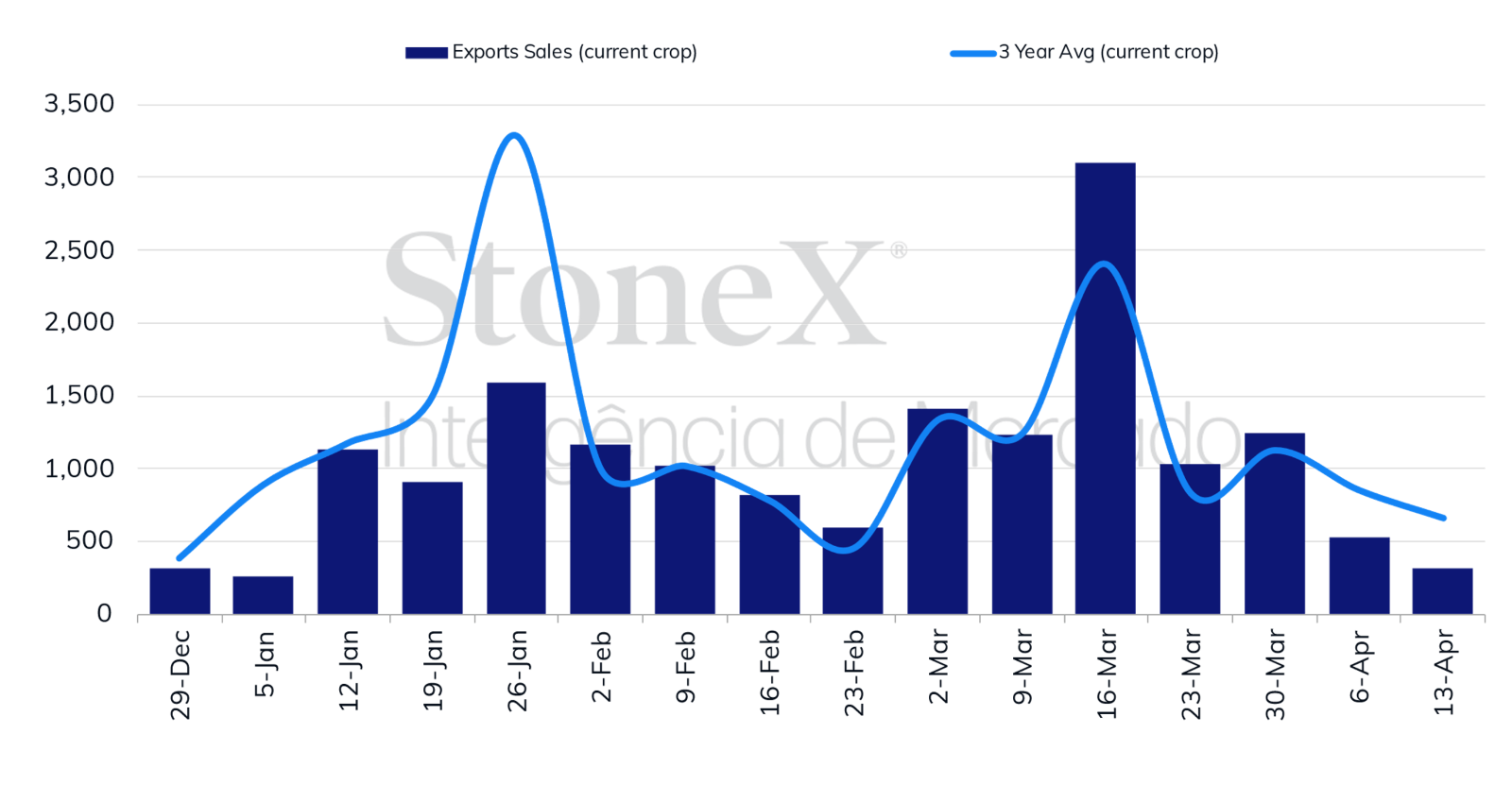
Deficit in export sales volume compared to last season widens again and disappoints agents. In its Export Sales Report, the USDA reported that US net sales totaled 312,400 tonnes for the week ended April 13, 215,300 tonnes less than a week earlier, 566,800 tonnes lower than in the same period of 2022 and 480,640 below the five-year average. In addition, the volume was also below the lower limit of the range expected by the market, which varied between 575,000 and 850,000 tonnes. As a result, cumulative sales increased to 38.1 million tonnes, but the deficit compared to the 2021/22 season increased from 18 million to 18.6 million tonnes.
US weekly export sales (000 tonnes)
Source: USDA. Design: StoneX.
Black Sea grain export agreement moves the market again. Last week, uncertainties surrounding the agreement to export grains through the Black Sea contributed to the significant oscillation presented by corn futures. Earlier in the week, reports surfaced that Russia had suspended inspections of ships and that European countries such as Poland, Hungary, Slovakia, and Bulgaria had banned the import and flow of Ukrainian grain through their territory in order to protect local farmers from great competition with grains of Ukrainian origin, which are considerably cheaper. All this concern about supply supported prices at the beginning of the week. However, at the end of the period, some news brought relief to the market, pressuring prices down. Russia resumed inspections and Poland and Bulgaria did not prevent the passage of Ukrainian grains through their territory, only imports.
Premiums in Brazil show a significant decline. Last week, there was a significant drop in corn premiums in Brazil. Throughout the week, the premium (purchase) at the port of Santos for delivery in August 2023 dropped from 40 cents/bu to 15 cents/bu. The high expectations related to the supply of the Brazilian crop and the low pace of sales are factors that have pressured the indicator and may also affect corn prices on the CBOT.
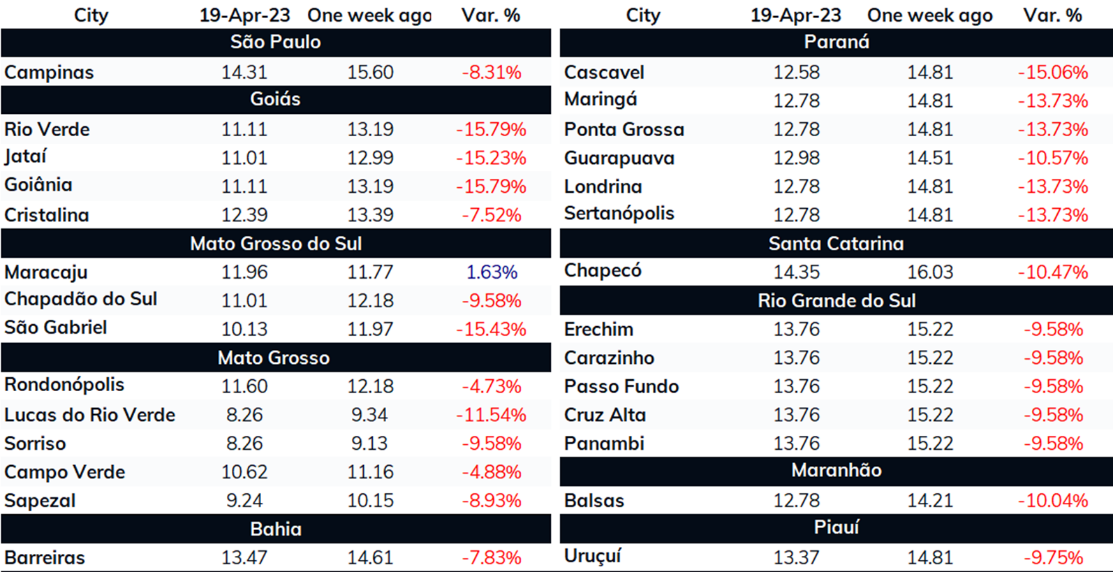
SPOT PRICES (USD/60kg-bag)