- Favorable prospects for Brazilian production;
- Weakened pace of US sales and cancelled shipments to China;
- Favorable prospects for US production;
- Renewed agreement for grain export via the Black Sea.
- Poor conditions for the Argentine corn crop.
- Weather models point to low rainfall in most of the corn producing regions in Brazil.
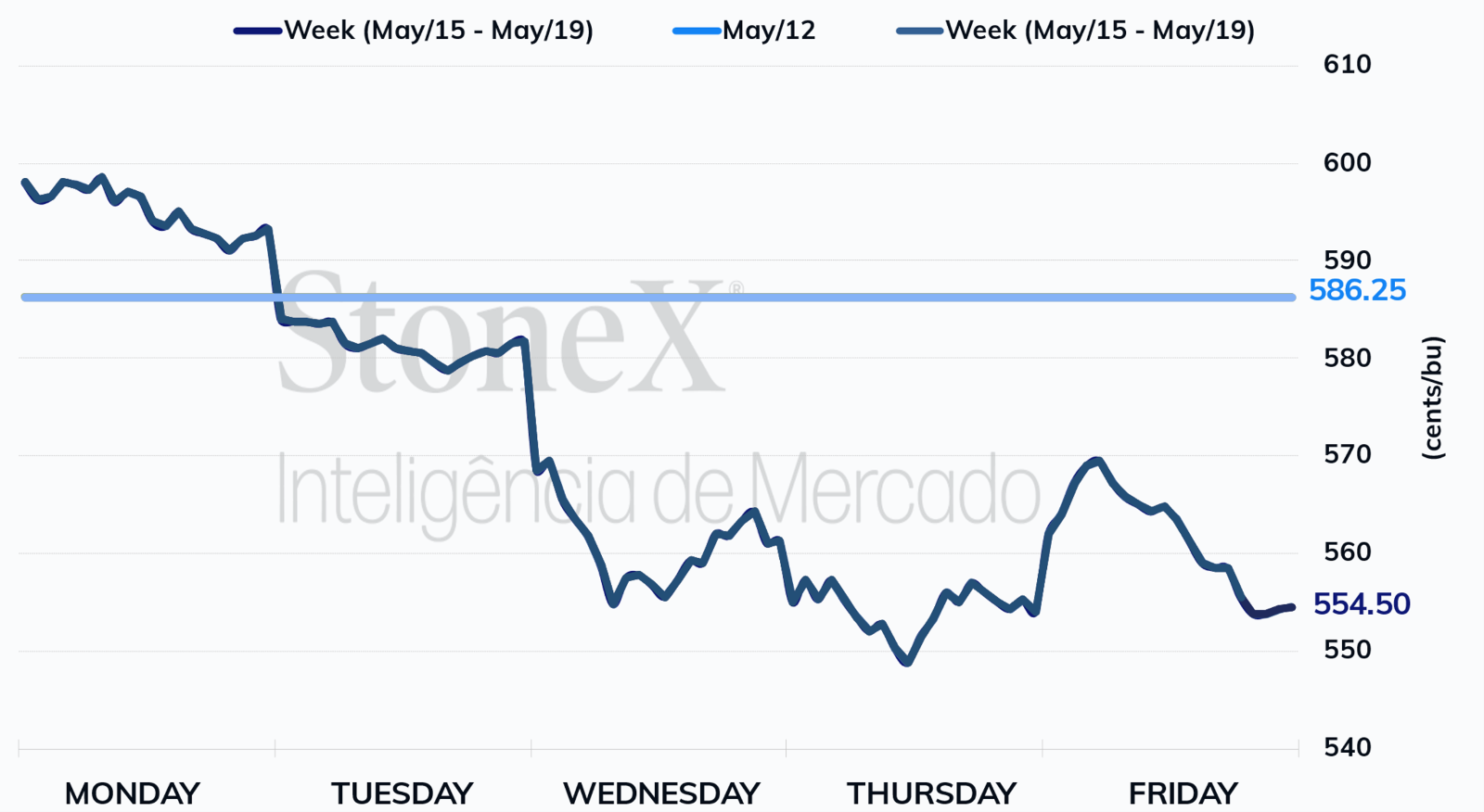
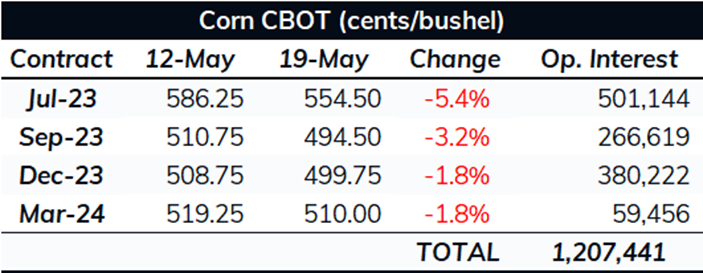
US shipments improve, but the deficit compared to last season remains high. According to the USDA's Export Inspection Report, the USA shipped 1.198 million tonnes in the week ended May 11, up 199,300 from a week earlier and 113,200 more than in the same period last year. Exports were close to the upper limit of market expectations, which ranged between 700,000 and 1.2 million tonnes. With this, accumulated shipments in the 2022/23 season totaled 26.1 million tonnes, 13.1 million less than in the same period of the previous cycle.
Corn planting in the US continues at an above average pace. On Monday (15), the USDA released its Crop Progress Report. The Department reported that corn planting in the US reached 65% by May 14, a weekly advance of 16 percentage points, 20 points higher than a year before (45%) and 6 points higher than the five-year average for the same period (59%). The NOAA weather models point to temperatures and precipitation within normal ranges over the next three months in most of the corn belt, which, combined with the good planting pace seen so far, supports the prospects for a robust production in the US in 2023/24.
Ethanol production advances in the weekly comparison. According to data released by the Energy Information Administration (EIA), US ethanol production advanced to 987,000 barrels per day in the week between May 5 and May 12, an increase of 22,000 on a weekly comparison. The production figure exceeded the five-year average for the same period by 37,200. The stocks, on the other hand, contracted to 23.19 million barrels, 100,000 barrels less than a week earlier.
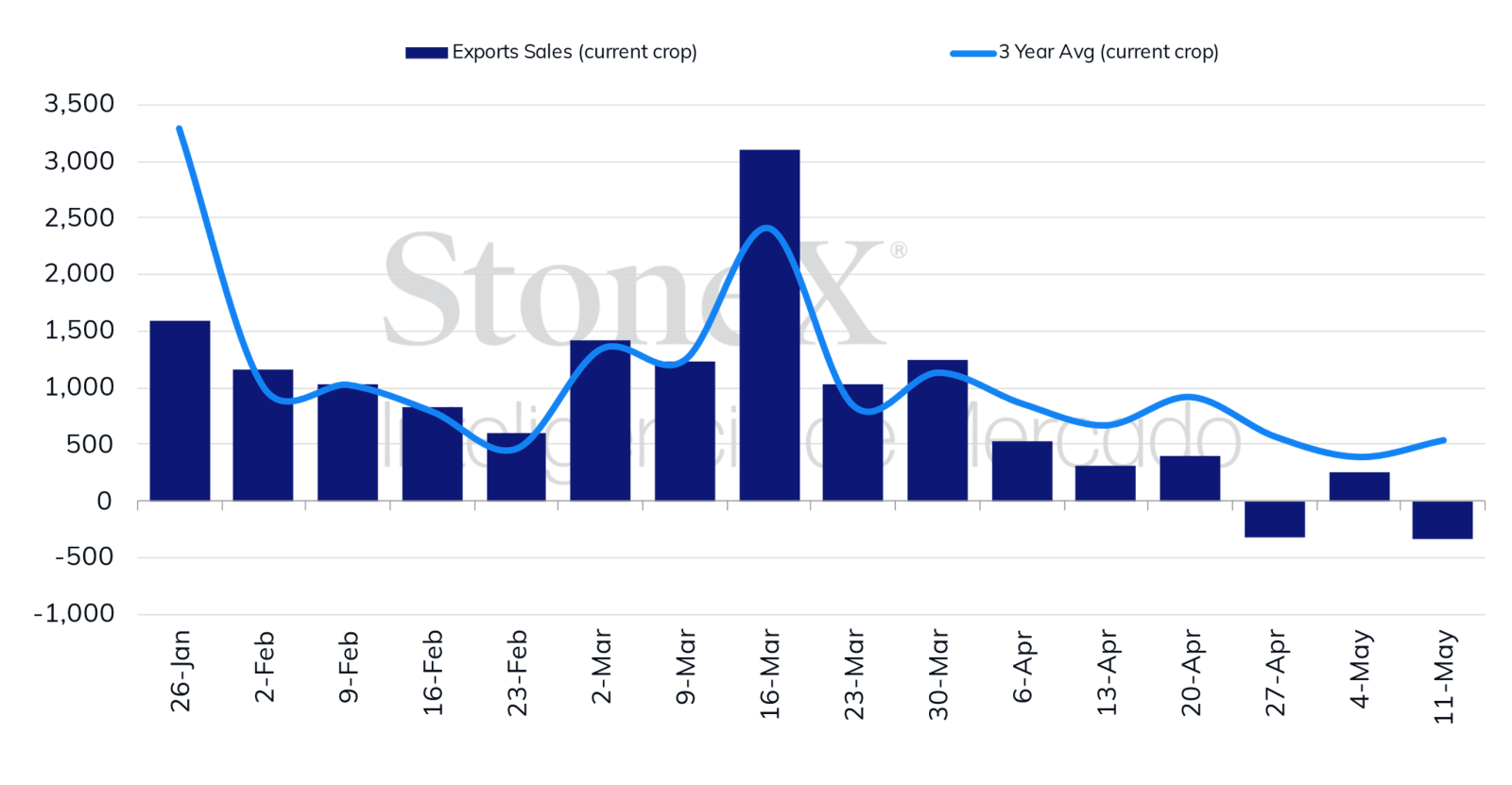
US again records net cancellations. In its Export Sales Report, the USDA informed that the US net sales totaled -339,000 tonnes in the week ended May 11, meaning that the number of cancellations in the period exceeded the number of sales. In the last three weeks, the country registered net cancellations twice. The main responsible for this result was China, which net cancelled 271,200 tonnes. In the last four weeks, the Asian giant has recorded net cancellations three times. There are still more than 2 million tonnes of unshipped sales to China, and the market continues to be concerned about additional cancellations. As a result of the cancellations, cumulative sales to all destinations retreated to 38.1 million tonnes, widening the deficit over the 2021/22 season to 20.8 million tonnes from 20.1 million tonnes a week earlier.
Argentinian crop conditions show slight improvement. The Buenos Aires Grains Exchange reported that 4% of the Argentinian corn crops were in good/excellent condition on May 18, up 2 percentage points on a weekly comparison, but 13 percentage points below the same week in 2022. The country's harvest reached 24.9%, 2.5 percentage points below a year earlier and 9 percentage points below the five-year average. The BCBA continues to estimate the Argentine crop at 36 million tonnes, 16 million less than in the 2021/22 cycle. However, as has been considered for a few weeks now, the significantly adverse crop situation could result in a lower number than currently forecast.
Renewal of the Black Sea grain export agreement puts pressure on corn prices. May 18 was the deadline for the extension of the Black Sea grain export agreement, and the uncertainty related to its renewal was causing great tension in the market. However, the Grain Initiative Agreement was renewed for another two months, which brought some relief to agents and put pressure on grain prices.
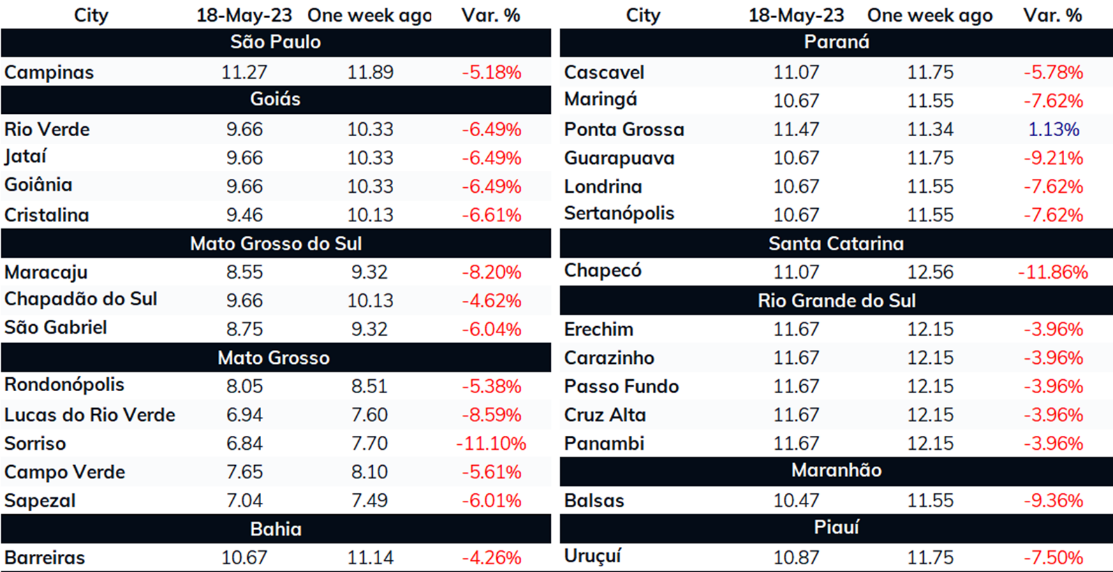
Safrinha corn fields are expected to register a low volume of rainfall in the coming weeks, but the outlook remains favorable for Brazilian production. The weather models point to a low volume of rainfall in most of the second-crop corn fields in Brazil. Regions that have delayed planting, such as portions of Mato Grosso do Sul and Paraná, are more vulnerable to the lack of rain. However, despite the lower moisture levels, the prospects remain very positive, especially for Mato Grosso, where crops are already in more advanced stages.