- Slow pace of shipments in the US;
- Concern about river levels in the US and impacts on grain flow;
- There are signs from Russia that it does not rule out the resumption of the Grain Agreement despite continuing tensions.
- Tensions between Russia and Ukraine;
- Recent increase in the sales pace by the US;
- Concerns about the weather impacts on the Chinese corn crop.
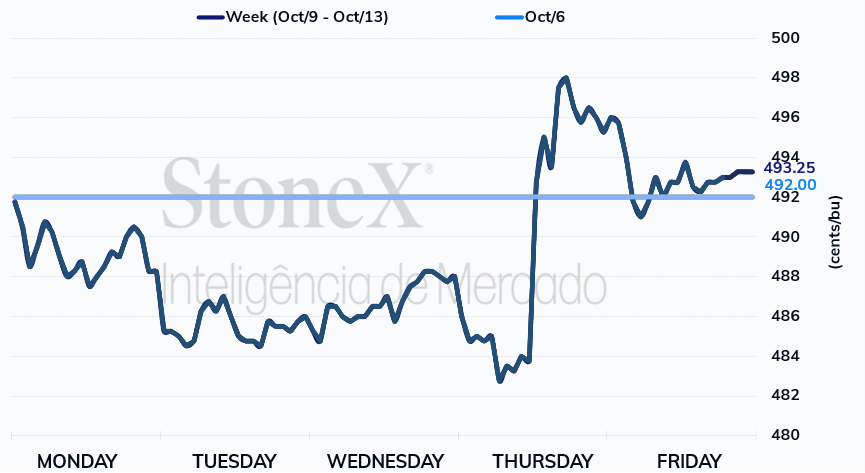
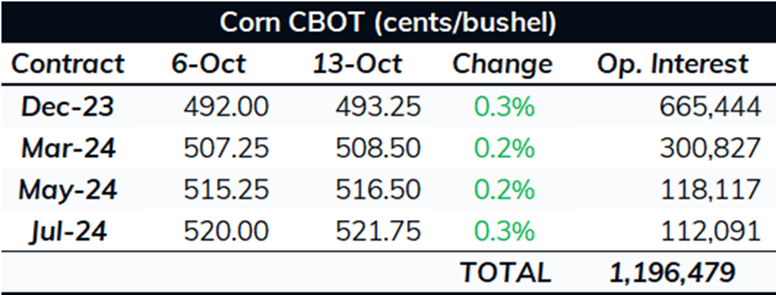
Last week was marked by high volatility in the corn market. After a downward movement at the beginning of the week, motivated by the good harvest pace and the low volume shipped, corn prices showed a strong upward movement due to the USDA's supply and demand report. However, the uptrend lost momentum at the end of the week, ending the period close to stability. December/23 ended the period quoted at 492 cents/bu, an increase of 3.2% compared to the previous week.
US crop conditions: In line with market expectations, the USDA indicated that the US continued to have 53% of its crops in good/excellent condition, the same number a week ago. The harvest is progressing smoothly, reaching 34% on October 8, up 11 percentage points week-on-week and 3 points above the 5-year average. The good pace of fieldwork was a bearish factor for prices at the beginning of the week. Click here to access the full report.
Mississippi River Level: River conditions continue to be monitored by the traders. According to NOAA data, levels in Memphis were at -3.6 meters on Monday morning (16), below what was recorded a week earlier (-3.1 meters). NOAA expects a slight recovery in the readings, estimated at around -3 meters, which is still considered low. As a result, the market should remain attentive to the navigation conditions on the Mississippi River.
Ethanol production in the US: According to data released by the Energy Information Administration (EIA), US ethanol production totaled 1,004 thousand barrels per day (tbpd) in the week ended Oct. 6, up five tbpd from a week earlier. Despite the drop, the recorded number exceeded the one observed in the same week of last year by 120 tbpd and the 5-year average by 64.8 tbpd. On the inventory side, there was a reduction to 21.53 million barrels, 358,000 less than a week earlier but 200,000 more than in the same period last year.
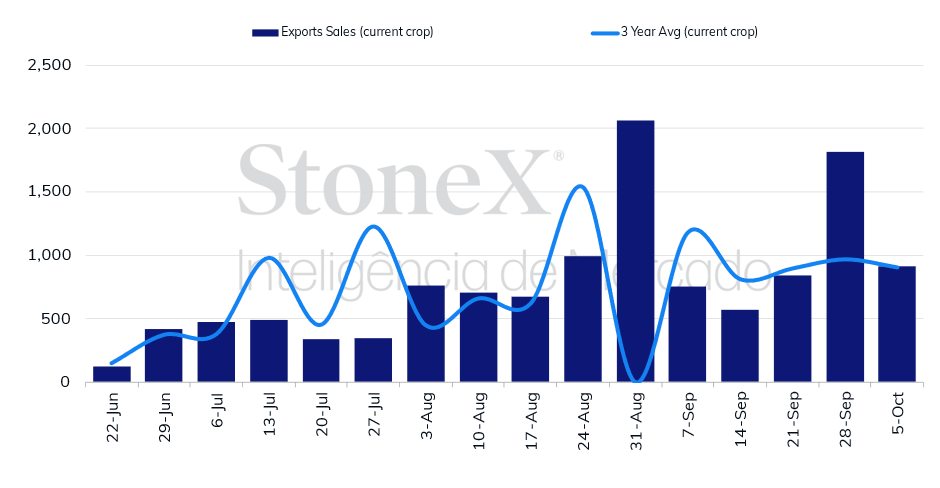
Weekly export sales - US (thousand tonnes)
US export inspections: According to the USDA's Export Inspection Report, the US continues to see low export volume. The country shipped 550,600 tonnes of corn in the week ended Oct. 5, 120,000 tonnes less than a week earlier. Despite being above that recorded in the same week of 2022 (457.4 thousand tonnes), the volume remains below the 5-year average, an issue that also pressured prices at the beginning of last week. In the 2023/24 crop, exports totaled 3.2 million tonnes, 400 thousand tonnes more than in the same period last season.
US export sales: Despite the slow pace of shipments, the export sales data brought some optimism to the market. Net sales for the 2023/24 season totaled 910,000 tonnes in the week ended Oct. 5, about 900,000 tonnes less than a week earlier but more than 700,000 tonnes higher than in the same week last season. The country traded 15.3 million tons in 2023/24 against 13.4 million in the same period last season.
Corn planting in South America: According to StoneX's report, the planting of the 2023/24 summer corn crop reached 30.8% by the end of last week, five percentage points less than a year ago. Click here to access the full report. In Argentina, due to a considerably drier situation than normal, the planting of the cereal reached 19.4%, a pace below the 5-year average.
USDA S&D Report: On October 12, the USDA released its long-awaited supply and demand report. The highlight of the North American balance was the reduction in ending stocks in 2022/23 to 34.6 million tonnes, driven by higher domestic consumption and production in 2023/24 to 382.6 million tonnes. As a result, ending stocks in 2023/24 also fell to 53.6 million tonnes. Amid these changes and a slightly tighter balance sheet in the US, prices advanced considerably on Thursday. Still, they lost momentum at the end of the week, as the corn cereal in the US and worldwide remains relatively comfortable. Click here to access the full report.