- Lagging pace of shipments and exports in the US;
- US harvest progress;
- Good volumes of rain recorded in important corn-producing regions in South America.
- Tensions between Russia and Ukraine;
- Logistical problems at ports in Northern Brazil;
- Despite still worrying conditions in the Mississippi River, improvement has been observed and the expectation is for a hike in the river level.
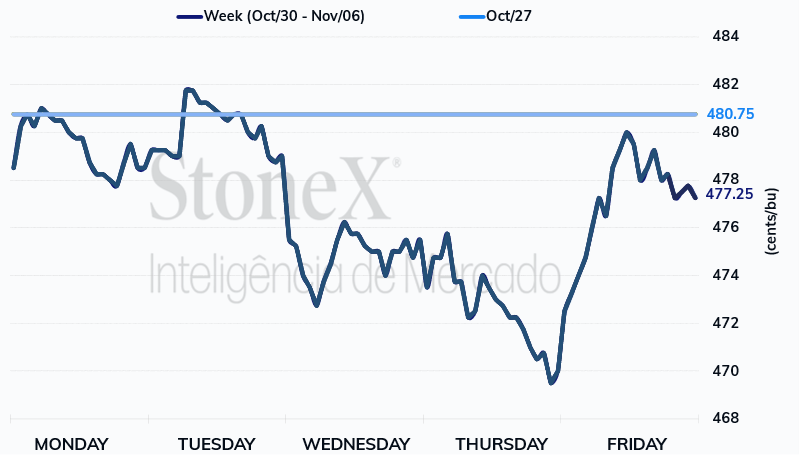
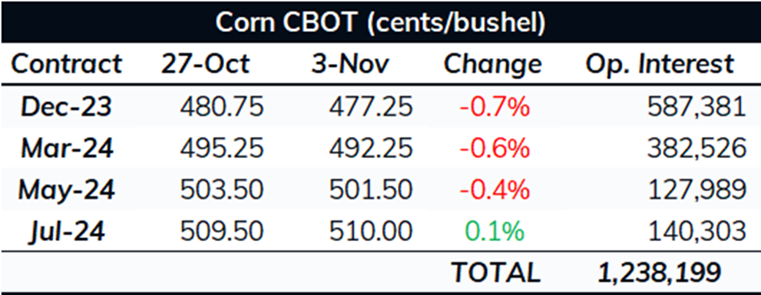
Corn futures had a week marked by high volatility in Chicago. A significant downtrend prevailed between Monday and Thursday, with December/23 accumulating a contraction of 2.3% compared to the previous week's closing (Oct 27), falling below the 470 cents/bu level. Nonetheless, on the last session of the week, corn futures recovered a good portion of the losses, ending Friday (Nov 3) priced at 477.25 cents/bu, finishing the week with a negative variation of 0.7%. The predominance of the bearish movement was promoted by the good pace of the harvest in the US, by the record of high rainfall in important producing regions of South America, and by the still weakened pace of US sales. On the other hand, it will be important to pay attention to a possible rebound in the level of the Mississippi River, which can benefit the flow of American grains and enable an advance in their prices.
US crop progress: According to the USDA's Weekly Crop Follow-up Report, corn harvest in the US reached 71% on October 29, a 12-percentage point (p.p.) increase, above the expected 10 p.p. by market participants. The country has not experienced any major disruptions in fieldwork, which has allowed for an above-average harvest pace over the past five years (66%) and weighing on corn futures. Nonetheless, with the harvest at an already advanced stage, fieldwork in the US should start to have less influence on corn quotes and the trade should focus more on other issues, such as the buildup of the crop in South America. Click here to access the full report.
Corn-based ethanol production: According to data released by the Energy Information Administration (EIA), US ethanol production totaled 1,052 thousand barrels per day (tbpd) in the week ended Oct. 27, up 12 tbpd from a week earlier and 21.8 tbpd above the 5-year average for the same period. On the other hand, the stocks fell during the period by 386 thousand barrels to 21.01 million barrels.
Mississippi River Level: The trade remains attentive to the conditions of the Mississippi River, as its low levels have hindered the flow of grains and increased freight costs over the past few weeks, acting as a pressure factor on corn in Chicago. Nonetheless, throughout the past week, an improvement in the conditions has been observed, placing the river above the low level at important points at the beginning of this month. If this movement continues, the flow of American grains may improve, supporting prices in Chicago.
Weekly export sales - US (TMT)
US export inspections: According to the USDA Weekly Export Inspections Report, the US shipped 531.5 tmt of corn in the week ended October 26, a volume higher than the previous week (449.3 tmt) and the same week last year (445.7 tmt). Thus, the accumulated exports reached 4.95 million tonnes in this 2023/24 crop season, compared to 4.22 million in the same period of the previous crop year.
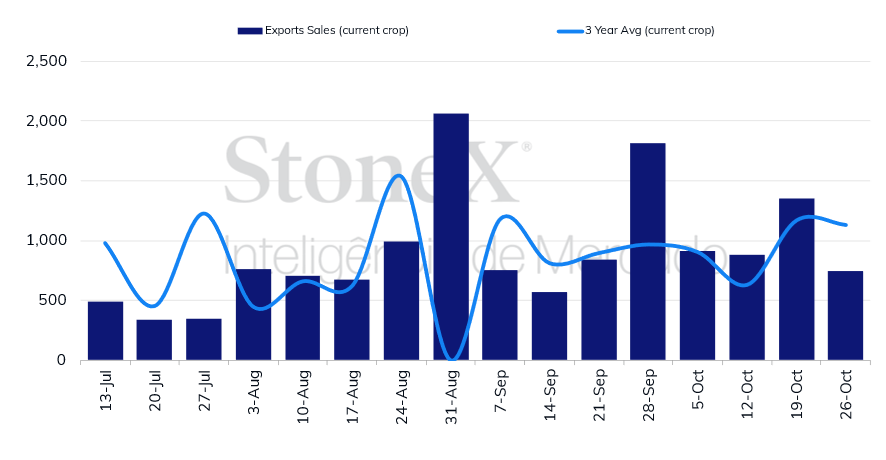
US export sales: According to USDA data, the pace of export sales faltered in the week ended October 26, totaling 748.1 tmt, 603,000 tonnes below the previous week's record. Despite the drop, the volume remained within the range expected by the trade, which ranged from 600,000 to 1.2 million tonnes and 376,000 tonnes above the observed in the equivalent week of 2022. In total, the country traded 18.3 million tonnes in 2023/24, 3.8 million tonnes above the same period of the previous season but below the pace needed to reach USDA's projection.
Weather in South America: The weather conditions in South America continue to be closely monitored by the market and should gain increasing importance as the harvest in the US approaches its final stretch. According to BCBA data, corn planting in Argentina totaled 23.4% until November 2, 0.5 p.p. above the previous year's record but almost 10 points below the 5-year average. Despite the delay, over the past two weeks, there has been a good volume of rain in the country's main producing regions, which should lead to more suitable moisture for the progress of sowing and the early stages of crops. On the cultivation conditions side, 20% of the crop is in good/excellent condition, compared to 15% one week ago.
In Brazil, planting the first corn crop is delayed, reaching 50% at the end of last week, compared to 59% in the same period last year. Despite the slower pace, the big question is about the speed of soybean planting, as its delay could ratchet down the window for safrinha corn planting. The soybean planting reached 50.7%, compared to 59.5% in the same period last year. Just like in the case of Argentina, the country has also experienced good rainfall recently, which should foster the progress of sowing. Anyway, it will be important to continue monitoring the weather pattern in the region, as a low volume of rainfall is expected for the main producing regions of both countries throughout the next week. Click here to access the Weekly Crop Progress Report - Brazil.
StoneX Brazil estimate: On November 1, StoneX published its Monthly Crop Estimate Report, which had as its main highlight the release of its first figure for the second corn crop 2023/24. The winter crop production is estimated at 98.96 million tonnes, a volume 8.7% lower than the harvested in the previous crop. Part of this drop can be explained by the expected reduction in acreage to 17.7 million hectares. Over the past few months, there has been a significant devaluation of corn prices, which has affected producers' margins and is expected to impact planting negatively, in addition to concerns about the planting window next year. In addition to the smaller area, productivity should contribute to lower production in this upcoming crop. An average yield of 5.58 tonnes/hectare is expected, which is in tandem with the trend of recent years but below the optimal productivity observed in 2022/23, made possible by quite favorable weather throughout the development of the crops. The total corn production in 2023/24 is estimated at 127.97 million tonnes, 8.1% below the previous season's record. Click here to access the full report.
StoneX US estimate: StoneX released last week its estimate for corn in the US, pointing the yield at 11.03 tonnes/ha, above the USDA's October estimate (10.86 tonnes/ha). Thus, production is expected at 388.69 million tonnes, 6 million above the last figure from the Department, reinforcing the idea present in the trade that American production should come above the last estimate brought by the USDA. Click here to access the full report. The next USDA's WASDE report will be released on November 9.