
Corn prices drop this week; Agricultural Forum hints at possible acreage reduction in the U.S., but market remains well-supplied
- Bullish
- Declining U.S. exports
- New incentives in the soybean market spill over to corn
- Argentinian crop revised downward
- Strong global consumption
- Bearish
- Well-supplied global corn market
- South American crop could hit record levels despite ongoing risks
- Geopolitical conflicts heighten market risks
CBOT
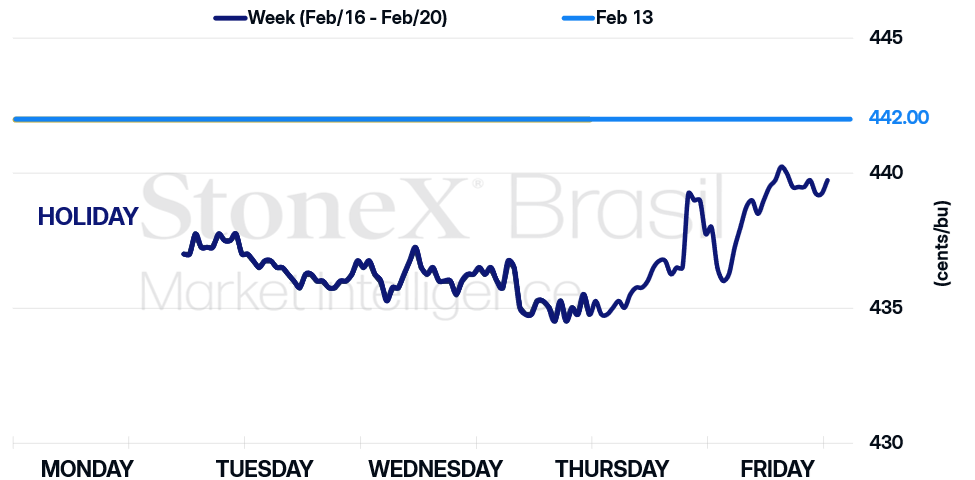
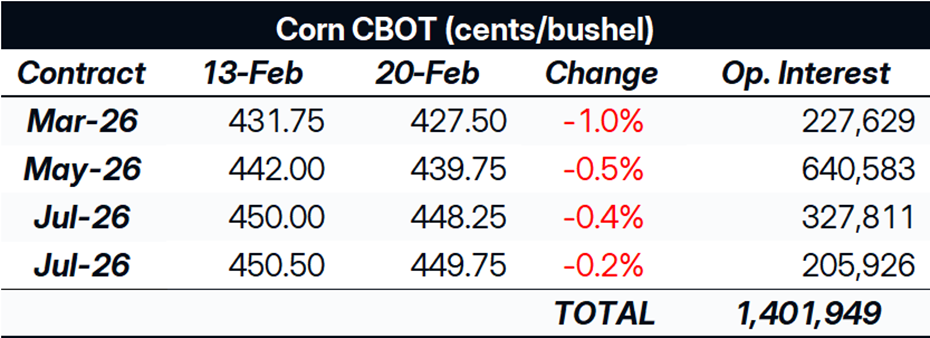
Corn futures saw a slight dip last week, with the May/26 contract closing on Friday at US¢ 439.75/bu (-0.5%).
In another uneventful week, the market paid some attention to the USDA’s initial projections for the 2026/27 crop year, presented during the Agricultural Forum held last week.
Intraday (15 min) May/26 contract - CBOT
Source: CBOT. Design: StoneX.
The initial projection for planted area in the U.S. this year pointed to a 5.1% reduction in corn acreage, resulting in approximately 38 million hectares planted. Assuming a yield of 11.49 tonnes/ha (below last year’s level but consistent with historical trends), the 2026/27 U.S. crop could reach around 400 million tonnes. Although this supply estimate is based purely on statistical models, nothing particularly stands out.
What is noteworthy, however, is how the USDA is addressing demand for U.S. corn in the next crop year.
Ethanol consumption projections remained steady at 142.2 million tonnes. Some analysts believe this year’s figure is noticeably overestimated, which suggests it could represent a slight increase over the 2025/26 crop year if we see a downward revision for the current year. The USDA does not mention the possibility of increased ethanol consumption should the E15 waiver for year-round sales be authorized—a topic gaining traction in the market after Donald Trump expressed support for the proposal in recent weeks. Regarding ethanol exports, a key driver of U.S. ethanol demand in recent years, the USDA assumes a stable scenario, which remains to be confirmed. It’s worth noting that trade agreements signed with various countries in recent months included commitments to import U.S. ethanol—a point not addressed in the report.
Feed consumption projections declined to 152.4 million tonnes. If Mexico’s border remains closed to live cattle traffic due to screwworm outbreaks in the country, this could continue to pressure domestic feed demand in the U.S. Nonetheless, a more robust domestic herd remains a supportive factor for feed demand.
Export projections dropped to 78.7 million tonnes. This year has been unusual, marked by several factors supporting strong U.S. corn export programs. However, there are no indicators suggesting this positive trend will reverse for the upcoming crop year. From a competitive standpoint, U.S. corn will likely remain favored, especially as internal demand in Brazil is expected to grow significantly, reducing the market share of the world’s second-largest exporter. Argentina and Ukraine have potential to expand their exports, which could moderately impact U.S. exports.
Separately, last Friday, the U.S. Supreme Court ruled that using the National Emergency Economic Powers Act (IEEPA) to impose tariffs by the U.S. president is illegal. As a result, the so-called “reciprocal tariffs” announced by President Donald Trump in April last year were overturned.
The immediate impact on commodities was bearish, as the market viewed the decision as weakening the U.S. government’s negotiating position with other countries. However, the reaction was limited and short-lived, indicating a degree of resilience among commodities to this development.
Looking ahead, we will monitor developments closely. Later on Friday, Trump announced new 15% tariffs—initially reported to be 10%—against all countries using an alternative legal framework. This reinforces the president’s commitment to maintaining his active trade policy. The market remains uncertain about the future of U.S. tariffs, and we can expect updates on this topic in the coming weeks. In March, Trump is scheduled to meet Brazilian President Lula, followed by a meeting with Chinese President Xi Jinping in April.
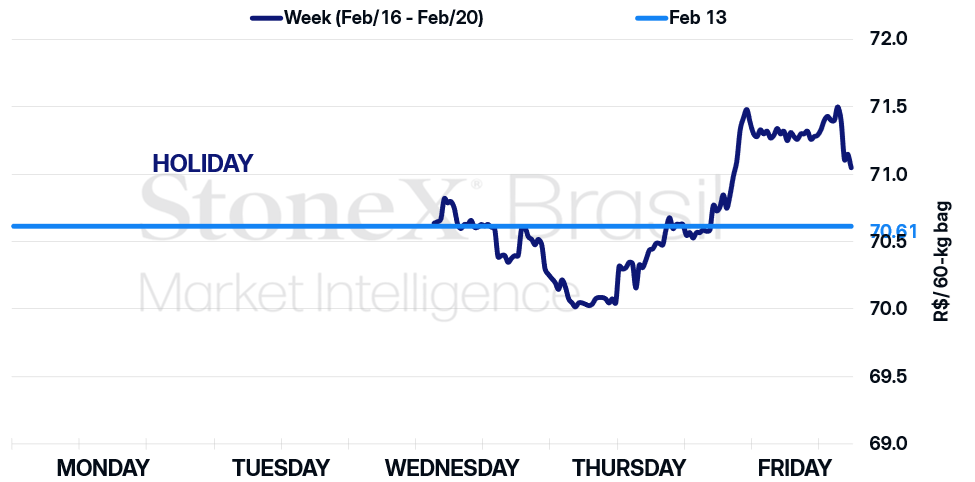
Intraday (15 min) May/26 contract - B3
Source: B3. Design: StoneX.
BRAZIL
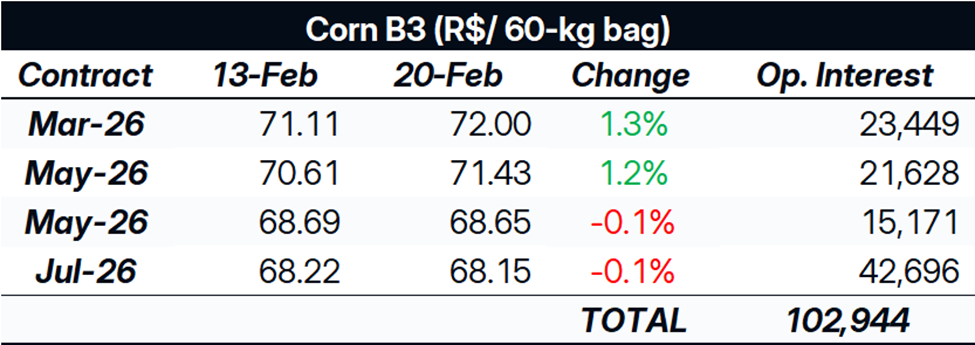
Corn prices traded on the B3 continued to climb last week, with the May/26 contract closing at R$71.43/bag (+1.2%).
Planting of the second corn crop is progressing but faces delays in key regions. Persistent rainy weather has hindered fieldwork, increasing risks to the crop’s full development—potentially driving stronger buying interest.
Futures contracts traded on CBOT (US¢/bu)
Source: CME. Design StoneX.
Futures contracts traded on B3 (R$/bag)

Source: B3. Prepared by: StoneX.
Spot prices in Brazil (USD/60kg bag)
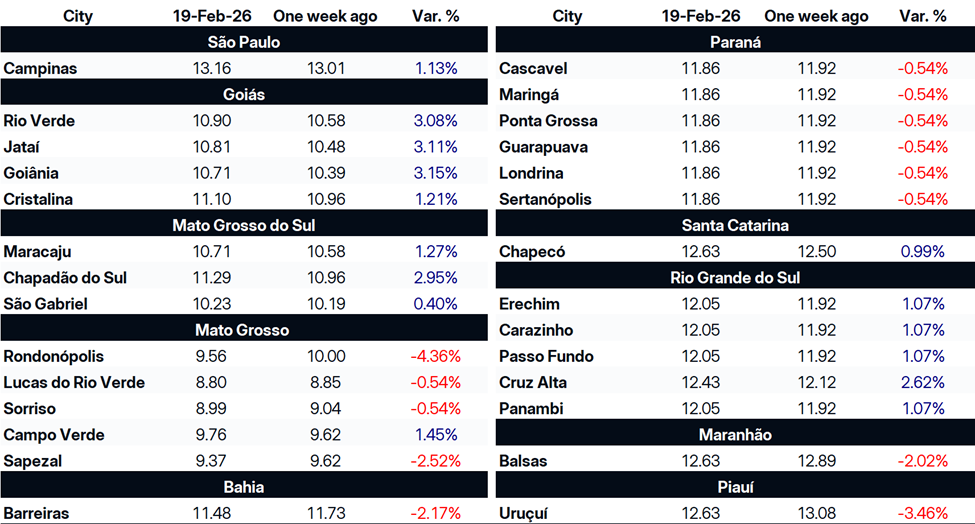

Source: StoneX.
INDICATORS




