Mato Grosso
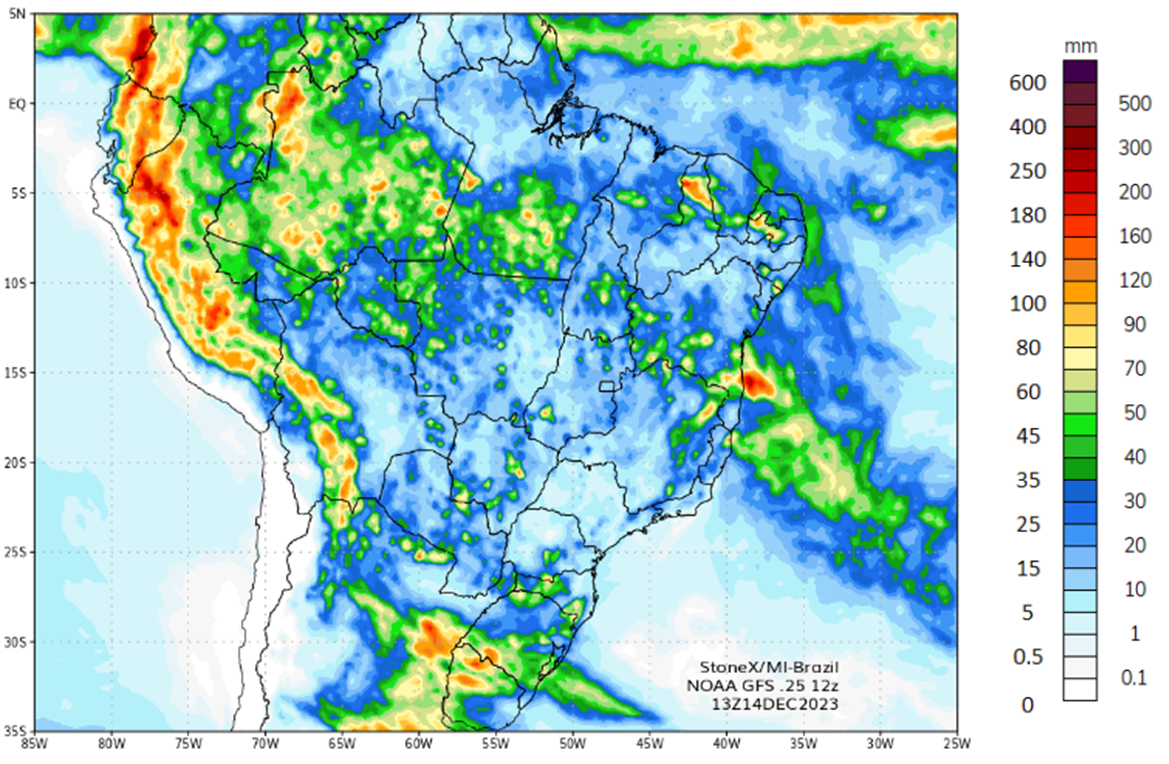
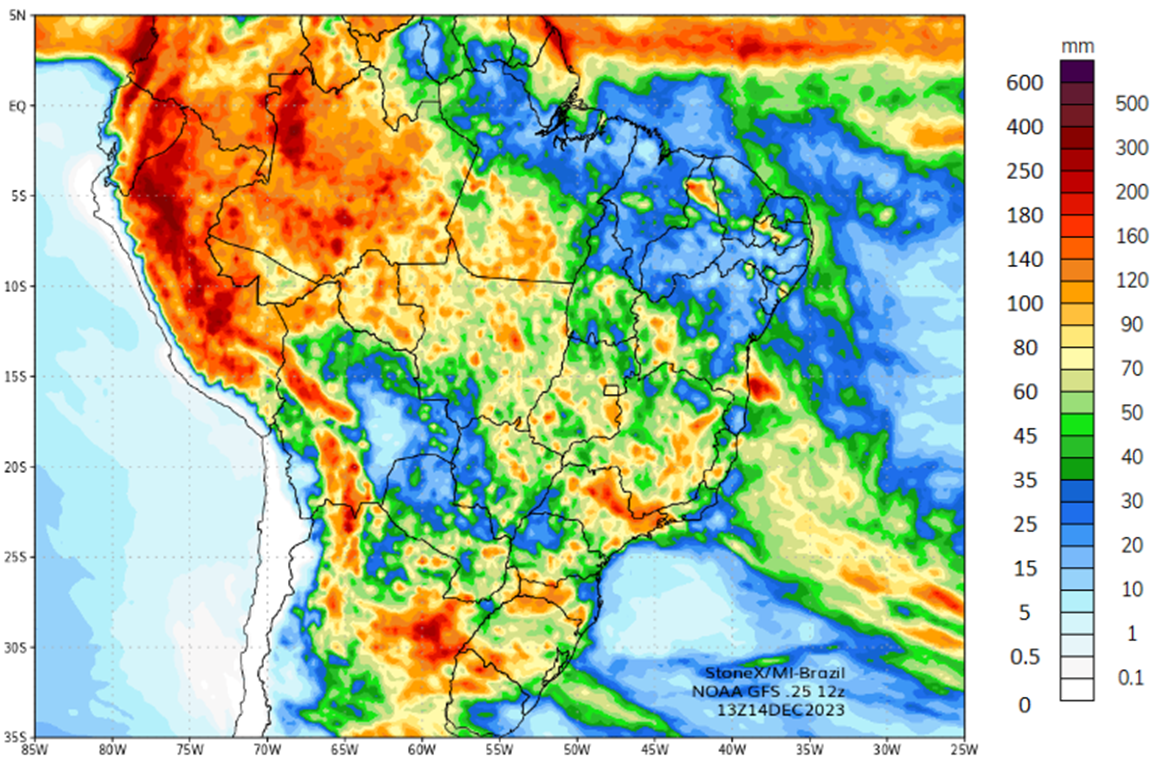
Irregular rains and heterogeneous volumes have marked the last 15 days. There has been an improvement in relation to the situation presented in the last comment, but below the ideal. At this time of year, a large part of the crops are in the reproductive stage, which makes them very sensitive to lack of moisture. As the rainfall volumes have been lower than normal, part of the productive potential has already been compromised and the high temperatures observed intensify the adverse conditions. All attention continues to be focused on the weather in the next 15 days, as this factor will be decisive for the state's production.
Southwest of Goiás
The situation in southwestern Goiás has slightly worsened since our last report. We received good volumes of rain throughout our areas at the end of last month and the maps for the beginning of December continued to show good volumes, which unfortunately did not happen as we expected. The situation in southwestern Goiás has slightly worsened since our last report. We received good amounts of rain throughout our areas at the end of last month, and the maps for early December continued to show good amounts, which unfortunately did not happen as we expected. We continue to have light rain almost daily, but with very low and still very irregular accumulated amounts. This lack of rain, combined with the heat we are facing, has caused the productive potential of our region to ratchet down. We started with a perspective of 68 bags/ha and today we are already working in the range of 66.70 bags/ha. Once again, we looked at and evaluated the climate maps, which show the last two weeks of December returning to present good rainfall volumes. However, if they do not materialize once again, we may see the productive potential decrease further, with our worst-case scenario estimated today at around 63.50 bags/ha. In other words, we can go from a production in our region of 8.2 million tonnes to 7.6 million. Remembering once again that we currently have a representation of 45% in Goiás.
Planting is wrapping up, reaching 95%. Planting later than the rest of the state also helped withstand the dry spells. The Formosa and Cristalina region, known for its pivots, has been struggling due to the lack of rainfall. So far, 15% of the area has been replanted. The productive potential is lower than last year but still within the region's average. The second corn crop will be determined over January.
The state of Mato Grosso do Sul has two realities regarding soybean production. For the northern part of the state, in the Coxim, São Gabriel, and Sonora region - which experienced a period without rain and high temperatures, with a delay in planting - a decrease of 5% to 10% is expected, figures that could increase if there is no regularity in rainfall. In the northeast of the state, the crop presents a better reality. Despite the lack of rain at its beginning, there is still potential for a full crop in the Chapadão do Sul region. From Campo Grande to the south of the state, there are producers with greater difficulties, but this reality is spotty - mostly in regions with many climatic adversities. Others believe they can exceed the productivity of the previous year. Overall, with the productions in the south reaching their potential - which corresponds to the majority of the production in Mato Grosso do Sul - the impacts resulting from the obstacles in the northern region would have little impact on the final performance of the state's production.
The weather has benefited the field activities here in Rio Grande do Sul in recent weeks. The partial truce in the rain favored both the significant progress of sowing and the cultural treatments in the already established soybean and corn. Currently, corn planting is finished, and soybean planting, with 88% of the estimated area, is already planted.
The development conditions of corn are favorable, despite some specific problems with pollination and incidence of leaf diseases. We maintain a positive bias for the crop estimate in the state, with over 40% of the crops in the grain-filling stage.
For soybeans, despite the initial delay in the planted area compared to the historical average for the period, the crops with more recent sowing have shown good germination, and the increase in solar incidence benefits all developing crops. We also maintain a positive boas towards productivity in this cycle.
In Paraná, we are observing a good development of the soybean and summer corn crops. So far, the soybean crop is 86% in good and excellent conditions, 12% in average conditions, and 2% in poor conditions. The monitoring shows that 24% of the crops are in the fruiting stage and 33% in the flowering stage. We had some reports of rust appearing in isolated areas and also records of greater difficulty in plant establishment, all due to excessive rainfall and moisture.
A week of more stable weather with higher temperatures will help producers properly carry out cultivation.
So far, summer corn has 80% of the crops in good/excellent conditions, 17% in fair conditions, and 3% in poor conditions. For the cereal, 2% of the crops are already in the maturation phase, 41% in the fruiting stage, 36% in flowering and 21% in vegetative development.
São Paulo has experienced an increase in rainfall from December 3 to 9, aligning with the pattern discussed in the last few weeks. The rains were more irregular in the areas of Ribeirão Preto and Araçatuba, while they were more frequent and uniform in Itapetininga, Paranapanema, Itaberá, Presidente Prudente, Cândido Mota, and Casa Branca. Remarkably, the most favorable conditions are mainly observed in Itapetininga, Paranapanema, and Itaberá, where the planting since the beginning of the crop was more advanced and benefited by the higher accumulated volume of precipitation. In the last week (December 10 to 14), the rains were less intense. With planting completed at 100% last Friday (December 8), both for soybeans and the first corn crop, the future weather pattern will play a crucial role in ensuring productivity. So far, we have not observed significant impacts that justify reducing production estimates.
Total volume expected in São Paulo (soybean): 5.50 million tonnes | Estimated productivity: 62 bag/ha (3.72 t/ha).
Total volume expected in São Paulo (1st corn crop): 2.34 million tonnes | Estimated productivity: 150 bags/ha (9.0 t/ha).
Minas Gerais
In general, the weather has been more favorable in the state, although we still have some points of attention. First of all, the lack of rain and the excessive heat at the beginning of the production cycle quite impacted what had been planted, even the pivot areas. Secondly, there are still planting delays in several regions of the state. Therefore, the combination of all these situations should have a negative impact on the state's production, but how much it will be is difficult to affirm at this moment.
Bahia
In the West of Bahia, the temperature remained high in the last few days and the rainfall was irregular and poorly distributed. The planting continues to evolve in areas with more suitable moisture, with 95% of soybean crops planted.
The weather forecasts still bring better prospects for rain in the second two-week period of December, in addition to good rates also for January and February, months that are traditionally marked by sharp Indian summers in El Niño years. The productive potential of the region will depend on the rains in the coming days, with possible reductions ahead.
BASIS: May/24: -253c/bu (SK4)
The state has shown improvement regarding climate issues in the past week, with specific regions still awaiting rain in their crops. Apart from the improved weather conditions, planting has progressed well in recent days, estimated at over 87% completed in the state. Out of this total planted volume, 60% is in the germination stage. So, if we estimate a total production of 1.944 million tonnes, around 1.1 million will be harvested in March and April 2024.
North/Northeast
North of Paraguay (Eastern Region: Canindeyú, San Pedro, and Alto Paraná above Route 2)
The weather has been favorable in recent days for the development of crops, which in most areas are already in the reproductive phase.
There is a forecast for harvest in the first areas (30% of the region) between late December and early January, where crops that were not affected by occasional droughts in the initial phase have a productive potential of 3,300kg/ha, while areas that suffered in the beginning have an approximate potential of 2,000kg/ha.
The trade has advanced little, with only occasional deals of volumes from the first areas to be harvested. The buyers are not active and the basis remains stable in the region, with a reference of -272 cents/bushel.
South of Paraguay (Eastern Region: Caaguazú, Itapúa, and Alto Paraná below Route 2)
The weather has been favorable for the development of crops in the region in recent days, where most of the crop is already in the grain-filling stage. Due to the concentration of planting in September, good harvest volumes are expected for the month of January.
Commercialization has not advanced and buyers remain out of the market, with the Basis reference unchanged at -266 cents/bushel.