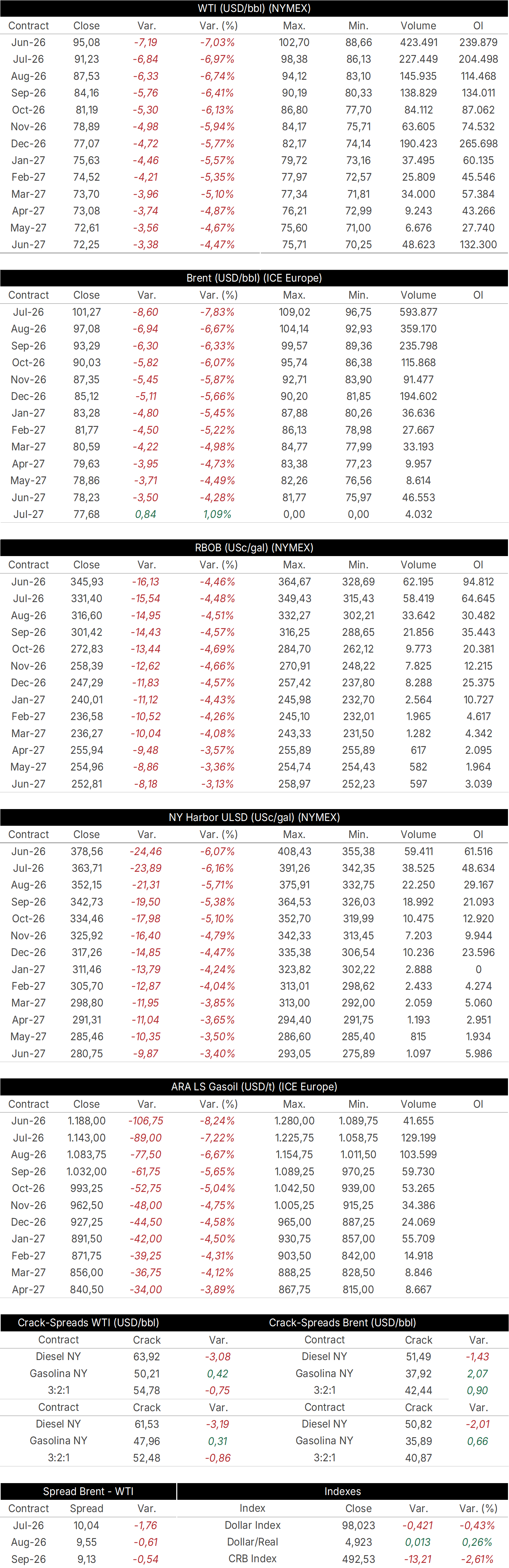
Market prices in potential memorandum of understanding
According to Axios, the memorandum of understanding between the U.S. and Iran is structured in three phases: formal cessation of the conflict, gradual reopening of the Strait of Hormuz, and a 30-day window for negotiations toward a comprehensive agreement. The proposal notably excludes key U.S. demands regarding Iran's nuclear program.
Why this matters: Initially, the signaling of a temporary agreement is enough to reduce the geopolitical risk premium in futures contracts, as the market interprets the suspension of hostilities as necessary for reopening the strait.
- At the same time, spot market prices remain above USD 100/bbl, as the global supply imbalance resulting from the suspension of a significant portion of Persian Gulf production persists.
- Yesterday, data from the U.S. Department of Energy (DOE) showed, for the second consecutive week, a decline in commercial oil inventories in the country, despite releases from strategic reserves (SPR) announced shortly after the conflict began, with the DOE having released over 23 million barrels from the SPR since late March.
- Diesel and gasoline inventories also declined by approximately 1.2 million and 2.5 million barrels, respectively, with both fuel stocks remaining below the five-year average levels observed in early May.
What to expect? The recent oil price movement mirrors the pattern observed on April 17, when Iran unilaterally announced the reopening of the Strait of Hormuz. At that time, however, the lack of a U.S. response to the measure led to the reimplementation of Iran's blockade, with price declines subsequently corrected in the following weeks.
- In this context, Tehran's response to the memorandum will be crucial in determining the direction of energy commodity prices in the coming days. If the response is favorable, prices are likely to experience another round of declines, potentially testing levels near USD 90/bbl.
- Conversely, another setback in negotiations between the nations could trigger a strong rebound in prices, given the fragile physical market supply, with prices potentially returning to levels above USD 100/bbl.
Even with an agreement, normalizing flows will take weeks
Even if the Strait of Hormuz formally reopens, the effective resumption of oil and derivative flows faces significant operational constraints.
Why this matters: It’s worth noting that the market is pricing in a faster reopening scenario than the physical market can realistically handle. This creates a notable asymmetry, as any delays in flow normalization following a potential agreement could result in continued inventory declines, with part of the risk premium being reincorporated into prices, thereby limiting the extent of short-term price decreases.
What to expect? EIA inventory data will be monitored weekly as a key indicator of supply normalization speed. If inventory declines continue to accelerate even after an agreement, the market may revise upward the price floor during the transitional period.