Yesterday (May 18), the most actively traded Brent contract closed higher at USD 112.10/bbl (+2.6%), while June WTI settled at USD 108.66/bbl (+3.1%).
The bullish momentum was fueled by the assessment that the Strait of Hormuz remains effectively closed, with no concrete prospects for reopening in the short term. The progressive drawdown of global commercial inventories reinforced the risk premium in oil futures. A report from the Iranian agency Tasnim suggesting that Washington might suspend sanctions on Iranian oil during negotiations briefly applied downward pressure throughout the day, but this was reversed after U.S. officials denied the possibility.
This morning (19), Brent has retreated to USD 110.37/bbl (-1.5%) and WTI has followed suit, dropping to USD 103.80/bbl. The correction was triggered by Trump’s statement—made after yesterday’s market close—that he would postpone the planned attack on Iran scheduled for Tuesday, creating space for negotiations.
U.S.–Iran Negotiations Remain Unresolved
Iran released the terms of its new peace proposal this morning: withdrawal of U.S. forces from regions near Iran, lifting of the naval blockade, suspension of sanctions, release of frozen assets, and war reparations.
The Iranian government itself acknowledges that the terms differ little from the previous proposal, which Trump had already rejected. There are isolated signs of flexibility from the U.S.—such as the release of 25% of frozen funds and permission for supervised civilian nuclear activity—but Washington denies agreeing to any “waiver” on Iranian oil sanctions.
Why it matters: The lack of structural concessions signals that the Strait of Hormuz will remain closed indefinitely, sustaining the risk premium embedded in the pricing curve. The key variable the market is monitoring now is whether Trump’s announced pause translates into formal negotiation rounds or is merely another cycle of diplomatic noise.
Overview: Global commercial inventories are in a sharply declining trajectory; while the International Energy Agency has not provided an exact figure, its reference to “a few weeks” implies coverage below 20 days for certain hubs—a critical alert level.
- In China, refining demand has hit its lowest level since August 2022, with retail sales at a three-year low—a sign that the supply shock is already compressing activity in the world’s largest oil importer.
What to expect?
If negotiations advance to a formal round mediated by Pakistan, with concessions on both sides in the coming days, Brent could retreat further toward the USD 100–105/bbl range, reflecting reduced geopolitical risk premiums.
- Conversely, if Trump’s pause is interpreted by the market as a pressure tactic with no Iranian concessions—the more likely scenario given recent history—the USD 110/bbl support level should hold, with upside risks if attacks resume.
U.S. Extends Waivers on Russian Oil
The U.S. Treasury has extended sanctions waivers on Russian oil for another 30 days, allowing “energy-vulnerable” countries to continue purchasing the commodity aboard ships loaded through April 17. This marks the second extension following the waiver’s expiration last Saturday (16).
Why it matters:
The mechanism functions as a flow substitution: South Asian and Mediterranean countries, cut off from Gulf routes, are competing with China for Russian oil already available at sea.
- The aggregate price impact is marginal but mitigates the risk of severe disruptions for smaller economies. The variable to monitor is whether the European Union and the United Kingdom will align their sanctions regimes with the U.S. move, which would increase accessible volumes.
Overview: The waiver applies exclusively to Russian oil loaded through April 17—capping available volumes and excluding newer production, which significantly limits potential supply relief.
- The extension reverses a public statement by Secretary Bessent in April, who had said no further renewal would occur—a sign that physical market pressures have outweighed geopolitical considerations tied to Ukraine.
What to expect: If the DOE confirms a drop in U.S. inventories tomorrow, the data will reinforce the IEA’s warnings of imminent shortages and could sustain Brent above USD 110/bbl despite temporary diplomatic relief.
- The automatic renewal of the Russian oil waiver for another 30 days should not be ruled out if the Strait remains closed—making the extension of this license a recurring variable in price formation over the coming weeks.
Daily Table - Previous Session Price Changes
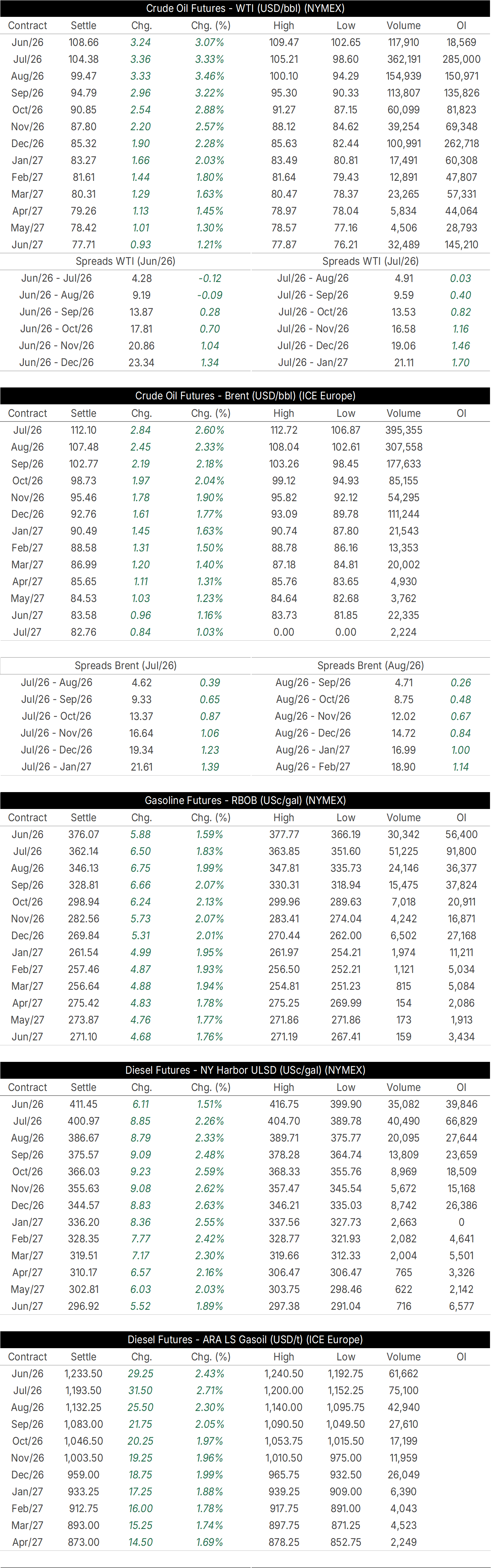
Source: ICE, NYMEX. Prepared by: StoneX.