Yesterday (May 28), the most active Brent contract for July settled down 0.6%, quoted at USD 93.71/bbl, after a volatile session marked by intense fluctuations between USD 94.59/bbl (high) and USD 92.99/bbl (low). WTI followed a similar trajectory, closing marginally higher by 0.3% at USD 88.90/bbl. Despite heightened military tensions between Iran and the United States, overall movement pointed toward profit taking and the closing of long positions on expectations for diplomatic progress.
The primary factor impacting the commodity futures market was a report by Axios stating that the final deal to extend the ceasefire depended solely on Trump’s approval, strongly pressuring prices and reversing gains observed earlier in the session.
This morning (May 29), the Brent contract for July delivery showed a decline of 1.8%, quoted at USD 92.05/bbl, with the most traded contract (August) at USD 91.07/bbl (-1.76%). The prevailing sentiment is short-lived momentum for long positions: the market is weighing a base-case scenario of a US-Iran agreement, pricing in the gradual return of barrels through the Strait and a reduction of the geopolitical risk premium.
US-Iran ceasefire and potential reopening of the Strait of Hormuz
The provisional agreement to extend the ceasefire between the United States and Iran by 60 days intensified long liquidation and triggered the largest weekly decline in Brent (-11%) and WTI (-10%) since April. Although sources indicate an understanding towards easing the maritime blockade of Hormuz, final confirmation hinges upon President Trump's approval and formalization of the text, which is still pending ratification by Iranian negotiators.
Why this matters: The consolidation of the agreement and a potential reopening of the Strait of Hormuz tend to return part of the volumes lost at the outset of the war to the physical market, pressuring price structure and regional spreads. In the very short term, the expectation of an agreement is already inducing profit taking and reducing the geopolitical premium.
- In the medium term, should the agreement evolve to include the release of frozen assets and lifting of sanctions, the trend is for a gradual replenishment of global inventories and recalibration of global flows, with downside risk should the text not be approved or Hormuz remain partially closed.
- It is noteworthy, however, that expectations point to a slow recovery of output by Gulf countries, which face technical difficulties in rapidly increasing crude oil extraction.
Overview: The US-Iran negotiations involve multiple aspects: ceasefire extension, gradual reopening of the Strait of Hormuz, lifting of sanctions, return of frozen assets, nuclear issues, and limits on armaments. The scenario remains unsettled, with tail risk linked to Israel’s stance, a regional conflict focal point and a critical actor in the security equation.
What to expect? In the base-case scenario, Brent maintains a pronounced weekly downward trajectory, with the possibility of further declines should the agreement be formalized. Risks persist along the curve, especially if political resistance arises in the US or if there are military retaliations—any setback tends to reactivate the premium and volatility, driving Brent back to higher levels.
US diesel inventories hit lowest level since 2003
US commercial crude inventories decreased by 3.3 million barrels last week, below the consensus of 4.1 million, according to DOE data. Gasoline inventories fell by 2.6 million and distillates dropped by 2.1 million, driven by robust summer demand and refineries operating at 94.5% capacity. US crude exports contracted by 1.16 million bpd, totaling 4.4 million bpd, while Cushing inventories registered a sharp drop (-2.79 million).
Why this matters: Alongside the reduction in commercial reserves, there was an accelerated drawdown from the SPR, around 9 million barrels, with total US inventories declining by 12.4 million barrels. In the short term, this data already exerts a limited effect on price, given the bearish pressure imposed by the geopolitical scenario.
- In the medium term, sustained high consumption—especially in gasoline, for which inventories are at very low levels—and robust refining capacity may provide new support to the market, should the return of barrels from the Persian Gulf prove slower than anticipated.
Overview: The reduction in commercial crude oil inventories marks the sixth consecutive week of decline. At the same time, since the beginning of the conflict, the SPR has dropped 50 million barrels, with this drawdown expected to continue until the US completes the sale of all volumes released under the IEA agreement, totaling 170 million barrels.
- Diesel inventories have reached their lowest value since 2003, near 100 million barrels, constituting a more evident market risk for the fossil derivative. Even so, the fact that the market is experiencing a moment of lower demand for this fuel has limited upward pressure on prices.
What to expect? In the base-case scenario, refineries are expected to maintain high utilization rates and fuel inventories to keep falling, but prices will adapt to a new reality of greater potential supply from the Persian Gulf. If exports accelerate and the US-Iran deal stalls, the bullish bias may return, with Brent reclaiming USD 95/bbl.
Daily table – Price variation in the previous session
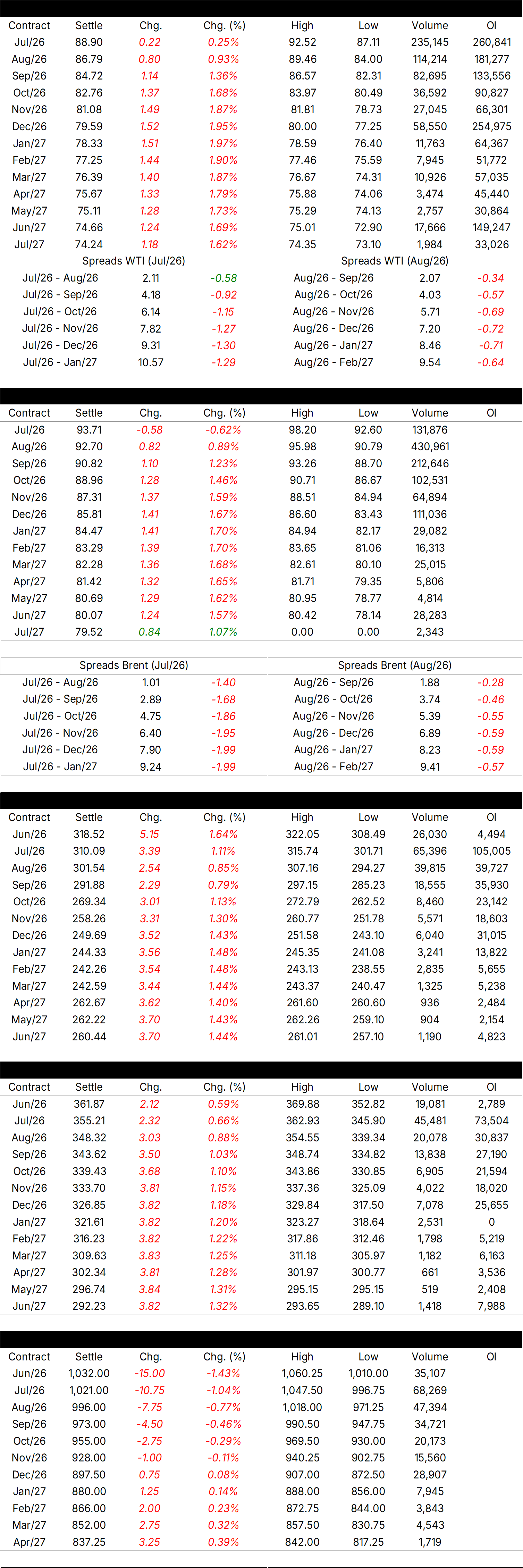
Source: ICE, NYMEX. Prepared by: StoneX.