Yesterday (May 1), the most active Brent contract closed sharply higher, totaling USD 94.98/bbl (+4.2%). WTI ended at USD 92.16/bbl (+5.5%), both reversing May's direction, when they lost between 17% and 19%—the largest monthly declines since the onset of the pandemic in March 2020. The rally was driven by reports of suspended US-Iran negotiations and Tehran's threats of an outright blockade of the Strait of Hormuz.
The main driver of the day was the intensification of geopolitical risk: Iran halted indirect talks with the US, while Israel expanded military operations in Lebanon. Statements by Iranian allies regarding a possible full blockade of Hormuz and other routes, such as Bab el-Mandeb, catalyzed a repricing of embedded risk premium in oil futures.
This morning, Brent is trading at USD 93.45/bbl (-1.6%) and WTI at USD 90.74/bbl (-1.5%), correcting part of the previous rally. The prevailing sentiment is caution, with investors closely monitoring the stance of the involved parties. Trump stated that negotiations with Iran continue, but the market persists in pricing uncertainty regarding Iran's position.
US and Iran back to deadlock in negotiations
The breakdown of talks between Iran and the US, as reported by Tasnim, heightened the risk of closing the Strait of Hormuz and other critical passages, such as Bab el-Mandeb, with Tehran confirming the possibility of blocking the Red Sea route through the Houthis in Yemen. The entry of Israeli troops into Lebanon and Hezbollah's movements added complexity, while the announcement of maritime mine deployments in Hormuz elevated operational risks.
Why is this relevant: The prospect of a full blockade of Hormuz by Iran raises the Brent risk premium. The longer tensions persist, the greater the pressure on commercial inventories and the risk of abrupt moves in the curve, fueled by reduced physical liquidity. If the crisis extends beyond July, structural dysfunctions may arise, such as shortages of specific crude grades, surging freight costs, and broader price volatility.
What to expect? The base scenario involves the maintenance of the risk premium while deadlocks persist; restricted physical flows through Hormuz and threats of blockade in Bab el-Mandeb are likely to support Brent above USD 90/bbl. In the event of direct military escalation or a complete blockade, Brent may retest highs above USD 100/bbl, especially if inventories continue to trend lower. The risk lies in fresh diplomatic signals or the emergency reopening of the strait, which could trigger a rapid price correction.
Tanker flows continue through the Strait of Hormuz, albeit at reduced volumes
Despite limited flows, two major oil tankers managed to exit Hormuz, while five LNG vessels positioned near the strait await clearance. Vessel movements with transponders switched off reflect attempts to evade monitoring and indicate rising operational risk.
Why is this relevant: Even under severe restriction, minor movements suggest that a fraction of cargos is still able to transit, signaling partial resilience of the oil chain. However, exported volumes remain far below normal, aggravating the imbalance between immediate supply and demand and reinforcing the risk premium.
What to expect? The current scenario is one of persistent restriction and volatility, with export levels below capacity, contributing to a broader stress trend in the market. Conversely, any diplomatic breakthrough is likely to catalyze flows and reduce the observed global deficit.
OPEC+ expected to raise targets for July
Sources indicate that seven OPEC+ members are expected to raise production targets by 188 kbpd in July, although most will be unable to fulfill their targets due to the interruption of exports through Hormuz.
Why is this relevant: The quota increase has a marginal effect on actual supply, as key exporters are prevented from shipping volumes, perpetuating the disconnect between production and physical flow. This scenario amplifies the risk premium and undermines the group's short-term price control. If restrictions persist, gradual production increases may prove irrelevant, with investors pricing only the logistical-geopolitical risk. The group's fragile storage capacity rules out the possibility of coordinated intervention should the market collapse.
What to expect? The increase in targets tends to be neutralized by the lack of physical shipping capacity. Thus, as long as the Strait of Hormuz remains closed, OPEC+ members will be unable to add more barrels to the market, nullifying any meaningful price impact from these decisions in the near term.
Daily Table - Price variation in previous session
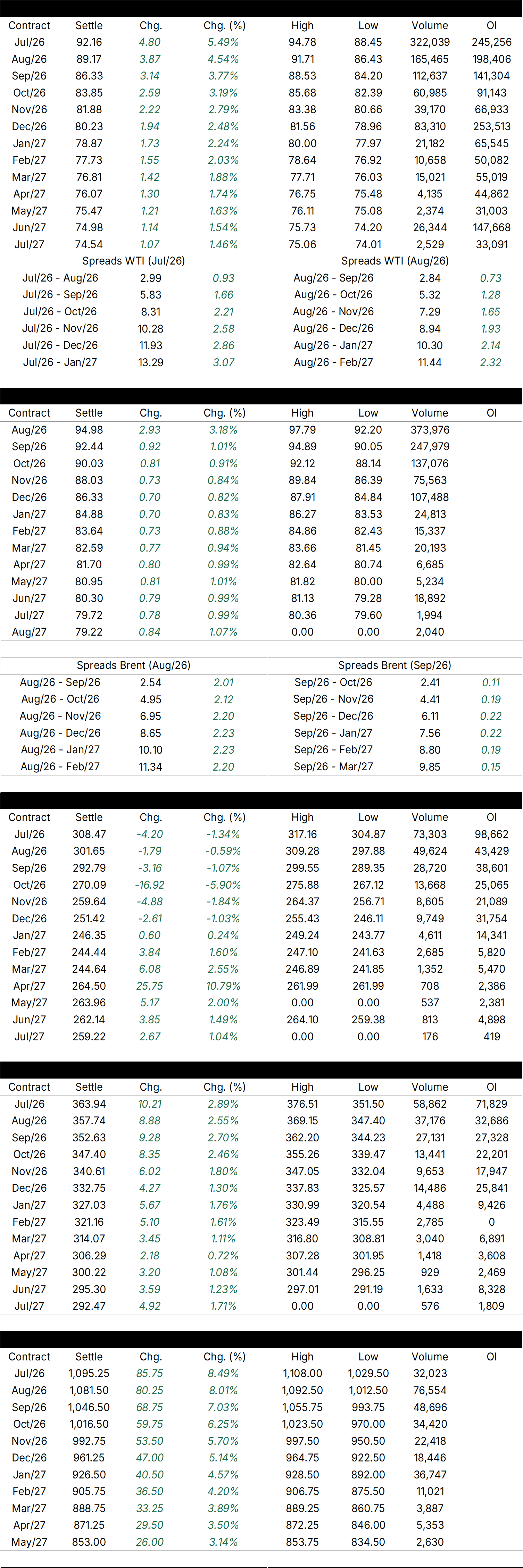
Source: ICE, NYMEX. Developed by StoneX.