Oil retreats amid temporary ceasefire between Iran and Israel
Yesterday (08), the most active Brent futures contract closed up 1.3%, totaling USD 94.25/bbl, after reaching an intraday high above USD 94.80 and a low at USD 92.90. WTI ended the session at USD 91.30/bbl (+0.8%). The movement reversed the previous session's bearish pressure, driven by the escalation of mutual attacks between Iran and Israel, with a direct impact on geopolitical risk expectations and supply via the Strait of Hormuz.
Monday's rally was initially underpinned by concerns over further logistical disruptions, with Israel targeting Iranian petrochemical facilities and Iran retaliating with offensives in the Haifa region. However, confirmation, early in the day, of a pause in hostilities between both sides contributed to a reduction in the gains posted.
This morning (09), around 08:00 am, Brent was down 1.9% at USD 92.4/bbl, with WTI declining 2.1% at USD 89.37/bbl. Market participants interpret the ceasefire announcement between Iran and Israel as a partial normalization, temporarily reducing the risk premium, but the maintenance of blockades in the Strait of Hormuz and the deadlock in Beirut support volatility. The scenario prices in a fragile ceasefire, with persistent stress on physical flows and the possibility of curve reversal should hostilities intensify.
Partial ceasefire and continued blockades in the Strait of Hormuz
After three months of conflict, Iran and Israel announced the suspension of mutual attacks in response to an appeal from President Donald Trump, without resolution regarding Israel's campaign in Beirut and logistical blockades.
Why it matters: Even with the ceasefire, additional controls and higher transit rates increase costs, limiting arbitrage and barrel availability, especially to Asian markets. There has been partial normalization in flights and port operations in Tehran, but risks of reversal and shortage remain. The maintenance of logistical blockades implies pronounced volatility and structural risk premium, with potential impact on regional spreads and storage, ultimately affecting major producers concentrated in the Persian Gulf.
What to expect? As long as operational restrictions in the Strait of Hormuz and instability in Beirut persist, Brent is expected to oscillate between USD 90–100/bbl, with sensitivity to any resumption of hostilities.
- If attacks resume or transit conditions tighten, oil futures could quickly surpass USD 100/bbl, with investors repricing the fragility in the global commodity balance.
Decline in Russian production limits oil exports abroad
According to market estimates, Russia will reduce oil exports in June to 1.7 mbpd—a volume 32% lower than observed in May—driven by increased domestic processing and decreased production caused by Ukrainian attacks.
Why it matters: The decline in Russian exports reduces global availability of heavier crudes, increases the risk premium, and complicates inventory replenishment, especially in Europe and Asia. The inability to quickly restore production makes relief for the balance dependent on alternative sources. Logistical stress may accentuate price swings, intensifying volatility if disruptions persist.
What to expect? If maintenance and repair conditions do not advance, Russian exports are expected to remain restricted, widening the global deficit and sustaining oil prices at elevated levels.
- If attacks on infrastructure continue, the market should observe reduced supply also from Eastern Europe, which would result in even more significant challenges for the global balance of oil and derivatives.
- It is worth noting that at the end of last month, the Russian government announced a ban on jetfuel exports, with rumors pointing to a possible limitation on diesel exports to be announced in the coming weeks. Although unlikely, a ban on diesel sales abroad would have a meaningful impact on the Brazilian market, given Russia remains the country's main supplier of the fuel.
Daily table – Price variation in the previous session
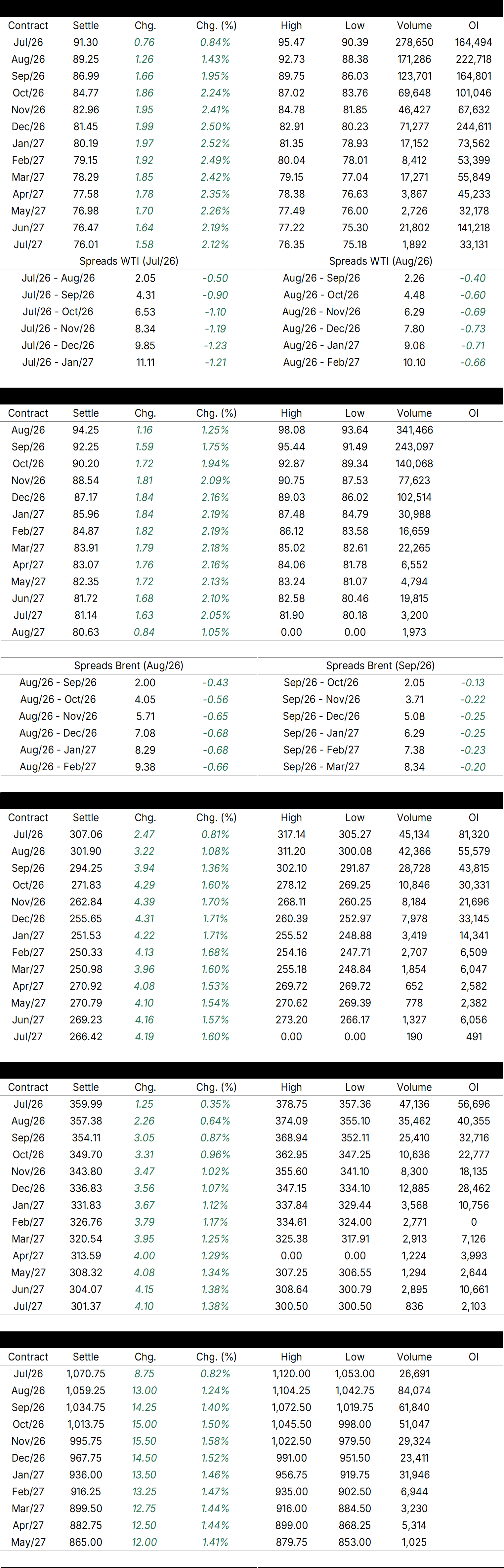
Source: ICE, NYMEX. Prepared by: StoneX.
The StoneX Group Inc. group of companies provides financial services worldwide through its subsidiaries, including physical commodities, securities, exchange-traded and over-the-counter derivatives, risk management, global payments and foreign exchange products in accordance with applicable law in the jurisdictions where services are provided. References to over-the-counter (“OTC”) products or swaps are made on behalf of StoneX Markets LLC (“SXM”), a member of the National Futures Association (“NFA”) and provisionally registered with the U.S. Commodity Futures Trading Commission (“CFTC”) as a swap dealer. SXM’s products are designed only for individuals or firms who qualify under CFTC rules as an ‘Eligible Contract Participant’ (“ECP”) and who have been accepted as customers of SXM. StoneX Financial Inc. (“SFI”) is a member of FINRA/NFA/SIPC and registered with the MSRB. SFI is registered with the U.S. Securities and Exchange Commission (“SEC”) as a Broker-Dealer and with the CFTC as a Futures Commission Merchant and Commodity Trading Adviser. References to securities trading are made on behalf of the BD Division of SFI and are intended only for an audience of institutional clients as defined by FINRA Rule 4512(c). References to exchange-traded futures and options are made on behalf of the FCM Division of SFI . StoneX is a trading name of StoneX Financial Ltd (“SFL”). SFL is registered in England and Wales, Company No. 5616586. SFL is authorized and regulated by the Financial Conduct Authority [FRN 446717] to provide to professional and eligible customers including: arrangement, execution and, where required, clearing derivative transactions in exchange traded futures and options. SFL is also authorised to engage in the arrangement and execution of transactions in certain OTC products, certain securities trading, precious metals trading and payment services to eligible customers. SFL is authorised & regulated by the Financial Conduct Authority under the Payment Services Regulations 2017 for the provision of payment services. SFL is a category 1 ring-dealing member of the London Metal Exchange. In addition SFL also engages in other physically delivered commodities business and other general business activities which are unregulated and not required to be authorised by the Financial Conduct Authority. StoneX Group Inc. acts as agent for SFL in New York with respect to its payments services business. StoneX APAC Pte. Ltd. acts as agent for SFL in Singapore with respect to its payments services business. ‘StoneX’ is the trade name used by StoneX Group Inc. and all its associated entities and subsidiaries.
Trading swaps and over-the-counter derivatives, exchange-traded derivatives and options and securities involves substantial risk and is not suitable for all investors. Past performance of any futures or option is not indicative of future success. Indicators are not a trading system and are not published as a specific trade recommendation. The information herein is not a recommendation to trade nor investment research or an offer to buy or sell any derivative or security. It does not take into account your particular investment objectives, financial situation or needs and does not create a binding obligation on any of the StoneX group of companies to enter into any transaction with you. You are advised to perform an independent investigation of any transaction to determine whether any transaction is suitable for you. No part of this material may be copied, photocopied or duplicated in any form by any means or redistributed without the prior written consent of StoneX Group Inc.
© 2026 StoneX Group Inc. All Rights Reserved.