Quarterly Commodities Outlook is available for free now.  Download your report  →

StoneX logo

Daily Petroleum Report

By: Bruno Santos, Market Intelligence Analyst

Banner Currencies

Oil retreats after Strait of Hormuz closure, with partial relief from negotiations

Yesterday (June 10), the most active Brent futures contract closed higher, ending the session at USD 93.10/bbl (+1.8%), while WTI advanced to USD 90.03/bbl (+2.0%). Both contracts accumulated gains of up to USD 3.0/bbl during trading, before partially retreating following statements from President Trump regarding a covert military operation escorting vessels through the Strait of Hormuz.

The market movement was driven by Trump’s threats to strike Iran “very hard” if no agreement is reached, with the conflict registering one of the most intense exchanges of fire since the April ceasefire. Concurrently, the DOE reported a decline of 7.2 million barrels in U.S. inventories for the week ending June 5—nearly twice the expectations—with refinery utilization at 95.3%, signaling increasing pressure on the domestic balance and fragility of global inventories.

This morning (June 11), around 8:30 a.m., Brent retreated to USD 92.1/bbl (-1.1%) and WTI to USD 89.1/bbl (-1%), after both accumulated gains of over USD 2.0/bbl at the start of the session. The market is simultaneously pricing the formal closure of the Strait of Hormuz by Iran and indications that negotiations between Washington and Tehran have intensified, reducing the risk premium relative to the opening.

Iran announces total closure of the Strait of Hormuz

Iran announced the formal closure of the Strait of Hormuz, with the Persian Gulf Strait Authority signaling that vessels attempting passage will be attacked. The closure was declared after new U.S. attacks against Iranian targets, including a strike on a ship in the Gulf of Oman carrying Iranian oil, resulting in a diplomatic incident with India, which reported three sailors killed. Despite the rhetoric, the U.S. confirmed that commercial vessels remain in transit and that no U.S. warship was hit; simultaneously, three LNG tankers left the Strait with transponders off, bound for Asia.

Why does this matter: The divergence between the formal closure announcement and ongoing partial transit is the main factor containing the risk premium, with the market betting that a total blockade is yet to materialize. In the medium term, maintaining restrictions limits Persian Gulf exports (Saudi Arabia, UAE, Kuwait, Iraq) and further compresses the already deficit global balance. The real possibility of a total blockade, which would eliminate the rest of the physical flows transported through the strait, should result in a more significant advance in commodity futures.

What to expect? As long as partial transit persists and negotiations progress, Brent tends to remain within the USD 90–100/bbl range, albeit with significant volatility. If Iran effectively prevents the passage of commercial vessels or a new large-scale military episode occurs, bullish repricing may be abrupt, with investors demonstrating less optimism regarding a potential memorandum of understanding between the parties.

China reduces imports; structural demand shift limits bullish pressure

Chinese oil imports in May fell 29% compared to the same period last year, to 7.8 mbpd—the lowest level in eight years—following a 20% drop in April. This movement combines the use of accumulated inventories from periods of lower prices with a surprising drop in fuel consumption: Sinopec gasoline sales declined by 8% and diesel by 6% year-over-year in April. The acceleration of fleet electrification and migration to electric rail and collective transportation indicate a behavioral shift with lasting potential, especially for gasoline.

Why does this matter: The cyclical reduction in Chinese demand for liquid derivatives—due to lower oil supply from the Persian Gulf—acts as a price ceiling for the commodity, partially offsetting the supply contraction from the Middle East. In the medium term, if the decline in Chinese imports consolidates below 8.5 mbpd in a sustained manner, the rebalancing of the global balance will occur at a lower price level than pre-conflict models projected. The risk is that, once Chinese strategic inventories are depleted, a resumption of imports will increase pressure on the physical market simultaneously with any eventual resolution of the conflict.

What to expect? While China maintains consumption of accumulated inventories and demand behavior remains subdued, oil prices should remain below USD 100/bbl. If China resumes imports at volumes close to pre-war levels (above 10 mbpd), the already fragile global balance would undergo significant bullish repricing.

U.S. inventories in sharp decline, with SPR at lowest level since 2023

U.S. commercial inventories dropped 7.2 million barrels in the week ending June 5, to 426.5 million barrels. Since the start of the conflict on February 28, total U.S. inventories, including the Strategic Petroleum Reserve (SPR), have accumulated a decline of 79 million barrels, with the SPR reaching its lowest level since August 2023. Refinery utilization rates reached 95.3%, a historically elevated level, reflecting efforts to offset the contraction of physical flows from the Persian Gulf.

Why does this matter: The acceleration in commercial inventory drawdowns, combined with the SPR at recent historical lows, narrows the U.S. margin to cushion further supply shocks. The increase in net imports and the decline in U.S. oil exports by 1.03 mbpd suggest that the role of the U.S. as a global exporter is being temporarily reversed. The fragility of the global balance increases the sensitivity of prices to any further deterioration in the Strait of Hormuz and other regions, with the decline in Russian exports contributing to this tightening of the global balance.

What to expect? The current scenario is one of inventories under continuous pressure while the conflict limits Persian Gulf exports and refineries operate at maximum capacity in the U.S. and Europe. If SPR transfers to commercial inventories are insufficient to offset weekly declines, pressure on domestic U.S. prices tends to intensify—potentially impacting inflation and Federal Reserve monetary policy. It is worth noting that the current period is critical, with the approach of the driving season potentially resulting in a worsening scenario for the gasoline balance in the country—depending, of course, on the geopolitical context in the coming weeks.

Daily table - Price variation in the previous session
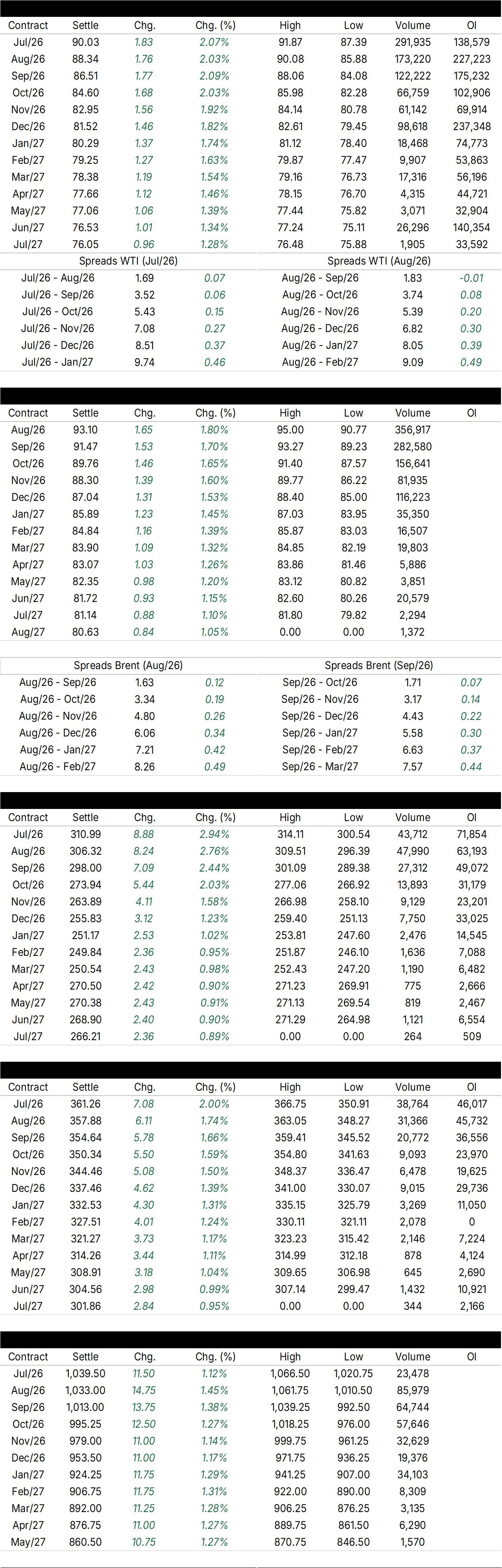
image 132606

Source: ICE, NYMEX. Prepared by: StoneX.

  • Energy

The StoneX Group Inc. group of companies provides financial services worldwide through its subsidiaries, including physical commodities, securities, exchange-traded and over-the-counter derivatives, risk management, global payments and foreign exchange products in accordance with applicable law in the jurisdictions where services are provided. References to over-the-counter (“OTC”) products or swaps are made on behalf of StoneX Markets LLC (“SXM”), a member of the National Futures Association (“NFA”) and provisionally registered with the U.S. Commodity Futures Trading Commission (“CFTC”) as a swap dealer. SXM’s products are designed only for individuals or firms who qualify under CFTC rules as an ‘Eligible Contract Participant’ (“ECP”) and who have been accepted as customers of SXM. StoneX Financial Inc. (“SFI”) is a member of FINRA/NFA/SIPC and registered with the MSRB. SFI is registered with the U.S. Securities and Exchange Commission (“SEC”) as a Broker-Dealer and with the CFTC as a Futures Commission Merchant and Commodity Trading Adviser. References to securities trading are made on behalf of the BD Division of SFI and are intended only for an audience of institutional clients as defined by FINRA Rule 4512(c). References to exchange-traded futures and options are made on behalf of the FCM Division of SFI . StoneX is a trading name of StoneX Financial Ltd (“SFL”). SFL is registered in England and Wales, Company No. 5616586. SFL is authorized and regulated by the Financial Conduct Authority [FRN 446717] to provide to professional and eligible customers including: arrangement, execution and, where required, clearing derivative transactions in exchange traded futures and options. SFL is also authorised to engage in the arrangement and execution of transactions in certain OTC products, certain securities trading, precious metals trading and payment services to eligible customers. SFL is authorised & regulated by the Financial Conduct Authority under the Payment Services Regulations 2017 for the provision of payment services. SFL is a category 1 ring-dealing member of the London Metal Exchange. In addition SFL also engages in other physically delivered commodities business and other general business activities which are unregulated and not required to be authorised by the Financial Conduct Authority. StoneX Group Inc. acts as agent for SFL in New York with respect to its payments services business. StoneX APAC Pte. Ltd. acts as agent for SFL in Singapore with respect to its payments services business. ‘StoneX’ is the trade name used by StoneX Group Inc. and all its associated entities and subsidiaries.
 
Trading swaps and over-the-counter derivatives, exchange-traded derivatives and options and securities involves substantial risk and is not suitable for all investors. Past performance of any futures or option is not indicative of future success. Indicators are not a trading system and are not published as a specific trade recommendation. The information herein is not a recommendation to trade nor investment research or an offer to buy or sell any derivative or security. It does not take into account your particular investment objectives, financial situation or needs and does not create a binding obligation on any of the StoneX group of companies to enter into any transaction with you. You are advised to perform an independent investigation of any transaction to determine whether any transaction is suitable for you. No part of this material may be copied, photocopied or duplicated in any form by any means or redistributed without the prior written consent of StoneX Group Inc.
 
© 2026 StoneX Group Inc. All Rights Reserved.

Satellite view of Earth at night showing illuminated cities across Asia and the Middle East

Discover more insights

Our subscribers have access to comprehensive market analysis from StoneX spanning commodities, equities, currencies and more.

Related articles for Energy

Perspective: Morning Commentary for August 13

August 13 – The major stock indices traded quietly mixed overnight ahead of this morning’s weekly job numbers and producer price index data. Like Wednesday, this morning’s data was considered good as well, providing support for stocks while generally allowing Treasury yields to slip a bit lower. The VIX is trading near 14.4, which is just above yesterday’s new low for the year. The dollar index is trading near 99.8. Yields on 10-year Treasuries are trading near 4.64%, while yields on 2-year Treasuries are trading near 4.15%. WTI crude oil is trading near $81 per barrel, while Brent trades near $87 per barrel. Wheat prices again firmed overnight on geopolitical risks in the Black Sea Region, while corn and soybean prices pulled back modestly from yesterday’s big gains.

Arlan Suderman
Arlan Suderman
  • Grains & Oilseeds
  • Energy
  • Dairy
  • Renewable Fuels
  • Cocoa
  • Coffee
  • Cotton
  • Sugar
  • Meats & Livestock
  • Forest Products

Perspective: Morning Commentary for August 12

August 12 – Today’s focus is on inflation, with the July consumer price index data out this morning. We have this, and one more month of data, ahead of the next Federal Reserve meeting. Of course, headlines from the Middle East and the Black Sea wars also have an ongoing influence on the markets. Stock futures posted gains this morning, while the VIX traded just below 15. The dollar index traded near 99.7. Yields on 10-year Treasuries are trading near 4.66%, while yields on 2-year Treasuries are trading near 4.18%. WTI crude oil is trading near $83, while Brent trades near $88 per barrel. The grain and oilseed markets rebounded from yesterday’s losses ahead of today’s highly anticipated WASDE crop report that is due out at Noon Eastern Time.

Arlan Suderman
Arlan Suderman
  • Grains & Oilseeds
  • Energy
  • Dairy
  • Renewable Fuels
  • Cocoa
  • Coffee
  • Cotton
  • Sugar
  • Meats & Livestock
  • Forest Products

U.S. Dollar Index Cycles Turn on Levels Drawn Nearly Two Decades Ago

The levels that decide the U.S. dollar index cycle were drawn long before 2026, in channels dating back to 2008 and 2022. Razan Hilal walks through the monthly structure and what separates a pullback inside the trend from a genuine turn.

Editorial Team
Editorial Team
  • Energy
StoneX: We open markets

Our market expertise, advanced platforms, global reach, culture of full transparency and commitment to our clients’ success all set us apart in the financial marketplace.

Reach

With access to 40+ derivatives exchanges, 180+ foreign exchange markets, nearly every global securities marketplace and numerous bi-lateral liquidity venues, StoneX’s digital network and deep relationships can take clients anywhere they want to go.

Transparency

As a publicly traded company meeting the highest standards of regulatory compliance in the markets we serve; our financials and record of accomplishment are matters of public record. StoneX’s commitment to “doing the right thing over the easy thing” sets us apart in the industry and helps us build respect, client trust and new partnerships.

Expertise

From our proprietary Market Intelligence platform, to “boots on the ground” expertise from award-winning traders and professionals, we connect our clients directly to actionable insights they can use to make more informed decisions and achieve their goals in the global markets.