Yesterday (07/13), the most active Brent contract closed sharply higher at USD 83.30/bbl (+9.6%), while WTI ended the session at USD 78.10/bbl (+9.4%). The session extended the bullish trend from the previous day, with both contracts reaching the highest levels in a month.
The main driver was the reactivation of the U.S. naval blockade on Iran in the Strait of Hormuz and Trump's proposal to impose a 20% fee on cargoes transiting the strait, which revived the risk premium on physical flows from the region, as the market repriced the likelihood of sustained disruption to Persian Gulf exports following the practical collapse of the memorandum of understanding signed on June 17.
This morning (07/14), Brent was trading at USD 87.30/bbl (+4.8%) around 8:20am, after Iranian missiles struck two United Arab Emirates oil tankers in the Strait of Hormuz, prompting investors to seek protection and price in rising risk of interruptions to flows from the region.
Iran launches new strikes on UAE vessels
Iranian missiles struck two ADNOC fleet tankers in the Strait of Hormuz. The attack reversed physical markets for Oman, Dubai, and Murban crude from discounts to premiums, with Cash Dubai surging from USD 72.30 to USD 83.20/bbl in a single session—the first time in roughly a month these benchmarks entered backwardation, signaling a perception of immediate supply tightness.
Why this matters: The abrupt shift in Gulf benchmarks indicates that the physical market is pricing in short-term scarcity, not merely abstract geopolitical risk, with Asian refiners reporting concern over deliveries in the coming weeks. The number of tankers transiting the Strait of Hormuz fell to its lowest level in two months on Monday, which, combined with shippers’ reluctance to enter the Gulf, may constrain physical flows even before any formal blockade is imposed.
Overview: Since the start of the conflict, global inventories have dropped by 360 million barrels between March and May (~3.9 mbpd), with an additional 96 million barrel decrease in June (~3.2 mbpd), according to the IEA. Meanwhile, total U.S. inventories (crude oil + products) reached their lowest level since 2003, highlighting the concerning situation facing the global market at this time.
What to expect? As long as the risk of further attacks on vessels in the Strait of Hormuz persists, the tendency is for higher front-end prices, putting pressure on Asian refining margins. Should shippers broadly suspend crossings through the strait, the interruption to physical flows could surpass the absorption capacity of already depleted global inventories, with oil futures returning to levels seen at the peak of the conflict.
Chinese oil demand falls to lowest level in a decade
Chinese oil imports declined 41.3% in June, to 7.12 mbpd—the lowest since October 2016—with distillation unit utilization rates dropping to 57.72%, a ten-year low. The contraction reflects the combination of weak domestic demand, restrictions on product exports, and the direct impact of the Iran conflict on the availability of Middle Eastern crude.
Why this matters: The sharp decline in Chinese demand was the main price buffer during the conflict, by freeing up volumes for other buyers and averting the shock analysts feared at the war’s outset. The normalization trend is being offset by this week’s events, with Chinese refineries waiting on the sidelines to return to the market. In this context, a significant share of domestic demand ends up being met by local production, existing imports, and inventories that were rapidly rebuilt in 2025.
Overview: China’s seaborne imports fell from 10.66 mbpd pre-conflict to 5.96 mbpd in June, according to Kpler data. Chinese imports from Iran decreased 40% month over month, dropping below 0.8 mbpd in June. At the same time, Chinese exports of refined products in H1 2026 dropped 13.2% year over year, resulting in tighter balance in the Asian fossil products market.
- Diesel and jetfuel in Asia reached two-month highs in refining margins and spot differentials, with the diesel crack closing the session at USD 65/bbl—a three-month high.
What to expect? Despite signs that China’s private refineries intended to return to the market between July and August, expectations have now shifted to these players remaining on standby before resuming purchases until the Persian Gulf situation is resolved. Should renewed conflict prolong the strait’s closure beyond September, there is a risk of a new round of cuts in processing rates and an impact on global demand.
Intraday price variation of the energy sector
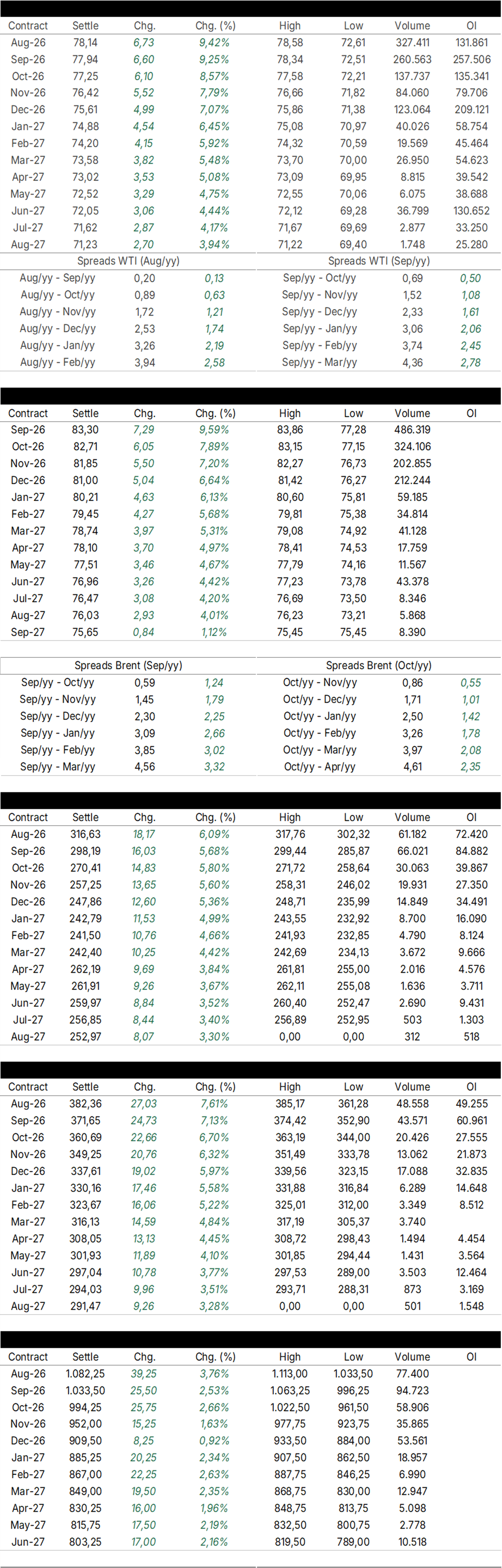
Source: ICE, NYMEX. Prepared by: StoneX.