Global
What is there to say about the market that doesn't do anything!!!
We saw where President Lukashenko of Belarus floated the idea of cutting potash production by 10%. No doubt his hope is that other friendly potash producing nations (Russia) would follow suit and the cut in world production would be enough to rally price ideas.
...that hasn't happened.
We have not seen anything from Russian producers that leads us to believe they are going to cut anytime soon. As such, prices have been extremely flat.
And I think that is the continuing story. Unless we start to see some production cuts around the world, it is difficult to see why potash prices would climb in the near-term. It should stay pretty rangebound.
North America
If we had a normal fall application season, we would end up with empty storage and plenty of space for manufacturers to fill. While the fall is far from done, it has not been anything close to that so far and the fear needs to be growing that we will celebrate Christmas without much of a wheel turned and storage across NA that is already full.
If the fall continues this poor pattern and we end still relatively full, that should pressure price ideas lower. A lack of storage options means inventories build quickly and could force some manufacturers to slow/stop production until demand returns. If we end up with a great fall run, even then it is difficult to see prices up substantially. Continues to look like potash is very well supplied and a well-supplied market struggles to push prices significantly higher.

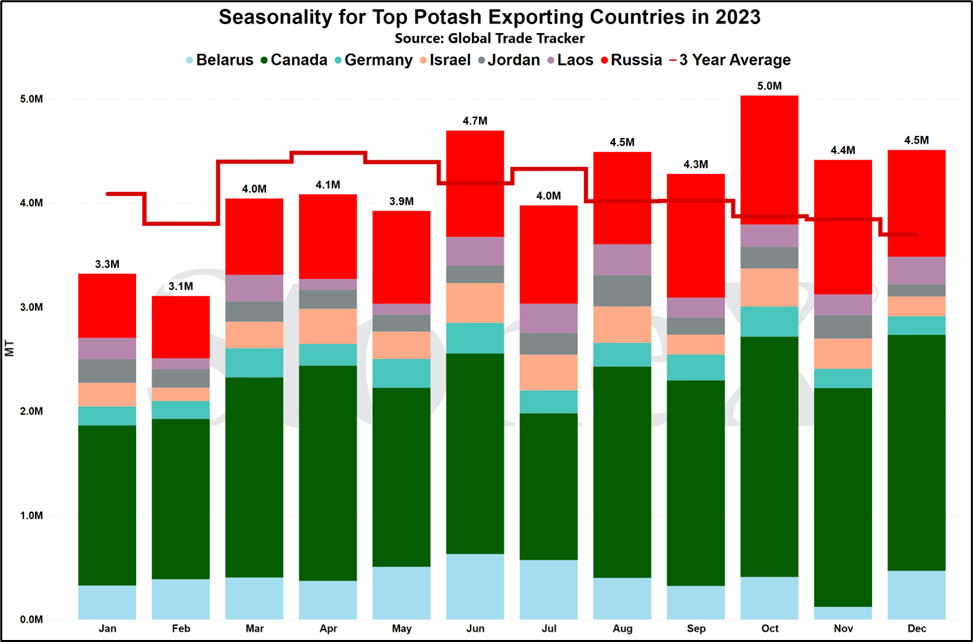
Escalations in the Russia/Ukraine war brings questions to Russian export reliability
I have talked and written so much about this situation that it is starting to get old!!!!! For a more thorough walkthrough of the situation, reference the urea newsletter.
So, what does this situation mean for the global potash market?
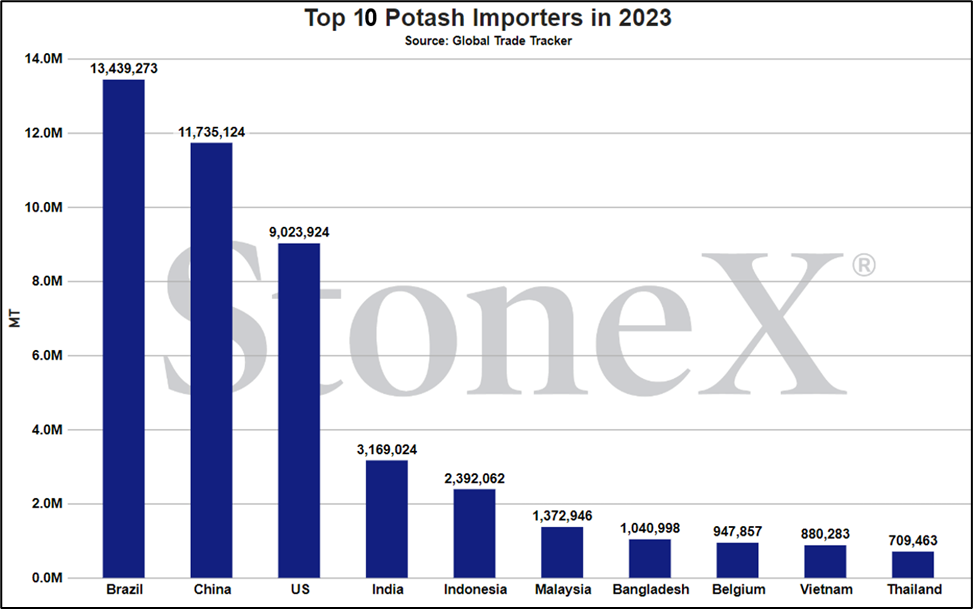
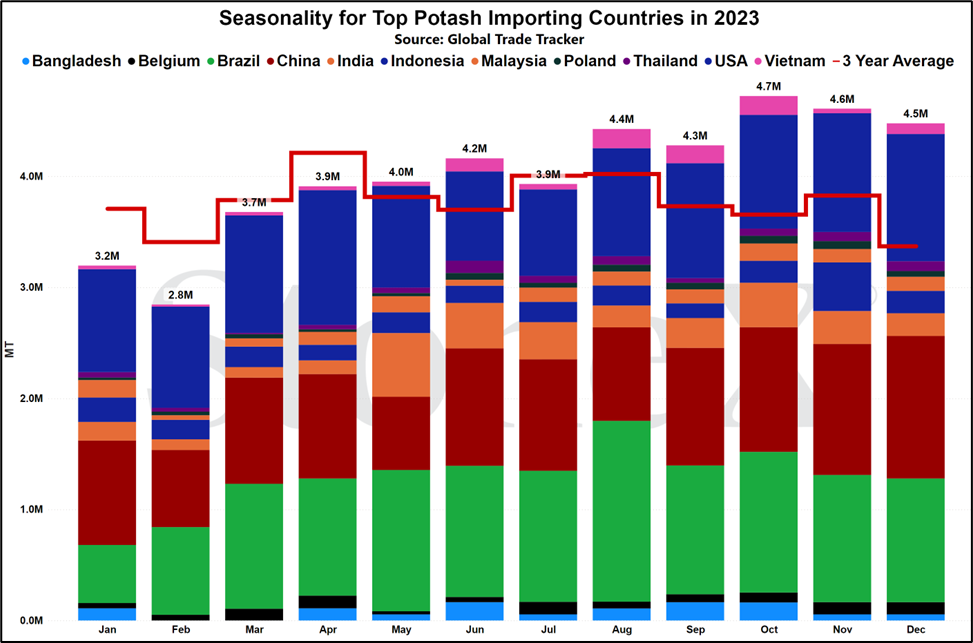
If you scroll up just a little bit, you will notice that Russia was the 2nd largest potash exporter in the world in 2023. They were significantly lower than Canada who still retains the top spot, but 11+M tons in a year is nothing to ignore.
Given what has been happening for escalations between Russia and Ukraine, combined with recent calls by several EU/NATO members calling for the stoppage of importing Russian produced fertilizers, we need to consider what the world looks like if these steps are taken.
It comes down to this: if "western" countries stop Russian potash shipments, there is enough demand left in the world for Russia to target.
The very simple is YES.
Scroll up and take a look at the biggest global importers in 2023.
- Brazil at nearly 13.5M tons
- China at 11.7M tons
- India at 3.1M tons
I could keep going but the point is already made. Russia exports 11M tons per year and 3 of the largest buyers in the world, combining for 28M tons of purchases, are seen as Russia friendly. Now, if western countries were to place stops on Russian product, we would likely see Brazil/China/India values fall vs the world as Russia gets aggressive to make sure it is THEIR product that gets used. That would be their way of trying to strong arm other product out.
So, if those countries see their values fall vs the world, that means the countries that call for the stops should start paying higher. Current global trade flows happen because logistically speaking, they are the best routes. If we start cutting these efficient routes (Russia), then we have to call on higher priced product/vessel freight/etc. to make up the difference. These values eventually make their way to the farmer who has to bear the burden.
Fortunately, we have not seen follow thru on this, but it has rapidly moved up the importance list. I hope calmer heads prevail, but it seems like the world continues to toe the cliff...
What does this mean for farmers
It depends on where you farm. If we see a situation where only western countries place blocks on Russian product:
- Russian friendly destinations should see their price lower vs the world.
- Russian combative destinations should see their price higher vs the world.
I wish I had more to reveal, but that is the simple explanation.
Belarusian president floats production curtailments to ebb weak potash values
In the last month, President Lukashenko of Belarus made some interesting comments. I'll save you the long and drawn-out speech. It basically came down to him calling for potash production rates to be reduced by 10% in response to low global values.
Historically, Belarus has been the world's 3rd largest provider of potash. In 2021, they exported nearly 10M tons. However, 2022 fell off markedly to just over 4M and 2023 just over 5M. The cause of the fall off was their role in Russia's invasion of Ukraine. When Russia made the decision to invade Ukraine, it was hoping for a quick victory. To help speed up the attack, they asked Belarus for permission to allow troops to use its territory to attack Kiev from the north. Belarus allowed the move...much to the anger of surrounding western friendly nations. Specifically, Lithuania.
The reason Lithuania's anger was most important was due to Belarus using its land and deep seaports to send vessels full of potash to sea. When Belarus opened its borders to Russia, Lithuania closed its borders. Literally overnight, Belarus lost its most important export route. Export plummeted volumes as a result.
Since that occurred, Belarus has been looking to shore up alternate routes and has been somewhat successful. Their exports are still short of normal but better than they were. For them, these new routes involve more costs which is why these current low values are of concern.
By themselves, Belarus cutting production rates by 10% does not feel enough to cause global prices to jump. There is just too much production and supply available for that to have an effect...but I do not think he made the statements thinking he could do it alone. By making public statements about it, my interpretation was that he was making statements to manufacturers around the world. Again, I have nothing definitive to go on, but it feels like he was hoping at worst Russian manufacturers would follow and at best countries like Canada would do the same.
As of today, we have not seen nor heard anyone following their lead. It appears everyone else is continuing to produce normally and values have remained very stagnant on solid supplies.
Now, the story isn't likely done. Just because we haven't seen others cut does not mean some couldn't be made in the future. If prices continue to fall, eventually someone has to cry uncle and slow/stop until the market recovers. Hopefully we continue as we are: well-priced and well-stocked.
What does this mean for farmers
Right now, nothing. This is more of a watch point story than it is an actionable story. However, this could change quickly. If Russia starts to follow, now we have the world's number 2 and 3 largest exporters cutting production. If Canada starts taking similar steps, prices should move higher.
Vancouver port strike brought to an end by government intervention
It seems that most of the time that the industry has talked about unions this year, it has been around threats of strikes.
Now, I am not here to support and go against any of these strikes. This is especially true when it comes to union strikes in other countries. That said we have to look at it thru the fertilizer prism.
Earlier this year, the fear was that the CP and CN railroads would shut down. Unions were demanding improved contracts. The railroads were refusing to move enough to meet those demands. Eventually, the story boiled down to an actual work stoppage which scared the heck out of marketplaces. Given Canada's reliance on rail shipments, any prolonged work stoppage would have been devastating. For the market (again, not taking a stance on who won or lost), it fortunately saw the Canadian government step in and refuse any work stoppages. Work resume and shipments returned to normal.
Well, other unions have seen what was done and have started taking the same approach. This is true for Vancouver port workers.
There have been threats of a work stoppage and it looked that it was headed that way but once again, the government intervened, and work continued. This would have been huge for Canadian potash exports if the stoppage happened and went on for a while. With workers back, it seems that this is a story of caution of what could happen to logistics.
Hopefully we will see these threats to logistics slow or even come to a stop.
NOLA/New Orleans Louisiana
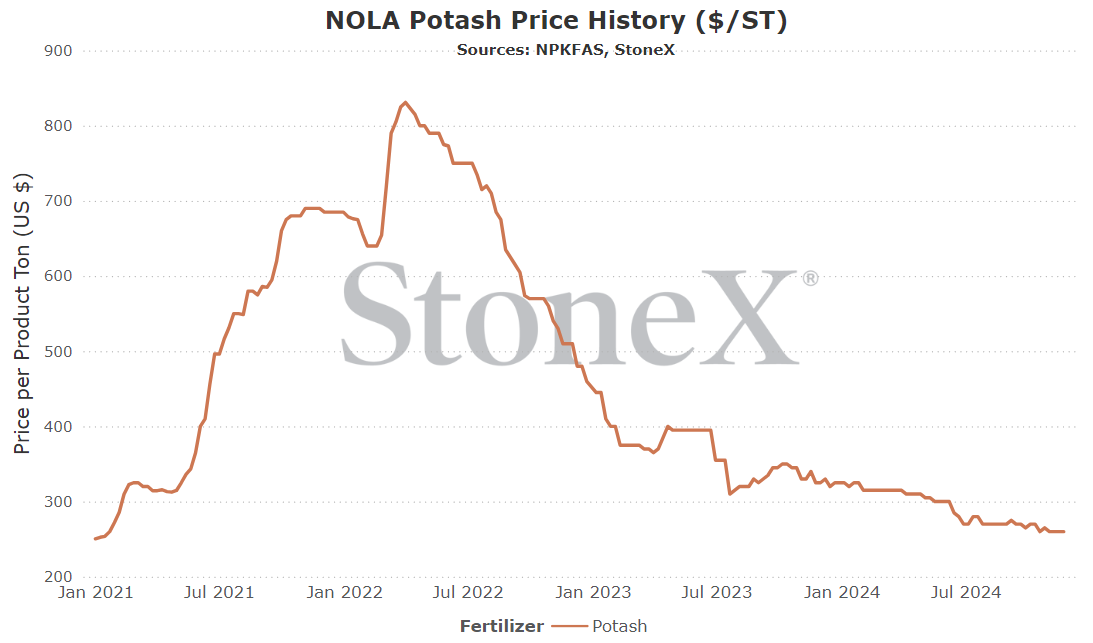
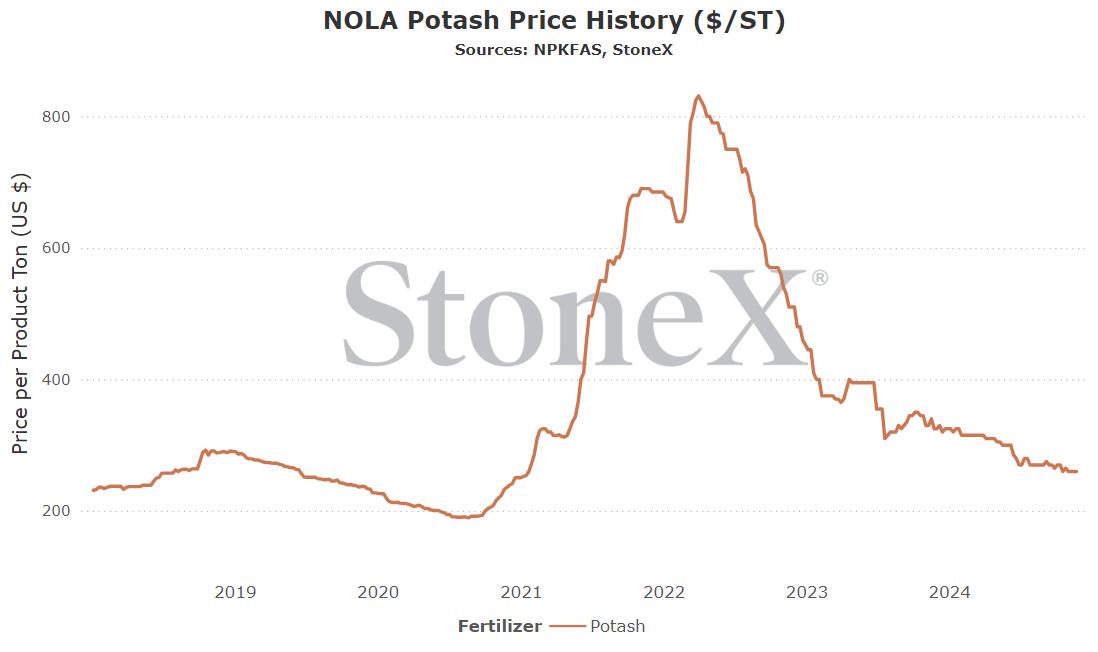
Vs 30 days ago - -2% or approximately $5 lower
Vs 90 days ago - -4% or approximately $10 lower
Vs 6 months ago - -13% or approximately $40 lower
Vs 1 year ago - -20% or approximately $65 lower
US Midwest Average (average of several points across the Midwest)
Vs 30 days ago - -2% or approximately $6 lower
Vs 90 days ago - -9% or approximately $33 lower
Vs 6 months ago - -14% or approximately $53 lower
Vs 1 year ago - -25% or approximately $104 lower
- Russian import stoppages start – Russia is my focus of the month. We already had Canada and Australia refusing Russian produced fertilizers. We now have EU/NATO members calling for a blockage of Russian produced fertilizer. If this trend continues and it limits Russian destinations enough that exports need to slow for lack of homes, then global supplies shrink and in theory prices rise.
- Other countries follow Belarus's call for lower production rates - the Belarusian President discussed cutting potash production rates by 10% in response to global values being low. No doubt, he made this public in the hopes that other nations/manufacturers would follow suite. Today, we have not seen nor heard anyone looking to mirror his approach...but things can change. If we suddenly see other nations matching his statement, then global supplies can shrink causing prices to rally.
- NA fall applications exceed expectations leaving inventories empty – given how little we have gotten done across NA this fall so far, it is hard to see a path where we completely empty warehouses...but it isn't impossible. This industry never ceases to amaze me on how much can be done with so little time. If NA can catch a couple/few open weeks, it can empty this system and give manufacturers plenty of sales opportunities.
- Global manufacturers ignore low pricing – this seems to be what is happening. Belarus called for production cuts but so far, he is being ignored. Manufacturers around the world appear to be keeping their foot on the production pedal with no sign of loosening. The world continues to feel very well supplied...and that keeps a cap on price ideas.
- Poor NA fall season causes high inventories in winter - I really hope this doesn't end up being the case because if the fall run is poor for potash, it is also poor for phosphate and NH3 and will build substantial issues in the spring. However, it is certainly on the table. We are late this fall. We have a lot of work ahead of us and one or two more timely moisture systems would likely be enough to stick a fork in fall.
- Expected global production increases come online – we and the rest of the market continue to watch new and expanded production progress. Eventually, even more products will be available which is fantastic news for buyers as it "should" keep values low and affordable. If progress on these plants gets ahead of schedule and we start seeing signs that increases are coming sooner than expected, then prices should dip lower as a result.
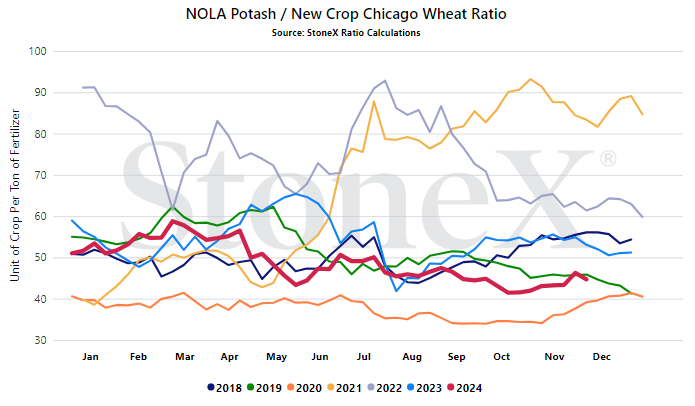
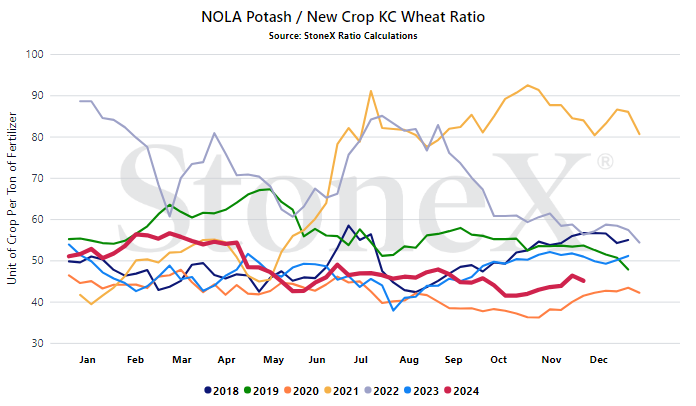
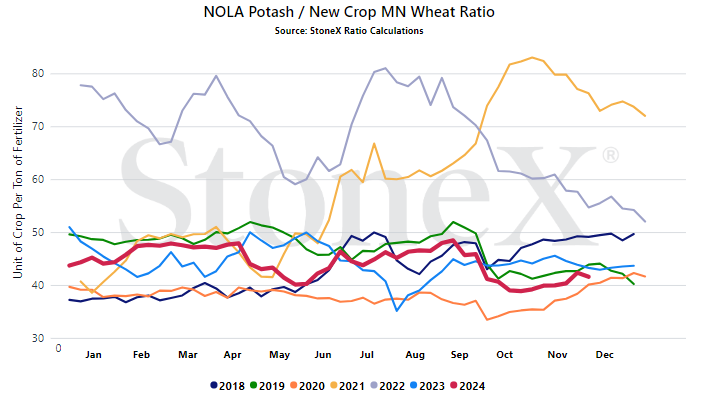
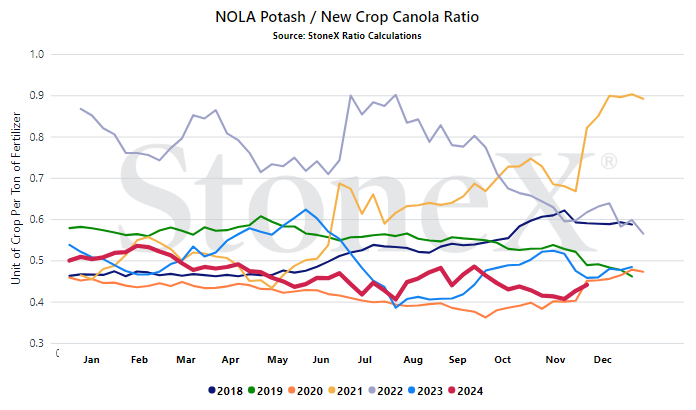
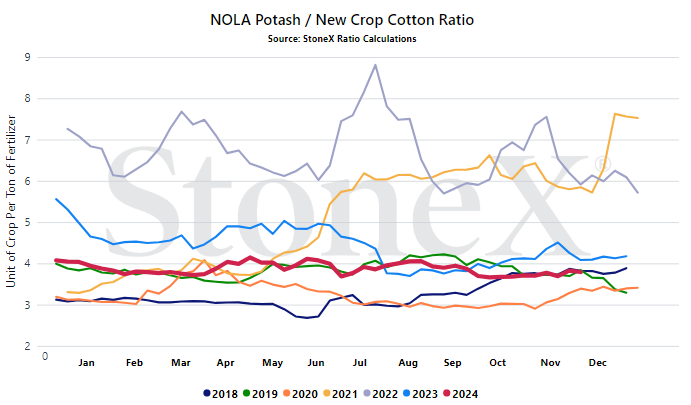
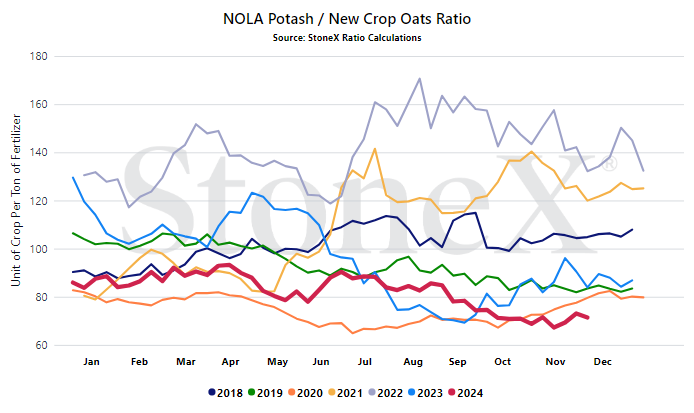
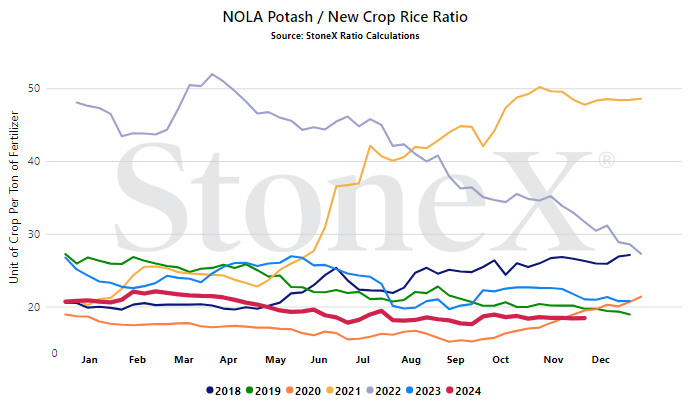
Where are the current potash/grain ratio values today
We believe that only looking at the flat price of either grains or fertilizer can be misleading:
-
Only selling grain can hurt you if fertilizer prices rise substantially
-
Only buying fertilizer can hurt you if grain prices fall
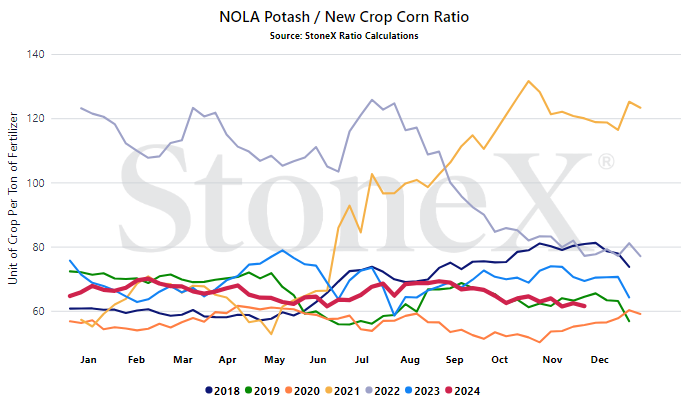
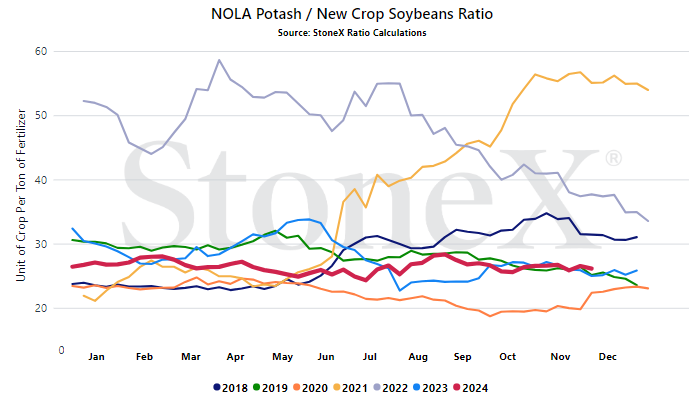
We look at the ratio "value" to get a better indication of where we are or how many bushels of X does it take to pay for 1 ton of fertilizer.
Would you rather:
-
Spend 120 bushels to pay for 1 ton of potash
-
Spend 60 bushels to pay for 1 ton of potash
When we compare the current ratio value against recent years, we start to see if we are high or low.
YOUR VALUES MAY LOOK DIFFERENT
This graph looks at the NOLA potash price vs the flat grain price. There are no logistics on either product. Your location will look different due to fertilizer logistical costs, grain basis, etc.
- Russian product starts getting blocked around the world - potash is one of those products where if western countries start blocking Russian produced potash, Russia should be able to still find enough homes for their product causing the global S&D to remain relatively unchanged. However, it would disrupt "normal" global trade flows. If Russia can continue to sell all their product, then the countries that block their flows (that would normally receive) would likely see their price more than a global premium while friendly Russian countries would enjoy lower values. Unseen what will happen, but this has jumped to my most important point.
- Whether anyone around the world listens to Belarus - manufacturers like high prices. If you put yourself in their shoes, it makes sense. Most of the time, higher prices equal higher margins. It becomes even more important when you are a country like Belarus who lost their primary export route thru Lithuania, have to rely on longer and more expensive routes thru Russia and likely represent some of the highest cost product in the world. They are the one likely getting squeezed the most with low prices. They can cut their production by 10% but it doesn't seem as though it will do anything to the market. How other countries/companies respond could make a difference.
StoneX Ratio Calculation
The ratio calculation is derived from Bloomberg historical grains values as well as fertilizer values from StoneX, NPKFAS, and Argus.
The calculation is simply dividing the fertilizer price by each grain price.
All data was sourced from StoneX unless otherwise noted.