Strait of Hormuz remains central to geopolitical negotiations
According to a White House statement, Trump and Xi Jinping agreed that the Strait of Hormuz must remain open for the free flow of energy commodities. At the same time, the Chinese president opposed militarization of the strait and any toll charges for its use, signaling alignment between the two powers on this second point.
Why it matters: The understanding between the world's two largest oil consumers that ending the war is necessary could increase Beijing's pressure on Tehran to advance peace negotiations, potentially reviving bearish sentiment in the market.
- At the same time, China's opposition to militarization of the strait and the challenges in bridging differences for a definitive peace agreement between the U.S. and Iran are factors leading investors to approach this potential resumption of oil and derivative flows through Hormuz cautiously, resulting in stable prices at the start of the session.
- It's worth noting that last week, Iran's Foreign Minister Abbas Araghchi met with the Chinese government to discuss the Middle Eastern conflict, presenting Tehran's conditions to Beijing for ending the war.
What to expect? In the short term, U.S.-China alignment could marginally reduce geopolitical risk premiums, but without concrete action to reopen the strait, the effect will remain limited.
- If Iran imposes new restrictions or resumes offensive actions against ships or territories of other Persian Gulf countries, Brent could regain upward momentum.
- Meanwhile, the physical market remains under significant stress, with the International Energy Agency confirming that even with a strait reopening this month, the global balance will likely remain in deficit until September, amid logistical reconfigurations and Gulf producers' challenges in rapidly scaling up supply.
Trump-Xi summit signals cooperation but lacks concrete progress on tariffs
Beyond the Iran issue, Xi Jinping also expressed interest in increasing purchases of American oil to reduce China's dependence on the Strait of Hormuz.
Why it matters: China has not imported American oil since May 2025 due to the 20% tariff imposed during the trade war. Despite its efforts to find alternatives to Hormuz, this tax makes U.S. oil commercially unviable compared to other available options.
- If these tariffs are removed or significantly reduced, the flow could resume, but historically, the U.S. has never been a major supplier to China: at its peak in 2020, it accounted for less than 4% of Chinese imports.
- The direct impact on the global balance would be limited, but the political signal could ease risk premiums.
What to expect? The market is likely to remain in a holding pattern until the summit concludes on Friday.
- If a concrete tariff agreement involving energy emerges, oil futures could face downward pressure due to U.S.-China alignment in pursuit of stability in the global oil market.
- However, if the meeting ends with only generic statements, frustration may erase some of the gains observed in recent weeks.
U.S. inventories drop more than expected, but distillates surprise
The commercial U.S. crude oil inventories fell by 4.3 million barrels in the week ending May 8th, exceeding expectations for a 2.1 million barrel drop. Gasoline inventories also declined by 4.1 million barrels, above the projected 2.9 million. On the other hand, diesel inventories rose by 200,000 barrels, defying expectations of a 2.7 million barrel decrease.
Why it matters: The sharp drop in crude oil and gasoline inventories reflects strong export activity and resilient domestic demand—bullish factors for prices. However, the unexpected increase in diesel reserves signals potential slowdown in industrial and logistics activity, aligning with concerns over economic impact from high inflation.
What to expect? The market will likely continue monitoring upcoming EIA weekly reports to confirm whether the declining trend in crude oil and gasoline inventories persists.
- It’s noteworthy that the U.S. strategic petroleum reserves dropped by almost 12 million barrels during the same period, highlighting that commercial inventories are struggling to sustain themselves even with SPR releases.
- In the case of diesel, sustained weak demand in the U.S. could further deteriorate the crack spread for the fuel, which already fell by 8.9% in the last session, hovering around USD 61/bbl.
Daily Table - Price Variation in the Previous Session
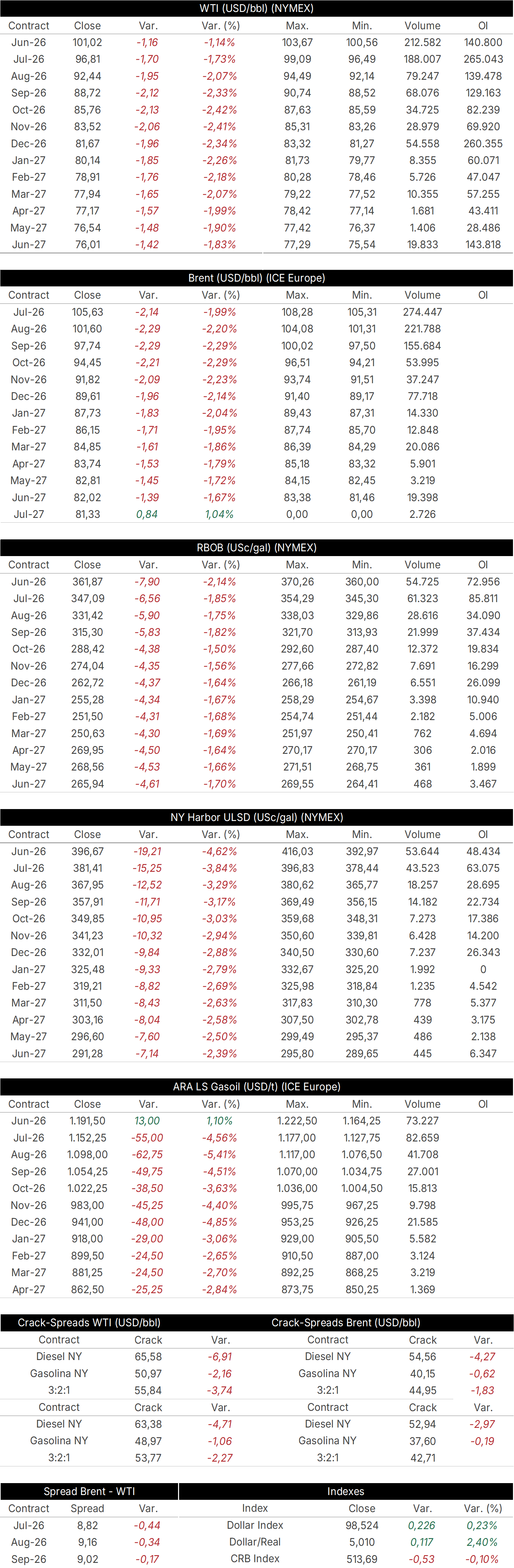
Source: ICE, NYMEX. Prepared by StoneX.