“Two pipelines remain operational, one flowing through Ukraine into central Europe, and another (called Turk Stream) flowing into Greece. Flows through the former have been intermittently affected,” Altham said.
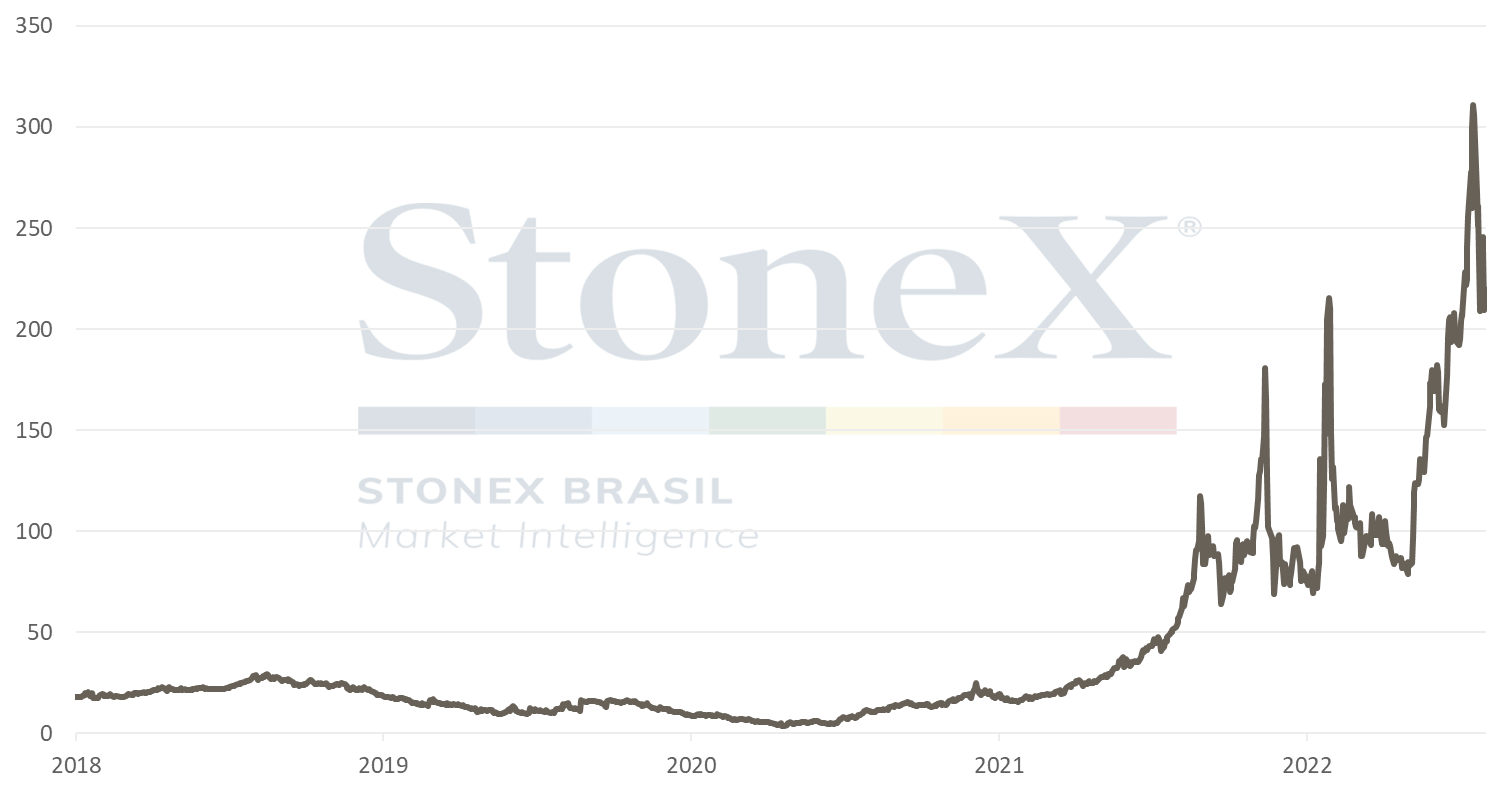
Altham explained that in the wake of the invasion, the TTF contract reached a high of €350 megawatt/hour, surging from the €26 megawatt/hour recorded in December 2020.
“Gas is flowing at a much reduced quantity. In terms of price shocks, reduced flows through Ukraine stand as the greatest upside price risk,” Altham said. “But in terms of supplies, Europe will be fine over the winter, even with a severe cold weather event. It would take a near-perfect storm for Germany to run out of gas this winter. We believe Europe as a whole will survive, but South East Europe is the greatest ‘risk area.”
According to the USDA, natural gas prices have temporarily plateaued but remain elevated significantly above their 10-year averages. The Henry Hub natural gas spot price average for July was down 10.5 percent from May 2022, but still up 89.5 percent from July 2021. Germany has embarked on a rapid plan to add additional liquified natural gas (LNG) terminals to receive LNG shipments, as gas flows from Russia remain lower and more unreliable. Reduced flows from Russia have led to concerns of gas shortages and even higher prices when gas demand rises in the upcoming winter months.
Most coffee roasters are dependent on gas, as there an no large-scale electrical roasters developed yet, due to the enormous amounts of electricity needed to gain that much heat.
Klaus Thomson, Co-founder of Denmark based Coffee Collective, tells CoffeeNetwork that they have experienced significant cost increases, “and are also worried about gas supplies this coming winter. The price increase so far is up towards 10% and might go higher,” he said.
Procaffe, an Italian roaster, uses 3 Probat machines with a capacity of 220-240 kilograms of coffee per batch. On average, they roast around 400 tons of coffee per month with their average fuel use around 25.000 m3 (cubic meters). According to Samuele De Lazzari, with Procaffe, the average cost of their bill in 2021 was 10.000 €uro per month. It shot up to 38.000 €uro in January and surged even higher to 56.000 €uro in July 2022.
Danesi Caffe, another Italian coffee roaster, also saw an increase of 40% of their fuel bill over the last few months. “To mitigate the increase in energy costs, we are currently installing a photovoltaic system that however won’t be capable to satisfy roasting plant energy demand since it only runs on gas,” Ilaria Danesi explained to CoffeeNetwork.
Blaser Café in Switzerland also operates 2 Probat machines, roasting between 100 to 130 tons per month.
“We use natural gas for about 85'000 kWh every month and we have costs of approximately CHF 6’250 per month, Marc Kappeli, Managing Director of Blaser Café tells CoffeeNetwork. “This is only for the gas without government levies and without contractual services by the supplier; so that means they charge us about CHF. 10’500.- per month.” He confirms that the gas price charged has increased by 30% since the beginning of the year (CHF. 0.06/kwh in January this year, now 0.085/kwh).
“We do not buy gas on the free market. We are dependent on our supplier and prices can change monthly. At the moment, we are still benefiting from our supplier's long-term contracts with reasonably low prices. However, the trend is clear and we will probably have to expect at least a doubling of the current prices,” he says.
Even before the current energy crisis in Europe, natural gas and coffee roasting was under the microscope. Roasting coffee with traditional gas‑powered equipment creates a cloud of smoke, particulates, and volatile organic compounds (VOCs) that have harmful health implications for people and contribute to negative environmental impacts. In the US, many states require an afterburner to break down the harmful gases even further. Afterburners also run on gas—and need a lot of it—which increases gas usage in a single session as much as 300%.
Last month, Probat, announced new alternatives to natural gas-powered burner technology by looking into adequate alternatives and now offers its customers LPG-compatible adaptations of burner technology.
Liquefied Petroleum Gas (LPG) is produced during oil refining or is extracted during the natural gas production process. With higher availability on the markets, LPG has much potential as an alternative to natural gas. Also, with manageable effort, roasting machines previously operated with natural gas can also be converted to LPG operation. The PROBAT experts derive the actual technical steps required, such as LPG-compatible adaptations of installed burner equipment, on a case-by-case basis.
“We needed to come up with an interim solution to help our customers overcome the natural gas shortage. That is why we are now offering retrofits to make burners LPG-compatible. However, the carbon-intensive nature of traditional roasting is hampering the coffee industry’s ability to reduce its environmental impact. Therefore, we have been looking into the issue of fossil fuel replacement for years now. And we have tested nearly all viable alternatives, such as biogas, electricity, or green hydrogen, which we consider the future of coffee roasting where direct electrification is not possible. Our whole engineering team made a concerted effort to develop roasting technology that can be operated with this highly combustible gas,” explains PROBAT CTO Thomas Koziorowski.
European coffee roasters will be closely following emergency talks scheduled for today aimed at finding new measures to curb the skyrocketing energy costs.
European Commission President Ursula von der Leyen has put forward plans including a price cap on Russian gas, a bloc-wide cut in electricity demand and a levy on non-gas generators.
President Vladimir Putin said on Wednesday that Russia will stop supplying all gas to Europe if it imposes a price cap, but with supplies already limited, the impact of a complete halt is unknown. Russian gas pipeline deliveries via the three main routes to Europe have fallen by almost 90% in a year, Refinitiv data show.
Alexis Rubinstein


 European Coffee Roasters Face Surging Gas Bills Amid Worsening Energy Crisis