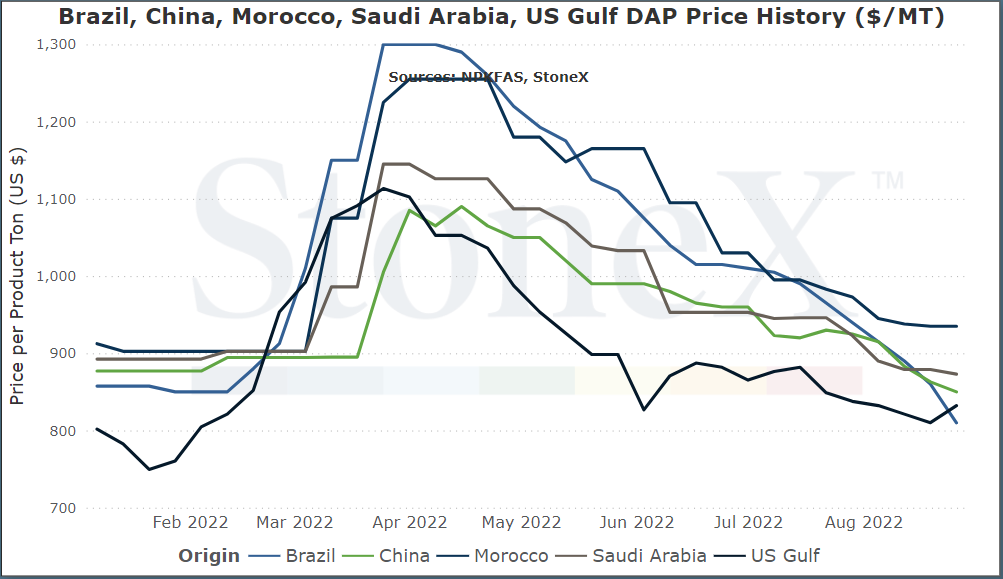
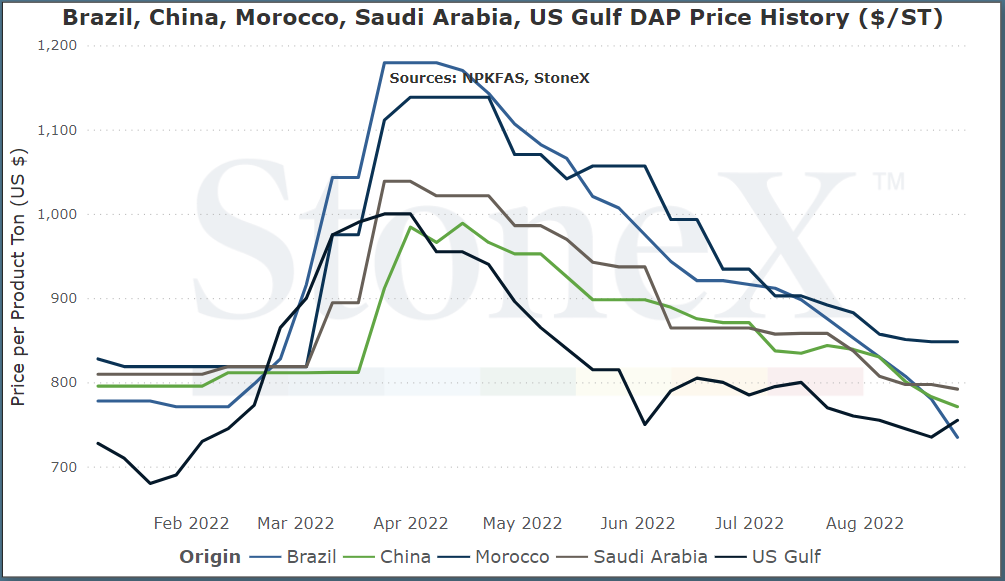
Major global phosphate export location price graphs
This is something new that I'm going to start adding to this newsletter. I will have 2 graphs: one that lists historical pricing in short tons and one in metric tons so that everyone can read it in a form they prefer. All prices are listed in USD. All prices are FOB or priced at their origin.
I will say this now and will say it going forward to eternity: these are the flat price graphs for each individual location. Your price where you are is going to be different. There are logistics. There is the cost of storage/interest/insurance/etc. These graphs should not be taken as "it shows the price at $700, why isn't my price $700". These graphs should be used to give an appreciation for price movements thru 2022.
What everyone wants to know first, what do we think will happen going forward
With the exception of a slight price increase in NOLA DAP values in the last week, the continued global price trend has been lower in the past month.
Further to that point, we continue to see North American production as some of the highest cost production in the world. The September Tampa NH3 price did not go up nearly as much as expected and sulfur prices are expected to be slashed for Q4 '22. That means the cost of production largely remains flat to expected lower.
A lower cost of production DOES NOT equate to a guaranteed drop in price. However, it does mean that if the market pushes back hard enough (i.e. doesn't buy or apply this fall), values can fall further.
I think phosphate is going to struggle to show a lot of strength in the near term. Especially if demand smells blood in the water (which I think does). There is global demand coming but I'm not sure it will be enough to offset overall demand destruction and application delays.
What I'm saying in a way too long way is that we could see a small price pop in the short term but ultimately, it seems that prices are going to remain under pressure.
Should you buy your fall '22/spring '23 phosphate needs?
November is coming up fast. If you are a fall application farmer, are far away from production sites and the numbers work, time to start making a hard consideration to lock up fall needs.
THIS IS NOT A ONE SIZE FITS ALL ANSWER.
Let me repeat that
THIS IS NOT A ONE SIZE FITS ALL ANSWER.
Yes, I know the above was a repeat from August. It was a long day at the Farm Progress Show. I'm tired. Leave me alone!!!
Seriously, this comes down to your operation. If you reside in the heart of the cornbelt and your 2023 financials are showing overall profits, it likely makes sense to lock up your needs and get ready to pour coals to the fire and produce every bushel you can next year. I personally wouldn't want to risk everything in today's environment trying to get just a little more.
However, if you farm in "fringe" acre regions, it may not make sense...right now. If you are looking at your numbers for next year and are questioning what to do, it makes sense to wait this thing out. See if grain prices rally further. See if phosphate values drop further.
Either way, TALK TO YOUR RETAILER. They are watching this market just like we are and they do not want to get hung with high priced product. A lot of retailers survived thru 2008 and 2012 and have swore never again. You cannot expect that product to be in the shed just waiting for you to show up on November 1. If you are going to roll this fall, talk to them. If you are going to wait until winter/spring, talk to them. I know many of you may see them as your adversary. In some cases, that may be but the majority that I work with want what is best for their customers because a healthy customer continues to buy from them.
What has happened in the last 30 days?
Global prices have continued to slide, but where is the end?
While the last month has not exactly been a freefall of global phosphate pricing, the trend has definitely been negative. From my perspective, I think there are a couple factors that are playing into this:
- Concerns that demand destruction is bigger than expected
- Normalizing tighter than typical global supplies.
Talk to almost anyone in the marketplace and they will admit that they expect phosphate application rates to be down thru the fertilizer year 2023 cycle. The only real question is by how much. Some believe we will only see single digit percentages from normal (almost non-event). Others, such as ourselves, continue to expect to see 10 - 15%...or more, as farmers cut back rates and pull phosphate from the soil in an attempt to boost profits and cut spending.
The second point is sort of hard to describe. When a market suddenly tightens up on typical inventories, there is a freak out period where prices skyrocket in response. That is what we saw happening. Demand went thru the roof when grain prices shot higher. China cut their exports and as the number 1 exporter in the world (using 2021 data), that made a big difference. Russia started capping exports. There were a lot of "scary" things happening and prices responded.
Today, several of those events are still in play but we are getting used to them. They are no longer ridiculous events. They are just part of our world and we are calming down to them.
This does not mean that prices cannot climb again. Quite the opposite. With low inventories, any new event will be felt more violently than previous years.
This just means we need to keep our heads on a swivel.
North American producers caught a break
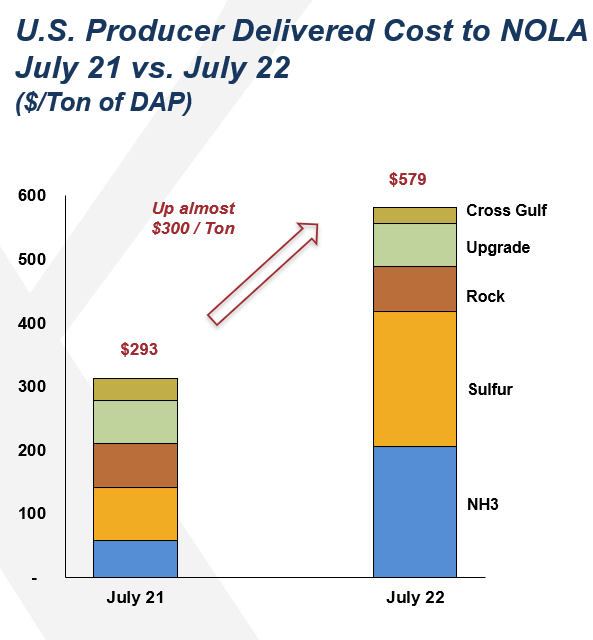
Last month, I showed this picture detailing our perceived cost of producing one ton of DAP in a NOLA barge:
The point was to show that while margins were still healthy, there was not hundreds of dollars of downside price risk from current markets. If the market dropped $200, producers such as Mosaic would simply shut down production. They are in this business to make money and are sitting on finite phosphate reserves.
With everything happening in the global nitrogen marketplace, I fully expected to see the Tampa NH3 price raise enormously from August. With it being a sizeable chunk of the cost of production, I was fully prepared to write this and talk about how the cost of production was likely decently above $600 now.
Well, that was not the case. The Tampa NH3 price was only raised by $50. Further, while it will not be felt in September, we expect to see the price of sulfur slashed for the 4th quarter. That should mean, if everything plays out as expected (how many times have I said that and been wrong?), the cost of production should drop decently by October 1.
Now, let me reiterate. This does not mean prices will fall to cost of production. We (N.A.) are still part of the world marketplace. If the N.A. market does not want to buy these tons, there might be export opportunities. With no export restrictions in place, tons can flow freely to rebalance the N.A. S&D.
This just means that under the right circumstances (global demand dries up, fall demand is poor, inventories are bursting at the seams), the price CAN fall further before forcing producers to decide to shut off production.
Biggest question: what is coming this fall?
At least that is my current biggest question.
As mentioned before, we already anticipate phosphate demand being lower than normal. We are currently estimating between 10 - 15% lower than normal. That is just the overall number and we think that will vary depending on where the farmer is.
The bigger question is what will the fall/spring split look like. Will we see farmers approach this fall normally and not care about the chance of prices continuing to fall thru the winter to provide cheaper options in the spring? Will farmers be angry at the continued high price and opt to wait? Will it matter due to mother nature not allowing any progress be made?
While the overall demand destruction is important, the fall/spring split is more so. If enough drag their feet to spring, we will see prices down thru some winter months. However, that will cause a huge demand surge in the spring that the market may struggle with. The results could be higher cost from higher logistics as well as late deliveries.
If I had the answer to this question, I would be much richer!
Still no change on the U.S counter vailing duty against Russia/Morocco
In past editions, I have mentioned that even if the CVD was reversed, it would likely make little difference as NOLA values were some of the cheapest in the world. Now, with global prices dropping and demand sluggish, it might make a difference.
Unfortunately, we have still not heard any further news in regards to a reversal. Hope spiked that there would be following CF's loss on their UAN duty case. News may still come. It just hasn't been heard as of this writing.
Obviously I'll send an update if we do hear.
Last minute addition: India purchases 500Kmt at $820
This happened on September 1 but I thought it was worth adding in here before I sent it out to everyone.
It was reported that India had purchased 500,000mt of phosphate at a delivered price of $820. This is yet another step LOWER in global phosphate price ideas and continues to prove that the global trend is definitely lower.
This trend will not be lower forever. Chinese exports remain very sluggish as the government restricts exports. N.A. production costs remain very high for September (likely to drop in October as lower sulfur prices get added to the equation). Demand, while likely lower than normal due to high price, is about to come in big waves.
Also keep in mind where you are and what the date on the calendar is. For our operation, international tons are almost to the point that they no longer matter. It would take most of a month to get a ship from most exporting countries. Then that product needs to be offloaded, reloaded on barges, moved up the river system, put thru a terminal and shipped via truck to our local retailer. You start to see where time is running out...
However, if global values continue to fall, that will weigh on price ideas...
Last minute addition 2.0: Pakistan demand may be way down
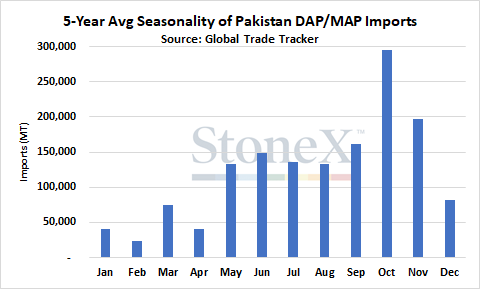
Many might be asking themselves "why is Josh talking about Pakistan phosphate demand?". As the number 8 DAP/MAP importer in the world, they matter. They very much matter.
Pakistan has been dealing with tremendous flooding which has a lot of questions popping up in regards to their demand this fall. We have heard that they have lost 2M acres of crops due to this flooding. Adding fuel to the fire is that they typically import their phosphate needs in September/October/November. You might be saying to yourself that we just started September so we have all 3 months in front of us. The flip side is this chart shows when product ARRIVES, not when it is purchased. Product needs to be purchased ahead of time to arrive in this window. There is still time but their absence has been notable.
Again, this is just another indicator of global price trends being justified. We need to keep watch because if they return to buy, it could be in a very big way.