Quarterly Commodities Outlook is available for free now.  Download your report  →

StoneX logo

Farmer Fertilizer Focus - UAN

By: Josh Linville, Vice President- Fertilizer

October '22 UAN (28% / 32%)
 
Josh Linville
Vice President- Fertilizer
major global uan export location price graph
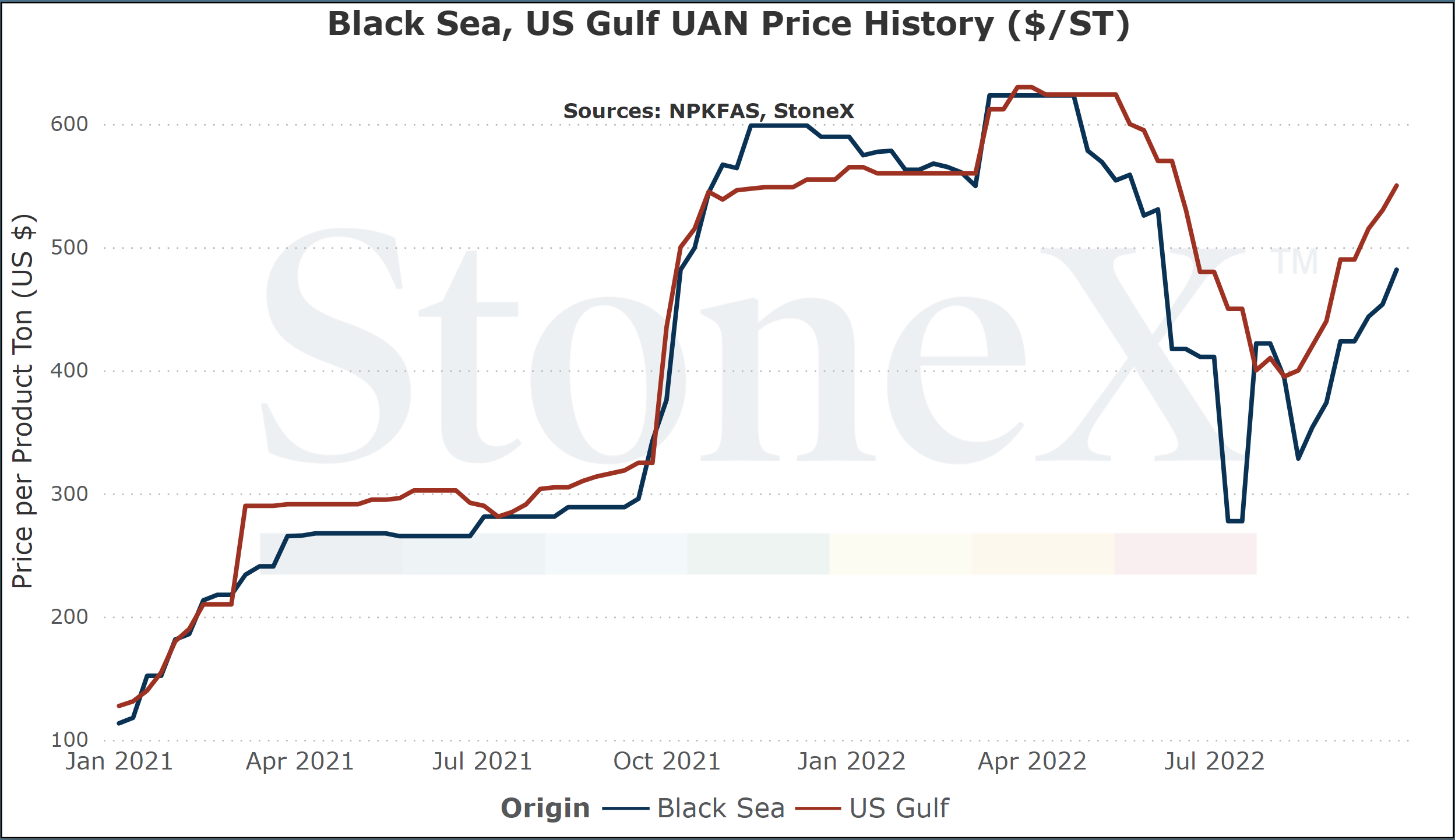
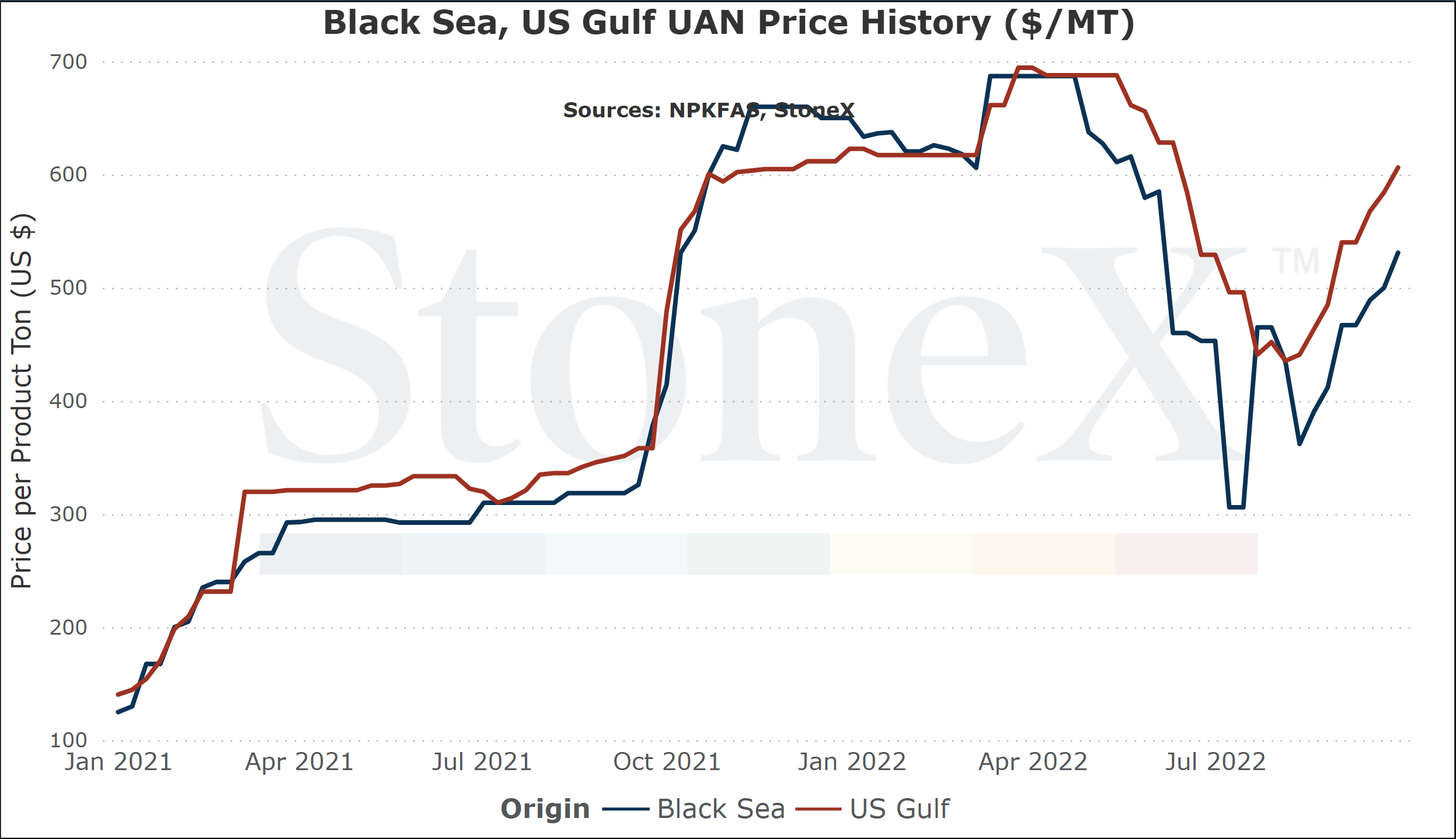
As mentioned in other products, the price graphs should be viewed by their price direction, not their absolute price.  The first graph looks at the Black Sea and NOLA values on a short ton basis.  The second looks at the same points except in metric ton.  Both are in USD.
image 51231
image 51232
What everyone wants to know first, what do we think will happen going forward
Nothing has changed in the last 30 days.  Europe production mostly offline with few hopes of restarting.  2023 N demand continues to look solid.  
Prices are up from last month and frankly, I'm not sure it is done.  In the last 30 days, we have lost the majority of European production.  That is around 20% of global capacity that is no longer there.  Not only that, but remaining world producers have more options.  It isn't like European farmers are going to say "oh well, we will just go without".
Unless there is a drastic change (possible), it is very hard to see UAN price ideas falling.  Urea is high priced.  NH3 is high priced.  Grain prices remain high.  That is a lot of leading indicators that support higher price ideas...and producers love money!
should you buy your Spring '23 uan needs today?
Keep layering...if it makes sense
If retail values are keeping up with replacement values (which a lot of times they lag), you are probably very near or above the $1/lb of actual N for UAN.  That is stout.  Especially this far in advance of spring.
However, if you are sitting there reading this thinking "well, it can't get any worse than this"...don't.  Haven't the last couple years taught you anything?!!!!
Right now for UAN, I am a huge advocate for if you buy your inputs, sell some of your outputs.  My biggest fear is not locking in the ratio today and it improving.  If we lock in today, we are happy with the result and we shouldn't look back.  My biggest fear is that someone buys their UAN, and then grain prices fall out or the other way around.  That is what destroys an operation.
I understand that forward selling comes with risks.  Work with your elevator/grain buyers/etc. to figure out what works best for your operation.
What has happened in the last 30 days?
Europe remains offline...and likely to stay that way
Another month and this story remains the focal point of the UAN global marketplace.  Or it should if it isn't!!!
We have been continuing to keep focus on European natural gas values.  Specifically, we are watching the Dutch TTF.  It isn't that every plant in Europe is based on that market.  It is just a very good indicator for the region in general.
Hope has been building incrementally in recent days/weeks.  The natural gas futures reached as high as $103 this year.  Since then, it has been declining to this morning (when I am writing this) when futures closed in the upper $40's/lower $50's range.  This means we are inching closer to some plants restarting...if the trend continues.
Unfortunately, time is running out.  Nitrogen plants can be difficult to restart after short term closures during the summer months.  That process gets even more difficult when the closure is longer term (as it is becoming there) and the temps start to turn cold (as they are about to be).  While not impossible, it is more difficult.
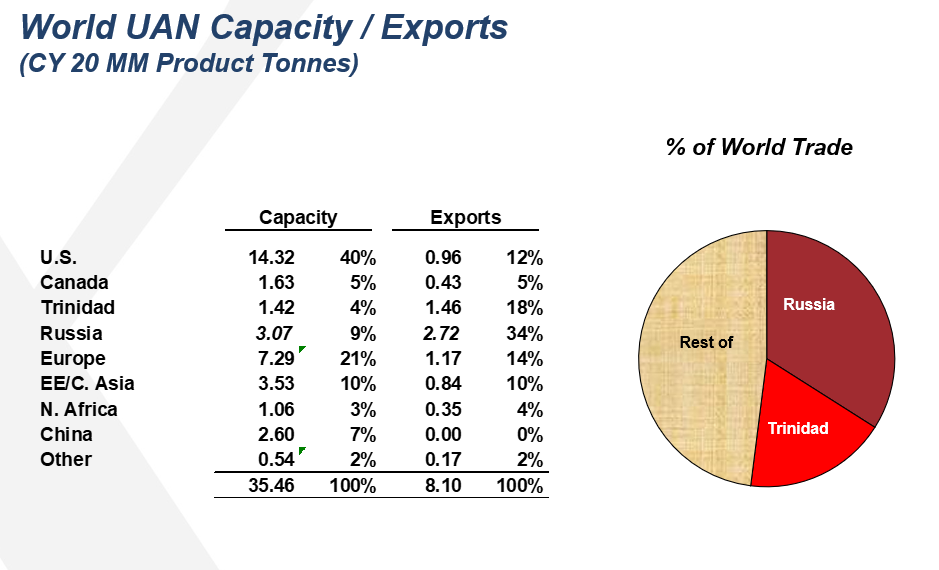
These plants have decisions to make and make quickly.  Those decisions will have global ramifications.  Western and central Europe account for approximately 1 out of every 5 tons of UAN produced around the world.  With the majority of that production offline, the world is incredibly tight vs normal.  However, the current market expects Europe to remain offline for the time being.  If production restarted, either by natural causes (profitable again) or government intervention, that will be 20% of global production that comes back.
These are not questions whose answers move markets $5 - $10.  These are questions whose answers could have ENORMOUS impacts on the global UAN complex.
image 42602
Nordstream pipeline attack lowers chance of Europe restarting
As you may have read and/or heard, the Nordstream pipeline which supplies natural gas from Russia to Europe was attacked last week.  Most quickly pointed to sabotage and pointed to Putin as the likely suspect.  Basically, Russia is losing the invasion of Ukraine and this attack is seen as Putin's retaliation or scorched earth approach.  If Europe is going to push him out of Ukraine, he is going to make sure no natural gas makes it to Europe as the winter temps come.
From a UAN production POV, this greatly lowers the chance of plants restarting.  Even though product was not flowing thru those pipelines, the opportunity was still there.  Now, with those pipelines having massive holes blown into them and specialized equipment/people needed to repair under that much water, the repair time is reported to be at least months.
This means supplies of natural gas remain tight in Europe.  If values do fall far enough to incentivize nitrogen production to restart, the expectation is that the markets will rally hard in response as N production is a major demand point.  The price rally would likely cause production to turn off again.
North American producers continue to have sales options
You might be noticing just how much higher priced UAN is in relation to both NH3 and urea.  It isn't the worst spread we have ever seen, but it is up there.
That continues to have to do with the European situation (sorry, couldn't go a point without bringing them up again).  From a urea perspective, western/central Europe accounts for 5% of global production.  NH3 is approximately 8.4%.  
UAN is a huge 21%.  1 out of ever 5 tons produced in the world are produced there...and they are largely offline.
The current wide spread between UAN and everything else is the markets way of trying to get demand to switch away.  I know it is uncomfortable to hear (it's uncomfortable to say) but it is the truth.  The UAN market has lost far more than either other N form.  Supplies are much tighter.  The market reacts by pushing that price so high that buyers start considering to change their practices.
"Well, if we switch away, that will force them to lower their price" you might be saying.  There is some truth to that...if Europe didn't need it so badly.  Many continue to point to export opportunities from plants in North America/Trinidad/etc. to Europe to backfill lost production.  They are willing to pay a higher price and producers are more than happy to ship there to fill that need.
I am not saying that there is no way values fall if demand locks up.  This is merely saying that producers will be able to hold onto higher prices for much longer if those export opportunities remain.
Where are current values in relation to the past
NOLA/New Orleans, Louisiana 
  • Vs 30 days ago - +25% or approximately $110 higher
  • Vs 90 days ago - +15% or approximately $70 higher
  • Vs 6 months ago - -13% or approximately $80 lower
  • Vs 1 year ago - +26% or approximately $115 higher

Black Sea

  • Vs 30 days ago - +29% or approximately $119 higher
  • Vs 90 days ago - +17% or approximately $78 higher
  • Vs 6 months ago - -23% or approximately $156 lower
  • Vs 1 year ago - +28% or approximately $116 higher
Bull/Bear Factors
Because no market is ever guaranteed to go higher/lower, we try to consider the factors that can sway values so that we are able to act when they occur rather than react.
Bullish Factors
  • European production remains offline for winter – this situation is growing in likelihood by the day.  Nitrogen plants are hard enough to restart after a short downtime and in the summer.  That gets much more difficult after a longer shutdown...and in the middle of winter.  Not to say it cannot be done.  Just gets hard.
  • Strong 2023 demand outlook – we originally had our 2023 corn acreage set at 90M.  Then we revised it up to 91M.  In the last several days, given how U.S. harvest appears, we moved it higher still to 93M.  There are others pointing to 95M or higher...and it is hard to argue today.  Regardless, N demand is going to be big once again. 
  • North America export options to Europe - with European UAN production offline, this creates a shortfall in global supplies.  However, this is a double edged sword.  The part that isn't discussed as much is the fact that global demand rises as European retailers/farmers compete to replace those tons lost.  As long as this scenario plays out, North American producers have solid export options (oftentimes, premium export options) which we cannot ignore.
Bearish Factors
  • Europe turns back on - this was already a very low probability situation that was made worse with the Nordstream pipelines being sabotaged.  However, if it were to happen, the reaction would be fairly substantial so we cannot ignore the possibility.  How many times in the last 2 years have we said not likely and then been proven wrong?
  • The price is high enough to influence demand – UAN values are very high vs urea.  UAN values are very high vs NH3.  UAN values are high vs...well, every crop I look at.  We have barely started October so there is a lot of time before spring.  This raises the chance that demand start switching away.
  • North American supplies better than expected – this can come in many forms.  The market is expecting major exports to Europe...but we did not see anything huge in the July export number.  Carryover inventory from spring was very heavy.  Producers could be producing more UAN than the market expected.  All of these and more could lead to much more supply than the market thinks is out there.  If demand remains the same and supplies are higher than expected, Econ 101 says prices should fall.  Not saying it happens, but this is a point I cannot get out of my head.
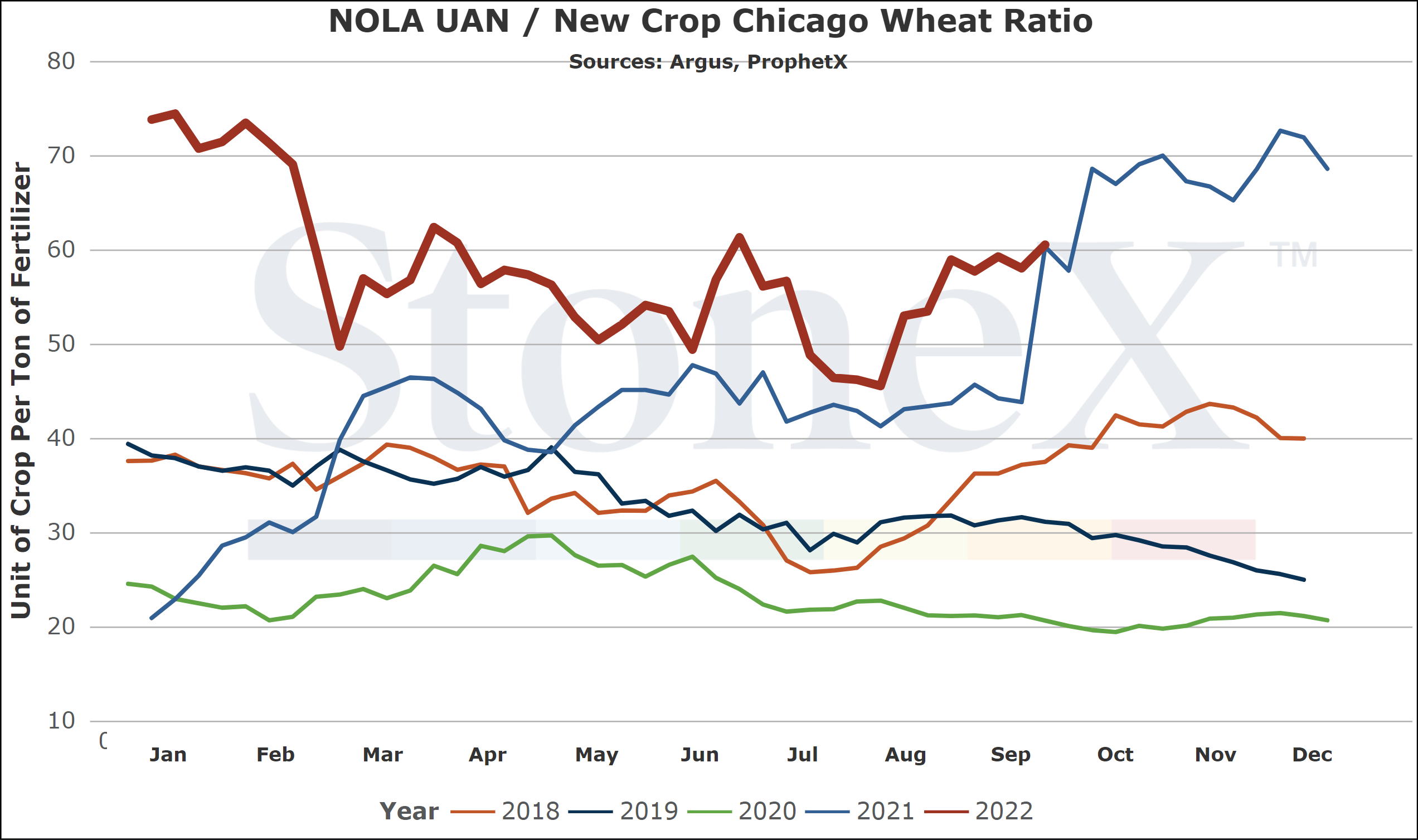
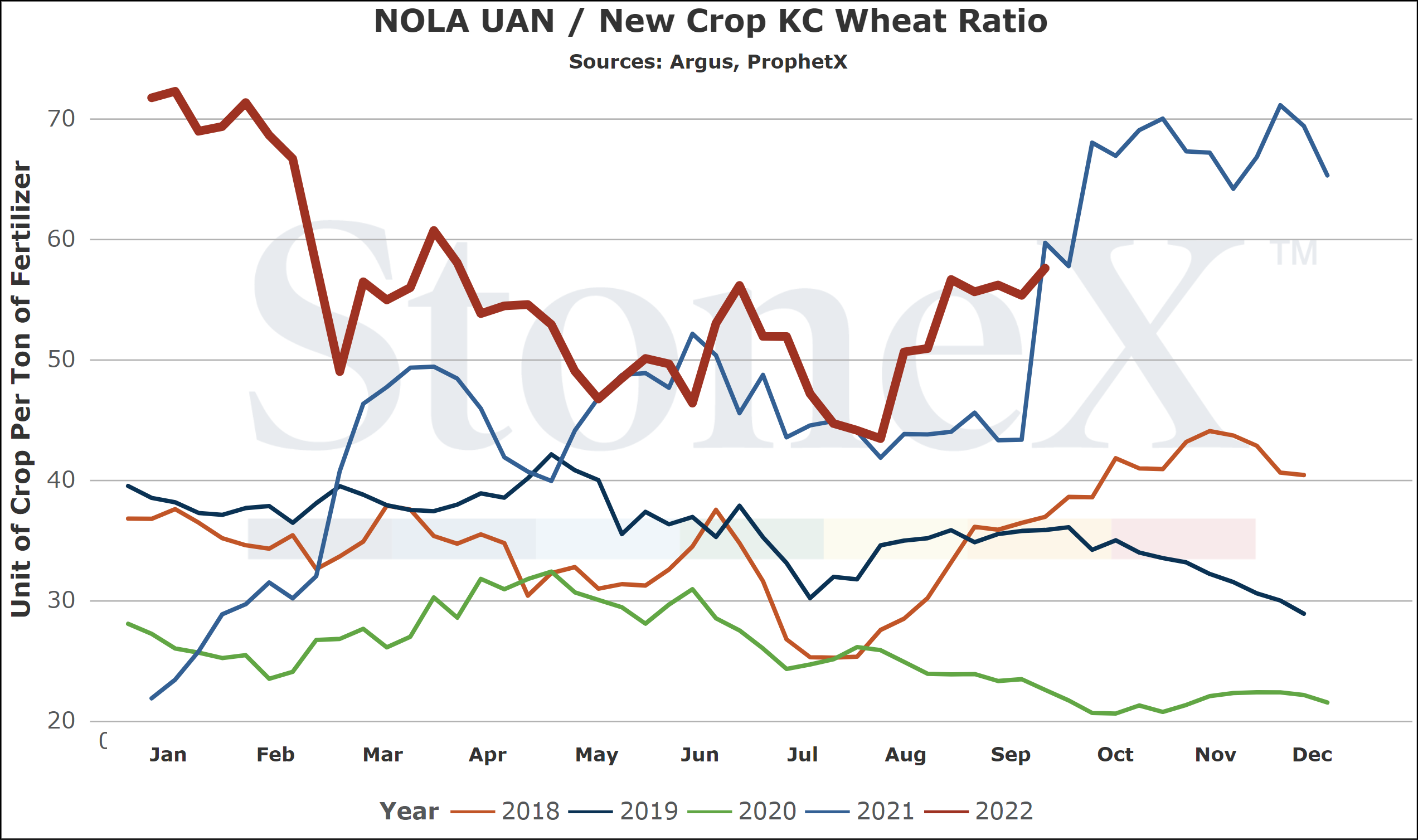
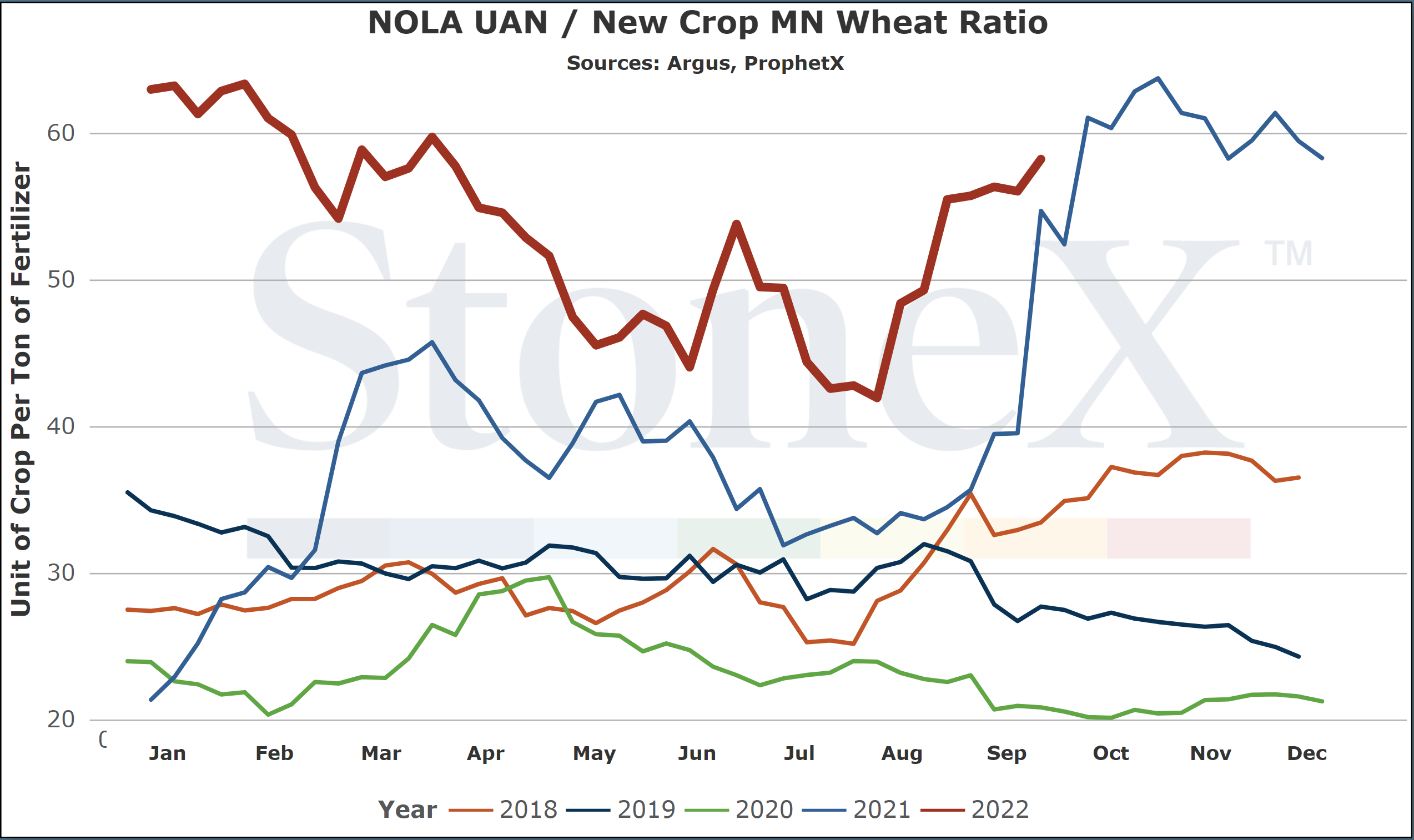
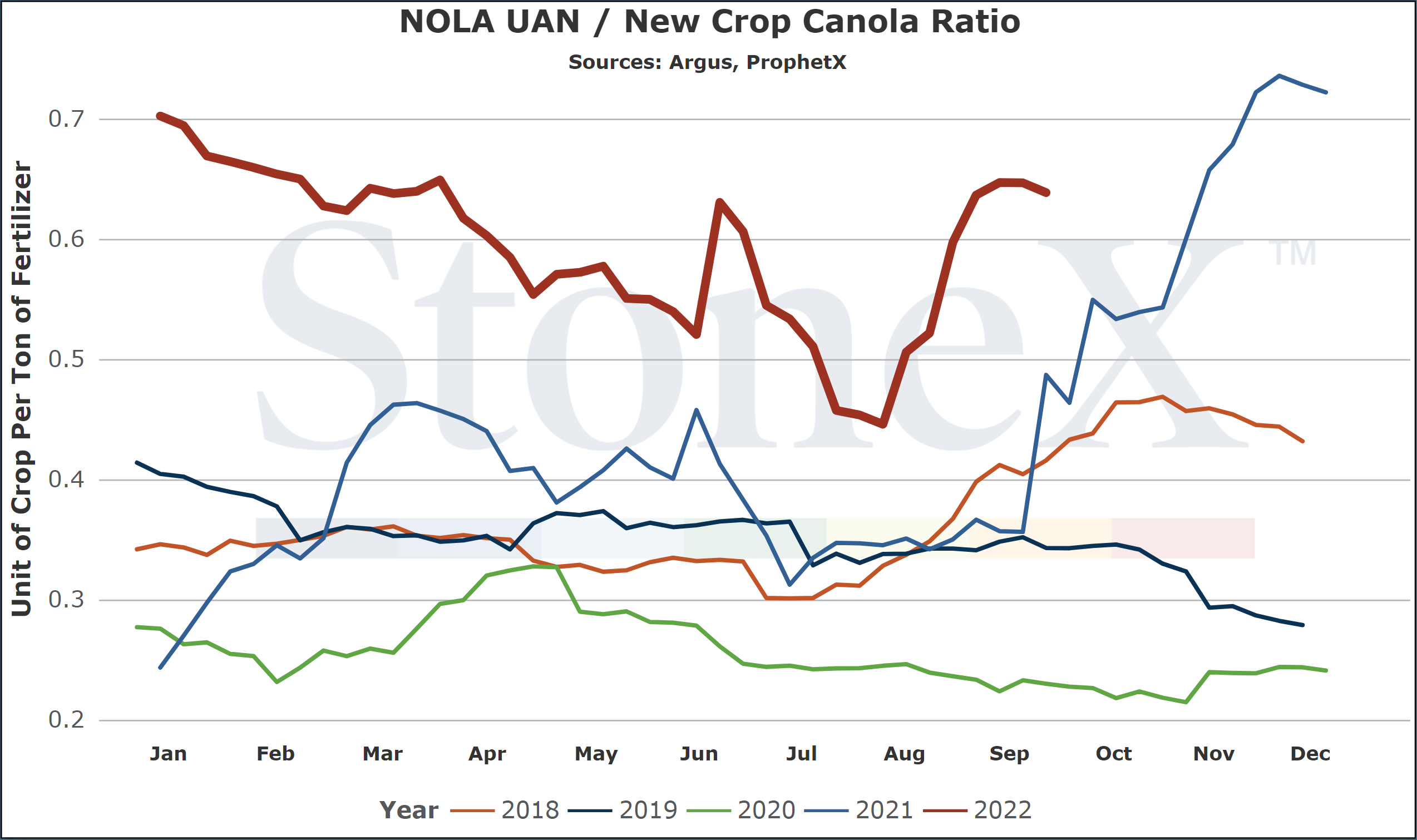
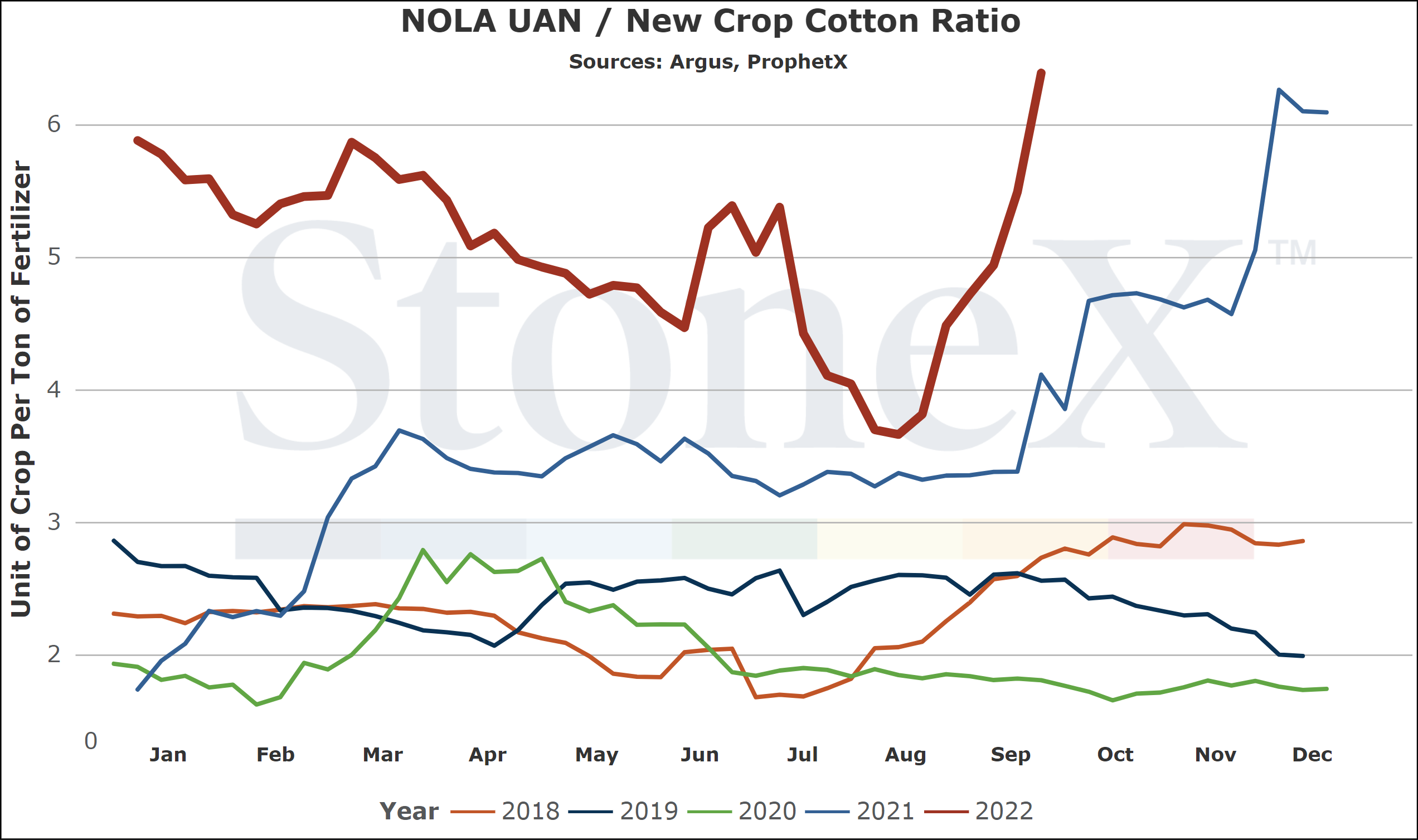
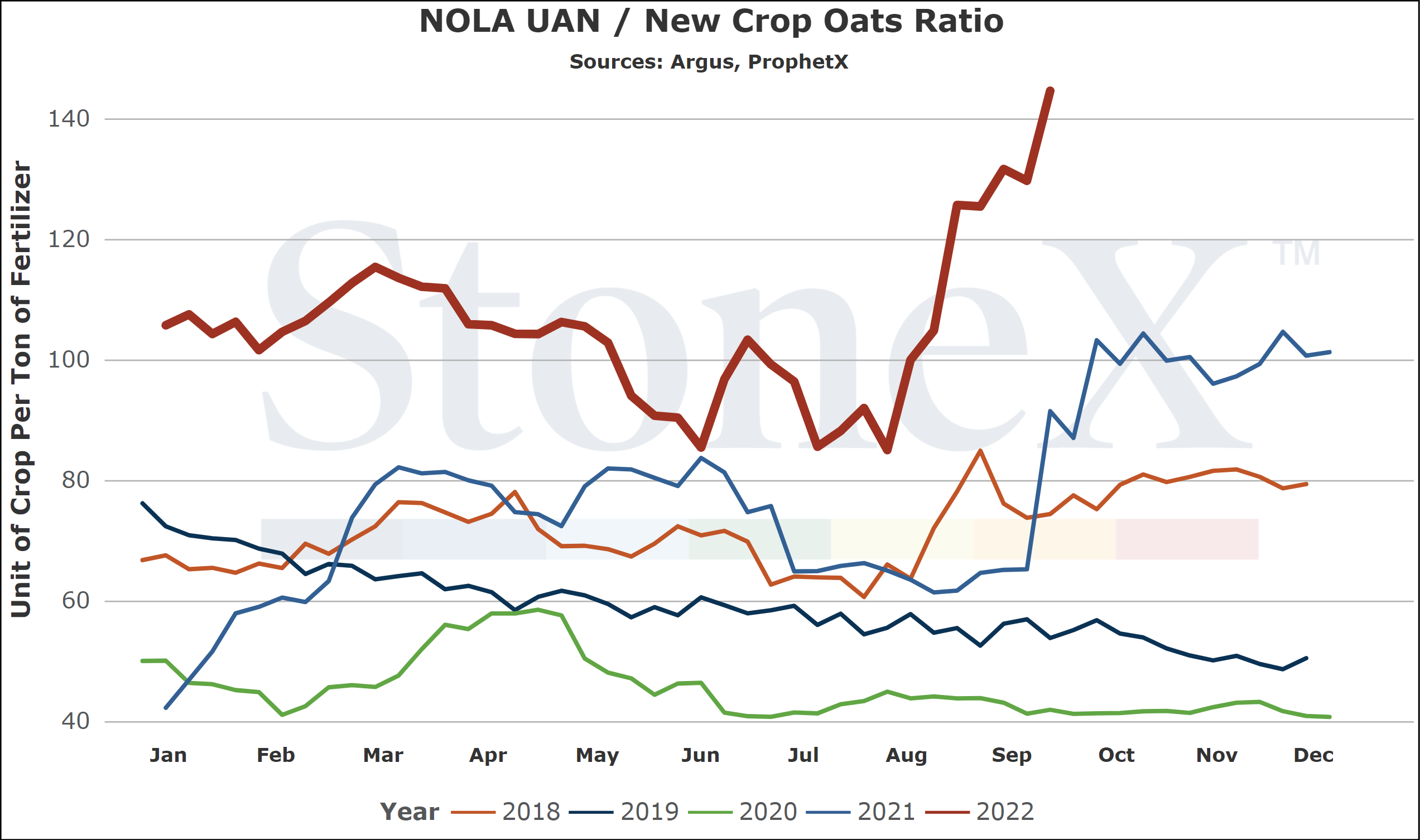
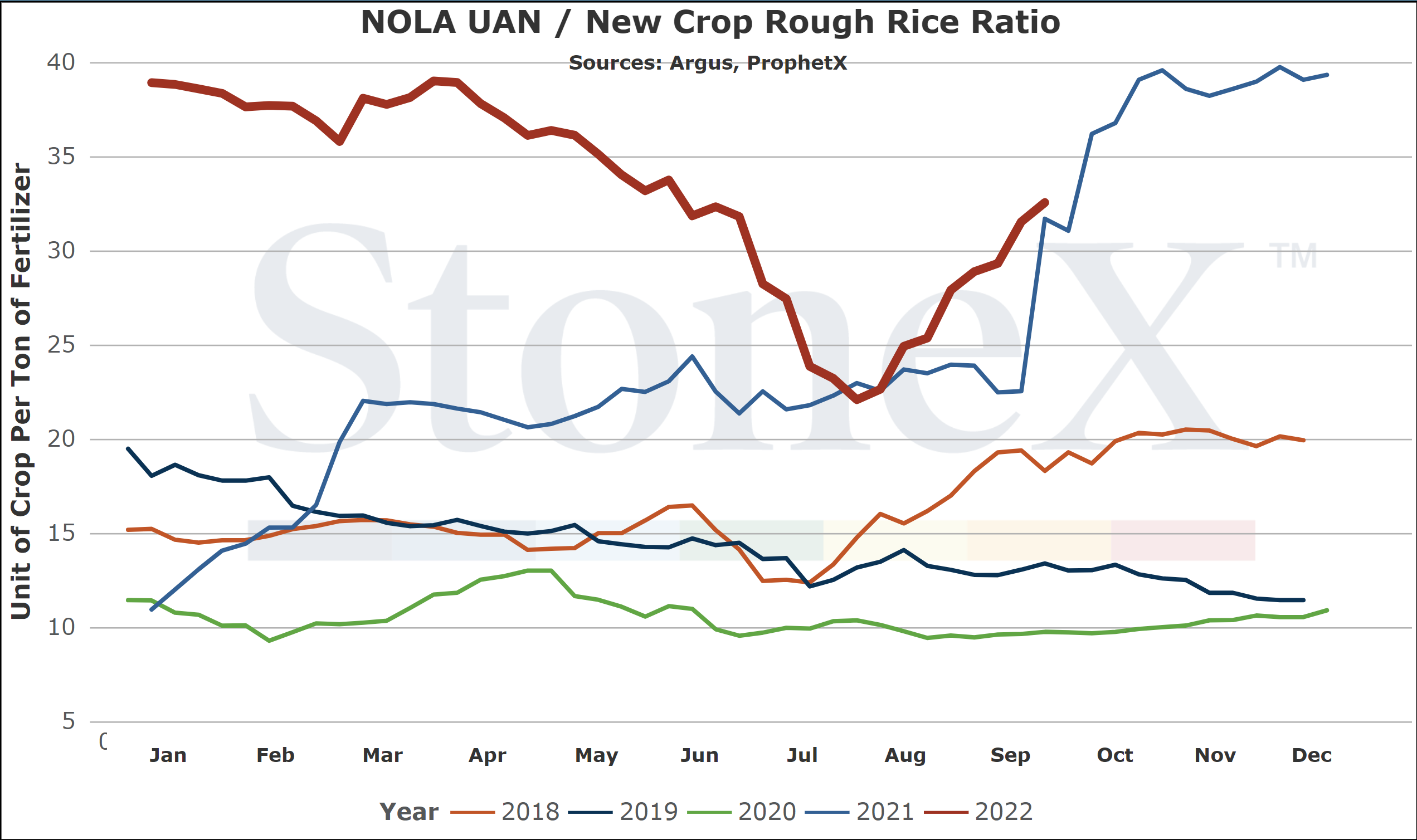
Where are the current uan/grain ratio values today?
We believe that only looking at the flat price of either grains or fertilizer can be misleading:
  • Only selling grain can hurt you if fertilizer prices rise substantially
  • Only buying fertilizer can hurt you if grain prices fall
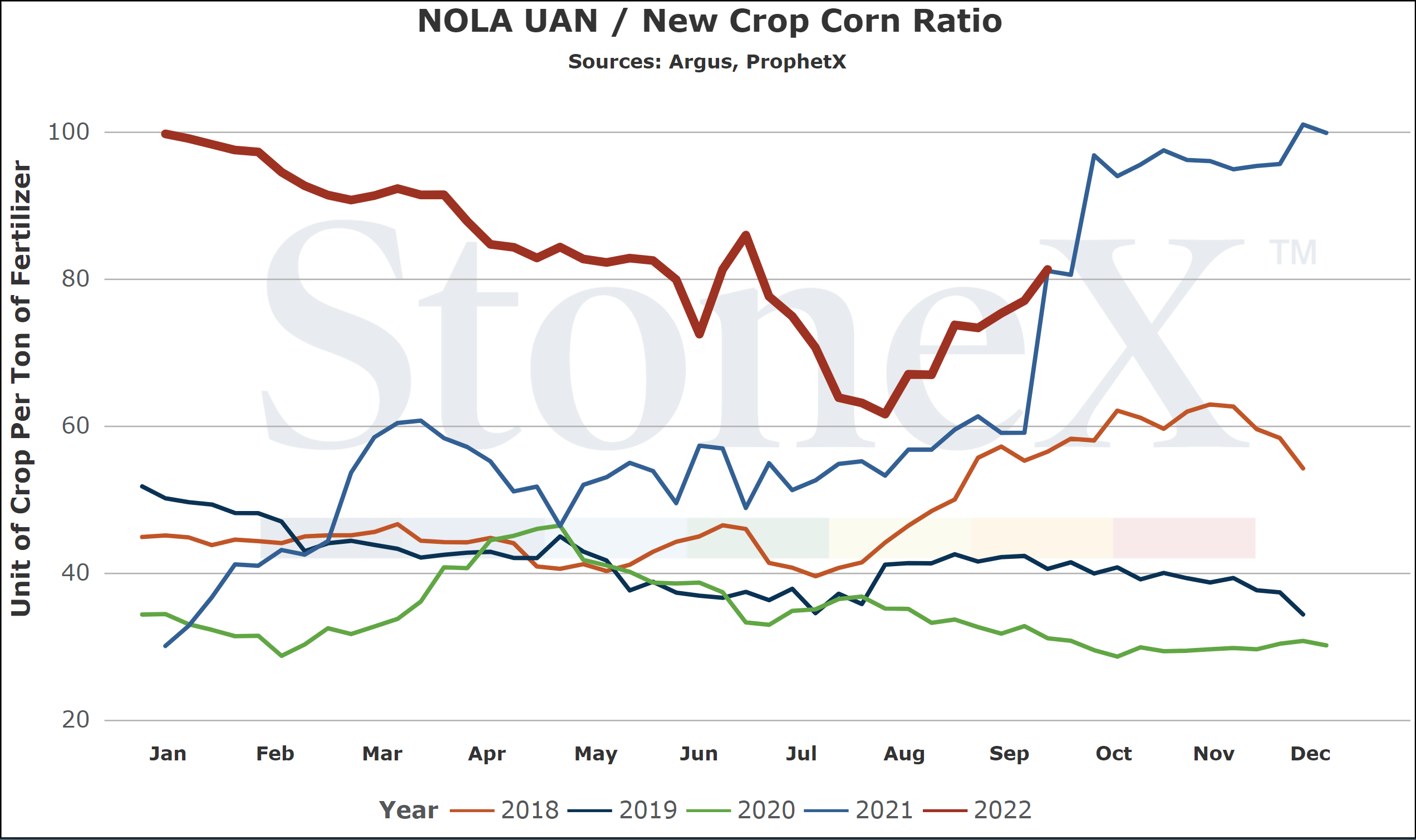
We look at the ratio "value" to get a better indication of where we are or how many bushels of X does it take to pay for 1 ton of fertilizer.
Would you rather:
  • Spend 100 bushels to pay for 1 ton of UAN
  • Spend 60 bushels to pay for 1 ton of UAN
When we compare the current ratio value against recent years, we start to see if we are high or low.
YOUR VALUES WILL LOOK DIFFERENT
This graph looks at the NOLA UAN price vs the flat grain price. There are no logistics on either product. Your location will look different due to fertilizer logistical costs, grain basis, etc.
image 51234
image 51235
image 51236
image 51237
image 51238
image 51239
image 51240
image 51241
 
Josh Linville’s focal points

I'm changing this going forward simply because I was struggling with what I should put here.  Typically, I fill it with general statements that a lot of times you all do not need.

When I look at markets, I try to find the one/couple points that are most important to me that tell the story.  That is what I will start doing on this section:

  • European production - plain and simple, as long as Europe production is offline, world supplies are tight.  They account for 1 of every 5 tons of UAN produced on planet earth.  While the chance is not large, there is a chance production ramps up again so we need to watch for that.  However, with the chance being so small, we need to proceed as if that is the case.
  • Price spread to urea and NH3 - at least here in North America, UAN is a HUGE premium to other N alternatives.  If producers think for a second that the wide price spread this far away from spring doesn't have farmers considering changes, they are fooling themselves.  If UAN remains this steep a price and such a premium, it is very likely that we will see demand switch away and force the price to come back to normal...whatever that is...
  • How UAN producers approach the market - unfortunately for buyers, there are limited producers of UAN in North America and around the world.  It simply isn't the huge product that urea/NH3/etc. are.  That limited number of suppliers means prices are less likely to fall apart as the few producers can be more patient on the marketplace.


  • Fertilizers

This material should be construed as the solicitation of an account, order, and/or services and represents the opinions and viewpoints of the individual authors or presenters. It does not constitute an individualized recommendation or take into account the particular trading objectives, financial situations, or needs of individual customers.


The views are current only through the date stated and are subject to change at any time based upon market or other conditions, and StoneX Group Inc. (“SGI”) disclaims any responsibility to update such views. Actual results, performance, or achievements may differ materially from those expressed or implied. Information is based on data gathered from what we believe are reliable sources. Past performance does not guarantee future results.


The StoneX Group Inc. group of companies provides financial services worldwide through its subsidiaries, including physical commodities, securities, exchange-traded and over-the-counter derivatives, risk management, global payments and foreign exchange products in accordance with applicable law in the jurisdictions where services are provided.


References to certain OTC products or swaps are made on behalf of StoneX Markets, LLC (SXM), a member of the National Futures Association (NFA) and provisionally registered with the U.S. Commodity Futures Trading Commission (CFTC) as a swap dealer. SXM’s products are designed only for individuals or firms who qualify under CFTC rules as an ‘Eligible Contract Participant’ and who have been accepted as customers of SXM.


StoneX Financial Inc. (SFI) is a member of FINRA/NFA/SIPC and registered with the MSRB. SFI is registered with the U.S. Securities and Exchange Commission (SEC) as a Broker-Dealer and with the CFTC as a Futures Commission Merchant and Commodity Trading Advisor. StoneX Financial (Canada) Inc. (SFCI) is registered in Canada and is a member of CIRO and CIPF. References to certain securities trading are made on behalf of the BD Division of SFI and are intended only for an audience of institutional clients as defined by FINRA Rule 4512(c). References to certain exchange-traded futures and options are made on behalf of the FCM Division of SFI. Wealth Management is offered through SA Stone Wealth Management Inc., member FINRA/SIPC, and SA Stone Investment Advisors Inc., an SEC-registered investment advisor, both wholly owned subsidiaries of SGI.

R.J. O’Brien & Associates, LLC (RJO) is registered with the CFTC as a Futures Commission Merchant and is a member of NFA.


StoneX Financial Ltd (SFL) is registered in England and Wales, company no. 5616586. SFL is authorized and regulated by the Financial Conduct Authority (FCA) (registration number FRN:446717) to provide services to professional and eligible customers including: arrangement, execution and, where required, clearing derivative transactions in exchange traded futures and options. SFL is also authorized to engage in the arrangement and execution of transactions in certain OTC products, certain securities trading, precious metals trading and payment services to eligible customers. SFL is authorized and regulated by the FCA under the Payment Services Regulations 2017 for the provision of payment services. SFL is a category 1 ring-dealing member of the London Metal Exchange. In addition SFL also engages in other physically delivered commodities business and other general business activities which are unregulated and not required to be authorized by the FCA.


This communication is issued in the European Economic Area by StoneX Financial Europe GmbH (SFEG). StoneX is the trade name used by STONEX GROUP INC. and all its associated entities and subsidiaries. StoneX Financial Europe GmbH (“SFEG”) is a securities trading firm registered in Germany under Company No. HRB 80844.


StoneX Financial Pte Ltd (Co. Reg. No 201130598R) (“SFP”) is regulated by the Monetary Authority of Singapore and is a Capital Markets Service Licence holder (for dealing in capital market products), an Exempt Financial Adviser (for advising on investment products and issuing or promulgating analyses/ reports on investment products) and a Major Payment Institution (for domestic and cross-border money transfer services).


SFP may distribute analysis/report produced by its respective foreign affiliates within the StoneX Group of companies pursuant to an arrangement under Regulation 32C of the Financial Advisers Regulations Recipients should contact SFP at (65) 6309 1000 for any matters arising from, or in connection with, this webinar.


StoneX APAC Pte. Ltd. (“SAP”) (Co. Reg. No 200616676W) is regulated as a Dealer (PS20190001002) under the Precious Stones and Precious Metals (Prevention of Money Laundering and Terrorism Financing) Act 2019 for purposes of anti-money laundering and countering the financing of terrorism.


StoneX Financial (HK) Limited (CE No.: BCQ152) (“SHK”) is regulated by the Hong Kong Securities and Futures Commission for Dealing in Securities and Dealing in Futures Contracts.


StoneX Financial Pty Ltd (ACN 141 774 727) holds an Australian Financial Service License (AFSL: 345646) for Dealing in Securities, Exchange-Traded Derivatives Contracts, OTC Derivatives Contracts and Foreign Exchange Contracts, and is regulated by the Australian Securities and Investments Commission.


StoneX Securities Co., Ltd. (“SSJ”) (Co. Reg. No 010401047199) is regulated by the Japanese Financial Services Agency as a Type-I Financial Instruments Business Operator (Kanto Local Finance Bureau (FIBO)No.291’), is a member of the Financial Futures Association of Japan for dealing and broking FX and FX Option transactions, and is a member of the Japan Securities Dealers Association for dealing and broking stock indices and option transactions.


Trading swaps and over-the-counter derivatives, exchange-traded derivatives and options and securities involves substantial risk and is not suitable for all investors. Past performance of any futures or option is not indicative of future success. Indicators are not a trading system and are not published as a specific trade recommendation. The information herein is not a recommendation to trade nor investment research or an offer to buy or sell any derivative or security. It does not take into account your particular investment objectives, financial situation or needs and does not create a binding obligation on any of the StoneX group of companies to enter into any transaction with you. You are advised to perform an independent investigation of any transaction to determine whether any transaction is suitable for you. No part of this material may be copied, photocopied or duplicated in any form by any means or redistributed without the prior written consent of StoneX Group Inc.


The report/analysis herein is not directed to, or intended for distribution to or use by, any person or entity who is a citizen or resident of or located in any locality, state, country or other jurisdiction where such distribution, publication, availability or use would be contrary to law or regulation.


© 2026 StoneX Group Inc. All Rights Reserved.

Satellite view of Earth at night showing illuminated cities across Asia and the Middle East

Discover more insights

Our subscribers have access to comprehensive market analysis from StoneX spanning commodities, equities, currencies and more.

StoneX: We open markets

Our market expertise, advanced platforms, global reach, culture of full transparency and commitment to our clients’ success all set us apart in the financial marketplace.

Reach

With access to 40+ derivatives exchanges, 180+ foreign exchange markets, nearly every global securities marketplace and numerous bi-lateral liquidity venues, StoneX’s digital network and deep relationships can take clients anywhere they want to go.

Transparency

As a publicly traded company meeting the highest standards of regulatory compliance in the markets we serve; our financials and record of accomplishment are matters of public record. StoneX’s commitment to “doing the right thing over the easy thing” sets us apart in the industry and helps us build respect, client trust and new partnerships.

Expertise

From our proprietary Market Intelligence platform, to “boots on the ground” expertise from award-winning traders and professionals, we connect our clients directly to actionable insights they can use to make more informed decisions and achieve their goals in the global markets.