Quarterly Commodities Outlook is available for free now.  Download your report  →

StoneX logo

Featured | Declining swine prices in China raise doubts about demand for soybean and corn

By: StoneX Intelligence Brazil, StoneX Intelligence Brazil

Declining swine prices in China raise doubts about demand for soybean and corn
 
João Pedro Lopes
Arthur Machado
Felipe Sawaia
However, expectation is still high use of grains in animal feed

Between 2018 and 2019, African swine fever outbreaks in China profoundly impacted pig farming in the country. The Chinese Ministry of Agriculture and Rural Affairs (MARA) estimates that between detection of the first case in the country on August 1, 2018 and the end of 2019, when the activity began to recover, the swine herd fell by about 40%. As expected, the production capacity of the country’s meat packing facilities was also severely affected. Based on data from the United States Department of Agriculture (USDA), pork production in China went from 54.52 million tonnes¹ in 2017, to just 36.34 million in 2020, a 33.3% drop.

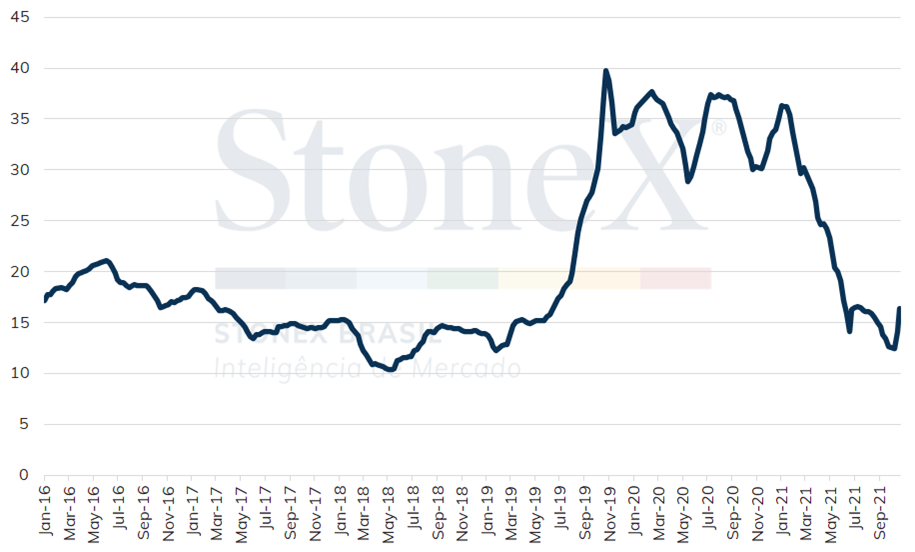
This decrease in domestic supply caused two important movements. First, swine prices on the Chinese domestic market soared. Between 2016 and 2018 one kilo of live animal was usually negotiated between RMB 10.00 and RMB 20.00, while in the last quarter of 2019 it had surpassed the RMB 30.00 and remained above this level until the beginning of 2021.

The other major consequence was the significant increase in Chinese pork imports, which made the country isolate itself as the main buyer of the product on the international market. Again using USDA data as a reference, imports of this protein source by China between 2017 and 2020 grew 3.52 times, jumping from 1.50 to 5.28 million tonnes. In addition to increasing the import of swine protein, the country has also started to consume and import more beef and poultry. 

Since 2020, with the outbreak relatively under control, the Chinese Communist Party started to boost the herd recovery, helping farmers and entrepreneurs. These state programs, together with the dynamism of the Chinese economy, enabled a rapid resumption. As early as June 2021, according to MARA estimates, the country’s herd was 439.11 million pigs, similar to pre-plague numbers.

Meanwhile, 2021 also marked a change in market fundamentals. With swine supply growing exponentially, prices began to decline, going back to values in line with the reality before 2018. Between the beginning of January this year and the end of October, swine prices fell by about 54.8% in China. Based on the swine price on the Dalian exchange, there was a 48.16% decline between January 8 and October 28, from RMB 28.29/kg to RMB 14.67/kg. Interestingly, the swine futures market was implemented in China on January 8, precisely due to the need of protecting physical market agents against price volatility.
 

Live pig price trend in China (RMB/kg)
image 21033
Source: China National Development and Reform Commission. Design: StoneX.

With the drop in quotes, herd recovery began to decline. In fact, MARA reports showed that between June and September 2021 the number of pigs in China declined from 439.11 million to 437.64 million. Meat production in the third quarter also fell from 13.46 million tonnes in the second quarter to 12.02 million tonnes. That is because producers’ margins are getting very tight, given the deflation of swine prices and high soybean and corn quotes. With this, herd recovery is slower, with smaller farms even getting rid of reproductive swines. According to the USDA estimate, in 2022 swine herd and pork production from China will decline again.

These movements in the Chinese swine protein sector also impact the grains market. According to USDA data, in the 2020/21 crop, China used about 73.4 million tonnes of soybean meal and 203 million tonnes of corn for animal feed, historical records for the country, since this latter corresponded to more than 70% of Chinese domestic consumption during the crop in question.

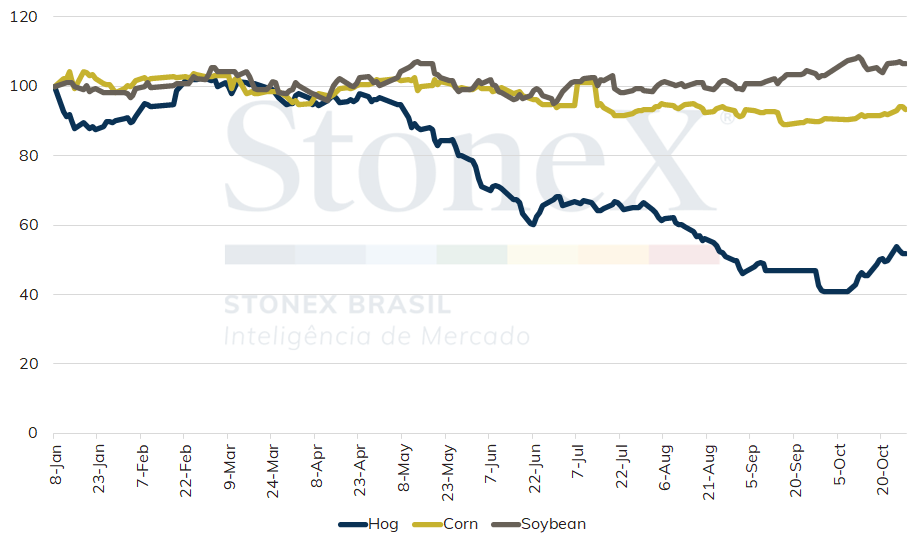
It is worth remembering that these record volumes were the result of a recovery of the country’s pig herd and measures to control the disease, such as the prohibition of food residues in animal feed. However, weakening swine prices and high grain prices on the Chinese domestic market raised questions about a possible disincentive to use corn and soybean meal in the country for ration.

 

Swine, corn and soybean prices on the Dalian exchange in 2021 (Jan/21 = 100)

image 21035
Source: Dalian Commodities Exchange. Design: StoneX.

However, despite the uncertainties surrounding the pig herds, there is demand for ration according to prices. Estimates still point to high consumption. The USDA projects that 214 million tonnes of corn and 76.6 million tonnes of soybean meal will be used for animal feed in 2021/22, which, if achieved, would renew the record from the previous crop.

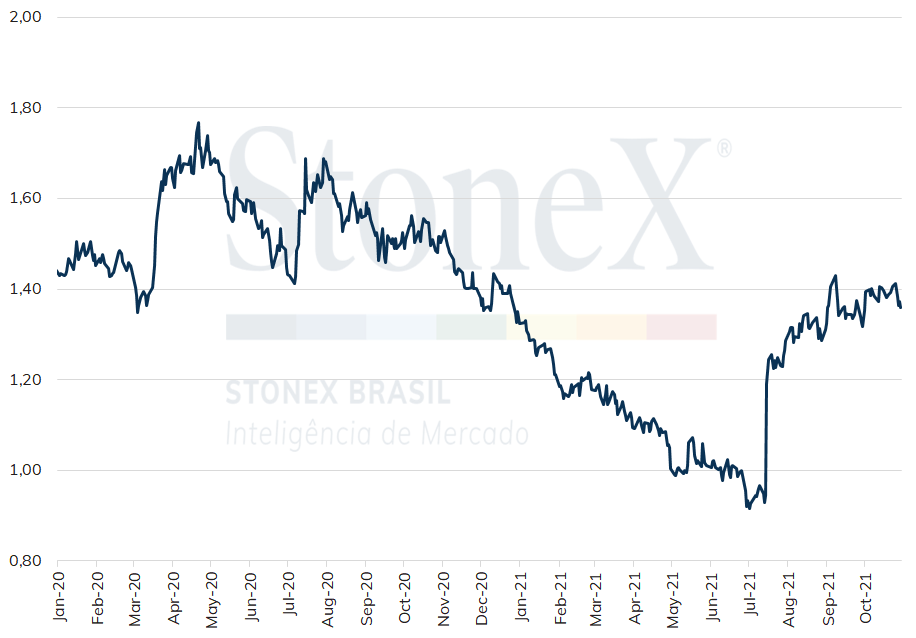
Although the wheat market is not influenced by the meat market in the same intensity as corn and soybean, winter wheat is much more susceptible to variations in the corn market and, when it is advantageous to the producer, it can even replace it in animal feed production. With a protein value higher than that of corn, wheat is often used in animal feed when the prices of the former are high. This movement took place in 2021, especially in the first half of this year. Between January and June, the relationship between wheat and corn on the Chicago exchange (CBOT) went from 1.33 to 0.91. The lower the ratio, the more expensive is corn compared to wheat.
 

Exchange ratio between wheat and corn contracts on the CBOT  

image 21034
Source:  CBOT. Design: StoneX. 

According to USDA data, every year, about 20% of global wheat consumption is for ration. In China, the USDA estimates that the use for ration will account for about 24% of total consumption in the country in 2021/22. Although the percentage shows an annual decline of 3 p.p. compared to the five years preceding the 2020/21 crop, of 15%, the estimated percentage is significantly higher.

Finally, it is interesting to highlight China’s pace of purchases in the global wheat market. Because of the high prices of Russian origin wheat and the decline of the US export capacity as a result of hurricane Ida, it is speculated that the Asian giant would have to resume trade relations with Australia, with which it has been under diplomatic tension since last year. In the case of the United States, in 2021/22, the total volume of wheat purchased is 848,160 tonnes, while in the same period last year this figure was 1,597 million.
 

¹Carcass-weight equivalent (CWE).


  • Grains & Oilseeds

The StoneX Group Inc. group of companies provides financial services worldwide through its subsidiaries, including physical commodities, securities, exchange-traded and over-the-counter derivatives, risk management, global payments and foreign exchange products in accordance with applicable law in the jurisdictions where services are provided. References to over-the-counter (“OTC”) products or swaps are made on behalf of StoneX Markets LLC (“SXM”), a member of the National Futures Association (“NFA”) and provisionally registered with the U.S. Commodity Futures Trading Commission (“CFTC”) as a swap dealer. SXM’s products are designed only for individuals or firms who qualify under CFTC rules as an ‘Eligible Contract Participant’ (“ECP”) and who have been accepted as customers of SXM. StoneX Financial Inc. (“SFI”) is a member of FINRA/NFA/SIPC and registered with the MSRB. SFI is registered with the U.S. Securities and Exchange Commission (“SEC”) as a Broker-Dealer and with the CFTC as a Futures Commission Merchant and Commodity Trading Adviser. References to securities trading are made on behalf of the BD Division of SFI and are intended only for an audience of institutional clients as defined by FINRA Rule 4512(c). References to exchange-traded futures and options are made on behalf of the FCM Division of SFI . StoneX is a trading name of StoneX Financial Ltd (“SFL”). SFL is registered in England and Wales, Company No. 5616586. SFL is authorized and regulated by the Financial Conduct Authority [FRN 446717] to provide to professional and eligible customers including: arrangement, execution and, where required, clearing derivative transactions in exchange traded futures and options. SFL is also authorised to engage in the arrangement and execution of transactions in certain OTC products, certain securities trading, precious metals trading and payment services to eligible customers. SFL is authorised & regulated by the Financial Conduct Authority under the Payment Services Regulations 2017 for the provision of payment services. SFL is a category 1 ring-dealing member of the London Metal Exchange. In addition SFL also engages in other physically delivered commodities business and other general business activities which are unregulated and not required to be authorised by the Financial Conduct Authority. StoneX Group Inc. acts as agent for SFL in New York with respect to its payments services business. StoneX APAC Pte. Ltd. acts as agent for SFL in Singapore with respect to its payments services business. ‘StoneX’ is the trade name used by StoneX Group Inc. and all its associated entities and subsidiaries.
 
Trading swaps and over-the-counter derivatives, exchange-traded derivatives and options and securities involves substantial risk and is not suitable for all investors. Past performance of any futures or option is not indicative of future success. Indicators are not a trading system and are not published as a specific trade recommendation. The information herein is not a recommendation to trade nor investment research or an offer to buy or sell any derivative or security. It does not take into account your particular investment objectives, financial situation or needs and does not create a binding obligation on any of the StoneX group of companies to enter into any transaction with you. You are advised to perform an independent investigation of any transaction to determine whether any transaction is suitable for you. No part of this material may be copied, photocopied or duplicated in any form by any means or redistributed without the prior written consent of StoneX Group Inc.
 
© 2026 StoneX Group Inc. All Rights Reserved.

Satellite view of Earth at night showing illuminated cities across Asia and the Middle East

Discover more insights

Our subscribers have access to comprehensive market analysis from StoneX spanning commodities, equities, currencies and more.

Related articles for Grains & Oilseeds

Perspective: Morning Commentary for August 7

August 7 – The U.S. economy unexpectedly lost 23k jobs in July, dramatically below market expectations of an 80k increase and marking the worst Non-Farm Payrolls print since February. Furthermore, May and June were both revised sharply downward, with combined revisions showing 103k fewer jobs than previously reported. Outside of the healthcare sector, which added 22k jobs in July, the losses were very broad-based. Government payrolls saw the largest decline, shedding 53k jobs in July, the largest seen since October 2025, while June was revised down to show a loss of 10k jobs as well. The private sector at least saw growth, adding 30k jobs in July, now matching the month prior after it was revised down from the 49k initially reported, and substantially missing forecasts of 78k jobs being added. This is a sharp reversal in course from the largely better than expected U.S. labor data seen earlier this week.

Mike Castle
Mike Castle
  • Grains & Oilseeds
  • Energy
  • Dairy
  • Renewable Fuels
  • Cocoa
  • Coffee
  • Cotton
  • Sugar
  • Meats & Livestock
  • Forest Products

Perspective: Mid-Day Commentary for August 6

August 6 – Stocks remain quietly mixed at midday as both the S&P 500 and Dow Jones remain just below their fresh all-time highs put in yesterday. This is allowing the VIX to cool to a four-week low below the 15.4 mark, reflecting the collective sigh of relief in the market amid largely better than expected U.S. economic data today. The dollar remains quietly in the green in its relatively tight range this week, trading at 99.9 at the time of writing. Treasuries remain elevated but have cooled from their recent peaks, with 30-year yields trading at 5.189%, 10-year yields trading at 4.647%, and 2-year yields trading at 4.229% at midday. Crude oil also remains quietly in the green, with nearby WTI up 2.3% on the day trading near $76.80 and nearby Brent up 2.4% on the day trading near $81.40. The ags remain mixed, with the wheat complex now squarely in the red while corn and soybeans cling to small gains, and the livestock complex largely pushes lower.

Mike Castle
Mike Castle
  • Grains & Oilseeds

Perspective: Morning Commentary for August 6

August 6 – This morning’s stronger-than-expected U.S. labor data offered markets some relief, reinforcing confidence in the economy while giving the Fed greater flexibility to raise rates should inflationary pressures reaccelerate in next week’s July data. Stock futures are pointing to a mixed open to start the day, with the tech-heavy Nasdaq showing the most weakness. The VIX has fallen notably from yesterday’s spike above 18.4 as it starts the day hovering just below the 16-mark. The dollar is quietly higher as it trades just above 99.8, holding in the tight range seen thus far this week as traders continue to digest data to shape expectations for the Fed’s next move, which we’ll dive into in more depth below. Long-term treasury yields have relaxed slightly from their recent spike, with 30-year yields starting the day trading just above 5.19%, while 10-year yields trade above 4.64%, and 2-year yields sit below 4.22%. Crude oil is modestly higher to start the session after sharp declines earlier in the week, with nearby WTI up 1.8% to trade at $76.40 and nearby Brent up 2.4% to trade at $81.40. Meanwhile, the ags are quietly mixed to start the day.

Mike Castle
Mike Castle
  • Grains & Oilseeds
  • Energy
  • Dairy
  • Renewable Fuels
  • Cocoa
  • Coffee
  • Cotton
  • Sugar
  • Meats & Livestock
  • Forest Products
StoneX: We open markets

Our market expertise, advanced platforms, global reach, culture of full transparency and commitment to our clients’ success all set us apart in the financial marketplace.

Reach

With access to 40+ derivatives exchanges, 180+ foreign exchange markets, nearly every global securities marketplace and numerous bi-lateral liquidity venues, StoneX’s digital network and deep relationships can take clients anywhere they want to go.

Transparency

As a publicly traded company meeting the highest standards of regulatory compliance in the markets we serve; our financials and record of accomplishment are matters of public record. StoneX’s commitment to “doing the right thing over the easy thing” sets us apart in the industry and helps us build respect, client trust and new partnerships.

Expertise

From our proprietary Market Intelligence platform, to “boots on the ground” expertise from award-winning traders and professionals, we connect our clients directly to actionable insights they can use to make more informed decisions and achieve their goals in the global markets.