In an already delicate market context, after the disruption caused by the war in Ukraine and prices exploring historical highs, the global vegetable oil market was caught by surprise when Indonesia announced it would ban palm oil exports "until domestic prices ease." On Monday, April 25, however, Indonesian government officials brought some relief to the news by stating that the ban on shipments would fall only on refined palm oil, which even brought down prices on Bursa at the time, in light of the breach in expectations. Over last week, however, rumors pointed to all varieties of palm oil, including crude, also being included in the list of retained products - which was finally confirmed on Wednesday afternoon, April 27, leading oil futures prices on Bursa to jump 10% on the day, touching the up limit.
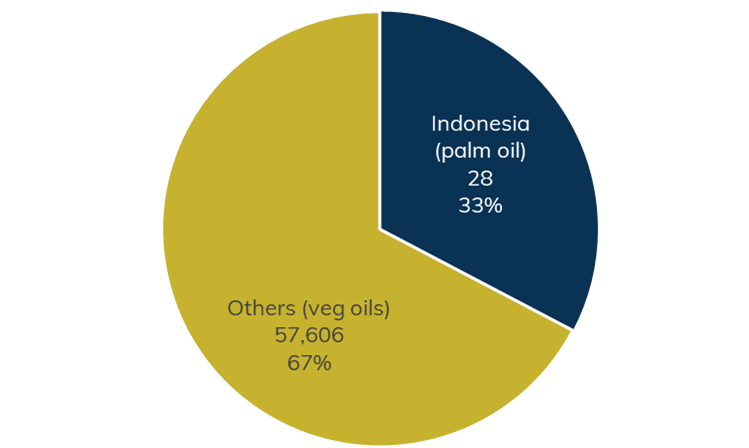
Indonesia is a protagonist in the global vegetable oil market and by far the largest exporter of palm oil, the most consumed oil globally. The USDA estimates that the country's palm oil exports will reach 28 million tonnes in the 2021/22 cycle. This volume represents more than half of the domestic production and 56% of global palm oil exports. By way of comparison, the estimated export of Malaysia, the second-largest producer and exporter, stands at 16.2 million tonnes. In contrast, Argentina, the largest exporter of soybean oil, would export 5.9 million tonnes.
Considering the export of all vegetable oils, according to the USDA, the estimated 28 million tonnes of palm oil from Indonesia would represent 33% of the total.
The disruption of palm oil supplies from Indonesia comes on top of a shortage of sunflower oil stemming from reduced Ukrainian and Russian exports following the outbreak of war in late February. Sunflower oil is the 4th most consumed oil globally, behind palm, soybean, and canola, and Russia and Ukraine account for about 60% of its global supply. In this sense, the oil complex, which was already going through a moment of tight availability driving prices up, surpassed the historical highs again in the last few days in the main negotiation centers.
Given its greatness in the market, there is no possible substitute for Indonesia's palm exports in the short term. Malaysia, which already has historically low stocks, will not be able to suddenly increase its production and exports and fill the vacuum left by its neighbor. However, even if there is no official date for exports to resume in Indonesia, the ban is unlikely to last for many days. The sector's absence of foreign revenue will be quickly felt, which should pressure the government to resume shipping to the foreign market.
In addition, the monthly export volume of palm oil in Indonesia is twice as high as the domestic consumption, and the retention of this volume should generate overcrowding of stocks in a few days.
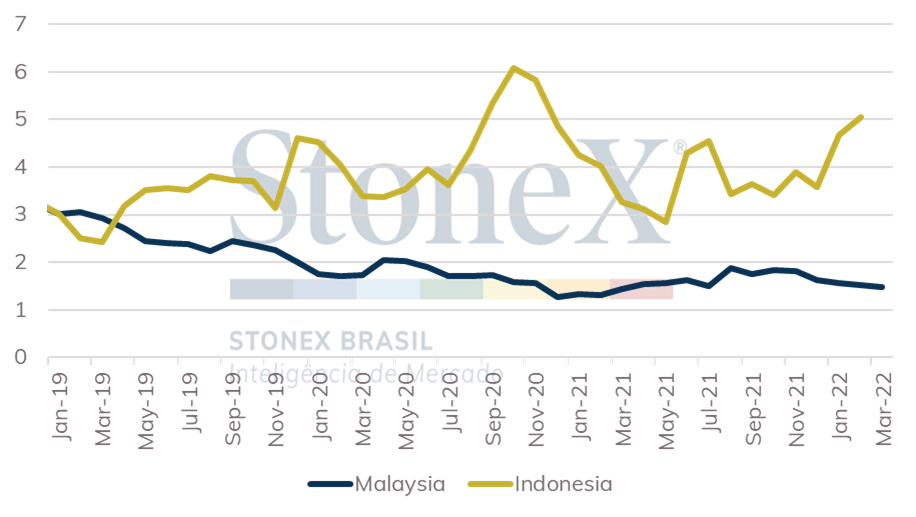
Indonesia's processing industry is not prepared to store all the volume produced domestically. Currently, there are around 5 million tonnes of oil in stock, and the storage capacity of the country's industries is between 6 and 7 million tonnes, according to local sources.
Palm oil stocks at the end of the month in Indonesia and Malaysia (MMT)
Sources: MPOB and GAPKI. Design: StoneX.
As a result of this probable pressure on stocks, two probable outcomes emerge: either export will resume in the coming days; or the domestic production will have to be significantly reduced, impacting producers, who will see their products deteriorating inside the gate - besides generating financial problems among small and medium producers, mainly. According to the country's President, the policy will be reviewed monthly, but analysts already expect that there will be a relaxation of shipments in about three weeks.
Also, next week, the Eid al-Fitr festival in Indonesia and Malaysia will occur, which usually increases the consumption of vegetable oils in the region. Therefore, it is believed that part of the political motivation to cease shipments was to maintain sufficient supply in Indonesia during peak consumption and replenish stocks.