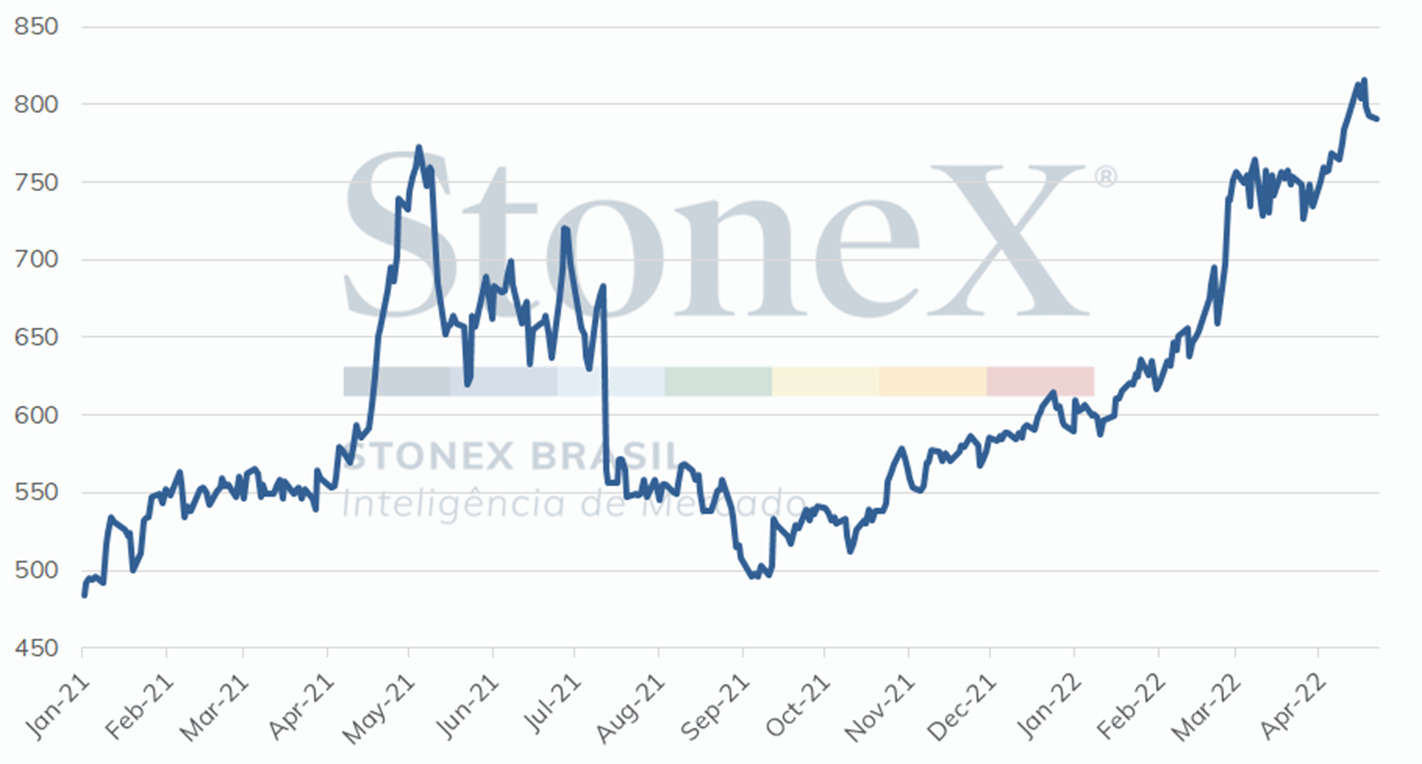
The first months of 2022 were marked by strong volatility in the international corn market. Until April 22, the corn nearby contract accumulated a high of 33.7% in Chicago, quoted at 793 cents/bushel, and the contract closed at 815.75 cents/bushel on April 20, the highest value since August 2012. Since the end of 2021, the upward trend was already predominant in the grain market, largely driven by concerns about the South American corn production 2021/22, amid a scenario already marked by a tight supply and demand balance. The adversities faced by the crop in the continent, especially in Argentina and southern Brazil, resulted in lower supply, providing support for grain prices, but it can be said that the main reason for this sharp rise and volatility was the conflict between Russia and Ukraine.
Corn prices - CBOT (US¢/bushel)
Source: CME. Design: StoneX
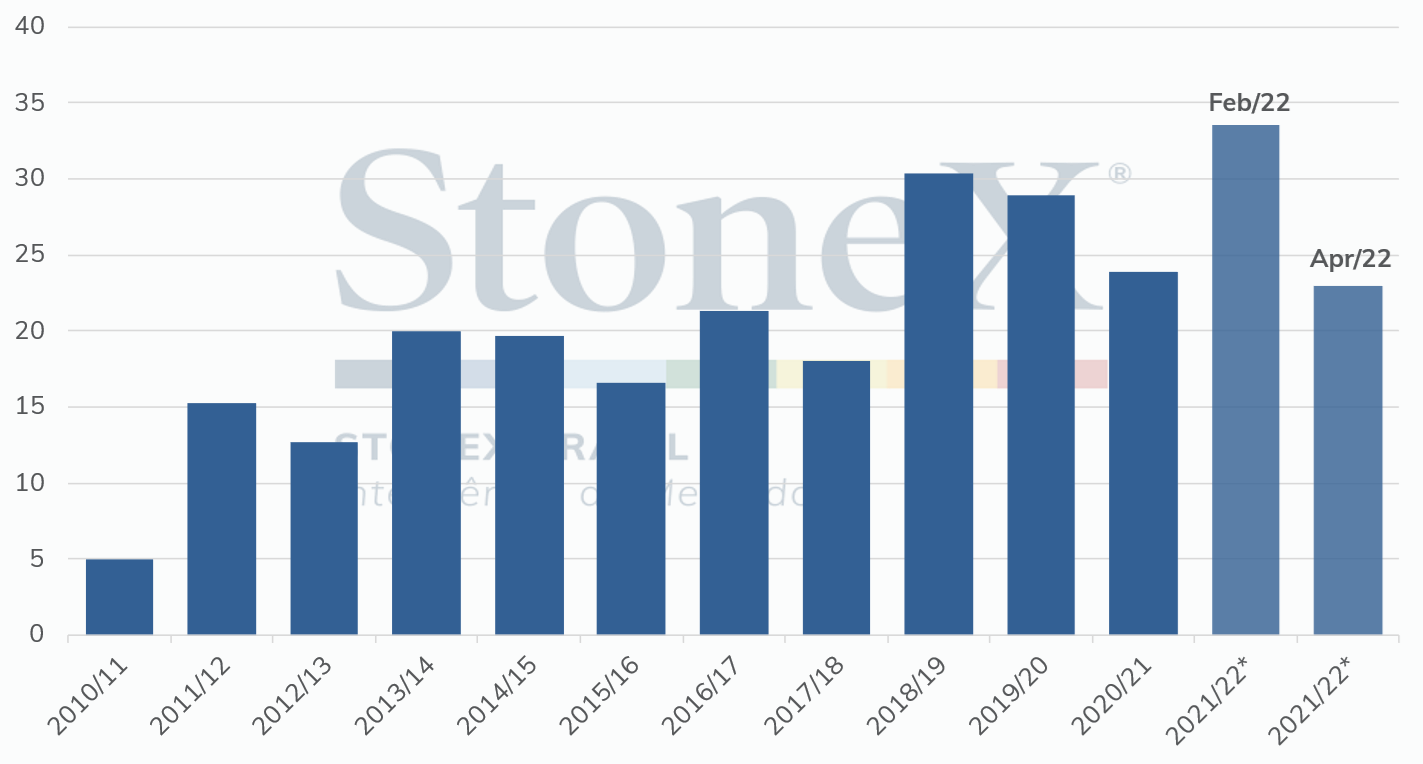
After the start of the Russian invasion on February 24, corn prices increased by 16% on the CBOT. Ukraine is one of the main players in the corn market, being the 3rd largest exporter of grains, responsible for 13.1% of the total exported in the world. From the 2021/22 crop, the USDA, which estimated the country’s exports at 33.5 million tonnes in February, pointed to 23 million tonnes in its April WASDE report. This cut was motivated by logistics disruptions caused by the war in Ukraine.
Ukraine | Corn exports (MMT)
Source: USDA. Design: StoneX. *Estimate.
Amid the corn shipping problems in the Black Sea region, the Ukrainian corn importers tend to redirect their purchases to other players, with highlight to the US – a move already pointed out by the USDA as it increased its US exports estimates in 2021/22, from 61.6 million tonnes in February to 63.5 million tonnes in April.
EUA | Corn exports (MMT)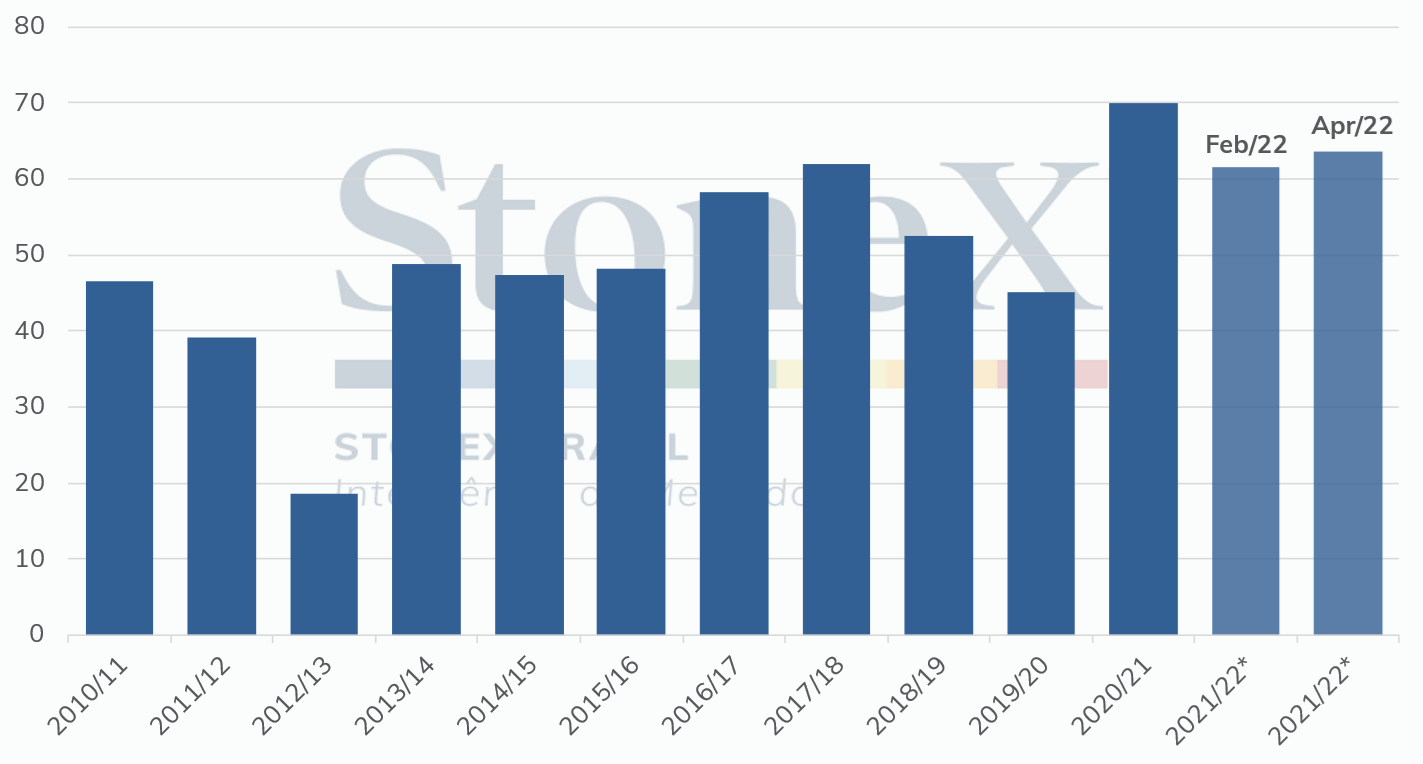
Source: USDA. Design: StoneX. *Estimate.
Besides the short-term impact, the conflict should also promote global supply and demand dynamics changes for the next season. The ideal planting window for the grain starts between late April and early May, and, as there are no signs that the conflict is moving towards a resolution, sowing will hardly come out unscathed from this war. About a month ago, the country's agriculture minister stated that producers were expected to plant up to 3.3 million hectares of corn this year, almost 40% less than in 2021.
Considering a planted area 40% lower than in 2021/22 and keeping other factors constant (abandonment rate and productivity), production in the country would fall to 25.1 million tonnes, 16.8 million less than that recorded in 2021/22. With this, based on USDA estimates for ending stocks in 2021/22 at 6.5 million tonnes, production at 25.1 million in 2022/23 and consumption at 6.5 million - calculated based on the average between 2016/17 and 2020/21, the country would have an export surplus of 25.2 million tonnes. However, besides the lower acreage, a drop in productivity is also expected due to the operational problems caused by the war. Thus, Ukrainian participation in the international market may be even lower next season.
The pressure on the US 2022/23 and Brazil's 2021/22 safrinha crops will be very high since any adversity would increase the tight supply and demand balance.
As for the US, the focus is currently directed to the planted area in the country. In the Planting Intentions report, the USDA indicated that the US would plant 36.2 million hectares of corn this year, 1.6 million or 4.2% lower than 2021 and 1 million or 2.7 lower than the market's expectations. However, it is worth noting that much of the survey was conducted before the conflict between Russia and Ukraine, not fully accounting for the rally that tensions in the Black Sea caused in corn prices. Therefore, the acreage could still be higher than estimated in the report. Accordingly, it will be extremely important to follow the first numbers from the Department for the 2022/23 season – not only for the US but also for other countries.
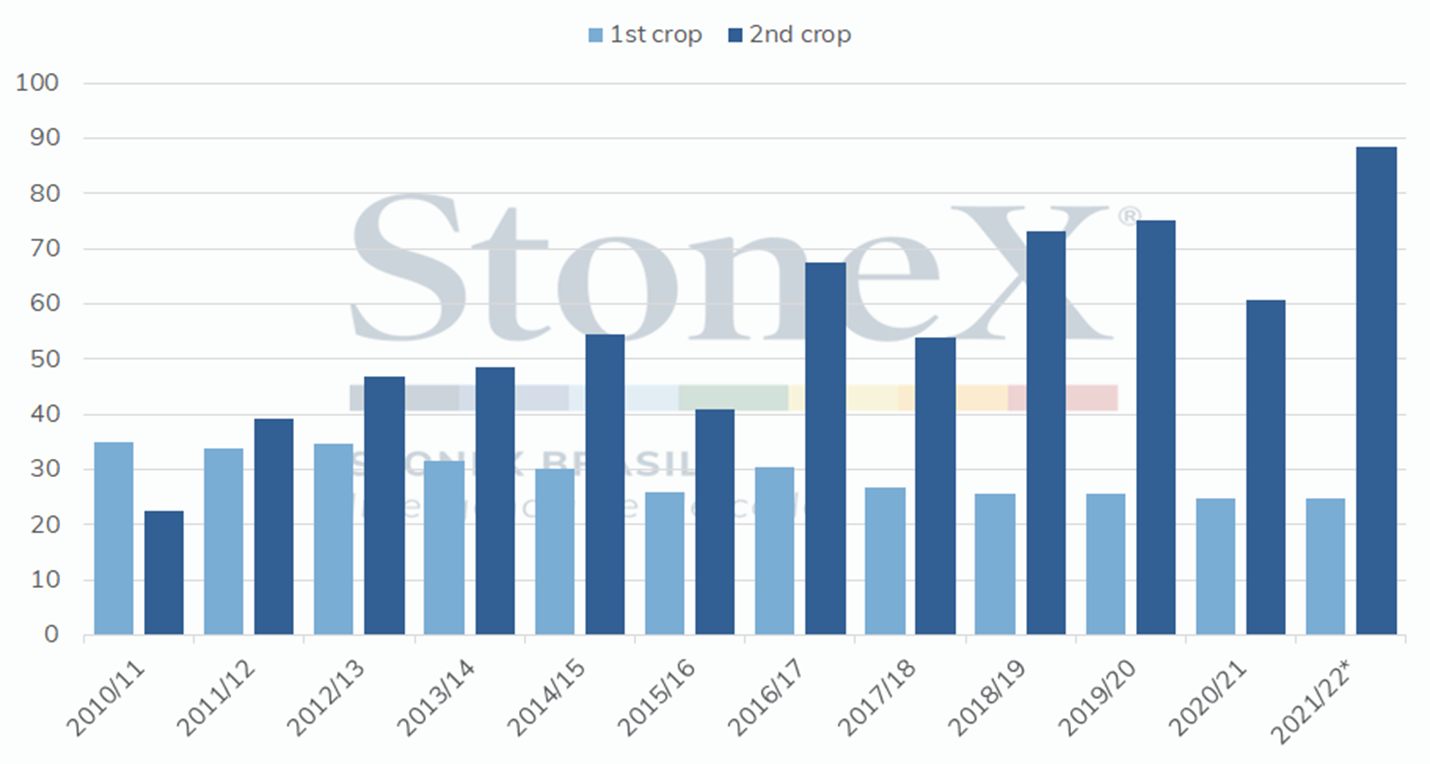
Shifting the focus to the southern hemisphere, the expectation for Brazil's 2021/22 cycle is currently at record levels. Even with the crop failure of the 2021/22 1st crop, whose production is estimated at 25 million tonnes – after being estimated at over 30 million – the record production expected for the winter crop (91.9 million) has given a relative relief to the market, since the country could help to supply, at least partially, the lower supply of Ukrainian grain. However, despite the positive outlook, following the weather in the coming months will be essential. Furthermore, due to the higher risk related to the safrinha, the scenario should undergo significant changes until the end of the season. Thus, the completion of the winter crop will be crucial for the country to meet the robust international demand and domestic demand.
Brazil | Corn production (MMT)
Source: Conab and StoneX. Design: StoneX. *Estimate.
Speaking of Argentina, the country faced drought problems at the end of last year and in the first months of this year, considerably impacting the country's crop. After being estimated at 57 million tonnes by the Buenos Aires Grain Exchange, the country's 2021/22 corn crop was projected at 49 million tonnes in April, 2.5 million tonnes less than the last cycle.
In the coming months, it will be crucial to monitor the weather conditions in Brazil, especially in May, and in the US, with July being crucial for productivity in the country. The April weather models from INMET indicated that important producing regions in Brazil might face dryer than normal weather in May, raising some concerns regarding yields. For the USA, NOOA indicates that most of Iowa and southern Minnesota, important producing states, will have below-normal rainfall between May and July.
It is still early to conclude the volume produced in the 2022/23 crop in the US and the 2021/22 crop in Brazil. The forecasts may significantly alter and change the current expectations for the international supply and demand balance. In these coming months, what can be expected is high volatility in cereal quotes.
Normally, May, June and July are already marked by greater volatility when compared with the rest of the year, precisely because they are key months for crops of two of the main global players. In a scenario marked by even more uncertainty due to the Black Sea conflict, the margin for productivity problems in Brazil and the US will be small. Thus, any abrupt change in the weather forecasts could lead to big moves in Chicago.
In addition, another important point to follow is the surge in Covid-19 cases in China. The Chinese government has adopted a “zero Covid” policy, implementing quarantines in several cities and causing the shutdown of several factories. Finally, it is important to remember that the animal protein industry has been suffering from tight margins, which has already raised doubts about the demand for grains from the Asian giant, an issue accentuated by the new economic slowdown faced by the country.